Beauty Marketing in China: The Ingredients War and the KOL Machine
Chinese shoppers read the back of the bottle before they read the ad. That single habit has rebuilt the world’s most competitive beauty market — and it is now squeezing the brands that taught everyone else how to sell.
Nine years ago, a skincare buyer walking into a pharmacy in Shanghai had two questions in her head. Does it work, and is it worth the money?
Today she has eight. What percentage of niacinamide. Which molecular weight of hyaluronic acid. Is the ceramide plant-derived or synthetic. Does the peptide come with a clinical endpoint or only a lab-bench result. Will the preservative system clash with her damaged barrier. Who ran the test, on how many people, for how long, and where is the summary filed.
That last question is not rhetorical. In China it is a document, uploaded to a government platform before the product is allowed to go on sale.
This is what people mean when they talk about the ingredients war, and it is the single most important thing to understand about beauty marketing in China. Not the platforms. Not the livestream hosts. The consumer’s expectations changed first, and everything downstream — the regulation, the influencer hierarchy, the product calendar, the P&L — reorganized itself around that change.
The short version
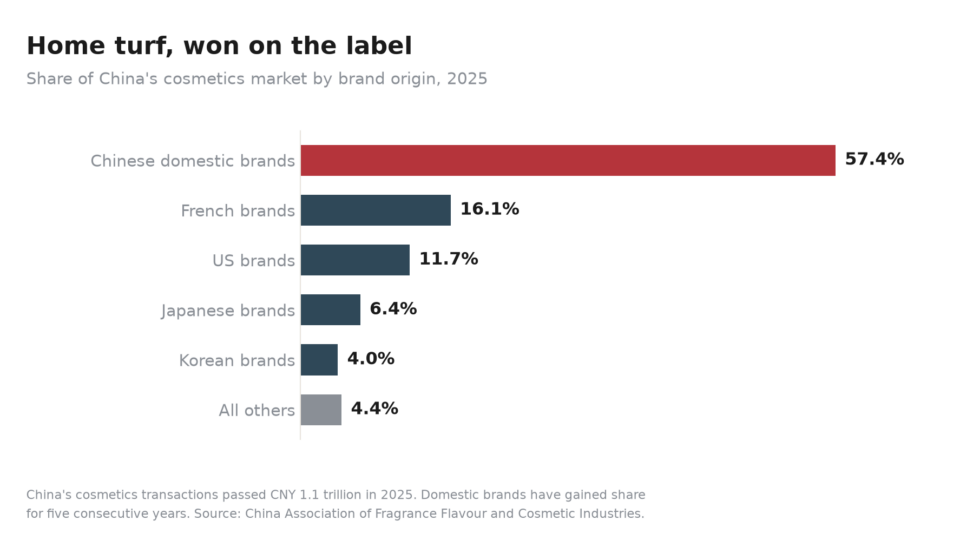
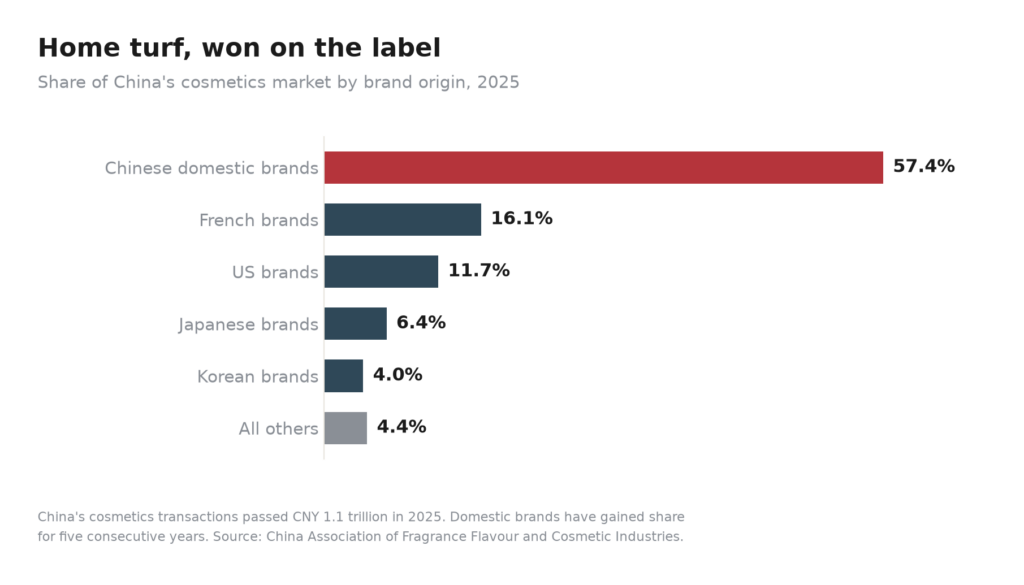
China’s cosmetics market passed CNY 1.1 trillion in transactions in 2025. Domestic brands now hold 57.4% of it, their fifth consecutive year of gains. The ingredient literacy that made this possible is measurable, not anecdotal. It has been codified into regulation since 2021, industrialized by a four-tier influencer economy, and distributed across four platforms that each do a different job. And in the last eighteen months the machine has started to strain: the two biggest domestic champions both posted their first revenue declines since listing, and the regulator has just rewritten the rules again — this time in ways that make China attractive as a launch market rather than merely a volume market.
First, the awkward question of size
Any honest piece about this market has to start by admitting that the headline numbers disagree, and that the disagreement is not sinister.
Euromonitor puts China’s beauty and personal care retail sales at roughly CNY 553 billion in 2025, growing about 2% — which makes it the world’s second-largest market, behind the United States. The China Association of Fragrance Flavour and Cosmetic Industries counts total cosmetics transactions above CNY 1.1 trillion, roughly double that, and calls China the largest. KPMG’s estimate for beauty retail growth in 2025 is 5.1%, after a 1.1% contraction in 2024.
Three different numbers, three different scopes. The trillion figure includes channels and categories that a narrow retail panel excludes; the Euromonitor figure is a cleaner like-for-like comparison across countries. Both are useful. Neither is a lie. What matters for a marketer is the direction: a market that stopped growing in high double digits, contracted in 2024, and came back to modest growth on a much larger base. The easy years are over. The sophisticated years have started.
The ingredients war: how a shopping checklist became a marketing system
The 74% problem
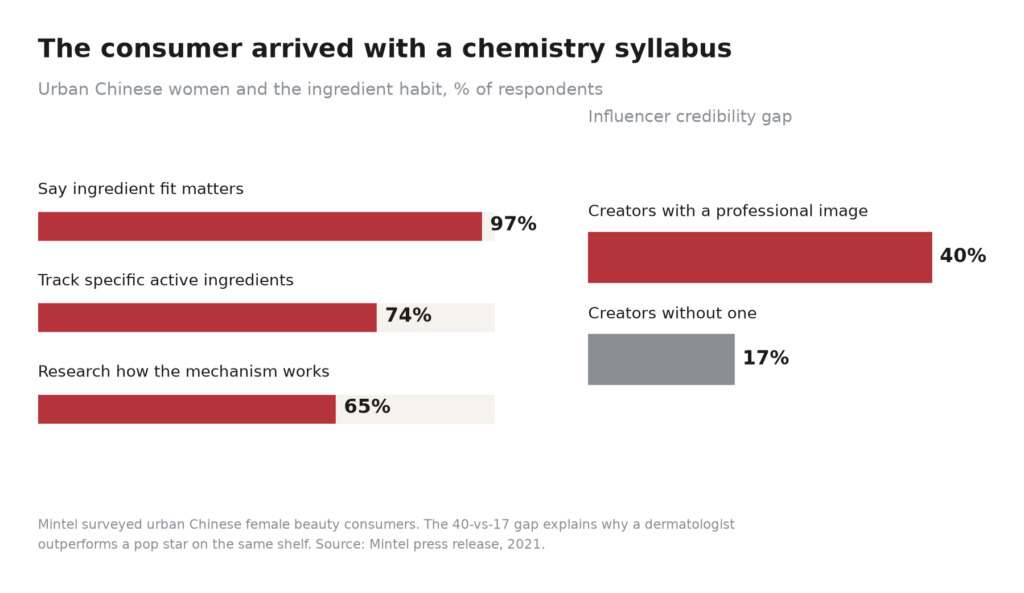
In 2021 Mintel surveyed urban Chinese women about how they choose beauty products and found something that should have been framed on every brand’s wall. Seventy-four percent said they pay attention to specific functional ingredients. Sixty-five percent said they would dig into how those ingredients work, not just that they were present. Ninety-seven percent agreed that knowing which ingredient suits their needs was important.
Read those three numbers as a sequence and you get a portrait of a consumer who is not being marketed to so much as audited. She is not asking to be persuaded. She is asking to be briefed.
This is why the phrase “because it is a luxury brand” lands with a thud in a Douyin comment section, and why “5% niacinamide plus ceramide NP in a 3:2 ratio” gets screenshotted and passed around. The unit of persuasion changed. It used to be story. It is now specification.
成分党: the tribe that reads the back of the bottle
Chinese marketing has a name for this consumer tribe: 成分党, chéngfèn dǎng, the ingredient party. The word is slightly derisive and mostly admiring. An ingredient party member will pull up a formulation database in a store aisle, cross-check a serum against three competitors, and reject a product because the advertised hero ingredient appears only in the small print — Chinese labeling rules allow everything at or below 0.1% (w/w) to be grouped out of descending order under the heading “other trace ingredients,” and the ingredient party reads that grouping as a confession.
That single regulatory quirk deserves more attention than it gets. Because the small print is public, a formulation is partially legible to anyone who can read a label. Once a label is legible, a whole cottage industry of decoding becomes viable — and China built exactly that industry, at scale, on Xiaohongshu.
Regulation turned marketing claims into filed evidence
Here is the part that Western brand teams routinely miss. Since the Cosmetics Supervision and Administration Regulation took effect at the start of 2021, every efficacy claim made in China must be backed by sufficient scientific evidence, and a summary of that efficacy evaluation must be uploaded to the NMPA’s online platform at the point of registration or filing. The standards governing this took effect in May 2021. Efficacy claims are not just policed after the fact. They are documented before the product exists commercially.
The consequence is structural rather than merely legal. A brand that wants to say “reduces redness” has to own the study that shows it reduces redness — which means the marketing claim is downstream of an R&D decision. Copywriters cannot invent a benefit and hope. The claim has to survive a filing.
You can see the result in ad copy. Chinese beauty advertising reads less like persuasion and more like a methods section, because the cheapest way to make a compliant claim is to make a narrow, testable one.
The KOL machine: education, validation, conversion
If ingredient literacy is the demand side, the influencer economy is the supply side. And it is not one thing. Chinese beauty influence operates as four distinct professions that happen to share a camera.
The four tiers
The dermatologist-educator is the top of the trust stack — a medically credentialed creator who explains barrier function, explains why a retinol purge happens, explains what “hypoallergenic” can and cannot legally mean. Their content is slow, dense, and enormously effective.
The beauty blogger or makeup artist does the traditional work: reviews, tutorials, wear tests, get-ready-with-me. This is the tier most Western brands instinctively hire, and it is the tier with the least pricing power in China, because it is the most substitutable.
The live-commerce host compresses education, demonstration, and checkout into a single unbroken hour. Li Jiaqi — Austin Li — is the archetype, and for most of a decade he was the most efficient beauty distribution channel in the world. The format works because the discount is real, the clock is real, and the host’s reputation is posted as collateral on every SKU.
The KOC, the key opinion consumer, is a real person with 400 followers and a phone. Individually negligible. Collectively, the most persuasive layer in the entire system, because a KOC has no obvious reason to lie.
Why the dermatologist outranks the celebrity
Mintel’s data explains the hierarchy with unusual precision. Among respondents who pay attention to ingredient information, 40% said they appreciated influencers with a professional image, against 17% for those without one. Sixty percent said they would trust a product endorsed by a professional organization.
Put simply: on an ingredient claim, credentials beat charisma by more than two to one. That is not how influence works in most markets. It is how influence works in a market where the audience can check the claim.
Which is why the most commercially valuable beauty creator in China is often a hospital-based dermatologist with a fraction of a pop star’s following, and why brands that buy reach instead of authority keep buying the same reach twice.
The funnel that eats itself
The system’s engine is a loop, not a funnel. A KOL explains. A KOC tries it on her own skin and posts the result. The reader buys. Six weeks later she posts her own result, and becomes the validation layer for the next reader.
This loop is why Chinese beauty launches can compound so fast. It is also why they decay so fast. Trust created by peers is cheap to manufacture at the margin and expensive to defend at scale — and once a category is saturated with peer validation, the marginal review stops moving anyone.
The rented-audience problem
The loop has an economic flaw that became visible in 2025 and 2026. A brand that builds its volume on a host’s audience is renting that audience, session by session, at a price set by the host.
The correction is already underway. Chinese beauty brands have been pulling spend out of celebrity livestream rooms and into in-house studios — owned rooms, owned hosts, owned data, better margins. Reuters reported in September 2026 that AI has cut livestreaming costs by as much as 90% in some formats, while human hosts remain decisive for the high-consideration categories where trust is the product.
The lesson is uncomfortable for the influencer industry: the tier that converts best is the tier the platform can most easily clone.
The platform stack: four jobs, one consumer
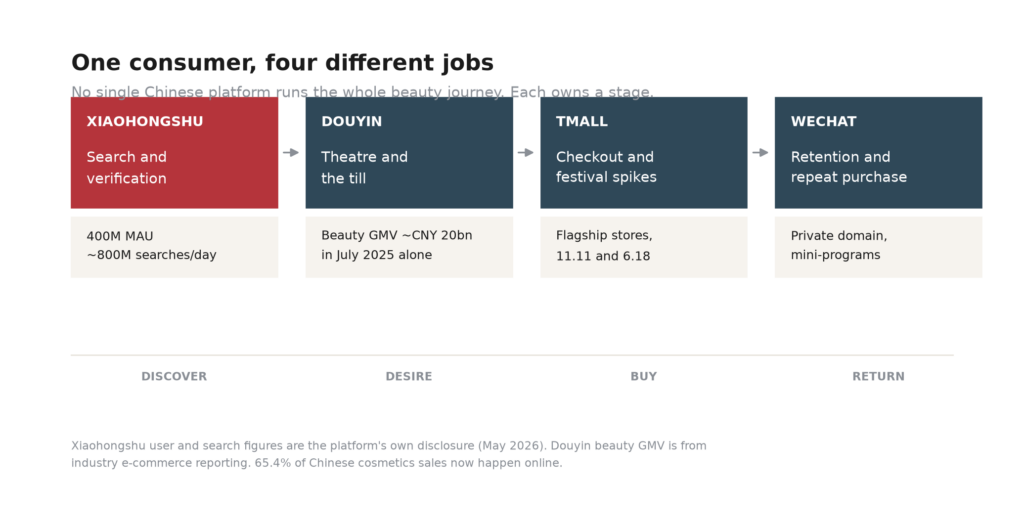
Chinese beauty marketing is frequently described as if it happens on “social media.” It does not. It happens across four systems with four different jobs, and brands that treat them as interchangeable pay for it in wasted budget.
Xiaohongshu is a search engine that looks like a magazine
Xiaohongshu disclosed more than 400 million monthly active users in May 2026, and roughly 800 million searches a day. Around 70% of its users search on it. For beauty specifically, it functions as the pre-purchase verification layer: a shopper does not go there to be inspired so much as to confirm.
This has a direct consequence for content strategy. Ranking on Xiaohongshu rewards notes that match a specific query and earn saves, which is another way of saying it rewards specificity. A post titled “my evening routine” dies. A post titled “niacinamide 5% vs 10%: what actually changed on my skin in 28 days” gets saved, and saved posts are what the search engine serves next month.
Douyin is theater, and increasingly the till
In July 2025 alone, beauty GMV on Douyin reached roughly CNY 20 billion. Cosmetics, skincare, and personal care together account for close to a fifth of the platform’s total GMV. Douyin is where a trend is manufactured, priced, demonstrated, and sold inside one scroll — and where a product’s fate can be decided in seventy-two hours.
Tmall is the balance sheet
Tmall is where the flagship store lives, where brand search gets captured, and where 11.11 and 6.18 turn a year of brand-building into a quarter of revenue. Its role is not discovery. It is conversion at scale, plus the data exhaust that tells you who to retarget.
WeChat is the only place you own the customer
Private domain is the part of the Chinese stack with no real Western equivalent. Once a customer is in a brand’s WeChat ecosystem, the brand can reach her without paying a platform for the privilege. For beauty, where repurchase is the whole business, this is where lifetime value is manufactured. It is also where the KOC relationship gets formalized, because a customer community is a KOC farm with better margins.
The overall shape: 65.4% of Chinese cosmetics sales now happen online, and most transactions sit under CNY 300. Beauty in China is a high-frequency, low-ticket, high-research business. That combination is precisely why ingredient content outperforms brand content — a CNY 200 decision is easy to research and hard to romanticize.
The great reversal: domestic brands won, then stumbled
57.4% and what it took
For two decades the assumption was that global brands owned the premium end and domestic brands fought over the value end. That assumption is now wrong at the aggregate level. Domestic brands hold 57.4% of a CNY 1.1 trillion market — up roughly 22 percentage points since 2020 by one industry estimate — and the gain came largely from skincare, where ingredient arguments are most legible.
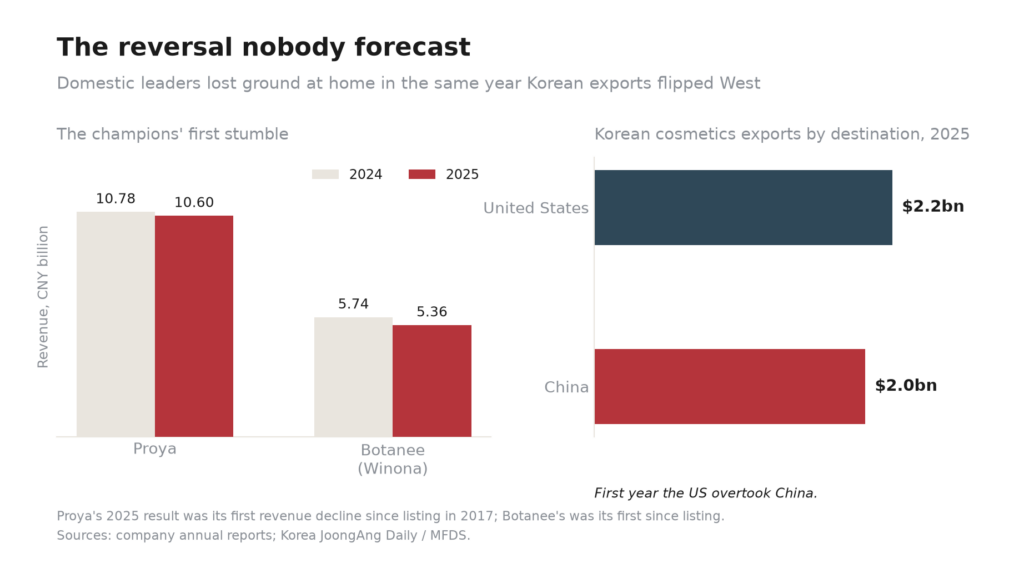
Proya is the proof of concept. In 2024 it became the first Chinese beauty brand to pass CNY 10 billion in annual revenue, at CNY 10.778 billion, built on a deliberate strategy of early-mover ingredient marketing: it staked claims on retinol and on early-morning antioxidant routines years before the category was crowded, and it priced at a level where a clinical claim felt like good value rather than an upsell.
The first stumble
Then the arithmetic turned. Proya’s 2025 revenue came in at CNY 10.597 billion, down 1.68%, with attributable net profit at CNY 1.498 billion, down 3.5% — its first revenue decline since listing in 2017, and the weakness carried into the first quarter of 2026.
Botanee, the parent of Winona, the clinical skincare brand that made “sensitive skin” a category in China, fared worse in relative terms: 2025 revenue of CNY 5.359 billion, down 6.58%, its first annual contraction since listing, with the core Winona brand at CNY 4.43 billion.
These are not collapses. They are something more instructive: the moment when the strategy that built the category stopped producing growth on its own. Ingredient claims had become table stakes. Every competitor had them. The differentiator had become the floor.
The 12% that survives
Xinhua, citing industry data, reported a number that reframes the whole story: of Chinese beauty brands founded between 2016 and 2020, only about 12% survive five years.
Read that alongside the 57.4% share and the picture inverts. Domestic dominance is not a rising tide lifting all local boats. It is a violent consolidation in which a handful of winners take share from foreign incumbents and from the wreckage of hundreds of failed local launches. The speed advantage that let Chinese brands out-iterate global competitors is the same speed that kills them — a brand can go from trend-spotting to KOL campaign in weeks, which means a competitor can too.
The machine is now being exported
The most interesting development of 2025 is that the machinery built for the domestic war has become an export product. Chinese cosmetics exports rose 11.7% to CNY 36.68 billion in the first eight months of 2025, extending a third consecutive year of double-digit growth, with more than 50 domestic brands operating overseas and products reaching over 180 countries. Florasis and Flower Knows have moved into mainstream Western retail.
And the traffic is not one-way. South Korean cosmetics exports hit a record USD 11.43 billion in 2025, but for the first time the United States — at USD 2.2 billion — overtook China at USD 2.0 billion as the top destination. That is not a story about China losing its taste for imported beauty. It is a story about a category whose center of gravity has stopped being a single country.
Why global brands keep misreading the brief
Translation is not localization
The most expensive mistake in this market is treating ingredient messaging as a translation task. “This makes your skin glow” is a sentence that survives translation and dies in review, because it asserts an outcome without specifying a mechanism, and the audience’s first move is to ask what the mechanism is.
The correct version is not a better adjective. It is a different sentence, of roughly this shape: this contains 5% niacinamide and ceramide NP; the barrier data comes from a four-week study; here is the summary. That sentence requires R&D to have done something worth describing.
The R&D number that decides everything
By mid-2025, listed Chinese beauty companies were spending 3.24% of revenue on R&D — a figure that would be unremarkable in pharmaceuticals and is remarkable in color cosmetics. Add to it the subsidy architecture: Guangzhou offered CNY 10 million for approved key laboratories and CNY 1 million per newly filed ingredient; Shenzhen offers up to CNY 1 million, and up to CNY 2 million for ingredients based on characteristic plant resources.
The result is visible in the filing data. Cumulatively about 122 new cosmetic ingredients have been filed in China. Peptide filings went from 1 in 2021 to 14 in the first half of 2025; plant extract filings from 1 to 24; fermentation-derived ingredients from none to 6. Guangdong alone accounts for 77 filings, roughly a third of the national total.
A market that files 14 peptides in six months is not a market where you win with a nicer bottle.
Prestige has no shelf talker
The strategic trap for heritage brands is that their equity is stored in exactly the asset this market discounts: mystique. Mystique cannot be evaluated, and what cannot be evaluated cannot be reviewed, and what cannot be reviewed does not enter the loop.
Estée Lauder is the cautionary case. Its heavy China dependence contributed to a decline that erased more than USD 100 billion in market value from its 2022 peak. The problem was not that Chinese consumers stopped wanting the brand. It was that a business built on department-store counters and aspirational positioning met a market that had moved its research and its checkout somewhere else.
The brands holding ground are the ones that converted prestige into specification — publishing trial data on product pages, naming concentrations, letting a dermatologist read the file on camera.
The regulator just moved the board again
Most Western coverage of Chinese beauty regulation is a story about tightening. The December 2025 NMPA reform opinions tell a more interesting story, and brand teams should read them closely.
The document — Guo Yao Jian [2025] No. 18 — sets out a reform agenda with two stated horizons: a complete framework by 2030, an internationally advanced regime by 2035. Four measures matter commercially.
New efficacy claims get a fast lane. Cosmetics making genuinely new efficacy claims will be supported through registration and filing, with immediate review on submission and a pre-submission consultation mechanism. The classification rules and catalogue will be adjusted to accommodate them. In practice, the regulator is offering to help brands make claims nobody has made before — provided the evidence holds.
The “first-launch economy.” For international products launched in China first, the requirement to submit marketing authorization documents from the country of manufacture is waived. This is a striking reversal. China spent a decade as a market you entered after you had proven yourself elsewhere. It is now building a pathway for brands to prove themselves in China first.
Personalization gets physical. Registrants will be allowed to offer on-site simplified mixing and repacking at distribution premises for registered ordinary cosmetics. Custom-blended skincare, previously a regulatory gray zone, gets a defined lane.
Packaging goes digital, and an older market gets attention. Electronic labeling is being accelerated, and the reform explicitly supports R&D into skin-aging mechanisms and products for older consumers — the “silver economy” the government has been promoting across categories.
The follow-on announcement, No. 70 of 2026, added registration and filing relief and expanded animal-testing waivers.
The strategic read: China is no longer only asking brands to comply. It is competing to be the place where products are born. For a global brand, that reframes the China question from “how do we sell here” to “should we launch here” — a materially different, and much more interesting, conversation.
What could break the machine
Four risks deserve honest weight.
Ingredient fatigue. When every brand leads with actives, actives stop differentiating. The likely next currency is clinical outcomes — measured skin changes rather than molecular inputs — which is far more expensive to produce and much harder to fake. Brands without trial infrastructure will find the next phase closed to them.
Trust erosion in the influencer tier. The credibility premium for professional creators is the system’s load-bearing wall. As commercial density rises and undisclosed paid content gets policed more aggressively, that premium is compressible. The loop that built the machine can run in reverse.
A price ceiling that will not lift. With most transactions under CNY 300, there is limited room to fund both clinical trials and influencer fees without margin compression. Proya’s profit falling faster than its revenue is the shape of this problem.
Regulatory asymmetry. Fast lanes and waivers reward brands with regulatory sophistication. Smaller brands get the compliance cost without the speed benefit, which accelerates consolidation — good for the winners, bad for category diversity, and eventually a problem for the platforms that depend on novelty.
A playbook that respects the arithmetic
If you are taking a global beauty brand into China in 2026, five things follow from the evidence above.
Lead with a mechanism, not a mood. Pick the one claim you can substantiate at the level of a filed summary, and build the campaign on it. If you cannot name the study, you do not have the claim.
Buy authority before reach. A dermatologist-educator collaboration converts better per yuan than a celebrity post, and the 40-to-17 credibility gap is the reason. Budget accordingly, and be patient with the format.
Treat Xiaohongshu as search, not social. Write to the query, not to the feed. Specificity is the ranking mechanism.
Build the owned room early. In-house livestream plus WeChat private domain is the only part of the stack where the audience is an asset rather than a rental. Start before you need it.
Use the new regulatory door. The first-launch pathway is a genuine strategic option now, not a compliance detail. Brands that file in China early get a claim nobody else has, which in this market is the whole game.
The takeaway
The Chinese beauty consumer is not buying a brand story. She is buying a molecular argument, checked against a label, verified by someone with credentials, and confirmed by a stranger with 400 followers.
That is a harder market than the one global brands entered in 2010. It is also a better one, because the argument has to be true. The brands now losing share are not losing to superior marketing. They are losing to brands that did the research and then said so, in a language the buyer could audit.
Winning here no longer means translating the campaign. It means joining the ingredients war at the level of clinical data — and being willing to publish it.