618, 11.11, and the Dates In Between: A Brand’s Guide to China’s Festival Economy
The most expensive five weeks in retail don’t look like a week. They look like a season.
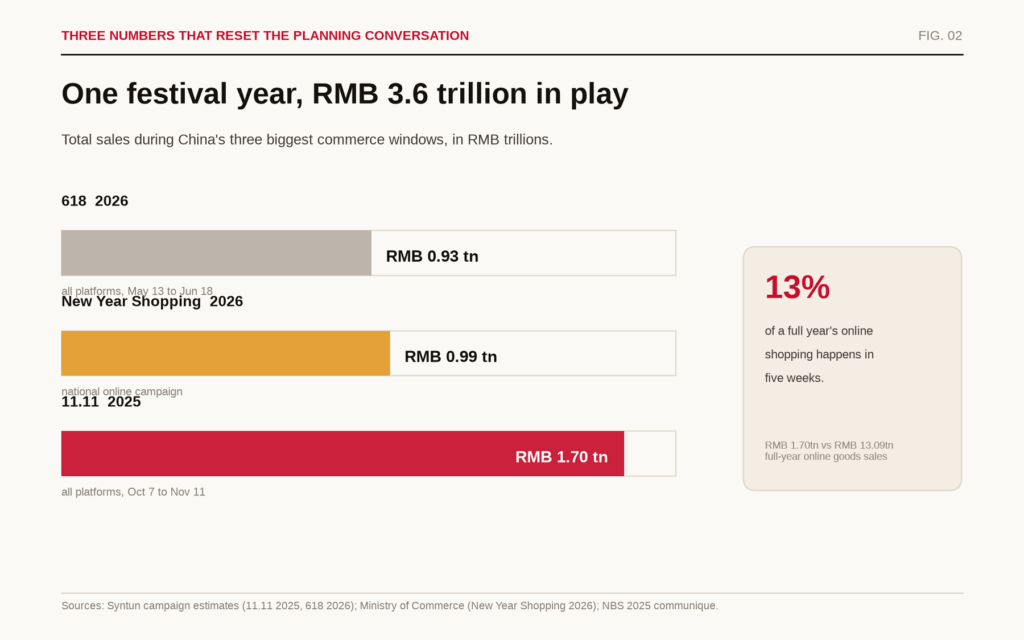
Between October 7 and November 11, 2025, Chinese shoppers spent an estimated RMB 1.695 trillion across the country’s e-commerce platforms. One number, thirty-six days of selling, roughly RMB 47 billion a day. Put another way: about 13% of the year’s entire online physical-goods retail happened inside that window.
Then the calendar moves on. Parcels arrive, the return window opens, and by the first week of December the platforms are discounting again.
This is the part that gets misfiled outside China. Most global teams treat 11.11 as a Chinese Black Friday, a date to bolt onto an existing campaign plan and budget the way they budget a promotion. But the date is not the mechanism. The calendar is.
Why a calendar beats a campaign
Western retail runs on retail logic. Black Friday began as the day American stores supposedly moved from loss to profit. Prime Day was invented by one company to move its own inventory and sign up Prime members. Both are commercial events with cultural decoration bolted on afterward.
China’s calendar runs in the opposite direction. Culture came first, and commerce moved in.
Singles’ Day started in 1993 as a dorm-room joke at Nanjing University. Four roommates, all single, noticed that November 11 is written as four ones: 11.11, four bare sticks. They called it Bachelors’ Day and celebrated it with snacks and self-deprecation. For sixteen years it was a student ritual with no commercial ambition whatsoever. Then Alibaba’s Taobao Mall put 27 brands on sale on November 11, 2009, and booked RMB 52 million. The rest is a very long footnote.
618 has a tidier origin. Liu Qiangdong founded JD.com on June 18, 1998, and the company marked its anniversary with a sale. JD made it an annual fixture in 2010; by 2013 Tmall and Suning had joined, and a company birthday became an industry-wide event.
Two festivals, two origins, one pattern: the emotion arrived before the discount. That sequence matters, because it explains why Chinese consumers will wait three weeks for a price instead of buying when they need something. They are not responding to a promotion. They are observing a ritual with a discount attached.
There is a third structural difference. Every major date is anchored to a platform. 618 is JD’s house. 11.11 is Tmall’s. The anchor doesn’t stop rivals from joining; it just means each festival carries a house style. 618 skews toward big-ticket electronics, appliances and household replenishment. 11.11 has historically skewed toward fashion, beauty and brand flagship stores. Where and how you show up depends on whose house you are visiting.
The two anchors
618: the mid-year replenishment engine
618 sits in the gap where household budgets get audited. Air conditioners before summer. Refrigerators, washing machines, phones, laptops. It is a replacement cycle dressed as a festival, which is why the average order value runs higher than in November and why the discount is often delivered as a trade-in subsidy rather than a straight markdown.
The event has also stretched. In 2025 the campaign ran 37 days, from May 13 to June 18; a year earlier it was 30. Syntun, the third-party monitor much of the industry now quotes, put comprehensive e-commerce GMV for the 2025 edition at RMB 855.6 billion, up 15.2%.
One caution for anyone benchmarking: the 2026 edition came in at RMB 934 billion, up 4.0%, but that is not the same measurement. Syntun widened its 2026 count to include instant retail and community group buying, two of the fastest-growing channels in the market. A wider net caught less growth, not more. Read the 2026 figure as evidence of a cooling core, not as a precise year-on-year rate.
11.11: the longest month in commerce
If 618 is a replacement cycle, 11.11 is a cultural permission slip. It is the moment when a year of watching, comparing and waiting gets released.
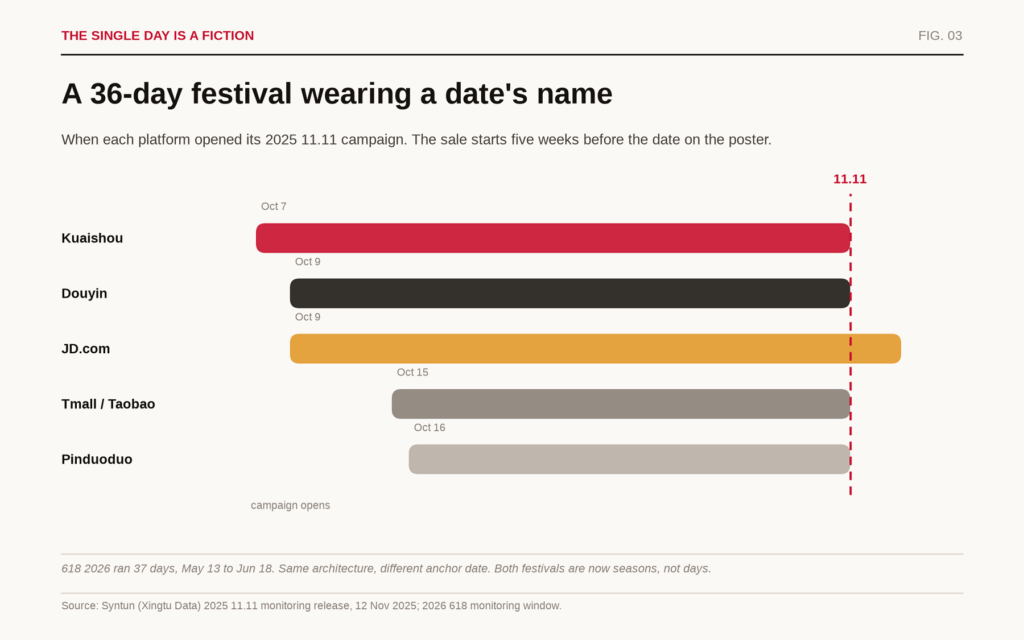
The scale is hard to hold in your head. In 2025 the campaign opened on October 7 with Kuaishou, picked up Douyin and JD on October 9, added Tmall on October 15 and Pinduoduo a day later, and closed on November 11: 36 days, RMB 1.695 trillion, up 14.2% year on year.
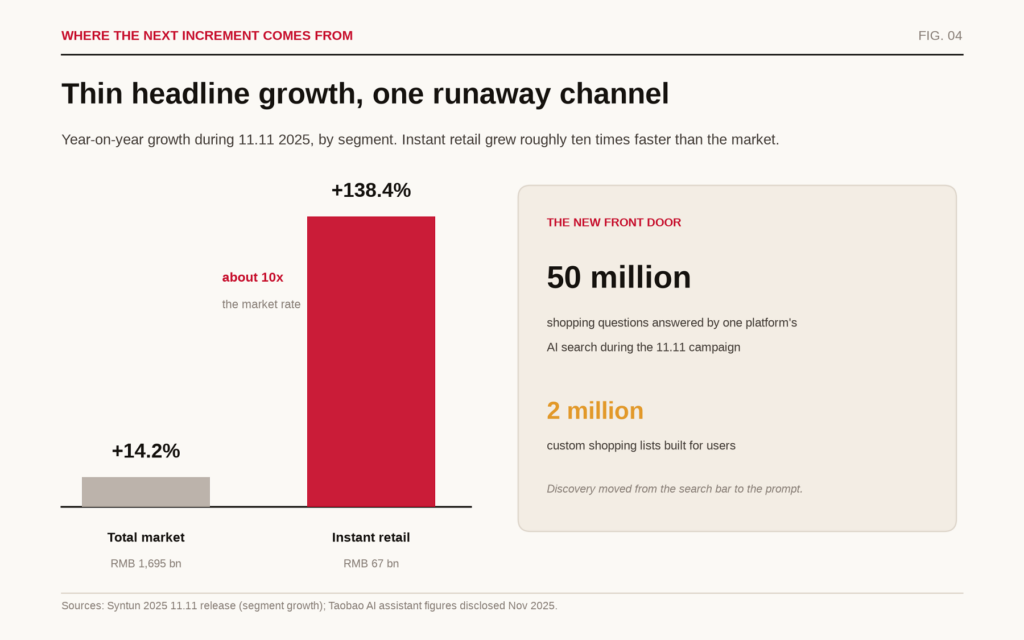
Inside that total, the interesting number isn’t the headline. It is instant retail: RMB 67 billion, up 138.4%. Thirty-minute delivery went from a novelty attached to groceries to a channel that shapes how people buy everything else. Once you can have a phone charger in twenty-eight minutes, a five-day shipping estimate stops feeling like normal service and starts feeling like a failure.
The second tier: dates that still move revenue
Below the two anchors sits a band of festivals that most foreign brands either ignore or treat as minor holidays. They are neither ignored nor minor. They are category-specific opportunities with much cheaper entry.
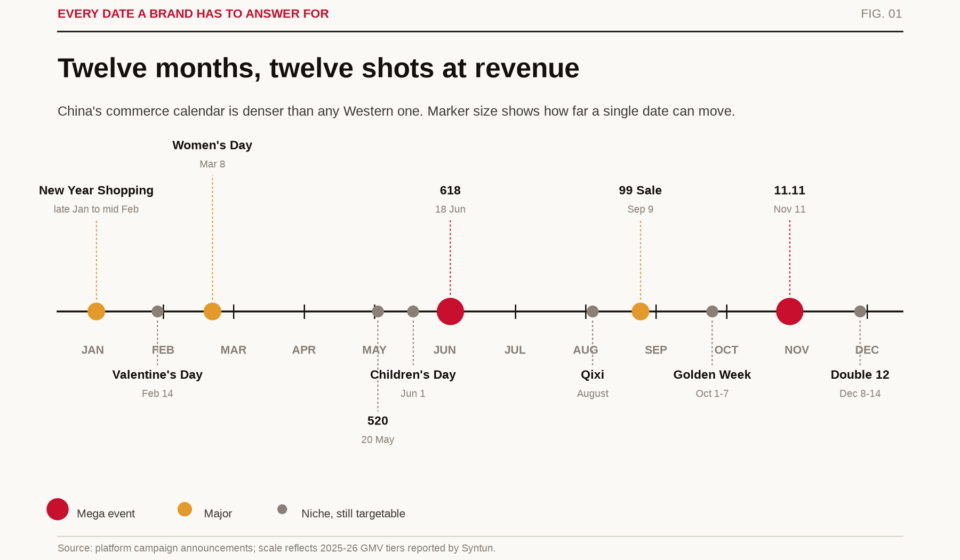
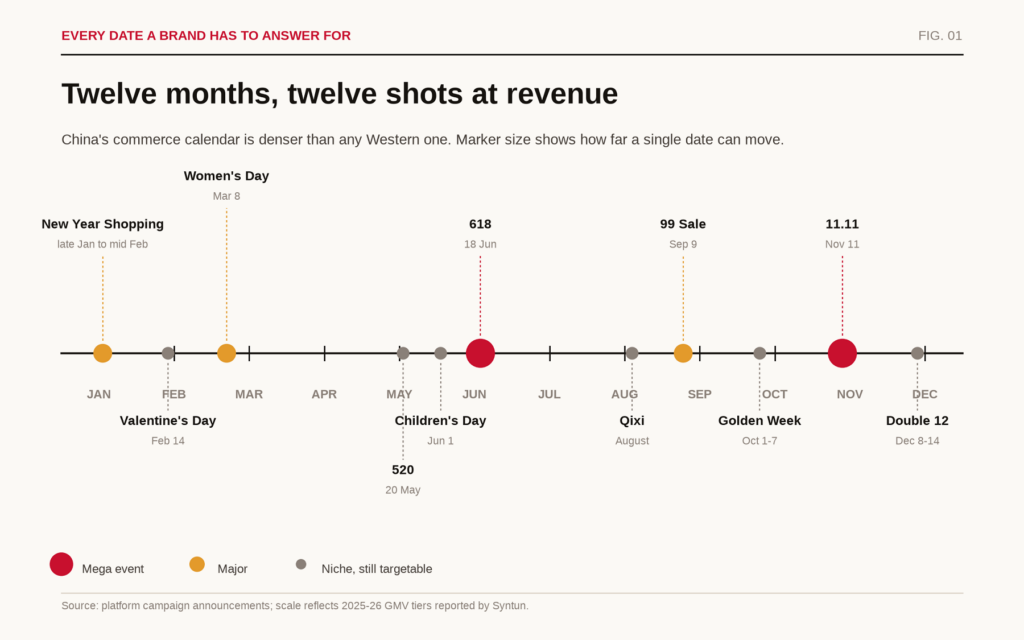
New Year Shopping (年货节), late January to mid-February. This is the most culturally load-bearing date on the list, because it is not really about shopping. It is about going home. Food, liquor, gift boxes, new clothes, anything that signals you did well this year. The Ministry of Commerce reported that the 2026 national online New Year Shopping Festival generated RMB 989.7 billion in online retail, which puts it roughly on par with 618. Almost nobody outside China plans for it.
Women’s Day (38), March 8. Beauty, skincare, fragrance, intimate apparel, wellness. The commercial logic has shifted from gifting to self-purchase, and the discovery happens on Xiaohongshu weeks before the discount lands on Tmall.
520, May 20. A manufactured romance date built on a homophone: 5-2-0 sounds like I love you. Jewelry, fragrance, dining, hotel bookings, anything that can be given with a card. It exists nowhere in the traditional calendar and yet behaves like a genuine holiday.
99 Sale, early September. A pre-season warm-up. Useful for testing creative and clearing summer inventory before the 11.11 machine starts consuming attention.
Double 12, December 8 to 14. Still running, still real, noticeably quieter. It has drifted from a second 11.11 into a clearance window, with a Taobao experiment in small-merchant discovery attached. If your inventory planning treats December as a second November, you will over-invest.
The micro-festivals
Then there is the fine grain: Valentine’s Day in February, Qixi in August, Children’s Day in June, Mother’s Day and Father’s Day, winter solstice and Laba in the depths of January.
Individually these dates are small. Collectively they are a cheap testing ground. A Qixi campaign costs a fraction of an 11.11 campaign and tells you how a gifting message performs before you commit real money to November. Children’s Day is a genuinely useful window for anything adjacent to education, toys or family health. Laba is one of the few moments when traditional food and home categories get undivided attention.
The risk is date fatigue. If every week has a festival, no week has one. The brands that do this well pick three or four micro-dates that fit their category and let the rest pass without comment.
How the money actually moves
Understanding the calendar is necessary but not sufficient. The mechanics inside each date are where execution lives or dies.
Pre-sale is the sale. Chinese festivals run on deposits. Consumers pay a small amount weeks ahead to lock a price, then settle the balance on the day. For a brand this is demand forecasting with a cash commitment attached: you know your volume before you commit your media budget. For a consumer it converts a decision into an obligation. Campaigns that treat pre-sale as a soft launch consistently underperform campaigns that treat it as the main event.
Livestream is the engine, but the engine is changing. Livestream rooms still drive the spikes. What changed in 2025 is that Syntun stopped separating livestream GMV from shelf GMV in its 11.11 release, because the distinction had stopped describing reality. Short video on Douyin now hands intent to Tmall or JD, where the checkout happens. The relay matters more than any single leg.
Price protection is a promise, not a tactic. Thirty-day price guarantees are standard. They sound consumer-friendly, and they are, but they also mean a discount you run in October constrains what you can do in November. Plan the curve, not the peak.
AI has become the front door. During 11.11 2025, Taobao’s AI search tool fielded close to 50 million shopping questions and generated around two million custom shopping lists. JD pushed conversational assistants into the purchase path. This changes something subtle: when a model assembles the shortlist, being the cheapest option matters less than being the option the model can describe accurately. Product data hygiene just became a media buying decision.
The 2026 reality check
Here is the part that most festival guides skip, and it is the part that should shape your budget.
Growth is thinning. China’s total retail sales reached RMB 50.12 trillion in 2025, up 3.7%. Online physical-goods sales hit RMB 13.09 trillion, up 5.2%, and that represented 26.1% of all retail. Read those two growth rates together and you see a market that has finished its land-grab. E-commerce penetration is no longer climbing steeply; it is holding.
The festival numbers tell the same story from a different angle. 11.11 still grew 14.2% in 2025, which is remarkable at that scale. 618 grew 4.0% in 2026, and that was on a wider measurement. Double-digit festival growth is no longer the default assumption.
What is happening underneath is more useful than the headline. Consumption is splitting by category. In 2025, jewelry rose 12.8%, sports and entertainment goods 15.7%, communication equipment 20.9%, furniture 14.6%. Automobiles fell 1.5%, petroleum products 5.7%, building materials 2.7%.
The pattern: festivals now amplify categories where a discount changes the decision, and do very little for categories where the purchase is already deferred for structural reasons. If you sell something people are postponing because they are worried about their mortgages, a bigger coupon will not fix it. If you sell something people want and are waiting to justify, the calendar is the justification.
That has a direct planning consequence. The question is no longer how big a discount you can afford. It is which date your category actually responds to, and what the smallest intervention that triggers the decision looks like.
The playbook: building a festival operating system
Five moves, in the order that matters.
1. Map the calendar against your category, not against the industry. A beauty brand’s year looks nothing like an electronics brand’s. Beauty peaks at 38, 520 and 11.11. Electronics peaks at 618 and 11.11. Food and gifting peak at New Year Shopping. Write your own twelve-month map before you write a budget.
2. Work backward from the anchor, in 90/60/30-day blocks. Ninety days out: category data, price architecture, inventory commitment. Sixty days: creative, creator contracts, platform negotiation. Thirty days: pre-sale mechanics, seeding, customer lists. Brands that start in October for a November date are not late. They are absent.
3. Lock creator inventory early. The best livestream slots for 11.11 are sold months ahead. This is not a media buy you can optimize in-flight; it is capacity you reserve. Treat top-tier hosts like venue bookings.
4. Assign each platform a job. JD for big-ticket and trade-in. Tmall for flagship brand experience and membership. Douyin for discovery and impulse. Xiaohongshu for pre-search and consideration. Pinduoduo for price-led volume. Running identical creative everywhere is the most expensive way to be invisible.
5. Plan the two weeks after. The two weeks after a festival are the most neglected stretch in Chinese e-commerce. Reviews get written, returns get processed, replenishment intent forms. A follow-up sequence that asks for the review, resolves the return without friction and offers the refill converts at a fraction of acquisition cost.
Why global brands underinvest
Three reasons, and none of them are about money.
The planning clock doesn’t match. Global campaign calendars are locked twelve to eighteen months ahead. China’s festival machine needs local autonomy inside a five-week window. When headquarters owns the calendar and the local team owns the execution, the execution loses.
Budget is sized by politics, not by opportunity. China budgets are often set as a percentage of global spend, which reflects historical revenue splits rather than where the growth is. Sizing against the opportunity would mean noticing that one date on the calendar is worth about 13% of a year’s online physical-goods sales.
The mechanics are genuinely opaque. Pre-sale deposits, subsidy stacking, price protection, platform-funded vouchers, livestream slot auctions: none of this is documented in a way a global team can absorb from a deck. It is learned by operating.
What changes next
Four shifts worth planning around.
The single day keeps mattering as a deadline, not as an event. The value has already migrated to the surrounding five weeks. Expect the date to stay as a psychological anchor while the campaign window keeps expanding.
AI moves from assistant to gatekeeper. If a model assembles the shortlist, brand discovery becomes a data problem: structured attributes, consistent specs, review volume, clear claims. The brands that win will be the ones a model can describe without guessing.
Instant retail becomes the baseline expectation. A 138% jump in one festival is not a blip. It recalibrates what consumers consider normal delivery, and it will pull more categories into local inventory models.
The discount arms race hits a cultural ceiling. Consumers have learned that the biggest number on the poster is a construction. Regulators have started paying attention to how those numbers are constructed. The next competitive edge is credibility: fewer, better discounts, clearly explained.
The takeaway
China’s festival calendar is not a list of dates to add to a marketing plan. It is a demand-generation system with a schedule, and it rewards the brands that treat it as infrastructure rather than as an occasion.
The winners are rarely the ones with the deepest discount. They are the ones who mapped their category to the right dates, started ninety days early, gave each platform a specific job, and treated the two weeks after the sale as seriously as the sale itself.
You do not need to win every date. You need to win the three that your category actually answers to, and to stop treating the biggest shopping day on earth as a line item.