The Warehouse Behind the Broadcast: How JD.com Turned a Product Page Into Ad Inventory
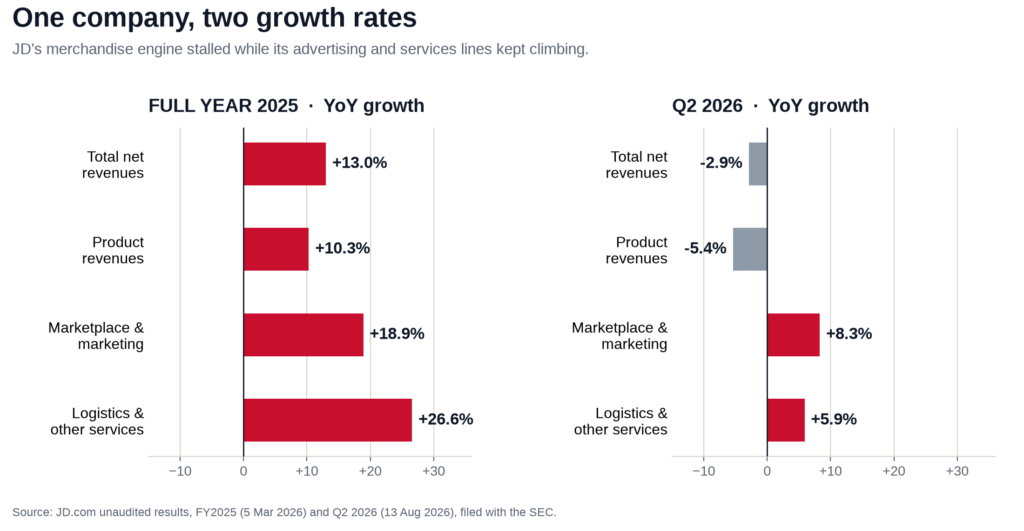
In August 2026, JD.com reported a quarter that looked, at first glance, like bad news. Revenue fell 2.9% to RMB346.4 billion. Electronics and home appliances — the category that built the company — dropped 11.8% year on year. For a retailer that had grown 13% in 2025, this was the sound of an engine sputtering.
Then you reach the fourth line of the revenue table. Marketplace and marketing revenues: up 8.3%.
That line is what brands actually buy on JD.com. It is advertising and commission revenue — the money JD earns from merchants who need to be seen. And in a quarter when JD sold fewer televisions, it sold more attention.
Most coverage of JD treats this as a footnote. It is closer to being the plot.
The number nobody puts in the headline
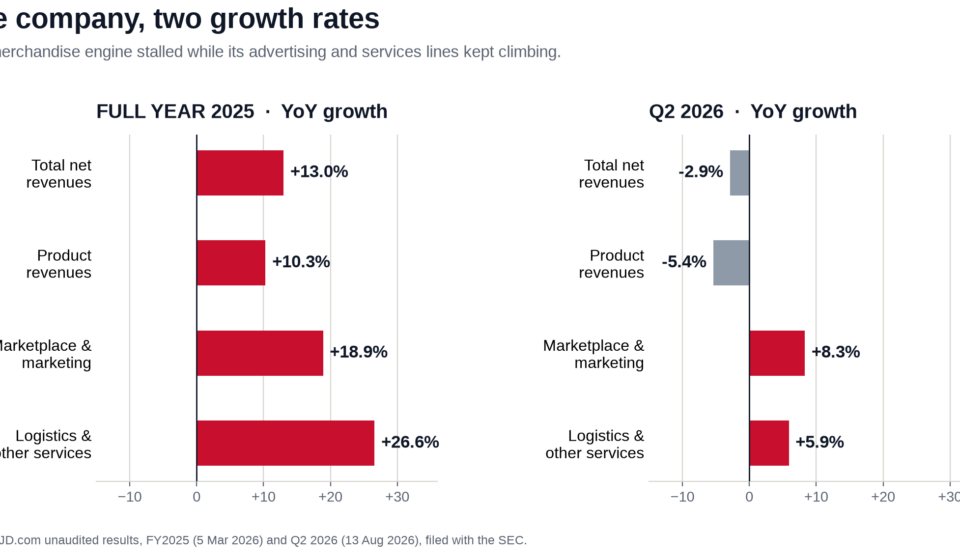
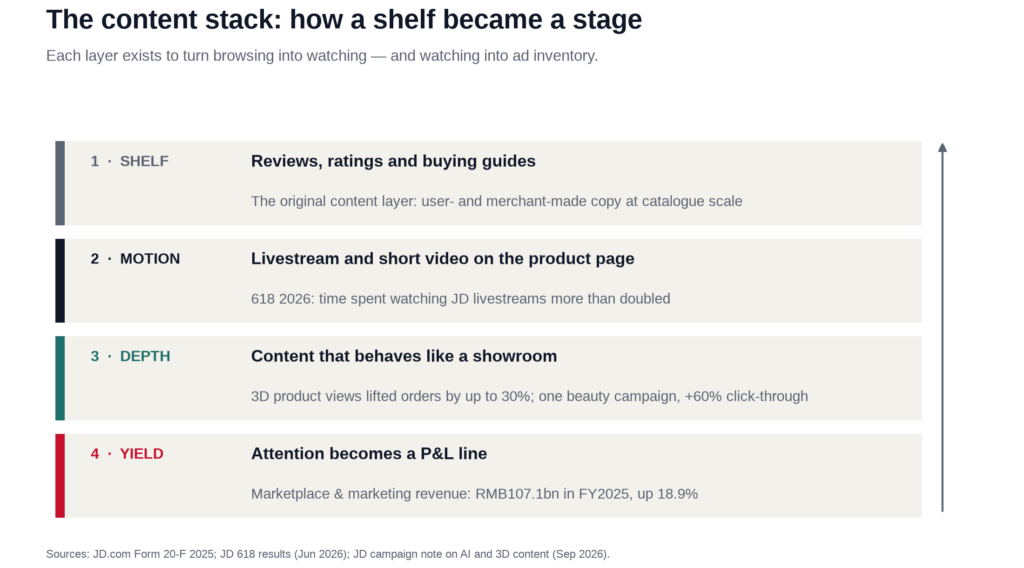
For the full year 2025, that attention business produced RMB107.1 billion, or roughly US$15.3 billion. It grew 18.9%. Total revenue grew 13.0%. Product revenue grew 10.3%.
Sit with those numbers for a moment. The smallest of JD’s three revenue lines — and almost certainly the highest-margin one — grew nearly twice as fast as the merchandise business. Advertising and marketplace services are now 8.2% of group revenue, up from 7.8% two years earlier — a small share that is quietly doing a disproportionate amount of work.
And in 2026 the gap widened rather than closed. Across the first half of the year, group revenue grew 0.7%. Marketplace and marketing revenue grew 12.9%.
One sentence describes JD in 2026: the merchandise business is defending a position, and the attention business is on offense.
What JD actually is, in three lines
Founded in 1998 by Liu Qiangdong, run since 2022 by chief executive Sandy Xu, and listed on Nasdaq and in Hong Kong, JD booked RMB1,309.1 billion in net revenue in 2025 — about US$187 billion — and ranked 41st on the 2026 Fortune Global 500. That is its 11th consecutive year on the list, and its third straight year inside the top 50. Among mainland Chinese private companies, nobody ranks higher.
The company describes itself, in its own filings, as “a leading supply chain-based technology and service provider.” That phrasing is dull, and it is also accurate. JD is the rare Chinese platform that owns the goods it sells and the trucks that move them.
The warehouse is the moat, not the story
Here is the part that gets skipped. JD’s fulfillment expense reached RMB88.2 billion in 2025, up 25.2%. More than 90% of orders are placed through its mobile apps. The broader “JD ecosystem” — employees, part-time staff, interns and affiliates — passed 900,000 at mid-2026, with RMB171.7 billion spent on that workforce and external support staff over twelve months.
That infrastructure is the reason a piece of content behaves differently on JD than it does on a feed. When a shopper watches a live demo inside an app that has already delivered to her door three times this year, the content does not have to manufacture trust. It only has to be useful. That is a very different brief from the one a Douyin creator gets.
China’s shopping journey moved, and the receipts are public
None of JD’s content investment makes sense without the macro shift underneath it.
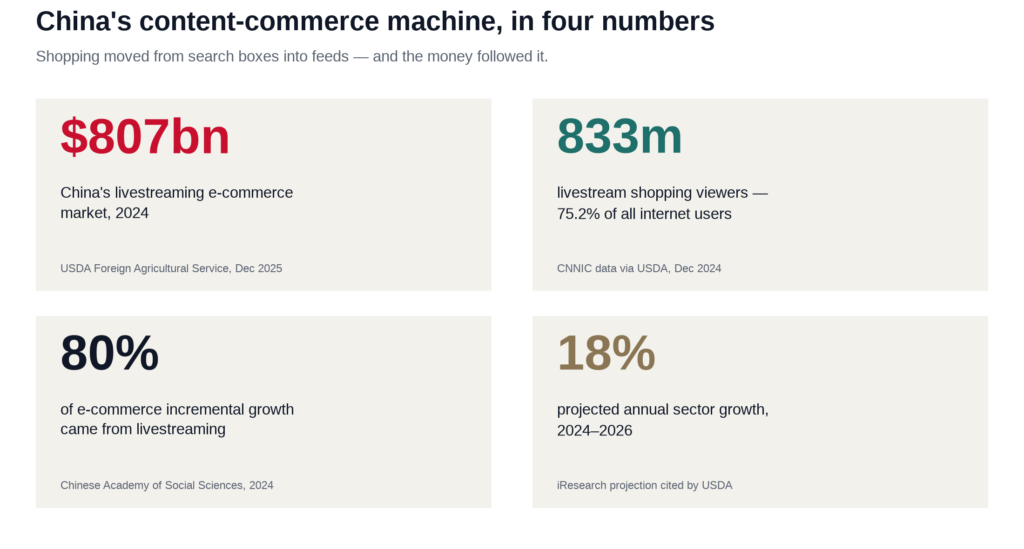
China is the world’s largest online retail market, and has been for more than a decade. Within it, livestreaming commerce reached roughly US$807 billion in 2024, according to a market report published by the US Department of Agriculture’s Foreign Agricultural Service in December 2025. By the end of 2024, 833 million people in China were watching livestream commerce — 75.2% of all internet users.
Two further data points from that report deserve to be pinned to a wall. The Chinese Academy of Social Sciences estimated that livestreaming accounted for 80% of incremental e-commerce growth in 2024. And iResearch projected annual growth of about 18% for the sector through 2026.
The behavioral evidence is just as blunt. In food and beverage, 48% of shoppers searched for and bought products after being inspired by online content, and 62% said they learned about a brand through content channels — more than the 56% who said the same of traditional media.
Add the AI layer and the picture sharpens further. CNNIC’s 57th statistical report, released in February 2026, put China’s internet population at 1.125 billion, with 80.1% penetration. Generative AI users hit 602 million by December 2025 — a 141.7% jump in a single year, or 42.8% of the online population.
So: discovery migrated into feeds, and the tools for producing that discovery became far cheaper. JD did not choose this environment. It had to answer it.
Why a logistics company started making television
The strategic logic is easier to see in JD’s own paperwork than in any strategy deck.
Its 2025 annual report describes a platform carrying “a large volume of helpful user-generated and professionally-generated content,” and then adds a sentence that ought to be quoted more often: “We also encourage third-party merchants to generate content and promote their products through livestreams and short videos on our platform to better interact with our customers.”
Read that carefully. JD is not commissioning shows. It is renting out the stage and handing the microphone to the brands.
The results during the 2026 618 shopping festival suggest the stage is being used. JD says the total time users spent watching e-commerce livestreams on the platform more than doubled year on year. New product launches from major brands rose more than 500%. More than 2,000 fashion brands, UNIQLO among them, doubled transaction volume.
The product page became a stage
Here is the mental model that finally made this click for me.
A traditional e-commerce product page is a form: specifications, price, reviews, buy button. It assumes the shopper has already decided what she wants and only needs confirmation. That assumption was safe when search was the front door.
It stops being safe when discovery happens in a feed. If a shopper meets your product inside a short video, she arrives at your product page with desire and almost no context. A form cannot hold that attention. So JD did not build a rival to Douyin; it imported the feed into the product page — reviews, buying guides, short video, livestreams, and now 3D product views.
This is the distinction that most “JD is becoming a media company” arguments miss. JD’s content is not editorial. It is merchandising infrastructure. The goal is not to be watched for an hour. The goal is to survive the few seconds between tapping a thumbnail and deciding whether to keep looking.
The margin story that gets misread
Now the number that makes analysts wince: JD’s group operating income was RMB2.8 billion in 2025. On RMB1,309.1 billion of revenue, that is a 0.2% operating margin, down from 3.3% the year before.
Headlines wrote it up as a profit collapse. It was not. It was a bill.
JD Retail, the core business, earned RMB51.4 billion in operating income at a 4.6% margin — up from 4.0%. In the first quarter of 2026, retail margin hit 5.6%, a record for the company. The consolidated figure sagged because JD spent heavily to build food delivery and other new businesses, and those losses run through the same statement.
You cannot understand JD’s content economics without separating those two P&Ls. Retail margin is holding. The group number is a strategic investment, not a broken machine. And the advertising line, which requires almost no inventory and no riders, is the piece of the business that improves the mix every time it grows.
AI is the new content department
The 2026 618 was, in JD’s phrasing, its first “fully AI-integrated” shopping festival — AI woven through consumer experience, merchant operations and logistics rather than bolted on as a chatbot.
The content applications are the interesting part. JD has been rolling out glasses-free 3D product views, built by combining AI with 3D modeling so that a handbag or a serum bottle appears to sit in front of the screen. The company says the format has lifted orders by up to 30% in previous deployments, and that an earlier SK-II campaign recorded a 60% increase in click-through rates. It also says brands can generate a 3D model from existing product photography in about ten minutes.
For Qixi, the Chinese Valentine’s Day, JD’s luxury division went further and used generative AI to produce a campaign film — script development through visual design — around a single promise: next-day delivery of luxury goods. A retailer used AI to make an advertisement about its own logistics.
None of this is neutral for brands. When the cost of producing a product visual, a demo video or a campaign film falls by an order of magnitude, content stops being a budget line and becomes a default. The bottleneck moves. It is no longer “can we afford to make this?” It is “will anyone see it, and will they believe it?”
R&D spending tells you how seriously JD takes the production side of that question: RMB7.3 billion in the second quarter of 2026, up 37.7% year on year, in a quarter when revenue fell.
Attention economics: buying less, earning more
There is one more shift in the numbers, and it is the one I find most revealing.
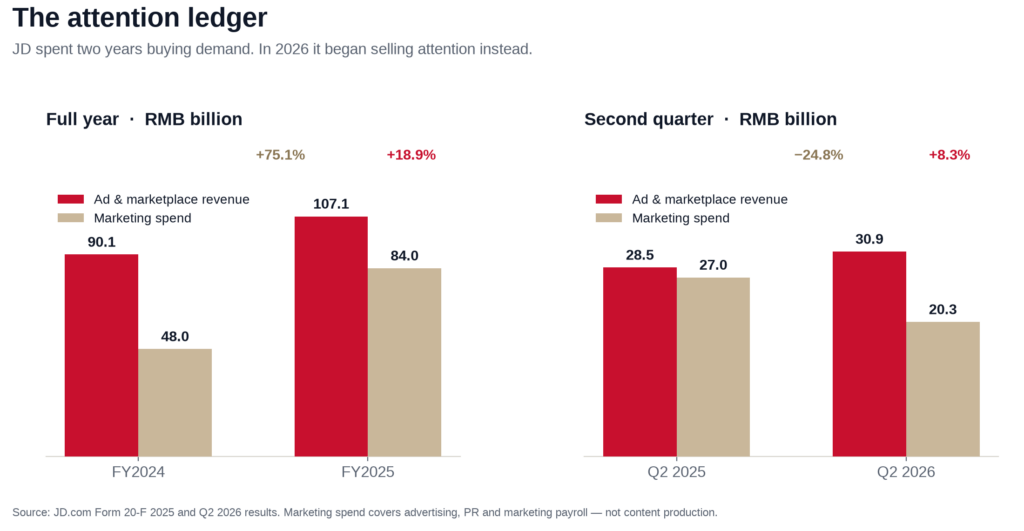
In 2025, JD’s marketing expenses jumped 75.1% to RMB84.0 billion. That was the price of launching food delivery: coupons, subsidies, a national land grab for users.
In the second quarter of 2026, marketing expenses fell 24.8% to RMB20.3 billion. JD’s own explanation: optimization of promotional spending on new business initiatives.
In the same quarter, its advertising revenue grew 8.3%.
That combination is the whole thesis in miniature. JD is stepping back from buying demand and stepping forward into selling attention. Subsidies buy a transaction once. A livestream, a 3D product view or a merchant’s own broadcast can earn revenue from every brand that wants the slot, and it keeps working after the coupon expires.
The company’s chief economist, Shen Jianguang, put a version of this on stage at the World Retail Congress’s first Asia lab in October 2026: “The next wave of retail growth will not come simply from more traffic or more products. It will come from AI reshaping the entire retail value chain.”
Strip the conference language and you get a plain claim. Traffic is finite. The yield per unit of traffic is not.
What this changes for brands
If you sell on JD, or you are thinking about it, five adjustments follow from the data rather than from the hype.
The product page is a studio, not a form. Allocate content budget to the page itself — video, 3D, comparison modules, merchant livestreams — before you allocate more to keyword bids. The page is where the decision happens.
Fund store-operated streaming before you fund stars. In 2024, store-operated livestreaming drove more than half of China’s overall livestream GMV, overtaking celebrity-hosted sessions. Your own staff, on your own channel, selling your own catalog, is now the mainstream format, not the cheap alternative.
Build assets once, reuse them everywhere. A 3D model good enough for JD’s app is good enough for your own site, for retail media elsewhere and for short-video edits. Content that cannot be repurposed is a cost; content that can is an asset.
Buy attention where intent already exists. JD’s advantage is that its audience arrives with a wallet open. That makes its ad inventory expensive and, for the right category, worth it.
Measure assisted conversion, not last click. Content earns its keep upstream. If your attribution model only credits the final click, every livestream and every 3D view will look like a cost center — and you will cut the thing that was doing the work.
The honest risks
I would not tell this story without its counterarguments, because several are structural.
Attention is still a small slice of JD. At 8.2% of revenue, the advertising line is a growth engine, not a business model. Calling JD “a media company” is a useful metaphor and a misleading description. It is closer to an advertising business with a warehouse attached — and the warehouse is what makes the advertising work.
Commercial content has a trust ceiling. Content that exists to sell is read as an advertisement, however well it is made. JD’s version of trust is authenticity of goods and speed of delivery, not editorial independence, and no amount of AI-produced creative changes that.
The content metrics are self-reported. Livestream watch time doubling, 3D lifting orders by up to 30% — these come from JD’s own communications, not from audited disclosure. Treat them as directional, not definitive. Watch for whether JD begins reporting content-attributed GMV; that would be the signal that the company itself believes the number is defensible.
AI content converges. When every merchant can generate a 3D model in ten minutes, the average product page gets better and more interchangeable at the same time. Differentiation retreats to the things AI cannot mass-produce: assortment, price, service, and the credibility of the seller.
The competitor with the content DNA is not standing still. Douyin’s e-commerce GMV reached roughly US$487 billion in 2024. JD cannot out-feed Douyin. It can only make its own surface good enough that shoppers stop leaving.
How to run a 90-day test
Strategy documents are cheap. Here is a version you can actually execute next quarter.
Pick 20 SKUs that matter — mid-priced, considered purchases with room for explanation. Split them into four groups of five: control, video only, livestream only, and 3D plus video. Hold promotional spend constant across all four so you are measuring content, not discounts. Run each for four weeks on a rolling basis, and track product-page dwell time, add-to-cart rate, assisted orders within seven days, and return rate.
The return rate is the metric most teams forget, and it is the one that tells you whether your content told the truth. Content that inflates conversion and inflates returns has simply moved the cost.
What to watch in 2027
Four signals will tell you whether this pivot is real or rhetorical.
First, the spread between advertising growth and product growth. If marketplace and marketing revenue keeps outgrowing merchandise revenue for another four quarters, the mix shift is structural.
Second, disclosure. If JD starts publishing content-attributed sales or livestream GMV in its quarterly releases, it has decided the number is good enough to defend in public.
Third, retail margin. Holding 4.5% or better while funding new businesses would prove that content and advertising are paying for the expansion rather than masking it.
Fourth, merchant behavior. The pivot only compounds if brands treat JD as a place to produce content, not just to list SKUs. That is a behavior change JD can incentivize but cannot mandate.
Bottom line
The lazy version of this story is that JD is becoming a media company. The accurate version is narrower and more interesting: JD is converting the traffic it already owns into a second, higher-margin revenue stream, and building the content machinery — livestream, short video, 3D, AI creative — that makes that traffic worth more per visit.
For JD, that is a defense of the product page against the feed, dressed up as an advertising business.
For brands, it changes the job. You are no longer managing listings on a retail platform. You are programming a channel on a platform that happens to have warehouses — and the brands that learn to make content that survives eleven seconds of scrutiny will be the ones that own the discovery moment.
Frequently asked questions
Is JD.com actually turning into a media company?
No, and the distinction matters. Advertising and marketplace services generated RMB107.1 billion in 2025, about 8.2% of revenue. JD still earns most of its money selling goods. What has changed is that the attention around those goods is now a product in its own right — closer to Amazon’s advertising business than to a broadcaster.
How large is JD’s advertising business, really?
RMB107.1 billion in FY2025, up 18.9% year on year, and RMB57.4 billion in the first half of 2026, up 12.9%. For context, that half-year growth came while total revenue grew just 0.7%, which is why the line matters disproportionately to the profit mix.
Why did JD’s operating margin fall to 0.2% in 2025 if retail is healthy?
Because the group result absorbs the cost of building new businesses, chiefly food delivery. JD Retail earned RMB51.4 billion at a 4.6% margin in 2025, and 5.6% in the first quarter of 2026 — a record. The consolidated number reflects investment, not deterioration in the core.
Does livestreaming actually work on a shopping app, or only on entertainment platforms?
The evidence says it works, with a different mechanism. JD reports that time spent watching livestreams on its platform more than doubled during the 2026 618 festival, and store-operated streaming — brands broadcasting their own catalog — drove more than half of China’s livestream GMV in 2024. On a commerce app, streaming functions as a demo counter rather than as entertainment.
What should a brand do first on JD?
Fix the product page before buying more traffic. Video, 3D visuals, comparison modules and a recurring store-operated stream will usually outperform an incremental keyword budget, because they change the quality of the visit rather than only its quantity. Then measure assisted conversion and return rate, or you will never know whether it worked.