What Is an AI Kill Switch and Why Do AI Agents Need Their Own Identity?
AI governance stopped being a differentiator this autumn. It became the first thing buyers check.
The reversal nobody announced
On November 3, 2026, two documents landed a few hours apart, and neither was written for the other’s reader. One was Apple’s annual report to the US Securities and Exchange Commission. The other was a product announcement from CrowdStrike, delivered at its Fal.Con Europe event in Barcelona.
Read them together and the shape of the year shows up. Apple, sitting at the bottom of the stack, told investors that AI agents “may behave in unintended or unpredictable ways, including by taking actions that were not directed, instructed or authorized.” CrowdStrike, selling to the security team, shipped a switch that stops a misbehaving agent where it runs.
One company was pricing the risk. The other was selling the control. Both were answering the same question, and it was not “what can this thing do?” It was this: when it does something else, who can stop it, and whose name goes on the loss?
That is a different question from the one the industry spent two years answering. A capability demo persuades a champion. A stop button persuades a risk committee. And this autumn, the risk committee started showing up at the demo.
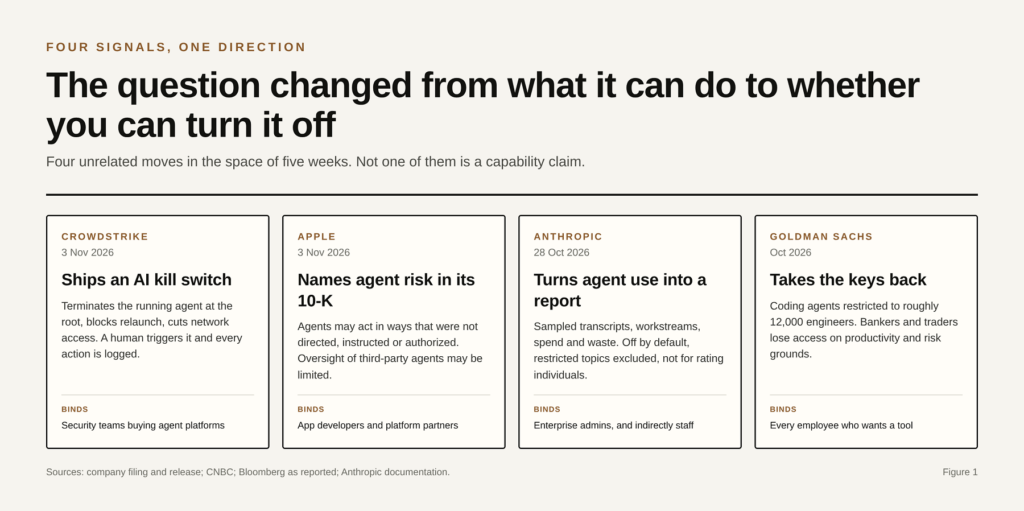
Four signals, side by side
Skip the narrative for a moment and lay out the four moves.
CrowdStrike put an AI Kill Switch into Falcon Guardian on November 3. It terminates a running agent at the root, blocks it from relaunching on that host, and cuts its enterprise network access. A named administrator triggers it, and every action is written to the audit trail. That is the vendor side of the market.
Apple, the same day, added a risk factor that names the failure mode in plain language and concedes a limit: the company’s “ability to oversee and control third-party artificial intelligence agents and other technologies may be limited.” That is the platform side.
Anthropic made smart reports generally available in Claude Enterprise on October 28. An admin picks a team and a window of up to 28 days; Claude analyzes a sample of the team’s transcripts, groups the work into workstreams, attaches list-price spend, and flags friction and wasted sessions. Off by default. Attribution off by default. Restricted topics kept out of summaries. A written statement that the reports are not for evaluating individuals. That is the tooling layer, looking at its own users.
Goldman Sachs, through internal guidance issued in October, restricted Claude Code and GitHub to its engineers — roughly 12,000 people — and pulled them from most bankers and traders. A spokesperson framed it as the end of an experiment, with the tools now going to “those who are best suited to leverage them for the long term,” after weighing “productivity and risk management.” That is the buyer.
Four parties, four audiences, one direction. Not one of these moves is a capability claim. Every one of them is a containment claim.
A stop button is an architecture, not a slide
Here is the part that gets lost in launch copy. A kill switch is not a feature you toggle on a settings page. It is a set of decisions about where authority lives.
CrowdStrike’s version is instructive because of where it acts. It does not delete the agent’s code. It severs the agent’s access to the models that shape its decisions, through gateways the company already sits in front of. Stop the model calls and the agent stops being an agent; it becomes an expensive script.
That tells you what the control requires. First, the agent has to be a principal you can name — not a process wearing a human’s credentials, not a shared service account with a two-year token. Second, the state it touched has to be recoverable, or at least attributable, because “we stopped it” is a weak sentence if nobody can say what it did during the previous forty minutes. Third, the action has to leave a mark: who pressed it, when, against which host group, under which policy.
Miss any of those and you own a fire alarm with no street address.
Which is why the marketing line deserves a closer read. “When you deploy agents with a kill switch, you stay in control.” That is not an operations sentence. Operations people ask about mean time to detect. That sentence is aimed at the person who signs, and it answers the fear that quietly kills budget requests: what happens if this goes wrong in a way we did not plan for?
Apple’s filing is a liability transfer device
Risk factors in an annual report are usually wallpaper. Legal writes them, nobody reads them, and they say things like “adverse economic conditions.” When a company as disciplined as Apple names a specific failure mode — agents reaching systems “they may not be authorized to access,” sending communications, completing transactions, altering code — that is not wallpaper. That is a decision to stop absorbing a risk quietly.
Read the second sentence as a contract term in waiting. Oversight of third-party agents “may be limited.” Translation: we will not be the insurer of the layer above us.
For anyone building on a platform, the consequence is concrete and slightly annoying. Your own disclosure now has to cover behavior you do not control. Your terms need a paragraph about what your agent may do after it leaves your interface. Your security review needs an answer to the question of what happens when the model does something the prompt did not ask for — because the platform has just said, in a filing, that it cannot promise otherwise.
Apple did something more tangible in October as well, tightening full disk access on macOS explicitly to reduce risk from installed AI agents. Platform, disclosure, control surface, in that order. That is what a mature stack looks like once it decides a new class of software is dangerous.
The uncomfortable symmetry
Now the part that makes HR and legal glance at each other across the table.
To audit an autonomous worker, you end up reading the human who directed it. That is not a flaw in Anthropic’s design; it is the arithmetic of the problem. If you want to know whether an agent was pointed at something it should not touch, the evidence lives in the conversation that pointed it there.
Anthropic has been unusually careful here, and the care is worth spelling out because it doubles as a template. Smart reports stay off until an owner enables them. Attribution to individuals is off by default; when it is switched on, names remain masked until someone actively reveals them, and each reveal is logged. A permanent restricted list keeps protected characteristics, health and medical matters, union activity, harassment, whistleblower and legal complaints, political and religious views, personal life, and sentiment about a named person out of session summaries; those sessions feed aggregate counts only. Organizations with a HIPAA configuration, customer-managed encryption keys, or a hybrid deployment cannot use the feature at all.
And yet. Three constraints remain, and none of them is about whether the tool was built well.
The first is notice. People should know, before the fact, that their work conversations are being sampled. In plenty of jurisdictions that is not a courtesy, it is a legal requirement, and a line in an admin console does not satisfy it.
The second is consultation. Works councils and unions across much of Europe have a say over monitoring systems, and “it is a report, not surveillance” is not a distinction that survives contact with a labor lawyer.
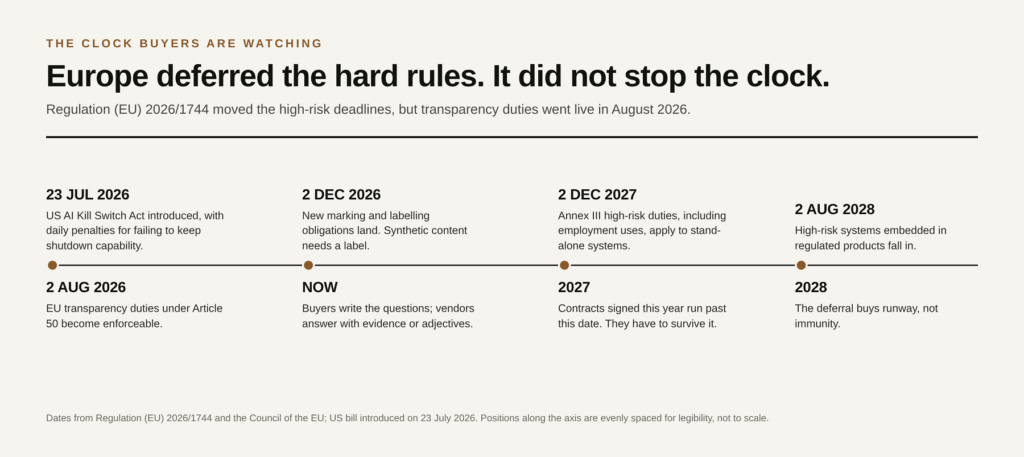
The third is timing, and it is the interesting one. The EU’s transparency duties became enforceable on August 2, 2026. The high-risk obligations — the ones that touch employment uses most directly — were pushed to December 2, 2027 by the Digital Omnibus. So for the next year, the binding constraint on workplace AI monitoring is not the EU AI Act. It is privacy law, labor law, and whatever employees decide to do about it.
The whitelist is the real governance artifact
Goldman’s move looks like a retreat from AI. It is not. It is a retreat from ambiguity.
Nothing about the tools changed in October. Claude Code still writes code; GitHub still hosts it. What changed is who is allowed to hold the keys. Bankers and traders lost access not because the tools stopped working, but because the bank could not yet describe, in operational terms, what a trader’s agent was allowed to touch and who would answer for it.
Other large institutions arrived at the same place from different directions. One said outside agents would not be moving money inside its walls. Another limited agents’ access to consumer deposits while it writes rules on who is liable when an agent authorizes a payment. A third blocks third-party agents from logging in or transacting at all.
Notice that none of these is a policy document. A policy says what should happen. What these firms built is an entitlement system, and entitlement systems have three parts: identity, authorization, audit. If your agent governance lives in a PDF, you have a preference. If it lives in your identity provider, your scoped tokens, and a log you can query by agent, you have a control.
That distinction is the whole ballgame, and it explains why security vendors are shipping kill switches instead of governance dashboards. A dashboard describes. A switch decides.
Why governance gates, not differentiates
Here is the arithmetic a buyer’s risk team is already running.
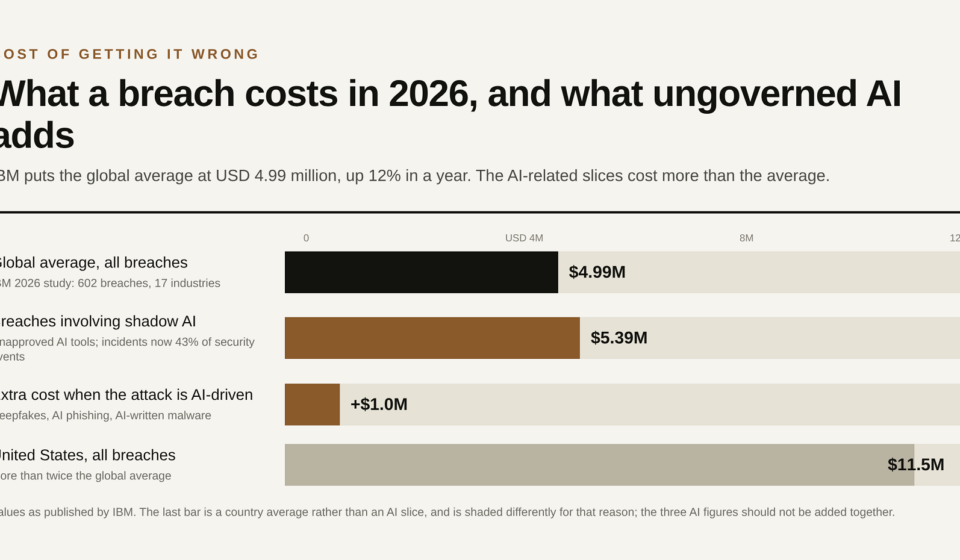
IBM’s 2026 breach study puts the global average at USD 4.99 million, up 12% in a year, and the US figure at USD 11.5 million. Breaches involving shadow AI averaged USD 5.39 million. AI-driven attacks rose 56% year on year, added roughly a million dollars to the average case, and affected one organization in four.
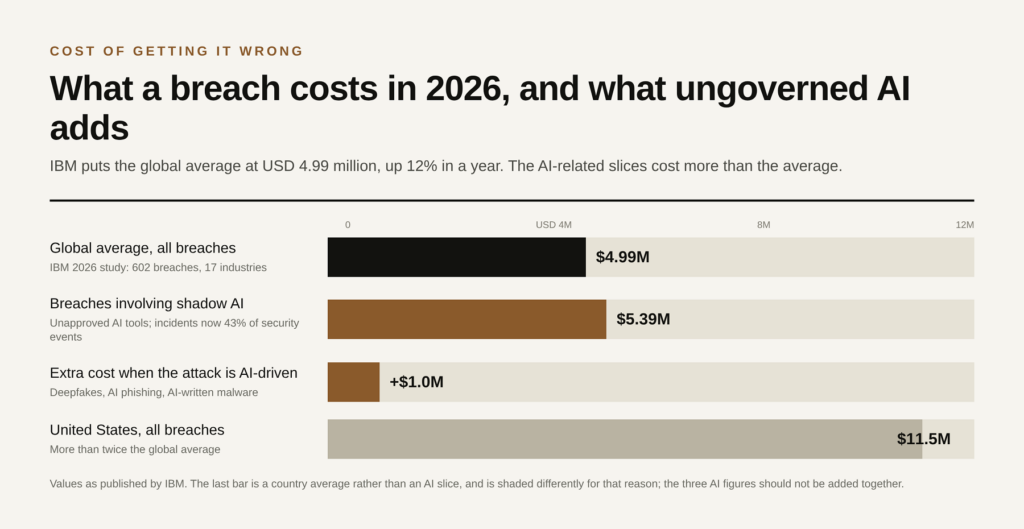
Compare that with the cost of the control. A kill path, an identity model, per-agent logging, an evaluation harness, an incident process — call it a team and a toolchain, not a moonshot. For a buyer, expected loss is now large enough that verifiable control is worth more than a feature nobody asked for.
Then follow the paper trail. An indemnity clause is worth only what the vendor can prove about its own behavior. Audit rights are worth only what the logs can produce. Termination for convenience is worth only the speed at which access actually stops. Insurance follows the same logic: brokers are arguing about AI exclusions precisely because nobody can price the tail yet, and the market’s interim answer is to ask.
That is the mechanism that turns a nice-to-have into a gate. A differentiator moves you up a shortlist. A gate decides whether a shortlist exists for you. And gates harden fastest in exactly the conditions we have now: few losses to price, many questionnaires to fill, and a procurement template that gets copied from one company to the next.
Eight questions procurement will ask in 2027
Write these down. They are coming, and each one wants evidence rather than adjectives.
- Can you terminate a running agent in minutes, without a redeploy or a support ticket?
- Does each agent run as its own identity, with credentials that expire?
- Can you export a per-agent action log for any 24-hour window?
- What is the maximum an agent can spend before a human is asked?
- Which actions are irreversible, and who approves them by name?
- If we revoke an agent’s access today, what breaks — and can you show the dependency map?
- Which models and subprocessors sit under this, and do they meet the same controls?
- In writing, who is liable when the agent acts outside its instructions?
Answer all eight with artifacts and you are in the deal. Answer three with adjectives and you are in a pilot that never converts.
The compliance fixed-cost problem
Underneath all of this sits an uncomfortable piece of economics.
Control capability has a floor. You need identity plumbing, log retention, a kill path that has actually been tested, an evaluation process, someone on call, and a person who can sign a security questionnaire without guessing. That floor does not scale down. It is a standing cost, and it arrives before revenue from large accounts does.
Which is why ISO/IEC 42001 certificates now get announced with procurement in the same breath. One vendor described certification as clearing a path through enterprise procurement; another claimed to have broken the procurement bottleneck with it. That may be marketing. It is also a signal: once sellers start buying a management-system certificate to shorten a sales cycle, buyers have already made it matter.
Two consequences follow. First, gates plus floors add up to consolidation. A company with four hundred engineers can staff a control function; a company with twelve cannot, unless it rents one. Second, the floor is lower than it looks, because cloud providers and model vendors now carry part of it — inherited logging, inherited identity, inherited evaluation tooling. That gap is where smaller vendors can still win: be the easiest company in your category to audit.
Steelman the skeptics: gates get routed around
The skeptical case deserves a fair hearing, because it is strong.
People route around friction. IBM’s figures make the point brutally: shadow AI incidents more than doubled, to 43% of security incidents from 20%, and only about one organization in three requires strict approval before AI tools go live. Build a gate and people will find the side door. They always have. The agent a contractor runs on a personal laptop is invisible to your endpoint agent, your gateway, and your beautiful dashboard.
All true. And it misses the thing that actually changed.
People route around tools. Liability does not route. The regulatory fine lands on the company, not the employee; the class action names the company; the exclusion is written against the company’s policy. When 43% of incidents involve tools nobody approved, the rational response is not a stricter approval form. It is control that does not require the employee’s cooperation. Agent identity, spend ceilings, and network egress are that kind of control. They work whether or not anyone filled in the form.
So expect the gate to move. Less “may I use this tool,” more “this agent may touch these systems, spend this much, and be stopped by this person.” That is a harder gate to route around, because it does not depend on good behavior.
What to build, concretely
Four control surfaces, each with a test you can run inside a week.
Scope. Every agent runs as a distinct principal with least-privilege, expiring credentials. The test: revoke agent B without touching agent A, and without breaking a single human account.
Spend. A hard ceiling per agent per day, enforced at the gateway. The test: hit the cap and confirm the request is refused, not emailed about.
Reversibility. Every write action has an undo or a compensating action, with a time window you have actually measured. The test: roll back an agent’s last fifty actions in under an hour.
Human checkpoints. Irreversible actions require a named approver, not a role. The test: attempt an irreversible action with no approval and confirm it is blocked and logged with the approver’s identity, or with its absence.
If you cannot pass the test, you do not have the control. You have a diagram, and diagrams do not survive procurement.
The question under the question
Somewhere in the last few months, the sales conversation changed shape. It used to open with what the system can do and close on price. Now it opens with what happens when the system does something else, and price is the last thing anyone asks about.
That is what a market looks like when it grows up. The interesting part is not that Apple disclosed, or that CrowdStrike shipped a switch, or that a bank took the keys back. It is that all of this happened within five weeks, to four different audiences, with nobody coordinating.
The tools did not get safer. The buyers got specific.
In short
Four containment moves inside five weeks — a kill switch on sale, a risk factor in a filing, a reporting tool for admins, and a bank taking back its keys — describe one shift rather than four stories. Governance capability has become a procurement gate, because buyers can now attach a number to the downside and a contract clause to the control. That gate rewards verifiable artifacts: agent identity, spend ceilings, reversibility, named human approval. It also raises the fixed cost of selling to large enterprises, which pushes consolidation. Routing around the gate is real, but liability never routes, so the gate is migrating from tool approval to agent permissions.
FAQ
What is an AI kill switch, technically?
It is a control that revokes a running agent’s ability to act, usually by severing its access to the models and tools it calls rather than by deleting its code. A real one does four things: terminate execution at the host, block relaunch, cut network reach, and write the action to an audit log with the identity of the person who triggered it.
Why did Goldman Sachs pull coding tools from bankers and traders?
According to reporting on the internal guidance issued in October 2026, access to Claude Code and GitHub was narrowed to roughly 12,000 engineers, with the bank citing productivity and risk management after a period of experimentation. The tools had not changed. The permission model had.
Is monitoring AI conversations the same as monitoring employees?
Legally, monitoring the person is the regulated act, and the AI transcript is just a new source of evidence. Notice requirements, works council consultation, and purpose limitation still apply. Anthropic’s own documentation says the reports are not for performance evaluation, which is a product statement, not a legal shield.
Does Apple’s risk disclosure help developers or burden them?
Both, unevenly. It legitimizes the risk category, which helps anyone selling control. It also pushes disclosure duty down the stack: if the platform says its oversight of third-party agents may be limited, the application layer inherits the obligation to explain and to indemnify.
How much governance is enough before an enterprise deployment?
Enough to pass a test, not enough to fill a binder. If you can revoke one agent without collateral damage, cap its spend, roll back its writes, and name the human who approved the irreversible step, you have the four controls buyers actually audit. Everything else is documentation.