From Messaging to Operating System: The Chinese Internet Blueprint the West Can’t Copy
You probably think of WeChat as China’s WhatsApp. That single sentence is where most global marketing strategies go wrong. In the West, you open five apps to do what one closed ecosystem does in a single tap: chat with a friend, split a bill, order dinner, book a doctor’s appointment, file a return, and buy again next week. In China, WeChat already holds the whole loop.
This isn’t a feature gap. It’s a different foundation. When overseas teams treat WeChat as “a messaging channel,” they miss the part that actually matters: WeChat behaves less like an app and more like an operating system that happens to boot into a chat screen.
What “Operating System” Really Means Here
An operating system does three quiet jobs. It gives every program one identity. It gives every program one way to move money. And it decides which programs are allowed to talk to each other. WeChat does exactly that, but inside one app instead of across a phone.
Picture a living room that also has a cash register, a storefront, a customer-service desk, and a delivery dock built into the walls. You don’t leave the room to buy anything. That is the mental model Chinese users grew up with, and it changes how marketing works at the root.
The Layer Map: How the Chinese Internet Stacks
WeChat is not flat. It is layered, and each layer is a marketing surface:
- Messaging layer — the root identity. Every user is one verified person, not a cookie.
- Payments layer — the default rail. Money moves inside the same identity, with no redirect to a bank page.
- Mini Programs layer — the app inside the app. Brands run lightweight services without forcing a download.
- Official Accounts and Channels layer — the publishing and video surface for owned content.
- Enterprise WeChat layer — the private-domain bridge between a brand’s staff and its customers.
The closure is not a bug. It is the feature. A closed identity means a brand can follow a person from first click to fifth repurchase without ever losing the thread.
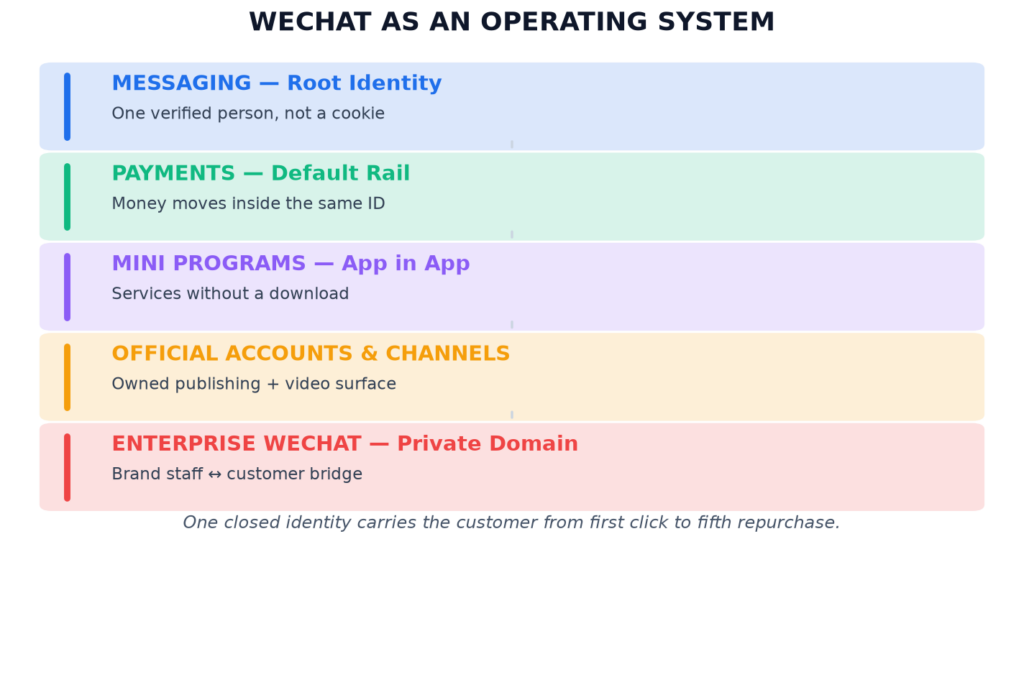
A five-layer visual showing Messaging → Payments → Mini Programs → Official Accounts & Channels → Enterprise WeChat, each with a one-line description, ending with the caption: one closed identity carries the customer from first click to fifth repurchase.
Why China Built an App That Replaced the App Store
The short answer is distribution gravity. When one identity already covers chat, pay, and commerce, a separate app becomes a heavier ask. Why download a new banking app when the bank already lives inside the super-app you open forty times a day?
So the Western pattern — acquire users on one platform, push them to a website, hope they install an app, then retarget them with cookies — simply does not map. China compressed that funnel into one continuous surface. For marketers, the job shifts from “building traffic” to “earning a place inside an existing operating system.”
The Numbers: China’s Digital Scale
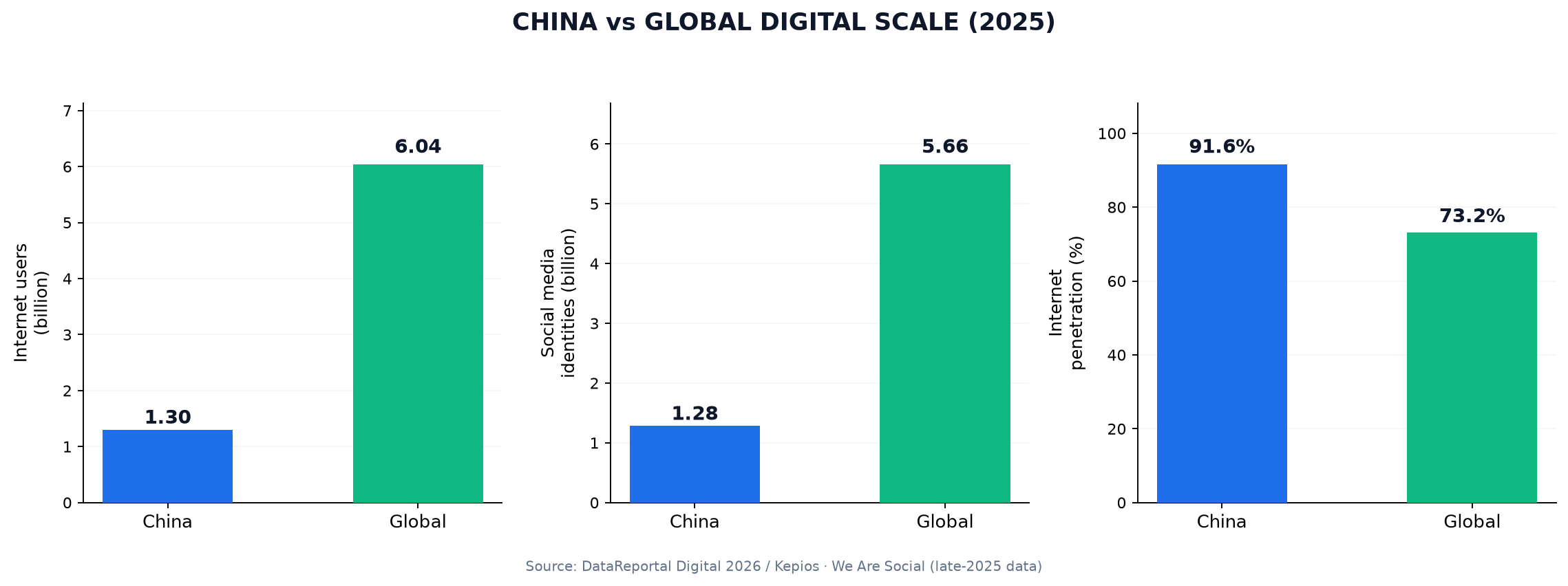
Let’s ground this in verified data rather than vibes. According to DataReportal’s Digital 2026 reporting (compiled by Kepios and We Are Social from late-2025 figures), China’s connected population looks like this:
- Internet users: 1.30 billion people, with online penetration at 91.6 percent.
- Social media user identities: 1.28 billion, equal to 90.3 percent of the population.
- Share of the global connected population: roughly 21.5 percent — more than one in five internet users on Earth is Chinese.
CNNIC’s own adoption figures, cited inside the same report, put social media users aged 18 and above at 1.07 billion, or 93.8 percent of China’s adult population. China’s total population stood near 1.42 billion in October 2025. The takeaway is blunt: the Chinese internet is not a niche. It is a continent.
WeChat itself is the anchor. Tencent’s second-quarter 2026 results disclose a combined monthly active user base of Weixin and WeChat at 1.439 billion, up 2 percent year on year. That is not “an app.” That is infrastructure.
The Global Picture: A Fragmented, Browser-Native World
Step outside China and the shape changes. The same DataReportal Global Overview shows:
- Global population: 8.25 billion people.
- Global internet users: 6.04 billion, a 73.2 percent penetration rate.
- Global social media identities: 5.66 billion, or 68.7 percent of all people.
The West never consolidated into one super-app. Instead it kept the browser, the app store, the ad network, and the payment processor as separate kingdoms. That fragmentation is a feature for competition and a headache for marketers, because no single identity follows the customer across all of them.
This is why “global digital marketing” and “China digital marketing” cannot share one playbook. One world runs on closed operating systems; the other runs on open, contestable layers.
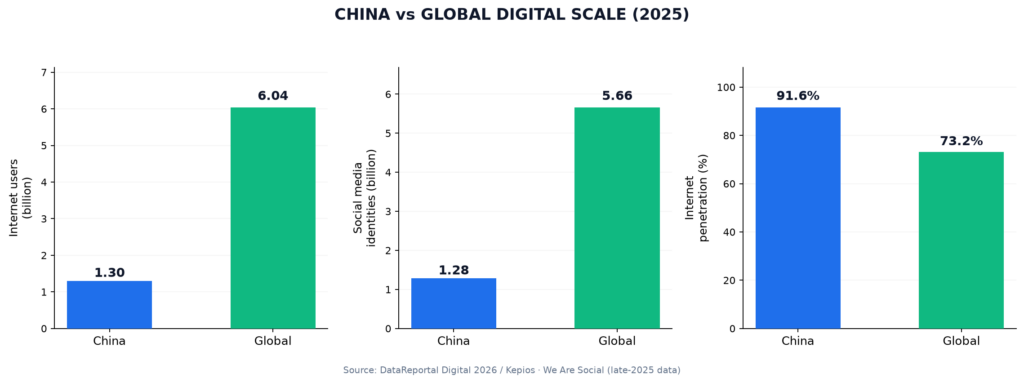
A side-by-side bar chart comparing China and the global market on three metrics: internet users (1.30B vs 6.04B), social media identities (1.28B vs 5.66B), and penetration (91.6% vs 73.2%), sourced to DataReportal Digital 2026.
Super-Apps Beyond China: The Pattern Is Asian, Not Just Chinese
WeChat is the loudest example, but the super-app logic repeats across Asia. LINE in Japan grew from messaging into a super-app with a digital wallet, a news stream, and video services. KakaoTalk commands roughly 90 percent of South Korea’s local market and has extended into payments, banking, ride-hailing, and games. Paytm in India built a payments-first super-app on QR and merchant terminals. Meituan in China reported more than 770 million annual transacting users and over 14.5 million annual active merchants by the end of 2024.
Notice the pattern: each started as one job — talk, pay, order — then absorbed the adjacent jobs until the app became the operating system for daily life. Western markets fragment those jobs; Asian markets fuse them.
AI Marketing Enters the Operating System
Now layer AI on top, because the audience you are writing for cares about AI marketing as much as digital marketing. The interesting part is where the AI lives.
Inside China’s super-app model, AI marketing is not a separate tool you bolt on. It is a function of the operating system. Tencent’s second-quarter 2026 results show marketing services revenue of 43.565 billion RMB, up 22 percent year on year, supported by targeted advertising across the ecosystem. Video Accounts — the in-app video surface — grew total time spent by more than 20 percent year on year in the same quarter. Tencent has even begun small-scale prototype testing of Xiaowei, an agentic AI inside Weixin powered by its own WeLM model, tuned for privacy and Weixin-specific use cases. When the chat, the feed, the payment, and the storefront share one identity, an AI model can read intent and serve relevance without ever leaving the room.
Global AI Adoption in Marketing
Outside China, the adoption curve is just as real, only distributed. Stanford’s Human-Centered AI Institute, in its 2025 AI Index, reports that 78 percent of organizations used AI in 2024, up from 55 percent the year before. That is a 23-point jump in a single year. The same report notes that in China, 83 percent of the public sees AI products and services as more beneficial than harmful — among the highest optimism levels surveyed.
And the money follows the model. Global social media advertising spend reached roughly 277 billion USD in 2025, growing 13.6 percent year on year, according to the Digital 2026 data. The same research puts combined ad spend on online retail platforms at 204 billion USD for 2025 — considerably more than the 146 billion USD flowing to traditional TV. AI is the engine quietly lifting both the targeting quality and the spend.
China vs Global: Two Different AI Marketing Curves
Here is the comparison that matters for strategy:
| Dimension | China (super-app model) | Global outside China |
| Core entry point | One closed super-app identity | Browser plus fragmented apps |
| Customer identity | Single verified ID across chat, pay, commerce | Separate logins per platform |
| AI marketing location | Inside the operating system | Across ad platforms, CDPs, LLM tools |
| Scale reference | 1.30 billion internet users; WeChat 1.439 billion MAU | 6.04 billion internet users; 5.66 billion social identities |
| Spend signal | Tencent marketing services 43.565 billion RMB per quarter, +22% | Global social ad spend 277 billion USD per year, +13.6% |
The curves are not competing so much as running on different rails. China optimized for depth inside one system. The rest of the world optimized for breadth across many.
What Western Marketers Keep Missing
The first miss is language. Calling WeChat “a Chinese WhatsApp” hides the operating-system truth and leads teams to budget for it like a social channel. The second miss is the assumption that a website is the center of gravity. In a super-app world, the center of gravity is the identity, not the domain. The third miss is treating AI as a campaign add-on. In China, AI is the substrate; in the West, it is increasingly the toolkit. Same technology, different seating arrangement.
How to Think in WeChat-Native and Global-Hybrid Terms
If you are building for China, stop thinking “landing page” and start thinking “service inside the room.” Earn a place in the operating system through mini programs, official accounts, and enterprise WeChat, then let one identity carry the customer from interest to repurchase.
If you are building for the global market, accept the fragmentation and design for it. Use a customer data platform to stitch identities, use generative AI to scale creative and intent modeling, and treat each platform as a contestable layer rather than a walled garden.
If you are building for both, do not copy-paste. Translate the strategy, not the tactic. The objective — own the customer relationship — is universal. The architecture is not.
The Operational Takeaways
A few principles survive both worlds:
- Identity beats traffic. Whether it is one super-app ID or a unified CDP, the durable asset is the recognized customer.
- Closure creates continuity. A closed loop converts better because nothing falls out of the funnel.
- AI is the new rail, not the new banner. The teams winning in 2025 and 2026 are the ones that put AI under the transaction, not just on top of the creative.
- Scale is lopsided. China is one-fifth of the world’s connected people and runs on a different operating logic. Ignore it and you misread the future of global marketing.
Summary
WeChat is not an app; it is an operating system that fused messaging, payments, mini programs, publishing, and private-domain commerce into one closed identity. China’s internet — 1.30 billion users at 91.6 percent penetration, or more than one in five of the world’s connected people — runs on that logic, anchored by WeChat’s 1.439 billion monthly active users. The rest of the world, with 6.04 billion internet users and 5.66 billion social identities, stayed fragmented and browser-native. AI marketing deepens the split: inside China it sits within the operating system — now surfacing as native agentic AI like Weixin’s Xiaowei — while globally it spreads across platforms and tools. Both curves are real, both are growing, and both deserve their own playbook.
Frequently Asked Questions
Is WeChat actually an operating system? In the functional sense, yes. It provides a single identity, a single payment rail, and controlled inter-app communication — the three jobs an operating system does — inside one app rather than across a device.
Why is the Chinese internet so closed compared with the West? Because one identity that already covers chat, pay, and commerce raises the cost of switching to a separate app. Closure keeps the customer inside a continuous loop, which benefits both the platform and the brands operating within it.
Can foreign brands operate inside WeChat? Foreign brands can run official accounts, mini programs, and enterprise WeChat engagements, but they do so inside Tencent’s rules and identity system rather than on their own independent web property.
How does AI marketing differ between China and the global market? In China, AI typically works inside the super-app operating system, reading intent from a unified identity — increasingly through native agentic AI like Weixin’s Xiaowei. Globally, AI is distributed across ad platforms, customer data platforms, and standalone generative tools, because no single identity spans the whole journey.
What is the one metric that proves China’s digital scale matters globally? China accounts for roughly 21.5 percent of the world’s connected population and runs on a super-app model the West lacks, so any global marketing thesis that ignores it is missing one-fifth of the internet and a preview of where integrated AI commerce may head.