The €3 parcel tax turned delivery time into a media buy
For most of its short life, the Temu story was a price story. That story has been legislated out of existence, and what replaced it is more interesting: delivery time became media spend.
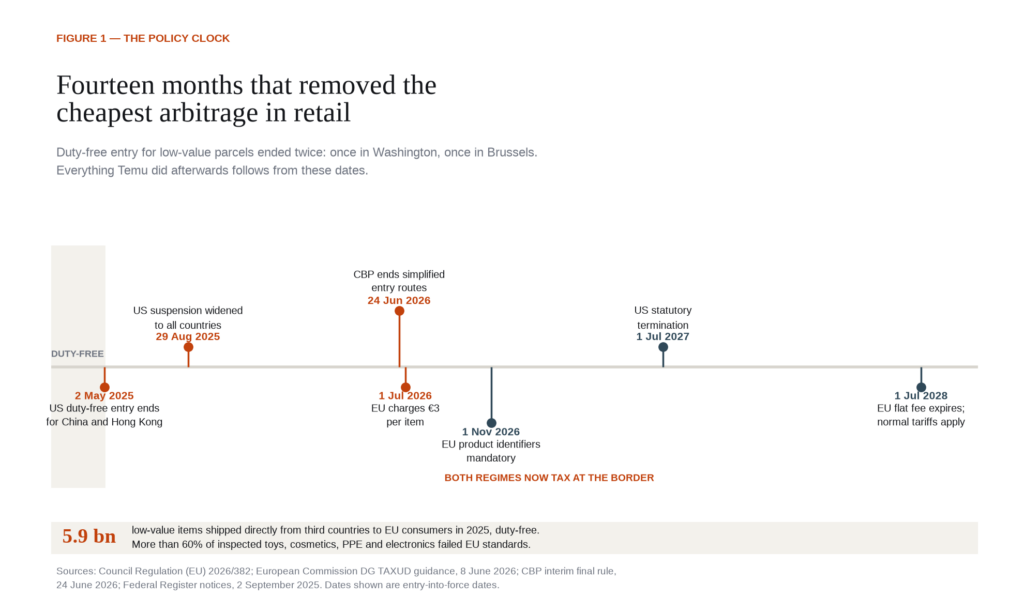
Two arbitrages died within fourteen months of each other. The United States suspended its $800 de minimis exemption for every country on 29 August 2025. The European Union started charging €3 per item on consignments valued at €150 or less on 1 July 2026. Temu’s answer was not a deeper discount. It moved inventory inside the countries where people actually buy, opened its platform to local merchants across 35-plus markets, and handed the last mile to national postal operators. Warehousing stopped being an operations line and became a media decision.
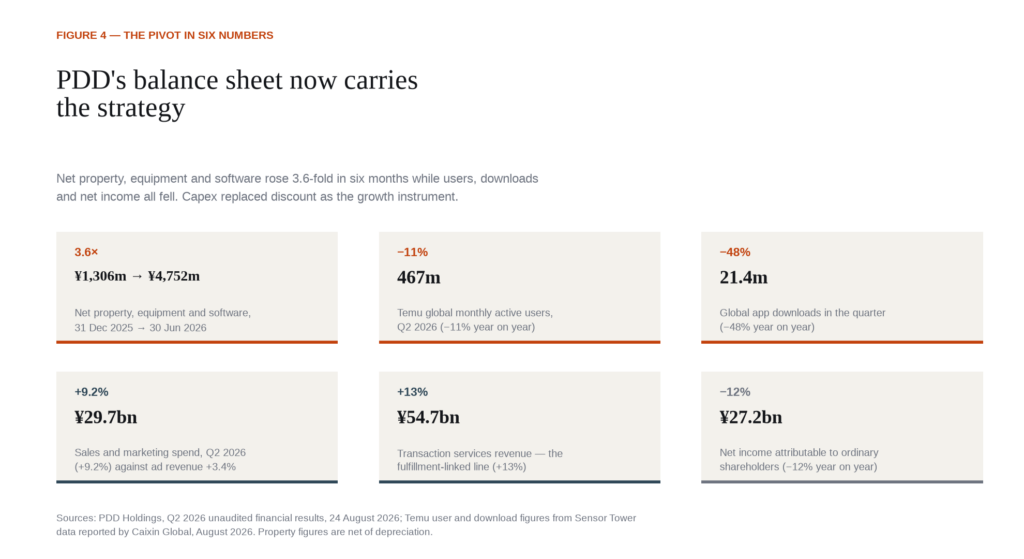
The earnings say the same thing in accounting language. PDD Holdings spent ¥29.7bn on sales and marketing in Q2 2026 against ¥27.2bn a year earlier, up 9.2%, while revenue from online marketing services — the advertising it sells — grew roughly 3.4%. Transaction services, the fulfillment-linked line, grew 13%. Spend is now climbing faster than the ad inventory it monetizes.
But here is the part most write-ups miss. This pivot is defensive, not offensive. Baymard Institute’s large-scale abandonment research puts “extra costs too high” at 40% of resolvable abandonment reasons and “delivery was too slow” at 20%. Shoppers punish extra cost twice as hard as they punish delay. Delivery speed does not replace the low-price claim at Temu. It protects it, expensively and not very well.
1. The de minimis floor gave way first
Start with the mechanics, because the strategy only makes sense as a reaction to them.
The United States suspended duty-free de minimis treatment under 19 U.S.C. 1321(a)(2)(C) in two steps: China and Hong Kong in May 2025, then every country from 29 August 2025. The $800 threshold itself dated to a 2016 statute that had raised it from $200. On 24 June 2026, Customs and Border Protection went further, indefinitely suspending the “release from manifest” shortcut and the simplified Entry Type 86 route for courier and other non-postal modes. Low-value parcels now generally need formal or informal entry. Separate legislation schedules a statutory end to the old exemption from 1 July 2027, which would convert a presidential suspension into permanent law.
The demand effect was immediate and unusually legible. Temu’s US monthly active users fell roughly 49% year over year in July 2025. No pricing experiment in the company’s history produced a number that large that fast.
What the collapse actually removed
It removed a subsidy, and subsidies are not strategies. A parcel that crosses a border duty-free and lands in a consumer’s hands for $1.90 in shipping is not evidence of operational genius. It is evidence of a policy choice made by someone else, in a building the company did not control.
Once that choice reversed, three things had to be rebuilt at once: where the goods sit, who pays the duty, and what the product page promises. Temu rebuilt all three, and it rebuilt them in that order.
2. Europe priced the parcel, not the product
Europe chose a different instrument, and the difference matters more than most coverage suggests.
Council Regulation (EU) 2026/382 abolished the €150 low-value duty relief and introduced a temporary flat customs duty of €3 per item, running from 1 July 2026 to 1 July 2028. Commission Implementing Regulation (EU) 2026/1200, published 8 June 2026, set the operational machinery: declaration codes F48, F49 and F53 to flag the VAT procedure; a definition of “item” as goods sharing tariff classification, description and origin; anti-abuse language aimed at operators who artfully merge separate sales onto one declaration line.
The Commission’s stated justification is not industrial policy. It is volume. Almost 5.9 billion low-value items were shipped directly from third countries to EU consumers in 2025 without paying duty. Targeted inspections across all 27 member states in 2025 found more than 60% of checked cosmetics, PPE, supplements, toys and electronics failing EU standards. Duty is being used here as a compliance filter as much as a revenue line.
The flat fee is regressive by design
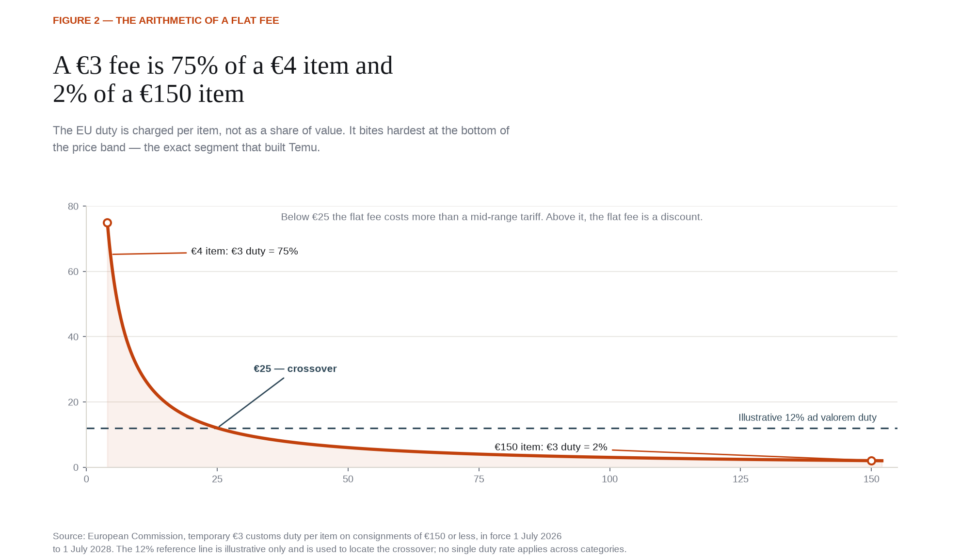
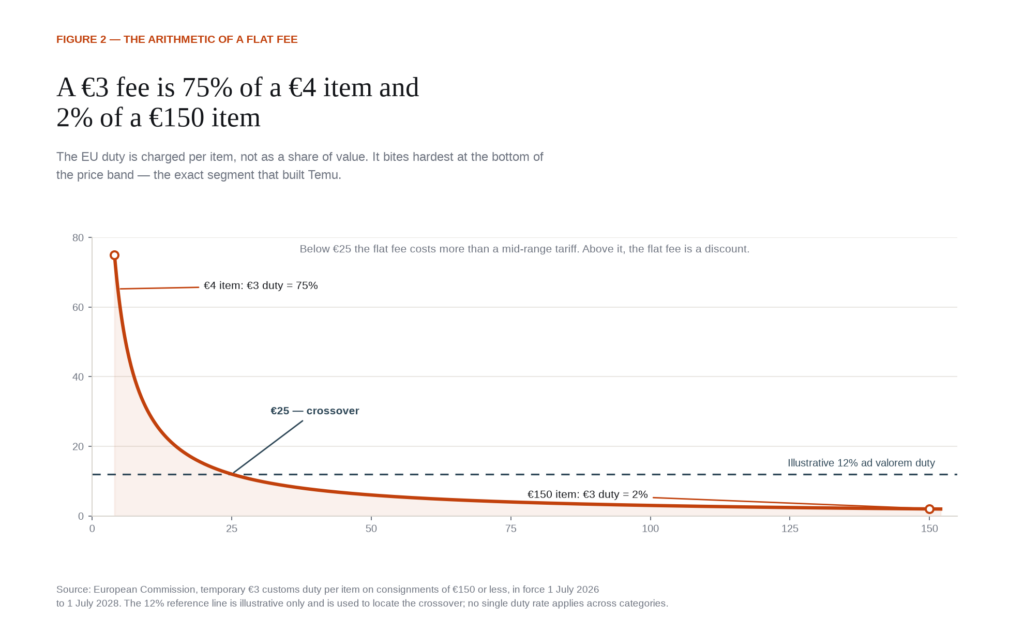
Here is the arithmetic nobody in the vendor decks mentions. €3 per item is 75% of a €4 item and 2% of a €150 item. The fee is brutal at the bottom of the band and generous at the top. That is the opposite of an ad valorem tariff, and it means the policy does not tax “cheap imports” evenly. It taxes the extreme low end of the assortment — the exact segment where Temu built its brand.
Two more dates sit in 2026. Product Identifiers become mandatory for declaration on 1 November 2026, which ends the era in which a generic product description was enough. And a separate Union handling fee, designed to cover customs processing costs rather than to raise duty, remains under discussion, with its amount and application date still to be settled. It is a second cost, not a replacement for the first.
3. The warehouse map flipped
The visible proof is on the balance sheet, and it is blunt.
PDD Holdings reported net property, equipment and software of ¥1,306m at 31 December 2025. At 30 June 2026 that line read ¥4,752m. A 3.6-fold increase in six months. Right-of-use assets moved the other way, from ¥4,863m to ¥4,316m, which is what happens when a company stops leasing other people’s space and starts buying its own.
On the 24 August 2026 earnings call, co-CEO Lei Chen described the rebuild in plain terms: PDD is onboarding local merchants to put supply closer to shoppers, and accelerating local warehousing, reusing the playbook it ran in the United States after duty-free entry ended there. He was equally direct about the cost — orders into affected markets will move less efficiently and cost more.
Capacity is being bought, not rented
Co-CEO Jiazhen Zhao added a detail that explains the urgency. In some markets merchants still ship item by item rather than consolidating, which raises unit costs and leaves demand unmet. That is the signature failure of a cross-border model forced into a domestic posture: the inventory is in the right country and the logistics are still operating in the wrong unit of work.
Europe’s warehouse footprint now concentrates in Germany, the Netherlands and Poland — the corridor that can reach most EU consumers inside a two-day promise. That is not a coincidence of geography. It is a service-level agreement dressed as a property decision.
4. The local seller program is now the product
Warehouses without merchants are empty shelves. Temu’s Local Seller Program, launched in early 2024, is now the load-bearing structure.
By Temu’s own account in September 2026, the program operates in more than 35 countries. Temu sells across 90-plus markets and more than 700 categories. It entered Europe in April 2023 and opened to local European merchants in 2024. It signed a memorandum of understanding with Poșta Română on 2 September 2026 covering collection from sellers, sorting at Romanian facilities, and last-mile delivery through homes, pickup points, lockers and post offices — a network the operator says can process more than 500,000 parcels a day.
What the sellers say, and what they do not
Temu commissioned a survey of more than 150 sellers across Germany, France, Spain, Italy, Poland and the UK, fielded June to July 2026. Half reported expanding production, adding headcount, or both, since joining. 34% had entered new international markets. 75% called Temu an important supplementary channel or their core channel. 38% rated the seller platform user-friendly; 35% approved of the cost structure; more than 65% valued dedicated account support.
Read those numbers carefully. The strongest result — three in four sellers treating Temu as material to their business — does not say the economics are good. It says the dependency is real. A seller survey commissioned by the platform will never be a neutral instrument, and the fair reading is directional. Local merchants are not a marketing garnish on Temu’s model. They are the mechanism by which inventory enters the country before an order exists.
5. Why a local delivery promise converts
The conversion case for local stock has been documented for years, and it is not subtle.
Baymard Institute’s 2026 synthesis of 50 studies puts average documented cart abandonment at 70.22%. Strip out the “just browsing” segment — 42% of US shoppers say they abandoned because they were not ready to buy — and the resolvable reasons sort into a clear hierarchy: 40% extra costs too high, 20% delivery was too slow, 19% distrust of card handling, 18% forced account creation, 17% checkout too long, 17% site errors, 13% unsatisfactory returns policy.
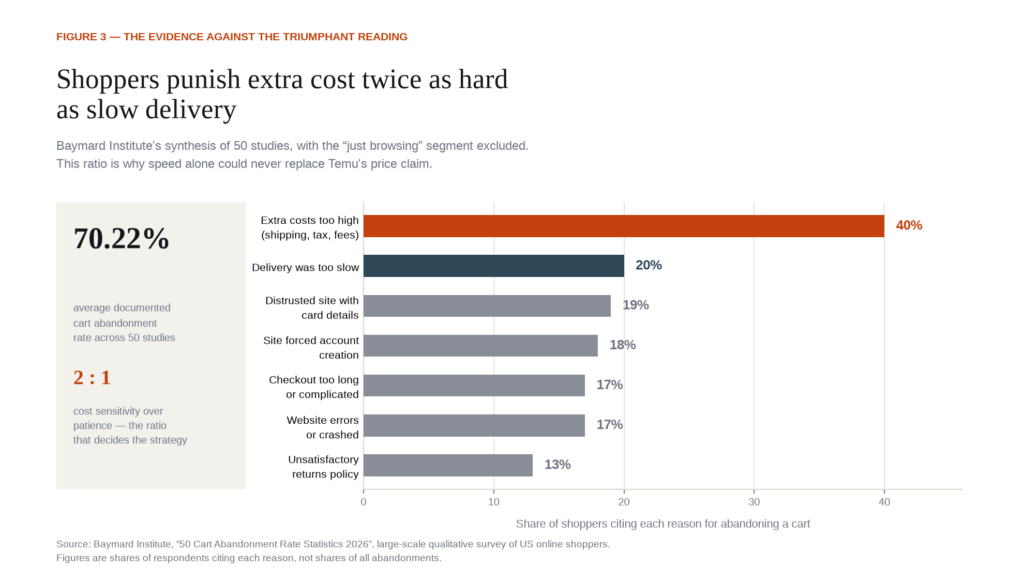
The 2:1 ratio that decides the strategy
Cost beats latency two to one. That single ratio explains why Temu could not simply switch to a faster promise and leave prices alone, and why it could not keep prices alone and accept slower delivery. It had to fix both, and one of them was no longer free.
What local fulfillment buys is not speed in the abstract. It buys the right to make a promise on the product page — a dated, specific, credible promise. “Arrives Thursday” is a marketing asset in a way “ships in 7–12 days” never was. A vague window asks the shopper to hold uncertainty in working memory while comparing three other tabs. A dated window removes that tax.
There is a second, quieter effect. In-market stock changes where the duty is paid and who is liable for it. The Commission is explicit that the €3 duty attaches to distance sales of goods located outside the EU at the time of supply, and that goods sold from a bonded warehouse cannot be treated as distance sales until released for free circulation. Inventory inside the customs territory does not dodge the tariff so much as change its shape — from a per-item penalty into an import declaration at scale. That is a media-planning fact expressed as a customs fact.
6. The new CAC arithmetic
Let us put numbers on the trade-off, because arguments like this only land with numbers.
Take an €18 basket spanning two tariff lines. The duty is €6. That is 33.3% of the basket, charged before a single euro of marketing. At a 25% gross margin the order contributes €4.50 before duty and −€1.50 after. At a generous 40% margin, €7.20 becomes €1.20, and the duty has consumed 83% of gross profit. At that point the fee is not a cost line inside the P&L. It is a margin event that happens before the P&L starts.
Two escapes, both expensive
Escape one: raise the shelf price. Recovering €6 on €18 means a 33% increase, and Baymard’s 40% figure makes extra cost the single largest resolvable reason people walk. You pay for the duty in conversion instead of in cash, and conversion is the more expensive currency.
Escape two: move the unit. Storage, local pick-and-pack and last-mile delivery cost more per unit than consolidated cross-border shipping did at scale. What you buy with that money is the absence of the €3 fee and the presence of a dated promise. So the honest comparison is never duty versus no duty. It is duty plus lost conversion versus warehouse cost plus better conversion.
The P&L already voted
PDD’s Q2 2026 print reads like a verdict on this arithmetic. Sales and marketing of ¥29.7bn came to 26.4% of revenue, which was ¥112.4bn. Total operating expenses rose 13%, which the company attributed primarily to that line. Online marketing services revenue — the ad inventory the spend is meant to monetize — moved from ¥55.7bn to ¥57.6bn, about 3.4%. Transaction services rose 13% to ¥54.7bn.
Spend up 9.2%, ad revenue up 3.4%, fulfillment revenue up 13%. When the fulfillment line outgrows the advertising line, logistics is no longer a cost center supporting marketing. It is the growth engine, and marketing is supporting logistics.
Non-GAAP operating margin compressed to 26% from 27%. Net income attributable to ordinary shareholders fell 12% to ¥27.2bn even as operating profit rose 8% to ¥27.8bn. That divergence — operating profit up, net income down — is the arithmetic of paying for a structural change out of the current quarter.
7. What the rebuild costs
Nobody should read this as a victory lap. The bill is visible in three places.
Users. Temu’s global monthly active users fell 11% year over year to 467 million in Q2 2026, per Sensor Tower data reported by Caixin Global — the first major measured decline in the platform’s four-year history, and a reversal from the 68% growth that had taken it to 416.5 million in Q2 2025. Daily active users fell 13% to 76.7 million. Global downloads fell 48% to 21.4 million. That downloads figure is the one to sit with: acquisition, not retention, is where the model broke first.
Margin. A 3.6-fold jump in net PP&E is a lasting commitment to fixed cost, and fixed cost is the least forgiving kind when demand wobbles.
Compliance. The European Commission fined Temu €200m in May 2026 under the Digital Services Act over inadequate risk assessment and unsafe products confirmed through independent mystery shopping. A detailed compliance action plan was due by 28 August 2026, with the Board for Digital Services reviewing and the Commission then setting an implementation timeline. The DSA ceiling is 6% of global annual turnover. Customs duty is not the only regulator in the room, and the other one does not care about your delivery promise.
The strategy is also slower than promised
Management acknowledged on the same call that the rollout of a first-party, self-operated brand model — disclosed through a Shanghai entity with ¥15bn of initial capital and a three-year investment plan around ¥100bn, operating mainly as an export-agency and supply-chain integration vehicle rather than a brand-building program — has run slower than expected for external reasons. Vertical integration is the logical end state of this pivot. It is also the most capital-hungry version of it.
8. Who can actually copy this
The honest answer is: very few, and fewer than the number of brands currently drafting a “local fulfillment” slide.
Three conditions have to hold at once.
Balance-sheet tolerance. Temu is executing this with ¥456.4bn in cash, cash equivalents and short-term investments as of 30 June 2026, up from ¥422.3bn at the end of 2025, and with an operating cash flow line that rose 19% to ¥25.7bn. The pivot is being funded from operations, not from a financing round. A brand with two quarters of runway cannot buy warehouse capacity and wait for the conversion benefit to compound.
Merchant density in the destination market. A local warehouse with no local suppliers is a museum. Temu’s leverage is that it spent two years recruiting sellers in-market before the duty arrived, and that it can sign national postal operators — Poșta Română being the template — instead of building last-mile capability from zero.
Category tolerance. Local fulfillment works when a SKU has predictable demand and reasonable value density. It works badly for long-tail, low-value, high-variance assortment, which is precisely the assortment that made the cross-border model work. Every brand adopting this will quietly prune its catalog and then discover that the pruning, not the duty, is what shrank revenue.
The copyable part is not the warehouses
What peers can genuinely steal is the sequencing: recruit supply in-market, then rent somebody else’s last mile, then buy property only once volume justifies it. What they cannot steal is the willingness to absorb a 12% net income decline and an 11% user decline in the same quarter as proof of progress.
9. The counter-case: price was never the secondary hook
The thesis needs its strongest objection stated plainly, because the evidence for it is inconveniently good.
If logistics had truly replaced price as the conversion engine, then raising effective prices while improving delivery should have held demand roughly flat. It did not. US monthly active users fell about 49% after de minimis ended. Global monthly active users fell 11% while the localization program was being rolled out. Those are not the numbers of a platform whose new promise outweighed its new price.
Baymard’s ratio cuts the same way. 40% cite extra costs; 20% cite slow delivery. Shoppers are twice as sensitive to what they pay as to when it arrives. A delivery badge can beat a competitor charging the same price. It cannot beat a competitor who is 20% cheaper.
So what is actually true
Logistics became ad copy — that part holds, and it is the real lesson. But it became defensive ad copy. Its job is to stop the price claim from collapsing once duty makes that claim expensive to make. Local stock lets Temu keep saying “cheap” without saying “and slow,” because “and slow” was the last honest thing attached to the old price.
That is a much narrower claim than “logistics is the new marketing.” It is also the only claim the data supports. The strategic asset Temu is buying is not speed. It is permission to keep advertising a price.
10. What this means for DTC brands
Four practical consequences, in order of how soon they bite.
Your landed cost model is now a media model. If duty is charged per item rather than per shipment, your bundle architecture changes your economics before your creative does. Brands that split one order across three items to save on packaging are paying triple. Consolidation is a margin lever that happens in the warehouse, not in the ad account.
The delivery promise belongs on the product page, above the buy button. Not in a shipping tab, not in a banner, not in the checkout summary. A dated, specific, verifiable claim is the cheapest conversion asset available to a brand that has the stock position to back it. A vague claim is worse than no claim, because it invites the shopper to model uncertainty.
Measure contribution after duty, last mile and paid media — never blended CAC. Blended CAC hides exactly the shift described here. A brand can report stable acquisition cost while quietly losing money on every two-item basket.
Do not copy the capex, copy the sequencing. Rent the last mile. Recruit in-market supply first. Buy property when the volume curve is boring. The brands that will get hurt in 2027 are the ones that signed a warehouse lease against a forecast rather than against a fill rate.
11. Three KPIs worth watching
Most dashboards will not capture any of this. Three numbers will.
1. In-market fulfillment share of orders. Not warehouse count, not square meters — the percentage of orders shipped from stock already inside the destination customs territory. This is the single variable that determines duty exposure, delivery promise credibility, and working capital simultaneously. If it stalls below roughly half of volume, the pivot is decoration.
2. Conversion delta on dated promises. Take the same SKUs, the same traffic, the same offer, and split on whether the page shows a specific arrival date. The gap is your true return on logistics. If the gap is under a few percentage points, you are buying speed nobody priced in.
3. Contribution margin per order after duty, last mile and paid media. Per order, not per campaign, not per channel. This is the only line where the €3-per-item world shows up honestly, because it is the only line where a two-item basket is visibly more expensive than a one-item basket.
12. The 2027 scenario
Three dates structure the next two years, and they do not all point the same way.
1 July 2027. Statutory termination of the US de minimis exemption under separate legislation would make the suspension permanent in law rather than by executive order. Treat this as the base case. Any strategy premised on the exemption returning is a strategy premised on a court.
1 July 2028. The EU’s temporary €3 duty expires and normal tariff classification applies, coinciding with the intended launch of the EU Customs Data Hub. This is the event most people have backwards. They assume 2028 is relief. For a €4 item, €3 of flat duty is punitive and 12% ad valorem is nearly free. For a €120 item, €3 is 2.5% and 12% ad valorem is €14.40. The flat fee protected the top of the band and punished the bottom. Normal tariffs will do the reverse.
Autumn 2026 through 2027. The Union handling fee, once its amount and date are settled, adds a fixed per-declaration cost that hits small consignments hardest and pushes consolidation further. Fixed cost per declaration is an argument for fewer, larger, better-organized shipments — which is an argument for exactly the model Temu is building.
The scenario that actually matters
Put those together and the plausible 2027 landscape is a mid-market squeeze. The ultra-cheap segment gets priced out by per-item fees. The mid-priced segment gets priced out by ad valorem tariffs from 2028. The only durable position is a locally stocked assortment with a credible dated promise and enough margin to absorb both.
That is not a story about price. It is a story about where the inventory sleeps. Which, in the end, is the same story told from the warehouse side: logistics did not replace marketing, it joined it. The delivery promise is now a line item in the media plan, and the warehouse lease is now a bid.
Summary
The de minimis era ended in the United States on 29 August 2025 and in the European Union on 1 July 2026, replacing a duty-free threshold with a €3 per-item fee that is punitive at the bottom of the price band and generous at the top. Temu responded by buying warehouses rather than discounts — net PP&E rose 3.6-fold in six months — recruiting local sellers across 35-plus markets, and outsourcing the last mile to national postal operators.
That pivot turned delivery time into a conversion asset, because a dated promise removes the uncertainty a vague shipping window imposes. But the evidence refuses the triumphant reading. Users fell 11% globally and roughly 49% in the US; net income fell 12%; and Baymard’s data shows shoppers punish extra cost twice as hard as slow delivery. Logistics became advertising, but it became defensive advertising. Its job is not to sell the product. Its job is to keep the price claim honest enough to keep selling.
Frequently asked questions
Does local fulfillment let Temu avoid the €3 EU duty entirely?
Not entirely, and not in the way the phrase “avoid the duty” implies. The duty attaches to distance sales of goods located outside the EU at the time of supply, and the Commission’s guidance states that goods held in a bonded warehouse cannot be treated as distance sales until released for free circulation. Moving stock into the customs territory converts a per-item penalty into an import declaration at scale — a different cost with a different cash-flow profile, not the absence of a cost.
Why is a flat €3 fee worse for cheap goods than a percentage tariff?
Because flat fees are regressive. Three euros is three quarters of a €4 item and 2% of a €150 item. A percentage tariff scales with value and therefore spares the cheapest end of the assortment while biting the middle. The 2028 transition from the flat fee to normal tariff classification will therefore hurt different products than the 2026 change did — a reversal most planning documents do not model.
If delivery speed matters so much, why did Temu’s users leave while delivery improved?
Because speed mattered less than price, and the improvement was paid for with price. Baymard Institute’s research puts “extra costs too high” at 40% of resolvable abandonment reasons against 20% for “delivery was too slow.” A credible dated promise can beat a competitor charging the same price. It cannot beat a competitor who is meaningfully cheaper.
Is the Local Seller Program evidence that the model works?
It is evidence that the dependency works, which is a weaker claim. Temu’s own survey of 150-plus sellers across six European markets found three in four treating the platform as an important or core channel, and half expanding production or headcount. That is real commercial gravity. But a platform-commissioned survey is a directional instrument, not a neutral one, and none of those numbers speak to unit profitability after duty.
What should a DTC brand actually take from this?
Three things. Model duty per item, not per shipment, because it changes which bundles are profitable. Put a dated delivery promise above the buy button, because it is the cheapest conversion asset a stocked brand owns. And measure contribution margin per order after duty, last mile and paid media — because blended CAC is precisely the metric designed to hide this shift.