WeChat Channels: the short-video platform foreign brands keep ignoring
Every global media plan for China has a Douyin line. Almost none of them has a Channels line. That is not because Channels failed. It is because Channels does not look like a media buy, and media plans are built by people who buy media.
The short version
- Weixin carried 1.439 billion combined monthly active users at the end of June 2026, up 2% year on year. Time spent inside Video Accounts grew by more than 20% over the same period. Tencent still describes its own ad load as “much lower” than peers’.
- Channels is a module inside Weixin, not a standalone app. No separate install, no separate identity, no cold-start audience. Distribution starts inside a graph, and you cannot buy your way to the top of it.
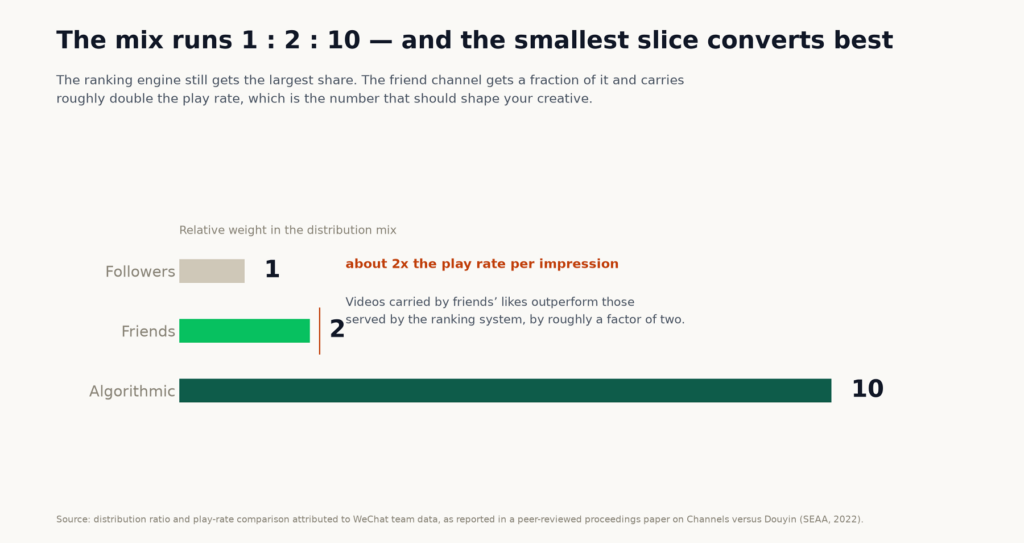
- The mix runs roughly 1 : 2 : 10 — followers, friends, algorithm. Videos carried by friends’ likes draw about twice the play rate of those served by the ranking system. The smallest slice converts best.
- Two hard gates stop most foreign brands before content ever becomes the question: a mainland business license for the ad account, and an 18-digit unified social credit code for enterprise verification.
- The economics that make it cheap are not CPM economics. They are re-reach economics. A follower, an Official Account subscriber, or a WeCom contact is paid for once and can be reached again for close to nothing.
- Tencent publishes no Channels DAU and no Channels GMV. Any figure you have seen with six digits of precision came from a vendor with a spreadsheet, not from the platform.
1. What Channels is, and what it is not
Start with the definition, because almost all of the confusion is definitional.
Video Accounts — 视频号 in Chinese, WeChat Channels in English — is Weixin’s short-video and live-streaming module. It lives inside the same app people use to pay for a taxi and message a supplier. Three feeds sit inside it: the accounts you follow, the videos your friends have watched, and a recommendation stream. It also carries live streaming, a storefront, and links into Official Accounts and Mini Programs. There is no separate login, no separate download, and no separate identity.
That last detail is the whole story. On Douyin, you are a stranger being served content by an interest model that has inferred what you might want. On Channels, you arrive with a name, a face, a hometown, an employer, and a payment wallet attached. The viewer is not anonymous, and neither is the act of watching.
The result is a different kind of media property. Douyin is a media business with a commerce layer bolted on. Channels is a relationship and commerce system with a media layer bolted on. Those two sentences imply different budgets, different creative, and different KPIs. Read the rest of this article as an argument for that distinction.
2. 1.4 billion people, and an ad load that never caught up
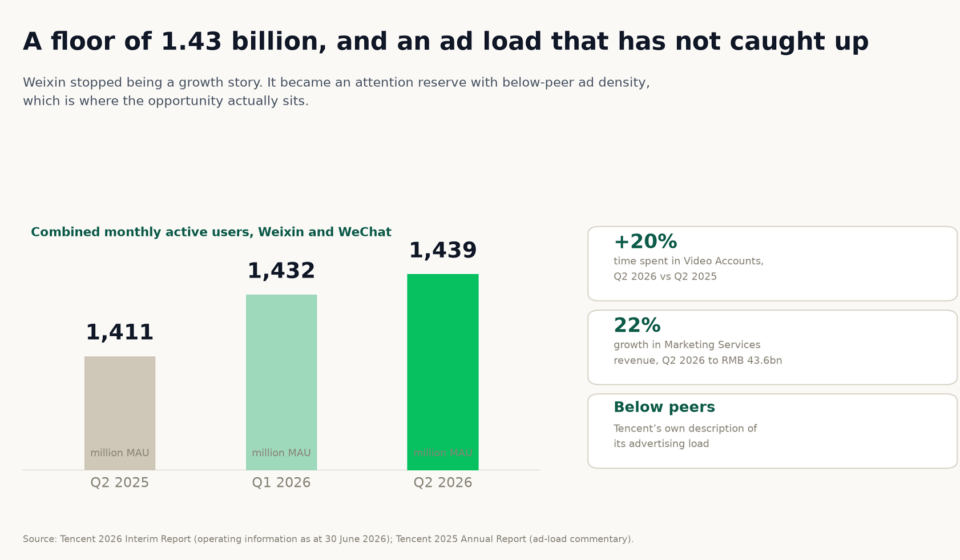
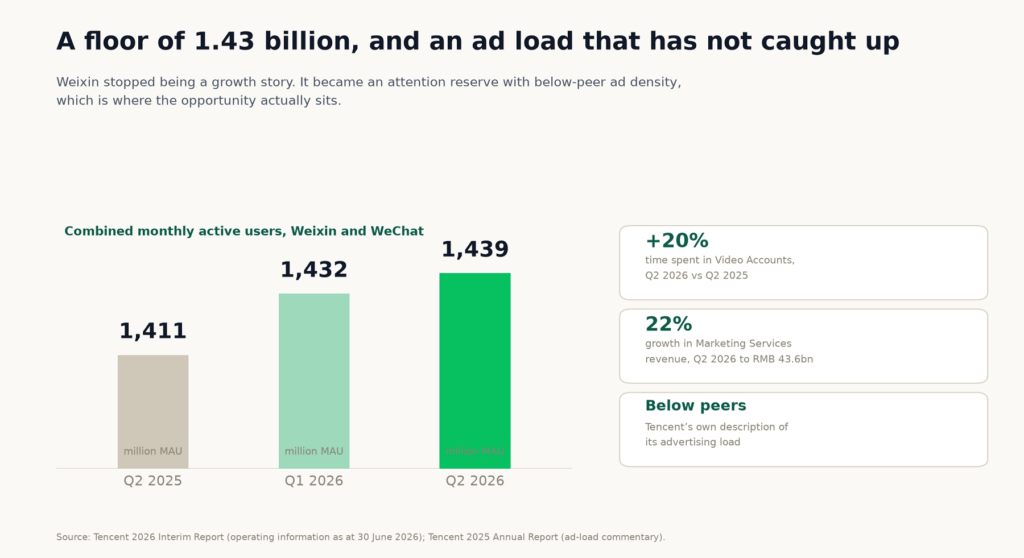
Here are the numbers Tencent actually reports. Combined MAU of Weixin and WeChat reached 1.439 billion at 30 June 2026, against 1.432 billion at 31 March and 1.411 billion a year earlier. That is 2% year on year, and half a percent in a quarter.
Flat-ish, in other words. The interesting growth sits underneath it. Video Accounts’ total time spent grew by more than 20% year on year in the second quarter of 2026, and Tencent attributes it to richer content for younger users, upgraded interactive features, and a new multi-variable content ranking system. Marketing Services revenue rose 22% to RMB 43.6 billion, within group revenue of RMB 204.8 billion, up 11%.
Put those together and you get the specific thing that should interest a foreign brand. The audience is not growing. The attention inside the audience is growing. Monetization per unit of attention is still arriving slowly, and Tencent says so out loud: “our ad load remained at a much lower level than peers’.” That sentence appeared in the 2025 annual report alongside a claim of above-industry revenue growth in Marketing Services.
Why does it matter? Because a feed that is under-filled has two properties a saturated feed does not. Inventory is still being added rather than rationed, and the clearing price has not yet been bid up by years of performance advertisers fighting over the same slots. Neither of those properties is permanent. Both are worth something to the brand that shows up while they hold.
One warning about the base. 1.439 billion is larger than China’s entire internet population of 1.125 billion, which CNNIC measured at the end of 2025 with 80.1% penetration. That is not a contradiction. MAU counts accounts, includes duplicates and lapsed logins, and reaches past the border. Treat the number as the size of a surface you can be present on. Do not treat it as reach.
3. Social recommendation comes first, interest second
Now the mechanism, which is where the strategy actually lives.
A peer-reviewed comparison of Channels and Douyin, drawing on WeChat team data, describes the distribution mix as roughly 1 : 2 : 10 — one part followers, two parts friends, ten parts the ranking engine. Weights, not percentages. The recommendation engine is clearly the majority of the volume.
And yet: videos carried by friends’ likes drew about twice the play rate of videos distributed by the ranking system. Twice, on roughly a sixth of the weight.
The reason sits in a tab literally labeled “friends”. It surfaces what friends have published, liked, commented on, or shared. Because the endorsement is visible and attributable, the viewer knows who vouched for the video before deciding whether to watch it. The paper’s authors note that engagement is higher because viewers recognize the recommender, and that distribution therefore runs from private to public: one account’s circle first, then outward.
Two consequences follow, and they are the practical ones.
Start with this. A hundred viewers matter more than a hundred thousand. On an interest feed, a video either clears the cold-start test or dies, and you solve that with hooks, volume, and paid seeding. On a relationship feed, a video enters a circle of people who already share context, and the question becomes whether that circle will pass it on. Passing it on requires that the video contain something worth passing — a fact, a number, a demonstration, a correction of something the viewer believed. Novelty does not survive a trust chain. Utility does.
Second, the like is a social act. Pressing it in Channels can be visible to people you know. Viewers therefore hesitate before endorsing anything that would make them look foolish, which is a polite way of saying that edgy creative, borrowed memes, and manufactured outrage all underperform here for reasons that have nothing to do with their quality. The content has to be something a viewer is willing to be seen standing next to. Slightly boring and demonstrably true beats clever and unverifiable.
4. The transaction happens inside the graph
Channels has a commerce spine, and it was deliberately unified.
WeChat’s own developer documentation describes the storefront as an upgrade from the Channels store to WeChat Store, with the explicit aim of simplifying merchant onboarding and consolidating brands across the ecosystem. In practice, that means one store reachable from a video, a live stream, an Official Account article, a Mini Program, or a search result, rather than a separate shop bolted onto each surface. The store’s own interfaces include gift orders, which tells you something about how Weixin expects products to move: socially, between people, and not only from a brand to a buyer.
Tencent’s second-quarter commentary points the same way. Marketing Services growth was supported partly by “integration of closed-loop marketing capabilities within the Weixin ecosystem”, which lets Weixin-native assets such as Mini Games and Mini Shops advertise more effectively on Tencent’s properties. In plain English: the ad system increasingly optimizes toward transactions that complete inside Weixin.
The practical benefit is a short path. A viewer watches, taps through to a store, pays with a wallet already on the device, and then receives service in a chat thread instead of an email queue. No browser hop, no app install, no password reset. For high-consideration categories — anything with a spec sheet, a fitting question, or a warranty — that reduction in friction is worth more than a better CPM.
The practical caution is that Tencent does not disclose Channels GMV. Third-party estimates circulate with great confidence and thin methodology. Build your plan on the infrastructure and on your own conversion data, not on a market-size number you cannot audit.
5. Why foreign brands walk past it
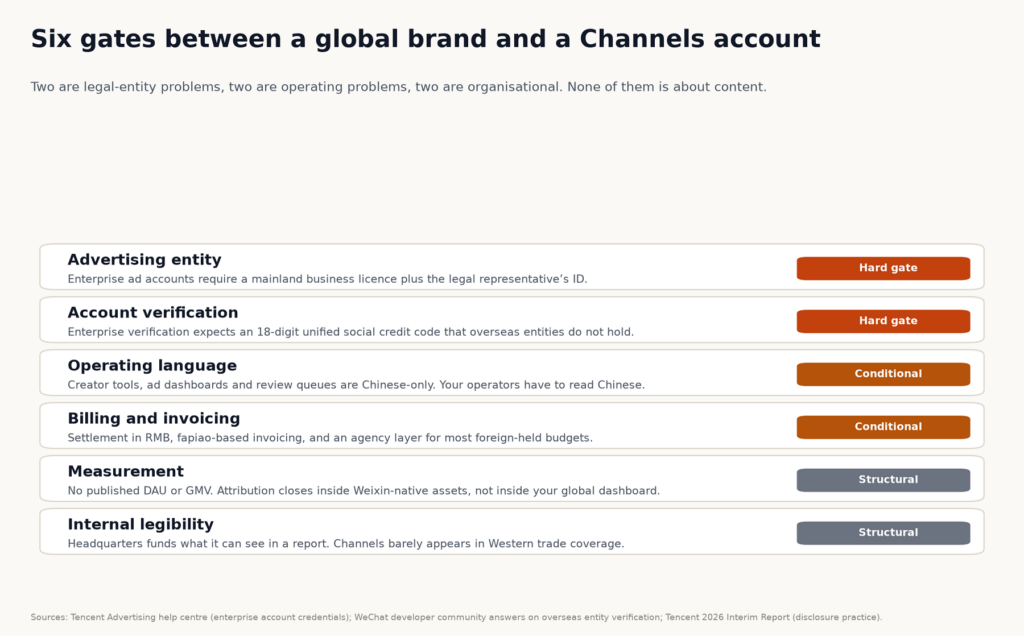
Six gates, ordered by how early they stop you.
The legal entity. A Tencent enterprise advertising account requires a business license — the mainland kind — plus the legal representative’s identity documents. This is not a formality an agency waves away; it is the account’s identity. Brands without a mainland entity buy through a partner, which means the account, the data, and often the relationship belong to somebody else.
The credit code. Channels enterprise verification expects an 18-digit unified social credit code. Overseas companies do not have one. WeChat’s own developer community has carried this question since 2021, when a reply from WeChat staff stated that overseas accounts could not open Channels directly and that verification for overseas institutions required a same-named, already-verified Official Account. The thread was still unresolved in 2025.
The working language. Creator tools, ad dashboards, appeal queues, and creative review are Chinese. Not “Chinese available” — Chinese. Your operators have to read it, and your legal team has to approve claims in it.
Billing. Settlement in RMB, invoicing in the local format, and an agency layer sitting between your budget and the platform.
Measurement. Covered below, but the short version: the platform does not publish the numbers your dashboard expects.
Legibility. This is the gate nobody admits to. Agencies sell what they can report. Regional teams propose what headquarters can recognize. A channel that produces no comparable reach figure, in English, in a standard format, does not survive a budget review — not because it failed, but because it cannot be shown.
Put those six together and the rational decision inside a large organization is to skip Channels and buy more Douyin. That decision is correct for the individual making it and expensive for the portfolio holding it. You keep renting attention you could be converting into relationships, and you keep paying for the same person four times a year.
6. What it actually costs to stand up
Less than a brand campaign, more than a social account. The figures below are planning bands, not market data, and you should replace them with your own quotes.
Verification is nominal: roughly RMB 300 per attempt for the account, non-refundable, plus a similar fee to verify the WeCom side. Entity work, if you need a local subsidiary, dwarfs both and belongs in a different budget conversation.
Production can be genuinely cheap, and section seven explains why it should be. Four posts a month plus one two-hour live, shot in an office or a factory, with subtitles and a Chinese-speaking host, sits in the low five figures in RMB per month. The moment you add an agency-produced film shoot, the number multiplies and the performance usually falls.
Media is the smallest line. A 60-day pilot can buy meaningful learning for well under the cost of a single Douyin brand burst. The auction here rewards relevance and completion more than raw spend, and there is no minimum efficient scale to clear before the data becomes readable.
The expensive item is the operating layer: one person who writes Chinese well, reads the review queue, answers comments within a day, and can hold a two-hour live stream without a script. That person is the platform. Budget for them before you budget for media.
7. The content that works looks wrong to a Western creative director
The formats that work on Channels are unfashionable. Long explainers of three to eight minutes. A founder or an engineer talking to camera with no cutaways. A live session that is mostly questions and answers. Side-by-side comparisons. A walk through how something is made, including the boring stages. Service content: what to do when the product fails, how to read the spec sheet, what the warranty excludes.
Four reasons, each testable.
The viewer arrives warm, so you are not paying for the first two seconds. You are paying for the fifth minute.
The endorsement needs substance. A friend’s name is attached to the video, and the video has to justify that attachment. Facts travel; aesthetics do not.
Production value is not the credibility signal here. The speaker is. A well-lit interview with someone who knows the product outperforms a beautifully graded film with a voice-over, because the first one can be trusted and the second one can only be admired.
Completion and saves beat likes. A save is a private intention to use the thing later. In a feed where liking is public, saving is the honest signal.
What fails, reliably. TikToks with translated captions. English audio over Chinese text. Brand films. Borrowed memes, which in a trust channel read as a foreigner doing an impression of the local accent. Anything whose value is entirely visual.
One operational note. Build the reuse chain before you build the calendar: one live session becomes eight clips, one clip becomes an Official Account article, and the article becomes the reason someone adds you on WeCom. A team that shoots for Channels without that chain is producing content, not building an asset.
8. The measurement ceiling, and how to work under it
The honest position is that Channels cannot be measured the way a Western media team expects to measure things.
There is no published DAU. There is no published GMV. Ad load is described in words, not percentages. Attribution ends inside Weixin-native assets — a store order, a Mini Program event, a WeCom add — rather than inside a neutral cross-platform layer. Server-to-server callbacks exist, so data can leave the platform, but reconciliation is your job and nobody will audit it for you. Brand lift is available at scale, which is another way of saying it is not available to a pilot.
So stop borrowing KPIs from a channel that is not this one. Measure four things instead.
Cost per reachable contact. Media spend divided by net new contacts you can message again without paying: WeCom contacts, Official Account subscribers, store followers. This is the number that matters, and it is the only one that compounds.
Ninety-day re-reach cost. What it costs to put a message in front of the same person in month two and month three. On Channels this approaches zero, which is the entire thesis.
Completion rate on the long assets. Not view-through. Completion. If your eight-minute explainer is being watched to the end, the audience is qualified and the topic is right.
Contact-to-purchase rate at 90 days. The conversion that proves the relationship is commercial rather than decorative.
What not to do: put a Channels CPM next to a Douyin CPM. They are outputs of different auctions with different intent, and the comparison will always flatter the cheaper-looking one while telling you nothing about the cost of the second purchase.
9. Pairing it with WeCom is the point, not a bonus
Channels without a capture path is a content channel. Channels with one is an asset purchase.
The architecture that works is boring and stable. Channels does discovery. The Official Account does depth and search. WeCom does one-to-one service and repeat contact. The store does the transaction. A Mini Program does whatever the product needs after that.
Two disciplines decide whether this holds.
The offer has to be worth an add. A discount is a transaction. A calibration guide, a restock reminder, a spec sheet with the numbers your buyer actually needs — that is a relationship. Ask for the contact at the moment the viewer has a reason to give it, which is usually thirty seconds after you have answered a real question, not thirty seconds after a joke.
Frequency has to be rationed. A contact list is inventory with a carrying cost. Every message that is not useful trains the reader to ignore the next one. Decide the annual message cadence before you build the list, not after.
Compliance sits underneath both. Consent for marketing messages, data minimization, and a lawful basis for the profile you are building are obligations, not preferences. The upside of owning a relationship is real; so is the cost of owning one badly.
10. A 60-day test with a kill criterion
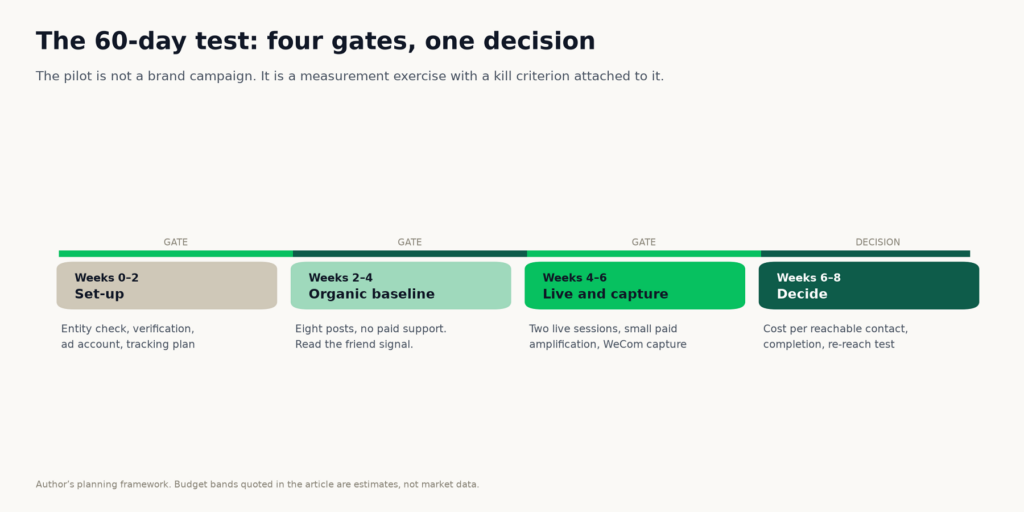
The pilot is not a brand campaign. It is a measurement exercise with a decision attached.
Weeks 0–2 — Set-up. Confirm the entity path and who owns the ad account. Complete verification. Agree the tracking plan with whoever owns your CRM, so that a contact created in Weixin is countable in your system. Draft eight posts; do not publish them yet.
Weeks 2–4 — Organic baseline. Publish the eight posts with no paid support. Watch which of them get carried by the friend channel rather than the recommendation feed, and watch completion rates rather than likes. This is the cheapest information you will ever buy.
Weeks 4–6 — Live and capture. Two live sessions, each built around questions you already know buyers ask. Turn on a small amount of paid amplification behind the two posts that traveled organically. Put the capture path live and staff it.
Weeks 6–8 — Decide. Compute the four numbers from section eight. Compare cost per reachable contact against your Douyin cost per acquired customer over the same period. Then take one of three decisions: scale, iterate, or stop.
The kill criterion should be written before week four, not discovered at the end. A defensible one: if cost per reachable contact is above your blended customer acquisition cost, and fewer than one in twenty viewers takes the capture action, the channel is not working for your category yet. Stop, keep the account warm with two posts a month, and revisit in two quarters.
11. Nine ways to waste the first 90 days
Treating it as a second Douyin. Different distribution, different intent, different creative. The only thing they share is a rectangle.
Translating your TikTok library. Captions on borrowed content produce borrowed results.
Buying reach before building a capture path. You will pay for impressions and keep none of them.
Optimizing for likes. In a feed where liking is public, likes measure safety, not interest.
Launching with a brand film. It cannot be endorsed, cannot be saved, and cannot be forwarded with a reason attached.
Judging it in the global dashboard. The absence of a number is a reporting gap, not a performance result.
Accepting agency screenshots as measurement. Ask for contact counts and completion rates, not impressions.
Ignoring ad identification rules. Chinese advertising rules require commercial content to be identifiable as advertising, and paid rankings must be clearly marked. Creative that hides the paid nature of the placement is a compliance risk, not a clever native play.
Scaling paid before organic signal. The recommendation engine will happily spend your budget on content the friend channel has already rejected.
12. Conclusion: two jobs, one budget
A China strategy has two jobs, and most budgets fund only one of them. The first is buying attention: Douyin, Xiaohongshu, search, retail media. The second is owning relationships: Weixin, Official Accounts, WeCom, the store.
The first job is well served. It is measurable, it is legible to headquarters, and it is priced accordingly — which is to say, competitively and expensively, forever. The second job is underfunded because it is hard to report and easy to postpone.
Channels is the cheapest bridge between them. Not because its impressions are cheap, although an under-filled feed helps. Because the marginal cost of the second, third, and tenth contact with the same person is close to zero once the relationship exists, and because the graph does the distribution work that paid media would otherwise have to buy.
The cost of ignoring it is not the impressions you did not buy this quarter. It is the rent you will pay every quarter after this one, to reach people you could have owned.
Frequently asked questions
Is WeChat Channels the same as Douyin?
No, and the difference is structural rather than cosmetic. Douyin is a standalone app whose feed is driven by an interest model, and whose audience you rent. Channels is a module inside Weixin whose distribution runs through a social graph first, and whose audience can become owned through follows, Official Accounts, and WeCom. They both show short videos. They are not the same inventory.
How large is Channels, really?
Tencent does not publish daily active users for Channels, so no outside estimate can be verified. What is published: 1.439 billion combined monthly users across Weixin and WeChat at 30 June 2026, more than 20% year-on-year growth in time spent inside Video Accounts, and 22% growth in Marketing Services revenue. Vendor estimates circulate widely; almost none publish a methodology.
Can a foreign brand advertise on Channels without a Chinese entity?
Not directly. Tencent’s enterprise advertising account requires a mainland business license and the legal representative’s identity documents, and Channels enterprise verification expects an 18-digit unified social credit code that overseas companies do not hold. The workable path is a mainland entity or a licensed partner that owns the account, which also means the data and the relationship usually sit with the partner unless the contract says otherwise.
What should the first 60 days cost?
Excluding entity formation, a lean pilot sits in the low five figures in RMB per month for production plus a modest media budget, with the significant line item being the Chinese-literate operator rather than the platform fees. Anyone quoting a large fixed package before your organic baseline is known is selling a calendar, not a test.
Why call it a retention channel when it is a video platform?
Because the unit you are buying is a reachable person, not an impression. A view is consumed once. A follower, a subscriber, or a WeCom contact can be reached again without paying the platform, and that re-reach is what compounds. The video is the format. The relationship is the asset.