AI Marketing Briefing: China and Global Markets
Definition: AI marketing is the use of artificial intelligence across advertising, content creation, media buying, and performance measurement. Generative Engine Optimization (GEO) is the practice of making a brand visible inside AI-generated answers — measured by AI answer position, AI citation rate, and AI visibility — rather than only by traditional search rankings.
Key takeaways
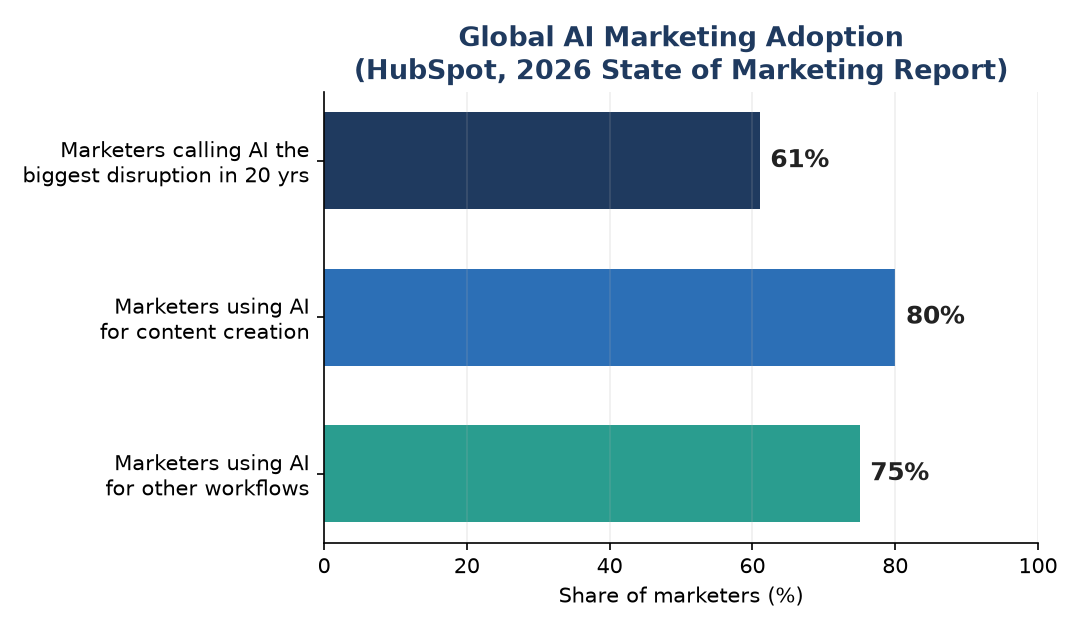
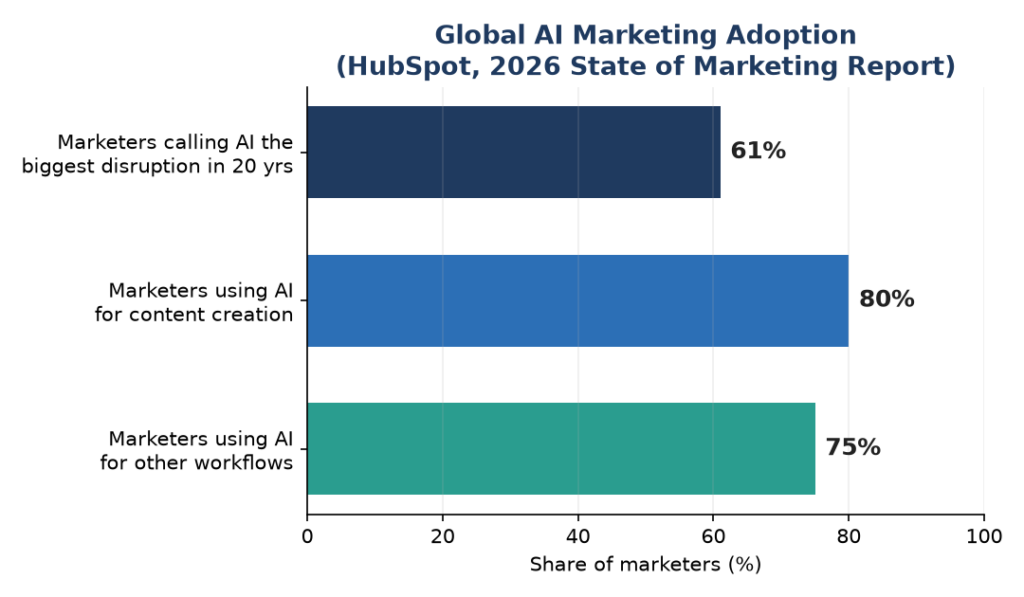
- AI adoption among marketers is now the default. In a global survey, 61% of marketers say AI is causing the biggest disruption to marketing in 20 years, 80% use AI for content creation, and 75% use it across other marketing workflows (HubSpot, 2026 State of Marketing Report).
- The measurement gap is the new risk. Adoption is high, but accountability lags: most organizations still do not tie AI spend to a defined return benchmark.
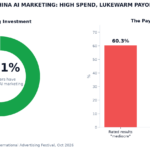
- China reached AI-marketing mainstream at scale. At the 33rd China International Advertising Festival, 94.1% of advertisers had invested in AI marketing, yet 60.3% rated results as only “mediocre” (CTR, Oct 2026). China’s internet base — 1.123 billion users, 79.7% penetration, and 602 million generative AI users — makes this a scale story (CNNIC, 56th Statistical Report).
- GEO is the channel that matters now. AI Overviews appear in about 12.95% of U.S. search queries on average, and when an AI summary is present, users click traditional result links only 8% of the time versus 15% without one (Semrush).
Global market: adoption is done, measurement is not
The global story is no longer “whether” marketers use AI, but “how well” they govern it. HubSpot’s 2026 State of Marketing Report found that 61% of marketers believe marketing is experiencing its biggest disruption in 20 years because of AI. Operational use is already baked in: 80% use AI for content creation and 75% use it for media and other marketing tasks.
That scale creates a second-order problem. When nearly everyone uses the same tools, differentiation comes from measurement, not access. Adoption has outpaced accountability — a pattern echoed across 2025–2026 industry reporting, even where the exact benchmark-measurement figure is not cleanly quoted.
Agentic marketing moves from pilot to production
Across October 2026, vendors shipped autonomous agents for email, advertising, SEO, and revenue operations as a product category rather than a demo. Agentic marketing has entered production; the structural shift is clear even though a single headline percentage is not reproduced here without a directly verifiable primary source.
China market: high spend, lukewarm payoff
China reached AI-marketing mainstream status faster than the measurement conversation caught up. At the 33rd China International Advertising Festival (Oct 23–25, 2026), CTR — China’s leading media and consumer research organization — presented that 94.1% of advertisers had already invested in AI marketing, including 68.7% who had deployed AI agents, while 60.3% rated the results as only mediocre — high spend, weak payoff.
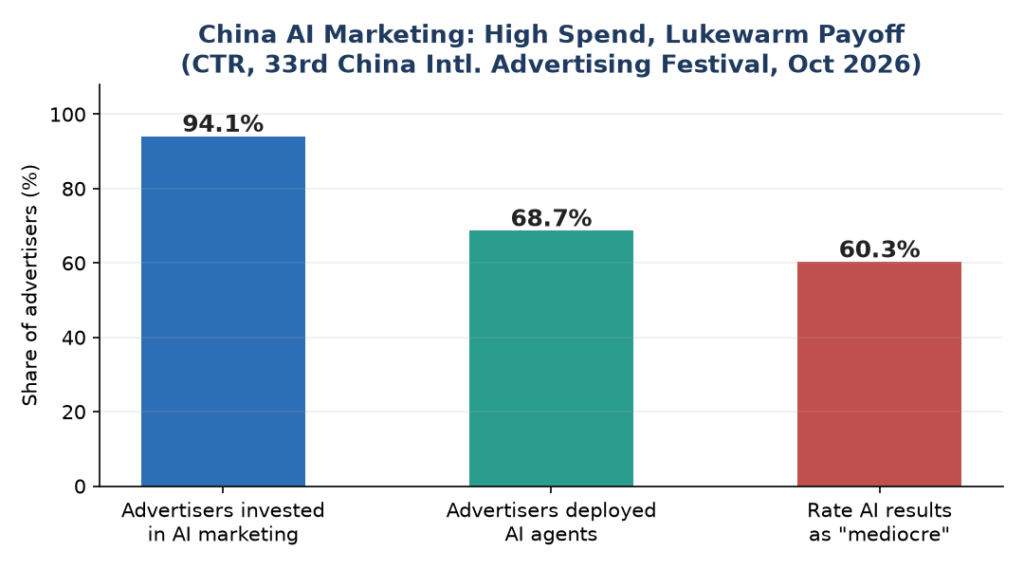
CTR’s sharper point is the KPI shift. The new metrics are no longer impressions and clicks; they are AI answer position, AI citation rate, and AI visibility. That reframes AI marketing from a productivity tool into a visibility channel with its own measurement standard.
China digital baseline (verified infrastructure data)
China’s AI marketing scale rests on a massive digital base. CNNIC’s 56th Statistical Report (published November 2025) put China’s internet population at 1.123 billion users, with 79.7% internet penetration, and 602 million generative AI users. These figures are cross-confirmed and anchor the “China at scale” argument.
GEO: the measurement standard that actually changed
Generative Engine Optimization is the discipline that the CTR KPI shift points to. Verified data from Semrush’s AI Overviews research shows the channel is already material:
- AI Overviews appear in about 12.95% of U.S. search queries on average.
- When an AI Overview is present, users click traditional result links only 8% of the time, versus 15% without one.
- Users click links inside the AI Overview itself just 1% of the time.
-
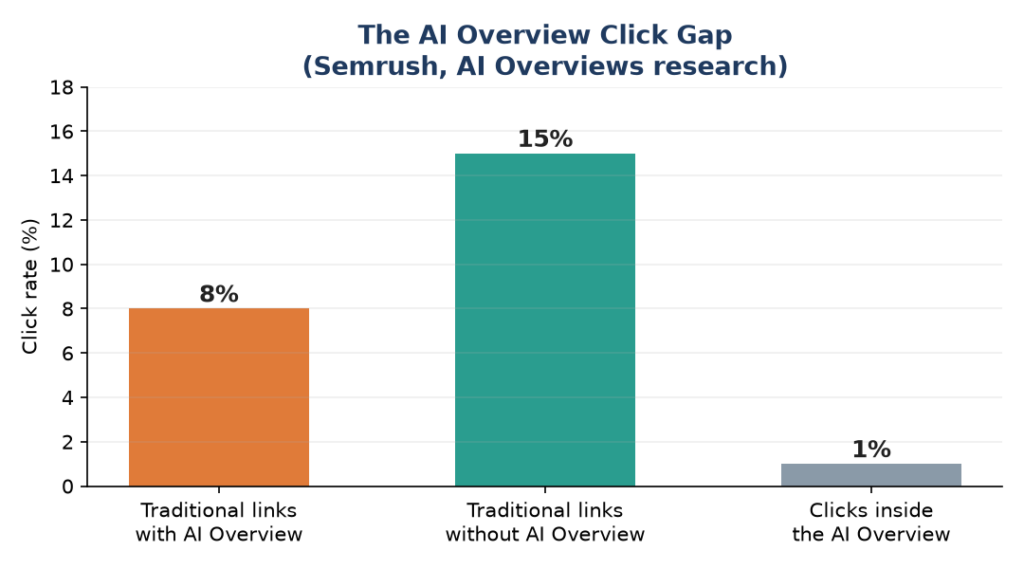
The AI Overview Click Gap (Semrush, AI Overviews research): bar chart of 8% “traditional links with AI Overview” vs 15% “without AI Overview” vs 1% “clicks inside the AI Overview.” The implication for marketers is direct: ranking first in blue links no longer guarantees visibility or traffic when an AI answer sits on top. AI answer position and AI citation rate are now the metrics that move pipeline.
Verified data points at a glance
Metric Figure Source Status Marketers calling AI the biggest disruption in 20 years 61% HubSpot, 2026 State of Marketing Verified (direct fetch) Marketers using AI for content creation 80% HubSpot, 2026 State of Marketing Verified (direct fetch) Marketers using AI across other workflows 75% HubSpot, 2026 State of Marketing Verified (direct fetch) Search queries showing AI Overviews (U.S. avg) ~12.95% Semrush, AI Overviews research Verified (direct fetch) Click rate on traditional links with AI Overview present 8% (vs 15% without) Semrush, AI Overviews research Verified (direct fetch) China internet users / penetration 1.123B / 79.7% CNNIC, 56th Statistical Report Verified (cross-confirmed) China generative AI users 602M CNNIC, 56th Statistical Report Verified (cross-confirmed) China advertisers invested in AI marketing 94.1% (68.7% use agents) CTR, 33rd China Advertising Festival, Oct 2026 Named primary source, dated China advertisers rating AI results “mediocre” 60.3% CTR, 33rd China Advertising Festival, Oct 2026 Named primary source, dated