The Trillion-Dollar Machine: Where Global AI Spending Is Actually Going in 2026
Executive Summary
The infrastructure layer underneath every marketing trend hit an inflection point this week. Global AI spending now sits on a trillion-dollar trajectory, and the money is flowing overwhelmingly into the machinery that runs models — not the models themselves. In China, a policy push is dragging AI straight into the checkout, while Huawei is eating into Nvidia’s chip share at home. For marketers, the quiet story is this: cheaper inference and AI-first discovery are about to rewrite the economics of being found.
The Trillion-Dollar Machine
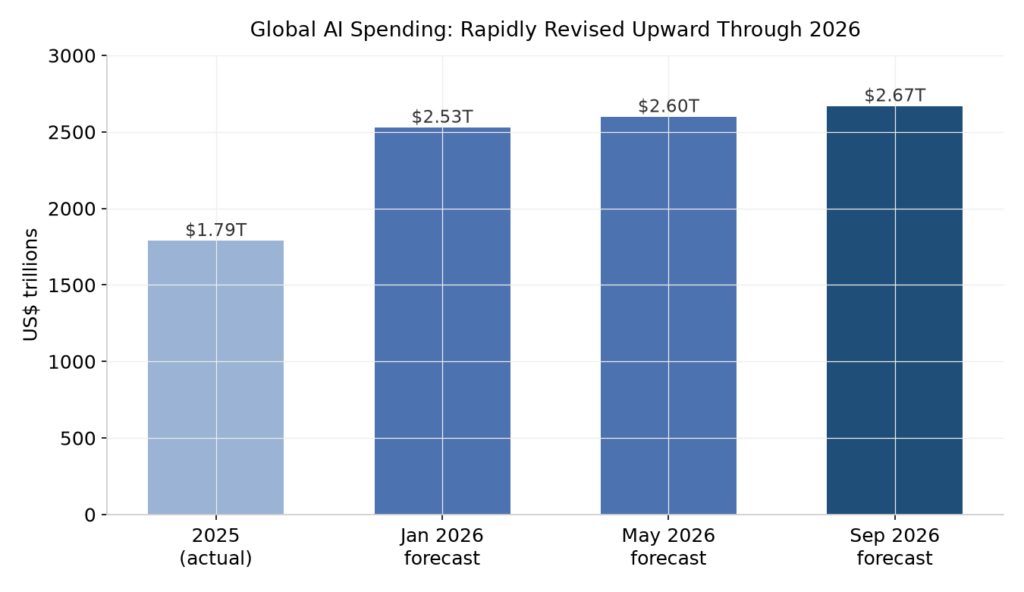
Gartner now expects worldwide AI spending to reach $2.67 trillion in 2026, up 49.5% from $1.79 trillion in 2025. What makes the number interesting is where the dollars land. AI infrastructure — servers, semiconductors, networking, cloud capacity, and the processors that keep them humming — takes $1.484 trillion, or about 56% of the whole.
Put differently, for every dollar spent on a generative AI model, more than $52 goes to infrastructure. The models that dominate the headlines are almost a rounding error next to the buildout required to run them. John-David Lovelock, a Gartner analyst, called the AI data-center buildout “the largest infrastructure project humanity has ever undertaken.”
The forecast has been a moving target all year. In January, Gartner projected $2.53 trillion for 2026. By May it was $2.60 trillion. Now it is $2.67 trillion. Most of that upward revision — roughly $118 billion of the $143 billion added since January — is pure infrastructure.
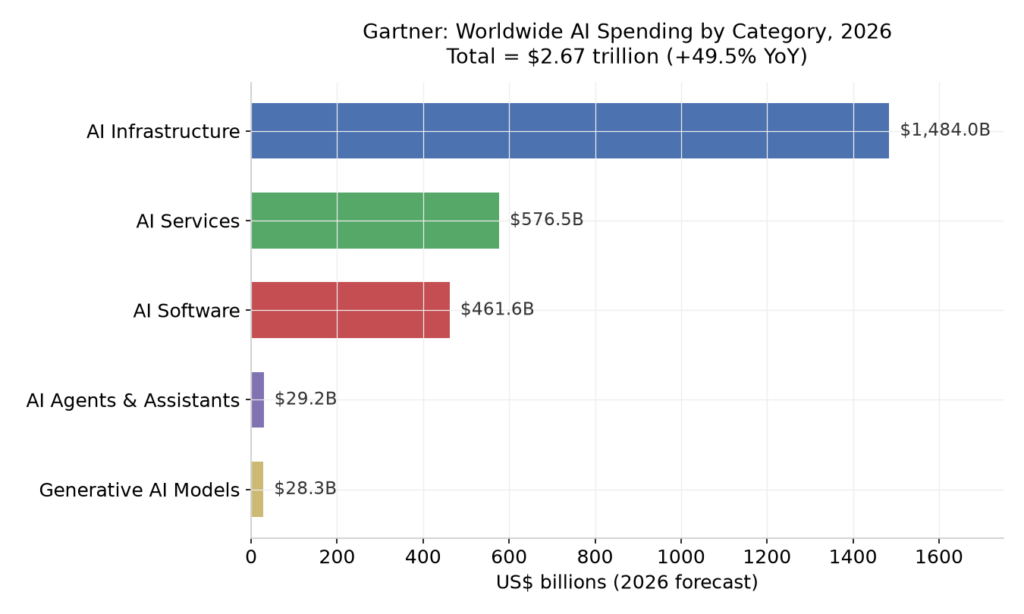
The category breakdown is worth sitting with. AI services are next at $576.5 billion, then AI software at $461.6 billion. AI agents and assistants reach $29.2 billion, and generative AI models themselves land at $28.3 billion. That gap — infrastructure dwarfing everything else — is the real shape of the market right now.
China: Policy Meets the Checkout
On October 19, nine Chinese government departments led by the Ministry of Commerce issued 18 measures to accelerate technology-driven commerce — the country’s first policy document dedicated to that goal. The measures steer AI into product development, design, manufacturing, and marketing, and explicitly call for commercial AI agents in shopping assistance, operations, and logistics, plus embodied intelligence and virtual shopping.
Two numbers from the accompanying briefing anchor the scale. China’s AI core industry was estimated to exceed RMB 1.2 trillion in 2025. And following a late-2025 manufacturing-AI initiative, AI adoption among large industrial firms has already passed 30%.
The operational read for marketers: Beijing is treating AI as a near-term commerce layer, not a research frontier. That accelerates demand for AI-native customer journeys, agent-driven shopping, and machine-readable product content.
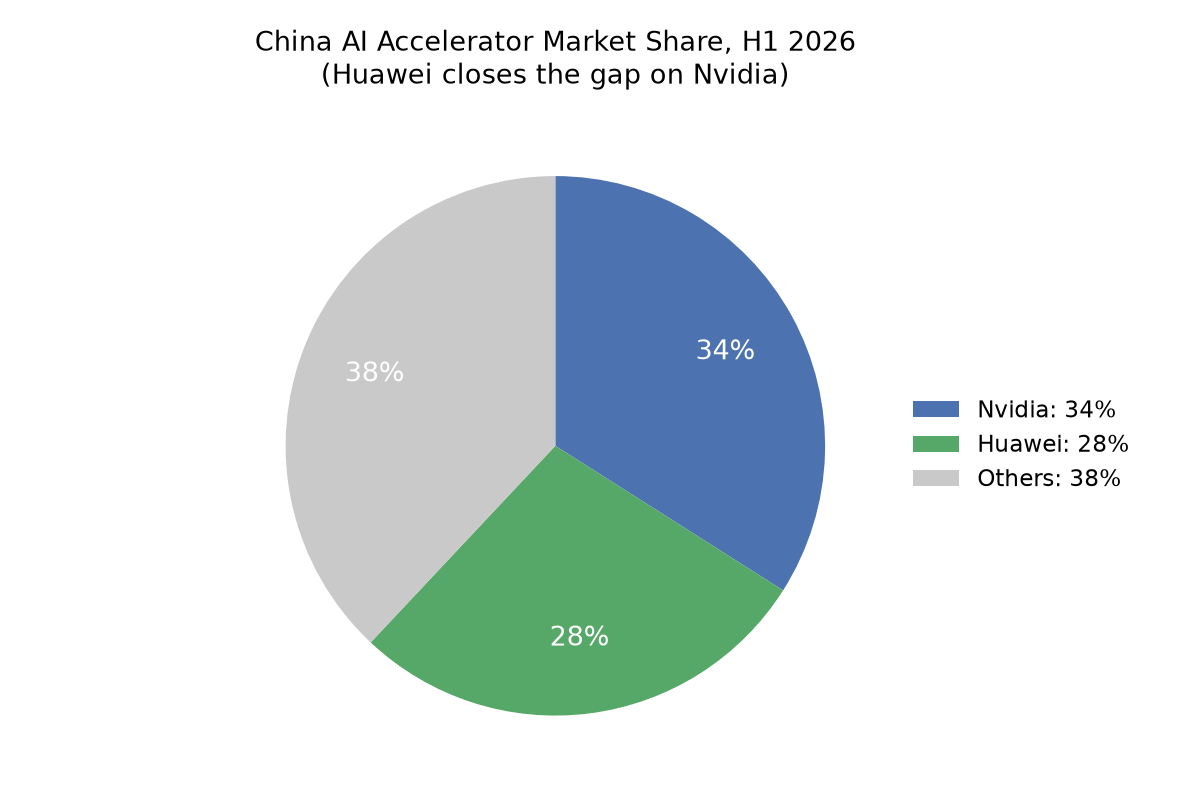
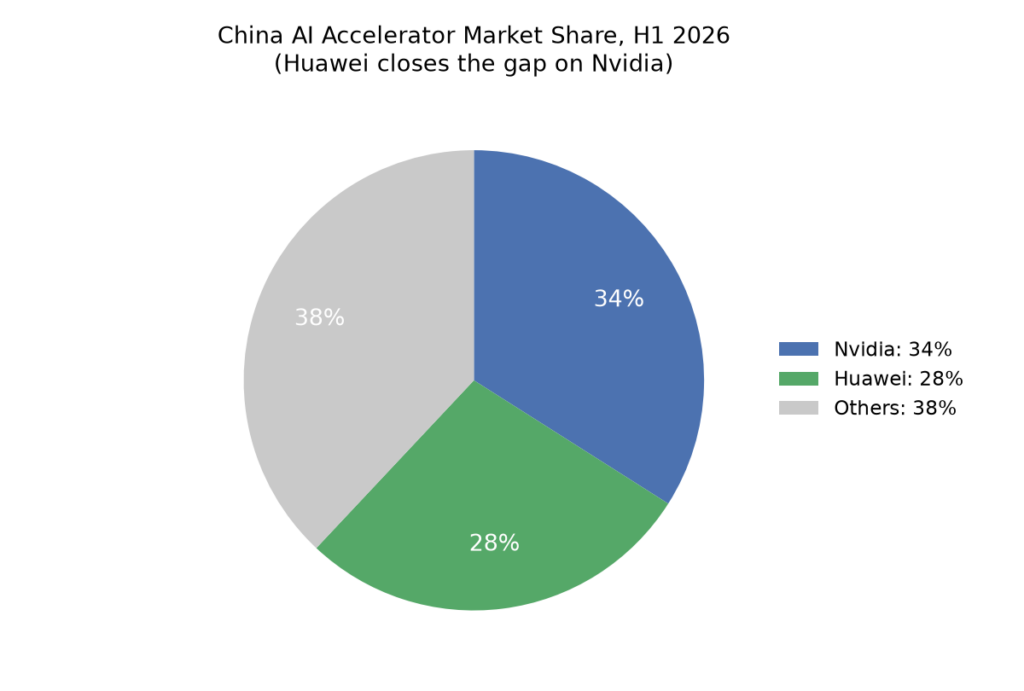
On the hardware side, the domestic race is tightening fast. In the first half of 2026, Nvidia’s China shipments fell 44% to 678,000 AI chips, while Huawei shipped 572,000 — taking 28% of the market against Nvidia’s 34%. US export curbs and Beijing’s push for domestic alternatives are redrawing the map beneath China’s AI stack.
Why This Matters for AI Marketing and GEO
The infrastructure and policy news is not separate from the marketing stack — it is the substrate the stack runs on. Two implications stand out.
First, inference efficiency becomes a marketing variable. When the cost of a quality token drops, the unit economics of AI-generated content, always-on customer agents, and real-time personalization change overnight. Providers competing on efficiency-per-token rather than price-per-token will decide how cheaply a brand can run AI touchpoints around the clock.
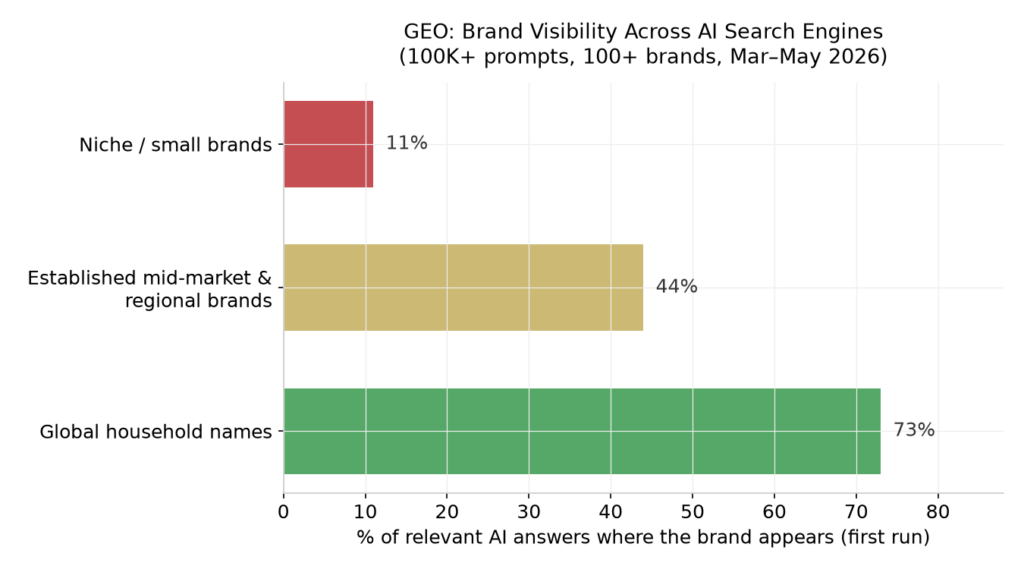
Second, machine-readable, citable content gains value. As AI systems become the front door to discovery, the discipline of Generative Engine Optimization — making brand and product information easy for AI engines to retrieve, trust, and cite — moves from experimental to core. The evidence is stark. In a study of over 100,000 prompt responses across more than 100 brands, global household names appeared in 73% of relevant AI answers on first run, established mid-market brands in 44%, and niche or small brands in just 11% — a 30-point drop at each step down the ladder. Research on content structure finds that thoughtful document architecture can lift citation rates by roughly 17%. And a separate study finds that more than a third of AI-assistant sessions involve no external web step at all, meaning a brand must be present inside the structured data the engine consumes, not just behind a search result.
Key Data Points
| Metric | Figure | Source |
|---|---|---|
| Global AI spending, 2026 | $2.67 trillion (+49.5%) | Gartner |
| AI infrastructure (share of total) | $1.484 trillion (56%) | Gartner |
| AI services / AI software, 2026 | $576.5B / $461.6B | Gartner |
| Generative AI models / AI agents, 2026 | $28.3B / $29.2B | Gartner |
| China AI core industry (2025) | >RMB 1.2 trillion | gov.cn / Ministry of Commerce |
| AI adoption, large industrial firms | >30% | MIIT, via gov.cn |
| China AI chip share, H1 2026 | Nvidia 34% vs Huawei 28% | Reuters |
| GEO brand visibility (household / mid / niche) | 73% / 44% / 11% | arXiv (Ranqo data) |