China’s MaaS Market Grew 9x in a Year — and Global Marketers Just Hit 98% AI Use
Snapshot
One number tells this week’s story: AI stopped being a pilot project and became the default operating layer in marketing on both sides of the globe. Global surveys put AI use among marketers at or above nine in ten. In China, the model-as-a-service market grew almost ninefold in a single year, and generative engine optimization (GEO) moved from a fringe tactic to a formal budget line with its own industry standards. The open question is no longer whether to adopt AI, but whether the data, governance, and measurement behind it can be trusted.
Global Market Pulse
AI Adoption Crosses the 90% Line
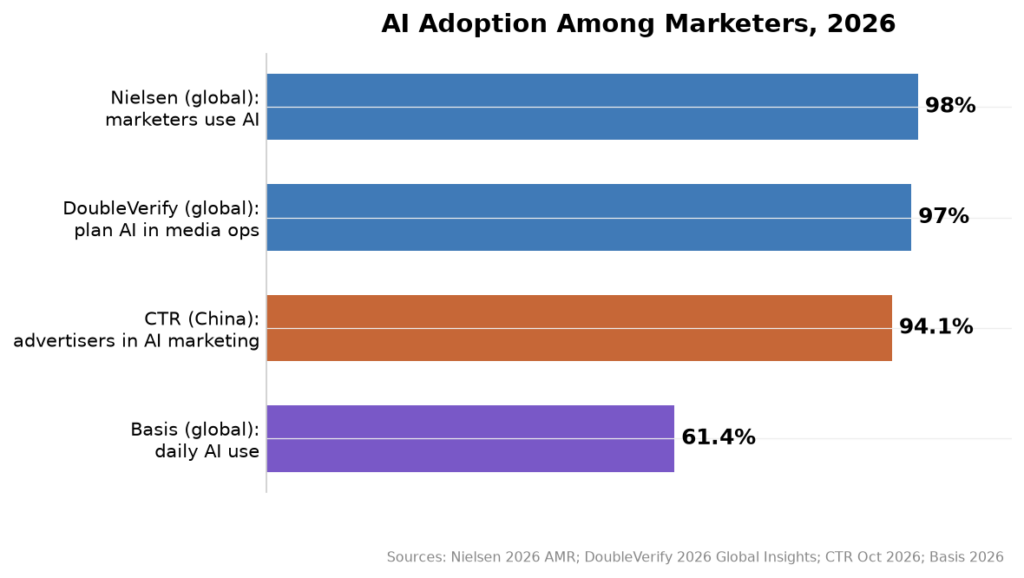
Nielsen published its 2026 Annual Marketing Report on October 26, built on responses from 1,200 marketers across six markets. The headline figure: 98% of marketers now use AI. A third of them say they fully trust AI recommendations without a human check, which is exactly why measurement accuracy has climbed to the top of their concerns [Nielsen, 2026 Annual Marketing Report].
DoubleVerify released its 2026 Global Insights Report on October 29, drawing on a survey of 2,020 marketers. It found that 97% plan to use AI across media planning, buying, and optimization this year. The report also shows the gap between intent and execution: AI use for summarizing media briefs rose from 28% in 2024 to 37% in 2025 and is expected to reach 40% in 2026; campaign activation moved from 31% to 35% and is projected at 40%; bidding optimization climbed from 24% to 29% with a 34% forecast; and mid-flight optimization jumped 10 points to 31%, heading toward 36% [DoubleVerify, 2026 Global Insights Report].
The payoff is real where adoption is deepest. Among marketers already using AI for bidding, 98% reported performance improvements. When evaluating AI tools, accuracy and effectiveness was the top priority at 35%, followed by data privacy and security compliance at 29% and cost or ROI at 29% [DoubleVerify, 2026 Global Insights Report].
A separate Basis report, dated October 19, adds two telling details. Daily AI use among marketing and advertising professionals nearly doubled to 61.4% in 2026, up from 33.6% a year earlier, based on a survey of 184 professionals. Yet only 6.5% of their organizations measure AI return against defined benchmarks — adoption is racing ahead of accountability [Basis, 2026 AI and the Future of Marketing Report].
Agentic Marketing Moves From Pilot to Production
The defining word this quarter is agentic. At Contentstack’s Experience Awards on October 28, the theme was explicit: from here to agentic, your roadmap for an adaptive brand. October 2026 brought a wave of marketing agent launches across email, advertising, SEO, and revenue operations, signaling that vendors now treat autonomous agents as a shipping category rather than a demo [Contentstack, Experience Awards 2026; industry release roundups, late October 2026].
The shift matters because it changes who executes the work. Agents are moving from suggesting copy to activating campaigns and adjusting bids under defined guardrails. Human oversight remains the constant, but the labor is relocating from production to supervision.
Search Is Being Rewritten by AI Answers
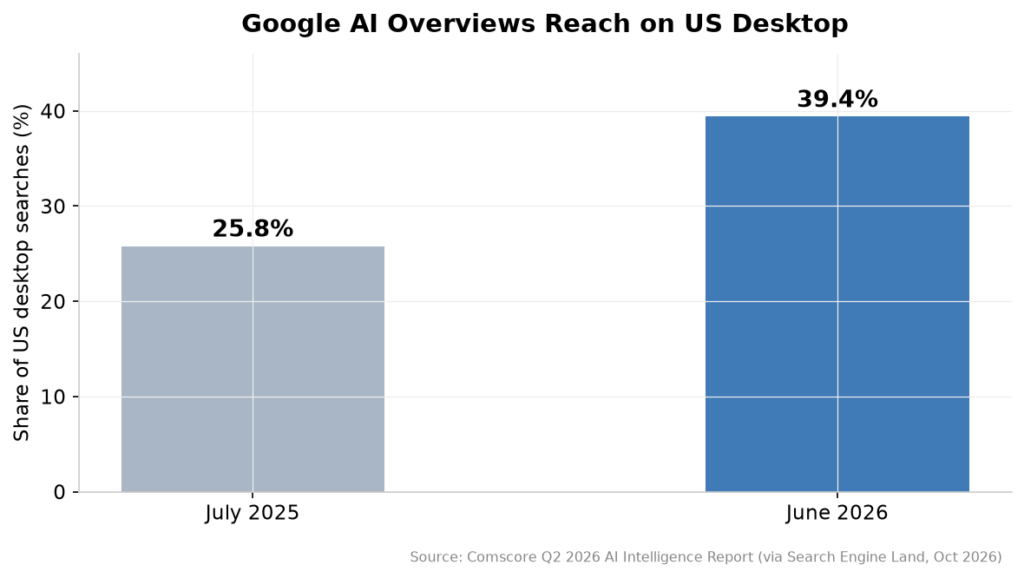
Comscore’s Q2 2026 AI Intelligence Report, widely cited by Search Engine Land and others in late October, shows Google’s AI Overviews appeared in 39.4% of U.S. desktop searches in June 2026, up from 25.8% in July 2025. That 13-point jump in under a year explains why so much budget is leaking out of the classic blue-link funnel and into answer engines [Comscore, Q2 2026 AI Intelligence Report].
The academic foundation for this shift is now well documented. The Princeton GEO study (Aggarwal et al., ACM KDD 2024) — the paper that coined the term generative engine optimization — tested optimization tactics across roughly 10,000 queries and found that adding statistics lifted visibility by up to 40%, while adding citations and quotations lifted it by up to 41% [Aggarwal et al., GEO: Generative Engine Optimization, KDD 2024].
China Market Pulse
MaaS Market Explodes Past RMB 10 Billion
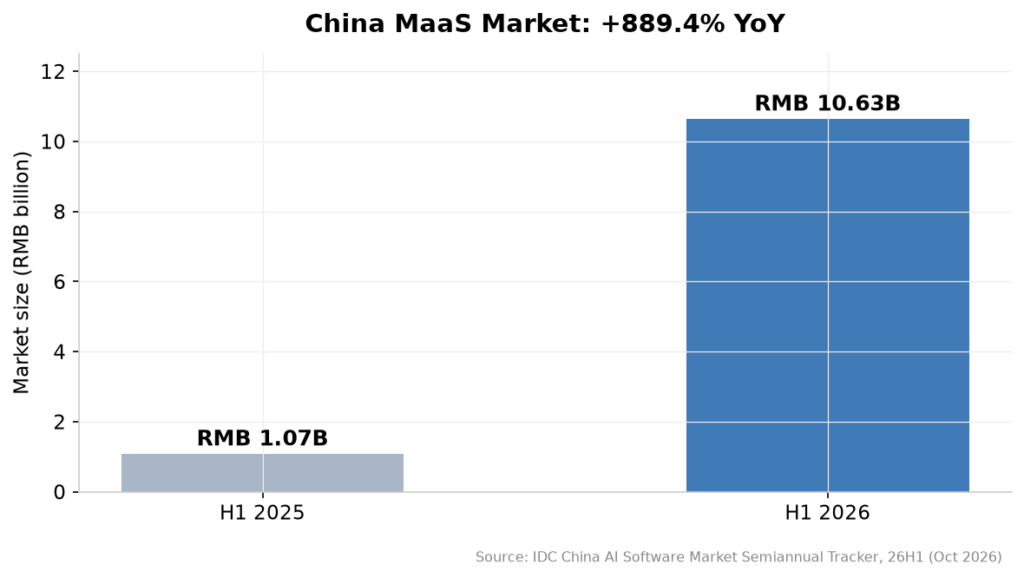
IDC released its semiannual China AI software tracker on October 29. The model-as-a-service segment reached RMB 106.3 billion (about USD 14.9 billion) in the first half of 2026, up 889.4% year over year — roughly a ninefold expansion in twelve months [IDC, China AI Software Market Semiannual Tracker, 26H1].
The report’s qualitative signal matters as much as the size. Large models are moving from assistive office tools into directly carrying production tasks. As model variety multiplies and agent scenarios scale, the competitive axis is shifting from price per token to inference efficiency: how many quality tokens a provider can deliver at equal cost. IDC also notes a distinct tier of independent, model-neutral MaaS providers gaining share, valued for flexible model routing and openness in a multi-model era [IDC, 26H1 tracker].
GEO Becomes a Budget Line, Not a Buzzword
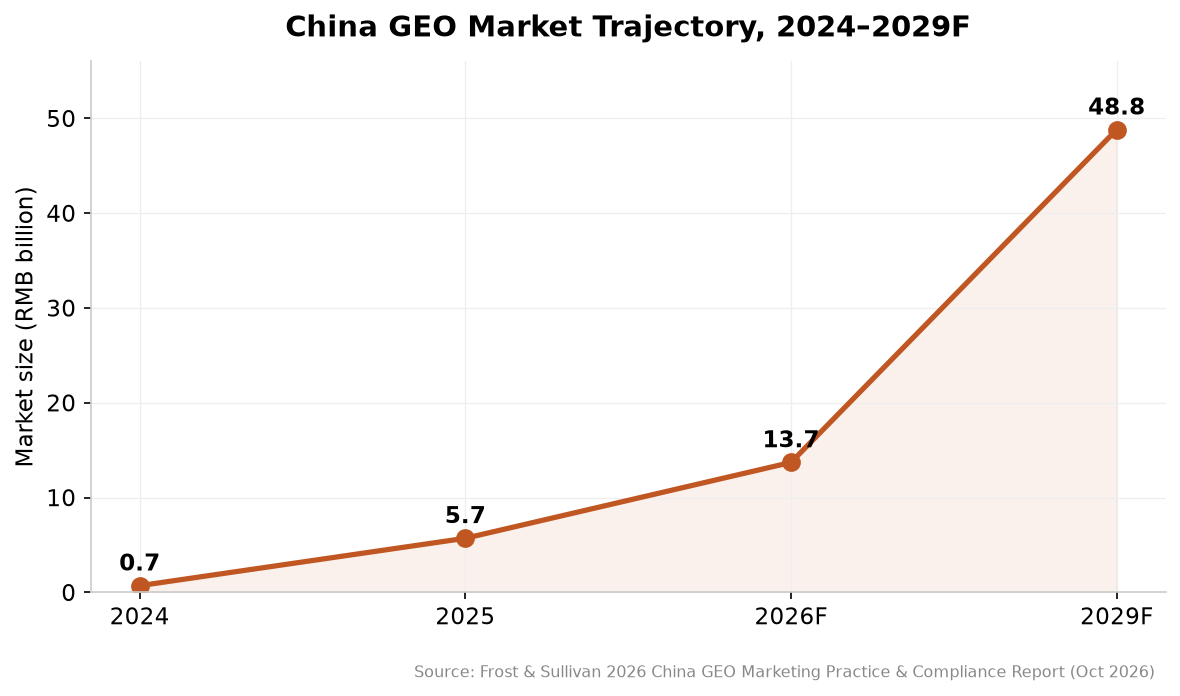
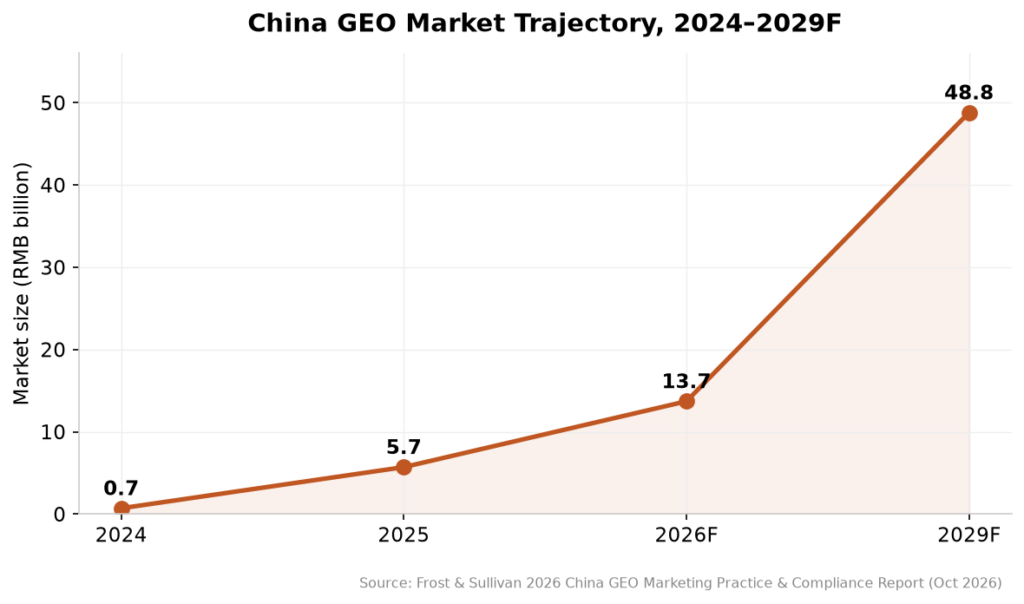
At the 33rd China International Advertising Festival on October 23, Frost & Sullivan, under the guidance of the China Advertising Association, released the 2026 China GEO Marketing Practice and Compliance Development Report. The numbers are steep: China’s GEO market was about RMB 700 million in 2024, grew to RMB 5.7 billion in 2025, and is forecast at RMB 13.7 billion for 2026, reaching RMB 48.8 billion by 2029 [Frost & Sullivan, 2026 China GEO Report].
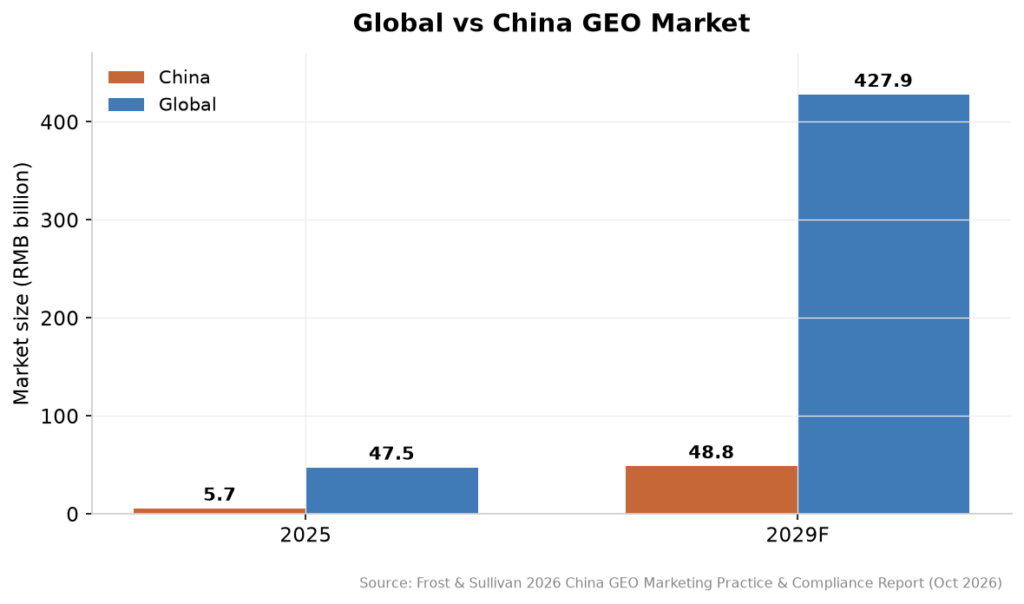
Globally, the same report sizes the GEO market at RMB 47.5 billion in 2025, projected to RMB 427.9 billion by 2029 [Frost & Sullivan, 2026 China GEO Report]. That spread — China roughly one-tenth of the global total today, both compounding fast — is the clearest map of where investment is heading.
Three group standards for GEO took effect the same day, covering service requirements, effect monitoring and verification, and classification of content-source subjects. This marks the first time the practice moved from vendor methodology to codified industry rules in China [China Advertising Association GEO standards, effective Oct 23, 2026].
AI Sits Inside the Consumer’s Decision Loop
CTR (CTV market research) presented at the festival that AI-enabled device coverage in China expanded from 130 million to 910 million units, and 57.4% of consumers now habitually ask AI before shopping [CTR, AI and Mainstream Media Marketing Insights, Oct 2026].
The same study found 94.1% of advertisers have already invested in AI marketing — including 68.7% who have deployed AI agents — yet 60.3% rate the results as only mediocre. That gap, high spend with lukewarm payoff, is the defining tension of the China market this year. CTR argues the new KPIs are no longer impressions and clicks but AI answer position, AI citation rate, and AI visibility [CTR, Oct 2026].
In the consumer journey, Frost & Sullivan data shows 61.7% of respondents say AI played a large or decisive role in the evaluation stage, the highest of any step. Accuracy is the gate: when users pick an AI tool, 41.8% cite result accuracy as their top concern, which is why many still cross-check AI output with search [Frost & Sullivan, 2026 China GEO Report].
The GEO Cross-Market View
Compliance and Trust Become the Real Moat
Both markets are converging on the same lesson. Early GEO tactics that stuffed low-quality content or manufactured fake sources to win short-term mentions are losing force. The durable version rests on four linked links: credible content, credible sources, credible distribution, and credible measurement [Frost & Sullivan, 2026 China GEO Report].
In China, this is now formal policy through the three group standards and a responsible-GEO initiative backed by more than 40 industry bodies. Globally, the parallel concern shows up in DoubleVerify’s finding that accuracy and privacy lead every buyer’s evaluation checklist. Trust, not raw visibility, is becoming the metric that separates providers who last from those who spike and fade.
What This Means
For operators, three moves matter this quarter. First, treat AI visibility as a measurable channel with its own KPIs instead of an extension of SEO. Second, build a clean fact base — official specs, verified sources, consistent messaging — because answer engines reward provable accuracy over volume. Third, close the spend-to-outcome gap by instrumenting measurement before scaling tooling; the China data showing 60% mediocre results is a warning the rest of the world will hit if it repeats the pattern.
Key Numbers at a Glance
| Metric | Latest figure | Source |
|---|---|---|
| Global marketers using AI | 98% | Nielsen 2026 Annual Marketing Report |
| Global marketers planning AI in media ops | 97% | DoubleVerify 2026 Global Insights Report |
| Daily AI use among ad professionals (global) | 61.4%, up from 33.6% | Basis 2026 (n=184) |
| Organizations measuring AI ROI vs benchmarks | 6.5% | Basis 2026 |
| China MaaS market, H1 2026 | RMB 106.3B, +889.4% YoY | IDC 26H1 tracker |
| China GEO market, 2026 forecast | RMB 13.7B (from RMB 700M in 2024) | Frost & Sullivan 2026 China GEO Report |
| Global GEO market, 2029 forecast | RMB 427.9B | Frost & Sullivan 2026 China GEO Report |
| Chinese advertisers in AI marketing | 94.1% (68.7% use AI agents) | CTR Oct 2026 |
| Chinese advertisers rating AI results mediocre | 60.3% | CTR Oct 2026 |
| Chinese consumers asking AI before shopping | 57.4% | CTR Oct 2026 |
| Google AI Overviews share of US desktop searches | 39.4% (June 2026), up from 25.8% (July 2025) | Comscore Q2 2026 |
| Princeton GEO study — statistics lift | up to 40% | Aggarwal et al., KDD 2024 |
| Princeton GEO study — citations/quotes lift | up to 41% | Aggarwal et al., KDD 2024 |