How to Run a Douyin Campaign From Zero: Budget, Content and the One Metric That Matters
Douyin does not pay you for the one video that takes off. It pays you for a store that shows up on camera at fixed times, with stock, a script and someone who can answer a question without reading from a card. That distinction is the whole game, and most brands entering the platform get it backwards: they hire a content team before they hire a store team, then wonder why a 2 million–view clip produced 400 orders and no second visit.
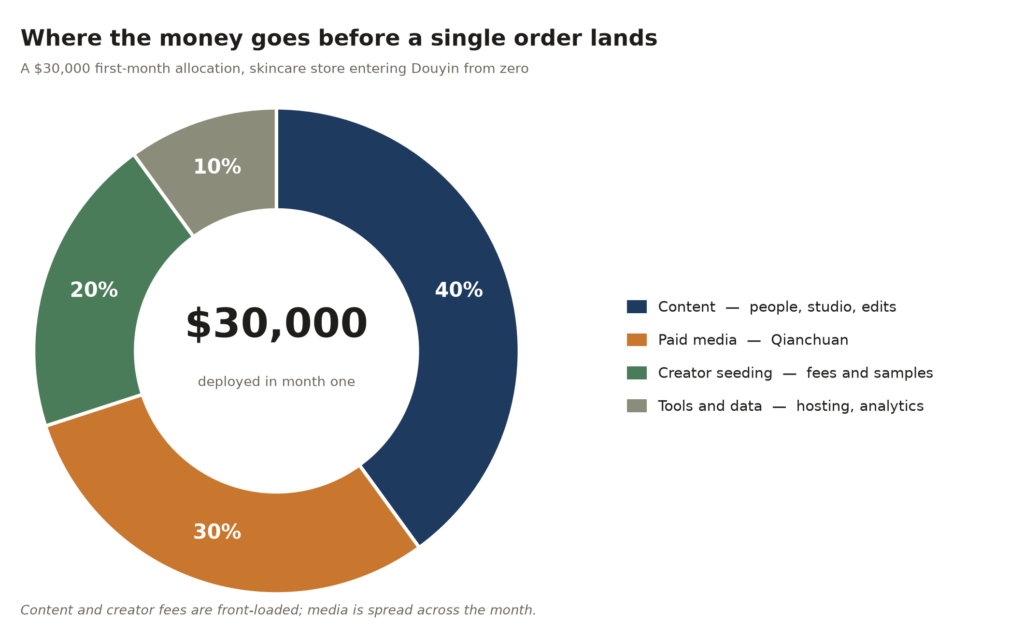
Here is the argument in five lines. First, “from zero” means the store, not the account — a follower count is not a retail capability. Second, the money splits roughly 40/30/20/10 across content, paid media, creator seeding and tooling, in that order of conviction rather than in that order of glamour. Third, the unit of production is a hook that survives three seconds of a stranger’s thumb, not a brand film. Fourth, the indicator worth reporting to your board is not GMV but the ratio of organic to paid GMV, because GMV can always be bought and the ratio cannot. Fifth, month one is supposed to land near break-even; if it looks wildly profitable, you probably sold the future at a discount.
The numbers that anchor all of this are recent and unusually specific. Industry reporting put Douyin e-commerce’s first-half 2026 payment-basis GMV at roughly RMB 2.4 trillion, with growth just under 20% — a figure the platform disputed, and a long way from its early years either way. That is still more than ten times the 1.3% growth in China’s total retail sales over the same six months. More than 120,000 merchants doubled their livestream GMV during 618 2026. Creators with fewer than a million followers delivered more than 80% of all creator-driven GMV. And in Douyin’s own 2026 domestic-brand report, livestreams carried 63% of GMV.
Definitions, so we are not talking past each other
- Store self-broadcast : a livestream run by the merchant, on the merchant’s own account, selling the merchant’s own inventory. Not a paid creator slot.
- Creator livestream : a livestream hosted by an independent creator, usually through the platform’s affiliate marketplace, paid by fee plus commission.
- The room: shorthand throughout this piece for the livestream itself — the thing customers enter, stay in and buy from.
- Shelf : the non-live surfaces — product cards, mall, search, shop page. Browsing without a host.
- Paid GMV: orders attributed to traffic bought through Qianchuan , the platform’s ad console.
- Organic GMV: orders from traffic the algorithm handed you for free — recommendations, search, follows, shares.
- Organic-to-paid ratio: organic GMV divided by paid GMV. The single number this article argues for.
- GPM: gross merchandise value per 1,000 views of a livestream. The efficiency number the room is judged on internally.
1. “From zero” means the store, not the account
Ask a founder what they have after three months on Douyin and you will usually hear a follower count. That is the wrong asset. Followers are a permission slip; the store is the machine that converts the permission into cash, and the two are built by different people with different skills.
Look at how the platform’s own GMV is now composed. Industry reporting in early 2025, citing people close to Douyin e-commerce, put store self-broadcast at slightly above 30% of total GMV and creator livestream at roughly 30%, with shelf plus store broadcast together above 70% of the whole. Read that again: the merchant-run room is now a bigger business than the creator economy on the same app, and it has been for two consecutive years. Douyin’s 2025 development report, covering August 2024 to August 2025, adds the direction of travel — the number of merchants whose revenue grew through store self-broadcast rose 45% year on year, and more than 80,000 new merchants cleared RMB 1 million in livestream GMV.
So what does “starting from zero” actually require? A shop with listings that can be found, a room that opens on a schedule a customer can learn, a supply chain that can absorb a good night without going out of stock, and two people who can talk about the product for four hours without repeating themselves. Notice that none of those things is content. Content is how you fill the room. The room is the business.
The practical consequence is a sequencing rule that saves people a fortune: build the store and the room first, produce content second, buy traffic third. Brands that invert the order pay for traffic into a room that cannot hold it. The algorithm reads that as a room that does not deserve free traffic, which is an expensive lesson to unlearn.
Interlude: the objection. “Douyin is saturated.” It is a fair sentence and a wrong conclusion. Saturation is real at the top of the market: the era when a single head creator could move a category is over, and the platform’s growth rate has cooled from triple digits to just under 20%. But the store layer is not saturated — it is being actively repopulated. During 618 2026, more than 120,000 merchants doubled their livestream GMV, nearly 30,000 first-time 618 participants broke RMB 1 million, and more than 570,000 creators doubled their own GMV. Meanwhile China’s total retail sales grew 1.3% in the first half of 2026 and goods retail grew 1.1%. If a channel growing near 20% inside a market growing near 1% counts as saturated, the word has lost its meaning. What has saturated is the shortcut: borrowed audience, one-off virality, a big name and a discount. What is scarce is a store that shows up.
2. The budget split: 40 / 30 / 20 / 10
Budget arguments are usually arguments about identity. Spend on content and you are a media company; spend on media and you are a buyer; spend on creators and you are a distributor. A launch needs all three, but not in equal measure, and not on day one.
The allocation this playbook uses is 40% content, 30% paid media, 20% creator seeding, 10% tools and data. On a $30,000 budget — nearly all of which is deployed inside the first month, because content and creator fees are front-loaded — that is $12,000, $9,000, $6,000 and $3,000.
Why content takes the largest slice: it is the only line item that gets cheaper over time. A shoot day produces a library; a library produces variants; variants produce learning. Media spend is consumed the moment it is spent, and creator fees are consumed the moment the post goes live. Content compounds, which is why underfunding it to fund ads is the most common false economy in the channel.
Why paid media takes 30% and not 50%: in month one you do not yet know which creative deserves money. Paid traffic does not fix a weak hook, it just buys a faster verdict. Thirty percent is enough to learn the auction, test three to five creatives with real money, and keep the room warm during the hours when the algorithm has not yet decided you are interesting.
Why creator seeding is 20% and not 40%: creators are a distribution shortcut with a short half-life. A creator post spikes, then decays, and the audience belongs to the creator, not to you. Twenty percent buys you proof of concept in someone else’s voice — useful, not load-bearing.
Why tools get 10%: hosting, analytics, a decent microphone, a second camera, an editing license. Tools are the cheapest part of the stack and the easiest to over-buy. If your tool line is 25% of a launch budget, you are shopping, not launching.
Three budget anti-patterns are worth naming, because each one looks prudent in a spreadsheet and is fatal in practice. Paying a mid-tier creator before the room can hold 200 concurrent viewers, which turns a marketing spend into a customer-service incident. Buying followers or engagement to “prime the algorithm”, which poisons the audience signal for months. And spreading the media budget evenly across thirty days when the first ten should be cheap and the last ten expensive, because you should be scaling what is proven rather than funding what is merely scheduled.
3. Content units: three hooks that survive the feed
A hook is not a headline. It is the reason a stranger’s thumb stops in the second or third second, before any brand promise has been made. Three formats do this reliably in commerce, and all three can be produced by the same small team.
The fifteen-second demonstration. Product in use, one claim, no introduction. Show the texture, not the bottle; show the swatch, not the packaging. The discipline is ruthlessness about what gets cut: if the first frame is a logo, the video is a billboard and the feed will treat it as one.
The arithmetic hook. Do the math on camera — price per milliliter, cost per use, what the bundle actually saves, what the cheap version costs you over a year. This format works because it gives the viewer something to repeat to a friend, and repeatable content travels. It also happens to be the most compliant way to talk about price, since you are comparing numbers rather than making claims about outcomes.
The objection hook. Take the five questions your customer service team answers most often and put the answers on camera, in the customer’s own words, without softening. “Will it pill under makeup?” “Is it tested on sensitive skin?” “Why is this twice the price of the one in the supermarket?” Objection content is unglamorous, has a long shelf life, and doubles as a script bank for the room.
The production model that makes this affordable is one shoot day, many cuts. A single day with a product, a person and a window yields twelve to twenty usable clips if the shot list is written as variants rather than as scenes. The platform’s own 618 2026 data shows why short video still matters in a livestream-led plan: views of videos with a shopping cart attached rose 57% year on year, and the number of merchants clearing RMB 10 million in short-video GMV rose 56%. Short video is not the sales floor. It is the queue outside.
4. Livestream rhythm, and why the night shift is a strategy
A store livestream is a shift business before it is a content business. Customers need to know when you are open, and the algorithm needs enough hours to learn what your room does with different audiences. Four hours a day is a test. Six is a habit. Eight is a business.
The rhythm that works in month one is three fixed blocks rather than one long marathon: a midday block for the browsing-at-work crowd, a prime block from early evening for the highest-intent traffic, and a late block that most brands refuse to run. Prime time is where everyone competes and where the cost per room entry is highest. The late block — roughly ten at night to two in the morning — has less traffic, far less competition, a distinct audience, and a materially cheaper entry price. It is not glamorous, and it is the closest thing to an arbitrage a small brand has.
Two operational notes decide whether the night shift works or quietly destroys your team. First, staff it as a separate short shift with its own host, not as an extension of the evening, because a tired host at 1 a.m. sounds exactly like a tired host at 1 a.m. Second, judge it on GPM per hour rather than on absolute sales. A late block that converts a smaller crowd at a higher rate is doing its job; comparing its revenue with prime time and then cancelling it is how brands talk themselves out of the only cheap traffic they had.
Inside the room, the loop is mechanical: hook, proof, offer, urgency, reset. Three to five minutes, repeated with variation, with a host handoff every ninety minutes so the energy does not sag. Month one’s job in the room is not maximum discount. It is retention long enough for the algorithm to place you, and follows enough for the audience to survive the night.
5. The micro-creator arithmetic
The instinct is to buy one credible name. The arithmetic says buy forty small ones.
The reason is not sentiment; it is the platform’s own distribution data. In the 618 2026 report, creators with fewer than one million followers contributed more than 80% of all creator-driven GMV, and more than 570,000 creators doubled their GMV year on year. Douyin’s 2025 development report tells the same story over a longer window: mid- and small-tier creators accounted for over 85% of creator-driven GMV. The market has already repriced this. A brand that still budgets for one hero creator is paying for a 2021 strategy at 2026 prices.
The unit economics of a seeding wave look like this. Forty creators, a median fee of $150 plus product, 20% commission on what they sell. Total cash outlay: $6,000 in fees, with commission treated as a variable cost of revenue rather than as marketing. Expected GMV is not evenly distributed — plan on a power law, where a handful of posts carry the wave, a majority return almost nothing, and two or three embarrass you by selling out a SKU you wanted for the room. The point of forty is that you cannot predict which four will work, so you buy forty lottery tickets instead of one expensive one.
Three rules help the wave survive contact with reality. Screen for audience overlap with your buyer, not follower count. Give creators a script bank and permission to break it, because a creator reading your copy sounds like an ad and the feed will punish it. And require the advertising label — more on that in the compliance section, where it is not optional.
6. What a 63% livestream share does to your creative brief
If most of the money changes hands in a livestream, then most of your video output has one job: get someone into the room at the right hour. That sentence should be printed above the desk of whoever writes your briefs.
The old brief asked a video to sell. The new brief asks it to schedule. That means the call to action is not “buy now” but “we go live at eight”; the hook includes a reason to be present rather than a reason to click; and the product demonstration ends on an open question that only the room will answer. It also means your content calendar and your room schedule have to be designed together — a video that drives people to a room that is closed is a refund request in waiting.
The other 37% deserves equal respect, and it is where most brands leave money on the floor. Shelf is not a passive leftover; it is a search surface. Product cards, shop pages and titles are found by people typing what they already want, and the 618 2026 data shows the shape of that demand: merchants clearing RMB 10 million in product-card GMV rose 82%, and merchants clearing RMB 10 million from search-driven GMV rose 53%. In practice this means writing your listing titles the way a customer speaks, uploading enough SKUs for the algorithm to have something to work with, and treating the shop page as a landing page rather than a filing cabinet.
7. Qianchuan without the jargon
Strip the vocabulary away and paid media on Douyin is one auction with one question: what will you pay for the next person who might buy? Everything else is packaging.
The current packaging is whole-domain promotion, which the ad console describes as removing the boundary between organic and paid traffic — one campaign bidding across livestream, short video and shelf, rather than three separate machines fighting each other. That single change is why the old habit of an “organic team” versus a “paid team” is now actively harmful: they bid in the same auction for the same eyeballs, and neither one can see the whole picture.
Four rules cover most of what a newcomer needs. Set a target return rather than a fixed bid, and understand that the target is a filter, not a promise: set it too high and the system simply stops spending, which people misread as a platform problem. Give the campaign a real learning period — a week of stable budget and stable creative, not three days of panic edits. Cap the day, not the hour, because intraday throttling teaches the system nothing. And accept diminishing returns as a fact of physics: the second thousand dollars always buys worse traffic than the first, so the question is never “can I spend more” but “does the next increment still clear my floor”.
One more thing, and it is the one people ignore. Budget is not a throttle; creative is. Raising the budget on a weak hook does not buy you more sales, it buys a faster and more expensive confirmation that the hook is weak. Fix the creative, then open the tap.
8. The metric that matters: organic-to-paid ratio
Most teams report GMV because it is the number everyone recognizes. It is also the number that lies most easily, since any sufficiently large media budget can manufacture it, and a good return on ad spend can coexist with a business that loses money on every order once salaries are counted.
The number that tells you whether you are building something is the organic-to-paid ratio: organic GMV divided by paid GMV. It answers a question GMV cannot. Is the algorithm recommending you, or are you renting the recommendation? A ratio near zero means you have bought a vending machine that only works while you feed it. A ratio above two means the platform has decided your content is worth distributing, which is the only durable advantage available on a feed.
| Stage | Organic-to-paid ratio | Paid share of GMV | What it means |
| Month 1 | 1.0 – 1.4 | 42 – 50% | Room is functional; content is not yet compounding |
| Month 3 | 1.5 – 2.2 | 31 – 40% | Recommendation is picking you up; scaling is safe |
| Month 6+ | ≥ 2.0 | under 30% | Paid becomes acceleration, not oxygen |
| Danger | under 0.6 | over 62% | You are renting demand and calling it growth |
Two companion metrics keep the ratio honest. The first is return rate by traffic source, because paid traffic often comes back more often than organic traffic does, and a rising ratio can hide a worsening mix. The second is 30-day repurchase, the real test of whether the room sold a product or a promotion. A ratio of two with a repurchase rate of 4% is a business buying customers it will never see again; a ratio of 1.5 with a repurchase rate of 20% is a business with a future.
9. The 30-day cold-start calendar
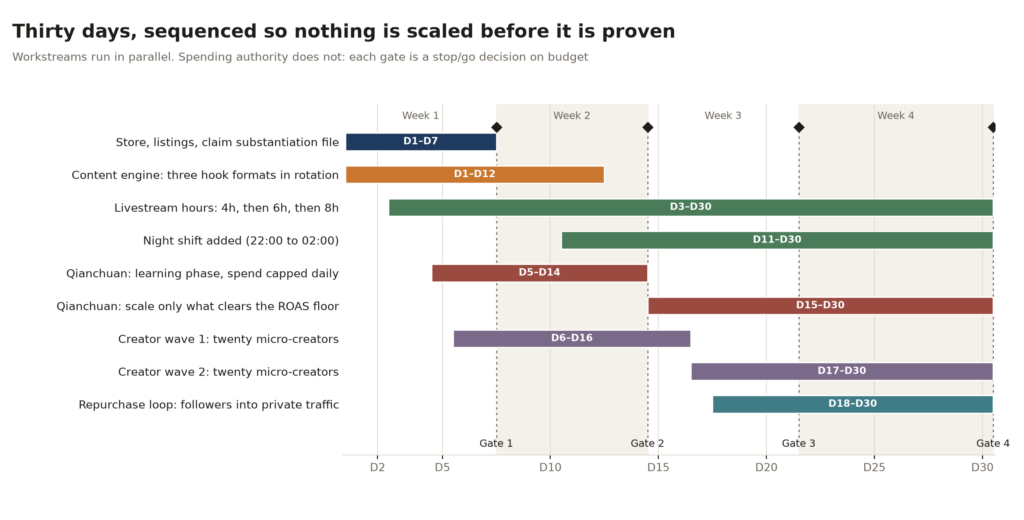
Thirty days is enough to prove a room and a hook, and not enough to prove a business. Treat the month as four gates rather than as one deadline.
Days 1–7, build. Listings live and findable, compliance file assembled, payment and after-sales flows tested by someone outside the team, first shoot day completed, room opened four hours a day. Gate one asks a single question: can a stranger find the shop and complete an order without help?
Days 8–14, learn. Three hook formats in rotation, Qianchuan capped and running, first creator wave out, paid creative tested in small increments. Gate two: does any creative clear the entry-cost threshold, and is the organic-to-paid ratio above 0.7?
Days 15–21, decide. Extend the hours only if the room holds retention; add the late block; scale the one or two creatives that cleared the floor; second creator wave. Gate three: is the ratio at or above 1.0 with a stable return rate?
Days 22–30, commit or stop. Rebuild the budget around what actually worked, cut what did not, and write the month-two plan on a single page with three numbers on it: ratio, return rate, repurchase.
10. The most common way to die: over-subsidizing month one
There is a failure mode that looks like success for about three weeks. You launch with an aggressive discount, the room fills, GMV beats the plan, everyone is congratulated, and then the discount comes off and the room empties — because you did not buy customers, you bought a price.
The damage is mechanical, not mystical. A deep public discount in the first month teaches the recommendation system to look for bargain hunters, so the audience it builds for you is the audience least likely to pay full price later. It trains the room to wait for offers, which means every subsequent full-price day underperforms and pressures you into another promotion. It inflates returns, because discounted beauty and apparel attract impulse orders that come back. And it destroys the price anchor you will need for the following twelve months, in a market where the customer can see your entire price history on your own shop page.
The alternative is not “no offer”. It is offers that buy the right behavior. Add value instead of cutting price — a sample, a tool, a bundle, a travel size. Limit quantity rather than time, so scarcity is real and restocking does not look like a retreat. Give members a better price than the public feed, which rewards the follow instead of the discount reflex. And if you must discount, discount one specific SKU, once, with a story, rather than the whole catalog as a permanent condition.
The test is simple and slightly uncomfortable: at the end of month one, would your GMV survive a 15% price increase? If the honest answer is no, you have not launched a store. You have rented a room.
11. Compliance: what changed in 2026
This is the section people skip and later pay for. Chinese livestream commerce got a new rulebook this year, and it is not decorative.
The central instrument is the Livestream E-Commerce Supervision and Administration Measures (《直播电商监督管理办法》), issued jointly by the State Administration for Market Regulation and the Cyberspace Administration of China as Order No. 117, published on December 18, 2025, and effective February 1, 2026. It regulates four separate duty-holders — platform operators, livestream room operators, on-camera sellers and livestream marketer service agencies — and it draws hard lines around false claims, commercial disparagement of competitors and the sale of prohibited goods. Room operators are required to verify and keep current the identity of the people selling on their account. In practice that means your hosts are named, documented and accountable, and “the agency handles it” stopped being a defense.
Food sellers face a second instrument, the regulation on food-safety responsibilities for livestream e-commerce operators (《直播电商经营者落实食品安全主体责任监督管理规定》), Order No. 120, effective March 20, 2026. A skincare brand can ignore the text; it cannot ignore the supply chain, because any food, supplement or ingestible adjacent to the product line now carries stricter obligations upstream.
Advertising carries two older rules that still catch the most people. The Internet Advertising Measures (《互联网广告管理办法》), in force since May 2023, require in Article 9 that promotion through knowledge-sharing, experience-sharing or consumer review, when attached to a purchase link, be clearly marked as advertising. That single clause governs your entire creator program: the label is not a courtesy, and “it was their own opinion” is not a defense. Separately, the Advertising Law prohibits absolute superlatives and medical terminology, which rules out most of the vocabulary that comes naturally to a beauty script.
Finally, cosmetics. Efficacy claims must rest on adequate scientific substantiation, and the registration or notification holder has to publish a summary of the evidence on the designated government website; products claiming whitening or freckle removal, sunscreen, hair dye, perm or anti-hair-loss effects sit in the special-cosmetics category and require registration rather than notification. Translated for the room: a host cannot improvise a claim the registration file does not support, and the script bank needs a compliance owner with the authority to delete a line.
12. A $30,000 worked example
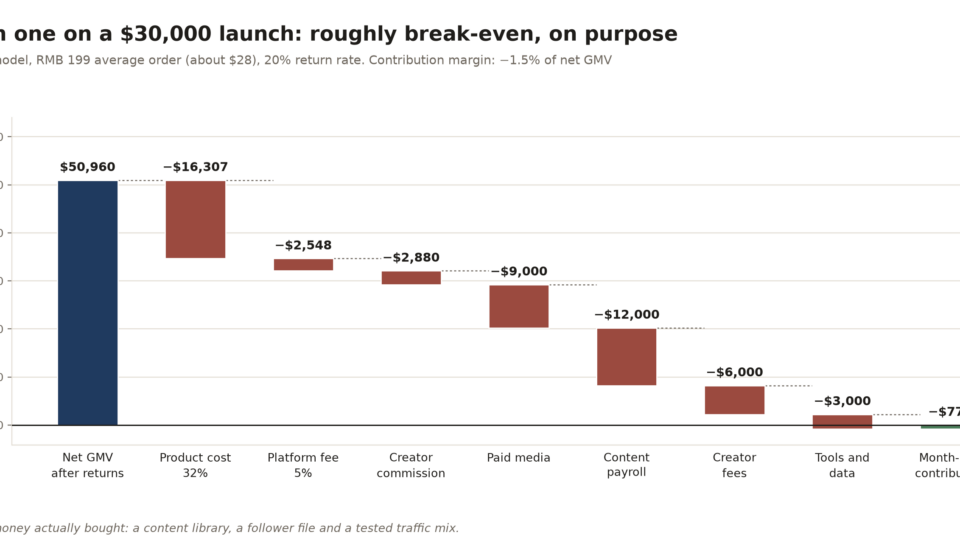
A model, not a case. Skincare, RMB 199 average order (about $28 at RMB 7.2 to the dollar), 20% return rate, 32% product cost, 5% platform fee, 30 days, the full $30,000 deployed, the 40/30/20/10 split.
| Line | Assumption | Value |
| Paid media | $9,000 at an $8 CPM, 1.9% entering the room, $0.42 per entry, 3.5% purchase | 21,400 entries, 750 orders, $20,700 GMV |
| Organics | Six hours a day, five orders per hour at steady state | 900 orders, $25,000 GMV |
| Creators | 40 creators at a $150 median fee, 20% commission | $18,000 GMV |
| Gross GMV | Sum of the three channels | $63,700 |
| Net GMV | After 20% returns | $50,960 |
| Platform return on ad spend | Paid GMV ÷ media spend | 2.3 |
| Organic-to-paid ratio | Organic GMV ÷ paid GMV | 1.21 |
Now the part nobody puts in the pitch deck. Product cost takes $16,307 of the net, the platform fee $2,548, creator commission $2,880, media $9,000, content payroll $12,000, creator fees $6,000 and tools $3,000. That leaves a contribution of minus $775, or about minus 1.5% of net GMV. You needed roughly $65,200 of gross GMV to break even, and you booked $63,700.
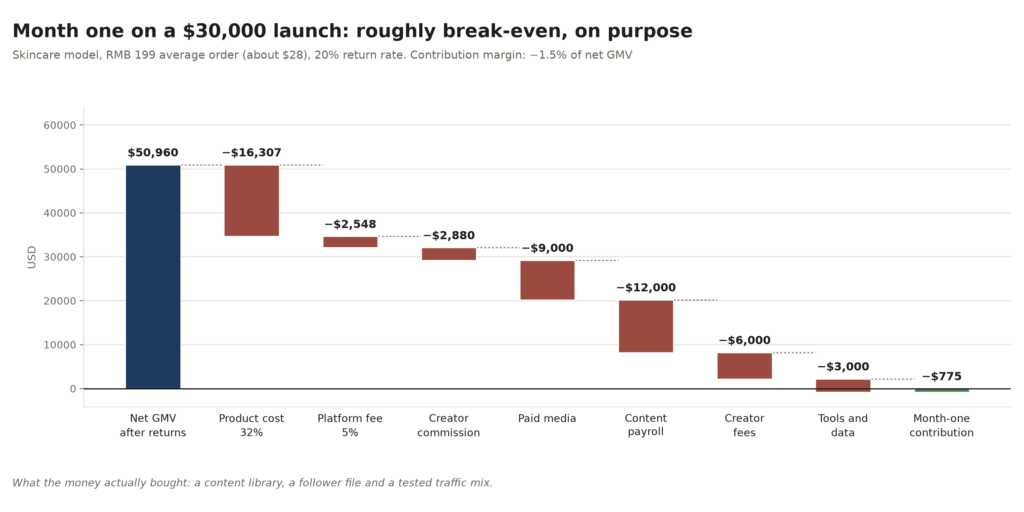
This is a good outcome, and it is worth saying why. At a ROAS of 2.3, paid media covers its own cost and a little more, but not the payroll behind it; the room is only viable because organics is doing slightly more work than the ads are. In month two, with the same media budget, half the content cost because the library exists, and the ratio at 1.8, the same machine produces about $5,500 of contribution. That is the thesis in one line: the first month buys the asset, the following months rent it out.
What to do on Monday morning
Pick the room schedule before you pick the camera. Write three hooks, not thirty, and shoot all three in one day. Open the shop and make sure a stranger can buy from it. Put a capped amount into paid media with a target return you would accept in writing. Send product to forty small creators and require the ad label. Then, at the end of week one, report the organic-to-paid ratio to whoever signs the invoices — because that is the number that tells you whether the next thirty days are an investment or a habit.
FAQ
What is the minimum budget to run this playbook properly? Around $25,000–$30,000 for the first month of a 90-day launch in a category with a $25–$40 average order. Below roughly $12,000 you can test content, but you cannot test a room plus a traffic mix, and testing half a system produces conclusions about the wrong half.
Can I skip livestream and run short video plus shelf only? You can, and some categories should. But understand what you are giving up: livestream is where 63% of GMV sits in Douyin’s own 2026 domestic-brand data, and the shelf surfaces are fed by the content around them. A shelf-only plan usually needs better search copy, more SKUs and a longer payback.
Is paid traffic ever a substitute for organic? Never as a substitute, sometimes as an accelerant. The test is whether paid spend is following proven creative or replacing missing creative. If your ratio is falling while your media budget is rising, you are buying volume at a loss and calling it growth.
How do I know the ratio is improving for the right reasons? Three checks. Return rate by traffic source should be flat or falling. Thirty-day repurchase should be rising. And the mix of your room — new versus returning viewers — should show returning share climbing slowly. A ratio that rises while all three move the wrong way is an accounting artifact.
Can a host say “clinically proven”, “best-selling” or “doctor recommended”? No. Absolute superlatives and medical framing are prohibited under the Advertising Law, and efficacy language has to match the substantiation published for the product’s registration or notification. Rewrite claims as mechanisms and experiences — what the formula does, how it feels, what it has been tested for — and give the compliance owner veto power over the script bank.