Marvell Pays $115 Billion for the Right to Own the Space Between Chips
Marvell spent Monday telling anyone who would listen that it had just bought the future of AI networking. Investors spent Monday deciding whether they believed it.
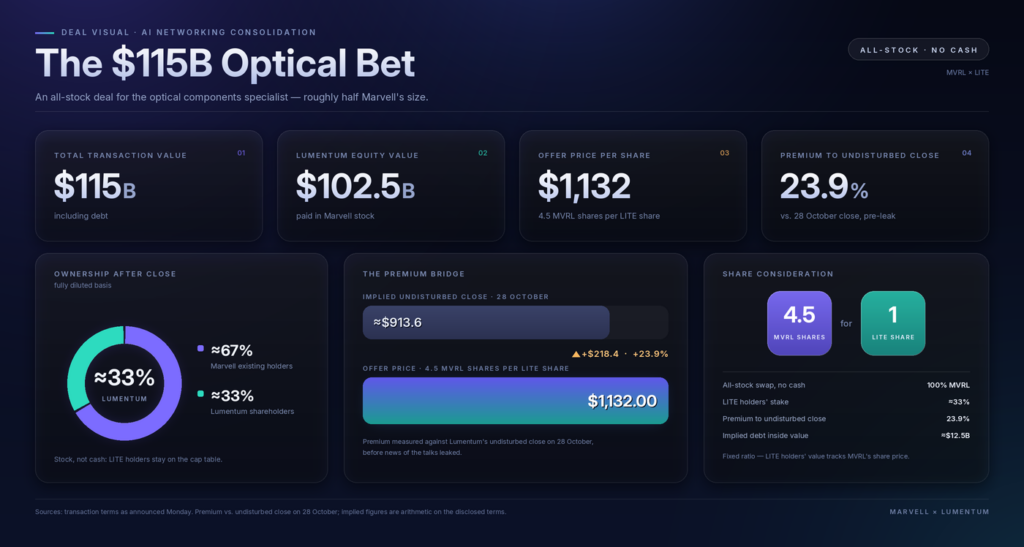
The chipmaker agreed to acquire Lumentum, an optical components specialist roughly half its size, in an all-stock transaction valued at $115 billion including debt. Marvell will issue 4.5 of its own shares for every Lumentum share, which works out to $1,132 per share and a 23.9% premium to Lumentum’s undisturbed close on 28 October, before news of the talks leaked. Lumentum’s equity is being valued at about $102.5 billion, and its shareholders will end up owning roughly a third of the combined company on a fully diluted basis.
That is the arithmetic. The strategy is the harder part.
What Marvell actually bought
Not a laser company. A bottleneck.
For two decades the constraint in computing was transistors. Then it was memory bandwidth. Right now, inside the largest AI clusters, it is the distance between racks. Thousands of accelerators have to talk to each other continuously, and copper stops being practical well before the distances involved get interesting. Light does not.
Lumentum makes the parts that turn electrical signals into photons and back: high-performance lasers, pump lasers, optical circuit switches, transceivers. Marvell makes custom accelerators and the networking silicon around them. Put the two together and you own both ends of a link that AI budgets are being rewritten to pay for.
Marvell has been building toward this for a while. It closed a $3.5 billion acquisition of Celestial AI in February. At its October investor day it guided to fiscal 2031 revenue of $70 billion to $90 billion, with roughly $37.5 billion coming from interconnect alone, and forecast that the interconnect market would reach $65 billion by 2030 growing at about 65% a year. Those are company projections, not consensus, but they explain the price.
The quarter that made the premium defensible
Lumentum reported its fiscal first quarter, ended 26 September, on the same day. Revenue came in at $1.263 billion against $534 million a year earlier, a 136.5% increase. Net income on a GAAP basis was $360.3 million. Non-GAAP diluted earnings per share reached $4.57; the GAAP figure was $3.54.
Then the guidance. Lumentum told investors to expect second-quarter revenue of $1.575 billion to $1.625 billion, against a consensus of roughly $1.48 billion.
Anyone arguing that Marvell overpaid has to argue against that trajectory. Anyone arguing it did not has to explain a 136.5% growth rate surviving long enough to justify a 23.9% premium on top of an already re-rated stock.
The premium landed in a hostile tape
Here is where the story gets uncomfortable. Both stocks traded lower on the announcement, and the damage started earlier than Monday. Since reports of deal talks surfaced in late October, Marvell has lost roughly 22% of its market value.
That matters more than any single day’s move. Marvell’s market capitalisation had climbed past $170 billion on the strength of custom silicon for hyperscalers and the networking that surrounds it. Paying in stock at that valuation, into a market that is actively repricing AI infrastructure risk, is a statement about conviction — and about how little room management has left to be wrong.
Several market participants framed the deal as a bet made at the top. The more precise worry is different: Marvell is buying a component supplier at the exact moment its customers are deciding whether to keep buying components or design them in-house.
Broadcom is the comparison that matters
Marvell’s real competition is not other optical vendors. It is Broadcom, which has spent years assembling a portfolio broad enough that a hyperscaler can source most of an AI data centre from one relationship. Google has been the anchor customer for that model.
Marvell’s answer was to buy the missing piece rather than build it. The logic is coherent. It is also the kind of move that invites a customer to ask whether it now depends on a supplier that competes with it. Every merchant silicon vendor eventually hears that question, and the answer usually involves a second source.
The clause nobody is pricing
In August, Marvell signed an agreement to supply chips that work alongside Google’s own AI processors, a deal that could generate up to $120 billion in sales through fiscal 2033. It also gives Google the right to take a $12.2 billion stake in Marvell.
Read that again. A customer with a right to become a large shareholder, inside a company that has just spent $115 billion to own more of that customer’s supply chain. Governance questions like this take a long time to surface and a longer time to resolve.
Nvidia, for its part, had already put $2 billion into Marvell and $2 billion into Lumentum earlier in the year. When a supplier’s main competitor is also an investor in both sides of a merger, the word “independent” starts doing less work than usual.
A 2028 closing date is not a formality
The companies expect to complete in the first half of calendar 2028, subject to shareholder and regulatory approval.
Eighteen months is a long time inside an AI cycle. It is long enough for demand to cool, for a competing interconnect standard to gain traction, for a large customer to qualify a second supplier, and for regulators in multiple jurisdictions to ask what happens to optical component pricing when two of the largest independent suppliers become one. Marvell will be integrating a business it does not yet control while the market it is buying into keeps moving.
What to watch from here
If you buy AI infrastructure, the number that matters is not the deal price. It is whether qualified second sources for high-end optics survive the consolidation. If you build it, watch whether Marvell’s custom silicon customers start hedging their interconnect orders.
If you invest, ignore the headline multiple and track one line item: Lumentum’s sequential revenue growth in the next two quarters. A company growing at triple digits does not need a merger to justify its valuation. A company whose growth decelerates hard does — which is precisely why the premium exists.
Frequently asked questions
Why pay in stock instead of cash? Because $115 billion in cash is not available to a company with roughly $8 billion in annual revenue, and because stock preserves balance-sheet capacity for the integration period. The cost is dilution at a share price the market is actively questioning.
Is Lumentum really worth $102.5 billion in equity? It reported $1.263 billion of quarterly revenue growing 136.5%, and guided the next quarter to as much as $1.625 billion against a $1.48 billion consensus. Whether that growth is durable is the entire question. The premium suggests Marvell thinks it is.
Does this make Marvell a competitor to its own customers? Partly. Owning Lumentum means owning a supplier that hyperscalers also buy from directly. That is a structural tension, not a solvable one.
What happens to Coherent and Chinese optical suppliers? Coherent becomes the most obvious remaining large independent Western alternative, which is generally good for a second-source narrative. Chinese suppliers face a separate variable: proposals in Washington to restrict new Chinese optical transceivers, which would redirect demand toward domestic vendors.
Should customers expect prices to rise? Consolidation usually argues for higher prices. The counter-argument is that hyperscalers have enough purchasing leverage to resist, and enough engineering capacity to dual-source. Watch qualification announcements, not commentary.