The Real Difference Between Douyin and TikTok (It’s Not the Algorithm)
Meta Description: Same app family, two different rulebooks. Douyin sells inside China’s super-app stack; TikTok sells into a fragmented West.
Here is a question worth sitting with. The same fifteen-second video format, built by the same company, with nearly identical mechanics. You scroll, you watch, you tap. In China, that tap can land a product in your hands within the hour. Outside China, that same tap usually sends you out of the app to Google for a coupon code, or to a storefront that lives somewhere else entirely. Same product, two completely different machines underneath it. If you are a marketer planning a short-video strategy across borders, understanding why that happens is the entire game. Translating your Douyin playbook to TikTok word for word is how you lose money slowly and confuse your team.
They Look the Same. They Are Not.
Douyin and TikTok both grew from the same root. ByteDance launched Douyin in China in 2016, then shipped the international version, TikTok, the following year. Same recommendation engine, same full-screen vertical feed, same creator tools on the surface. The code was, for a long time, nearly identical.
But software is only half the story. An app is a tenant in a larger building, and the buildings these two apps live in could not be more different. Douyin sits inside a Chinese mobile internet where payments, logistics, identity, and commerce are already wired together by a handful of platforms. TikTok sits inside a Western internet that is, by design, fragmented: different payment rails, different app stores, different regulators, different shopping habits. The app is the same; the plumbing it connects to is not.
The Infrastructure Difference Nobody Talks About
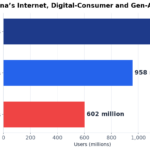
Let us put numbers on the foundations first. China’s internet user base passed 1.12 billion people in 2025, according to the China Internet Network Information Center, the country’s official internet monitor, and the figure was confirmed by the state news agency Xinhua. QuestMobile’s 2026 ecosystem report counts roughly 1.278 billion monthly active users on China’s mobile internet. That is a market where almost everyone who owns a phone is already on the mobile web, and where a short-video app plugs directly into a mature, standardized commerce layer.
Think about what Douyin inherited. WeChat Pay and Alipay already worked everywhere. Buyers did not need to enter card details into a new app because the payment layer was already there. Logistics companies could deliver next-day across a country with dense urban clusters. Live-stream selling, which Douyin popularized, worked because the whole transaction could happen without the user ever leaving the feed.
And Douyin has dug itself deep into that foundation. By 2026, Douyin had become the app where Chinese users spend the most time each day, overtaking WeChat for the first time, while ByteDance’s family of apps collectively captured roughly 40 percent of all time spent on China’s mobile internet. That level of attention density is not something a Western platform can assume; it is a structural advantage Douyin was built into, not just built on.
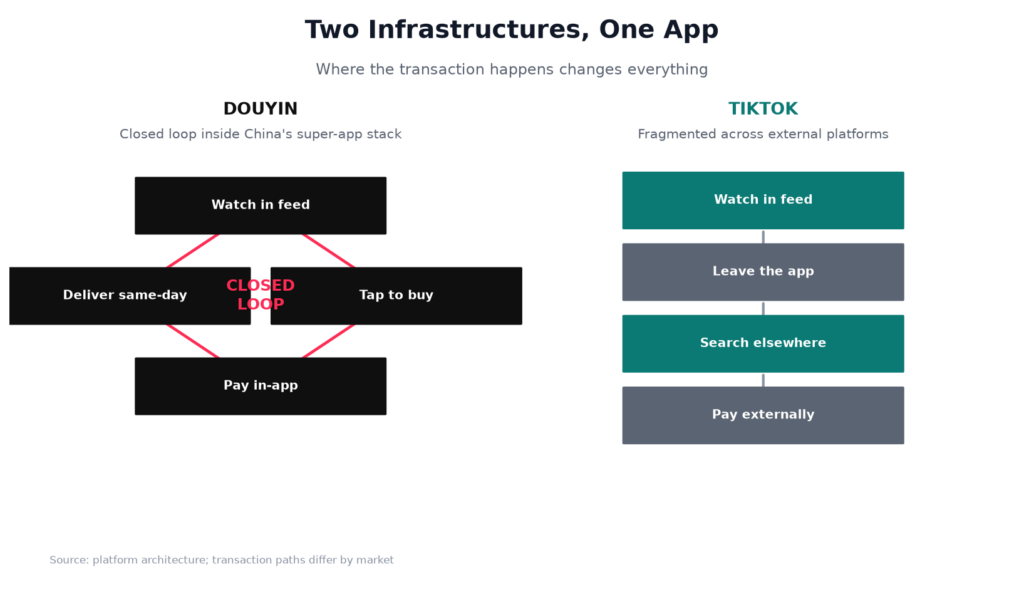
TikTok got none of that. In the markets where it grew fastest, the United States, the United Kingdom, Southeast Asia, there was no single dominant payment rail, no default logistics backbone, and a user base far less conditioned to buy inside a video feed. TikTok had to build or bolt on the commerce layer piece by piece, market by market. That is why the two apps convert so differently even when the content looks identical.
Discovery Logic: Entertainment vs Transaction
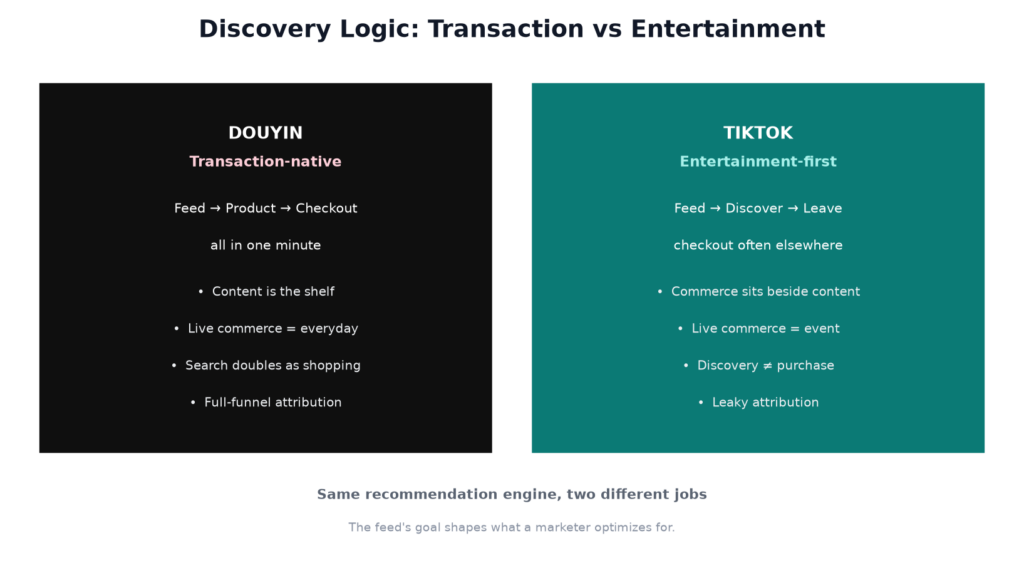
Here is the second fork in the road. Douyin’s feed is tuned, increasingly, toward transaction. A user in China scrolling Douyin is a few swipes away from a product page, a live shopping stream, or a storefront that feels like a natural extension of the content. The platform has merged discovery and purchase into a single loop: watch, want, buy, all inside the same minute.
TikTok’s feed is still primarily an entertainment and discovery machine. Commerce exists, and it is growing fast, but it sits alongside the content rather than fused into it. A TikTok user is more likely to discover a product, then go elsewhere to complete the purchase, on Amazon, on a brand’s site, in a retail store. The discovery happens on TikTok; the transaction often does not. For a marketer, that distinction changes everything about how you measure success and where you put your budget.
Where the Checkout Lives
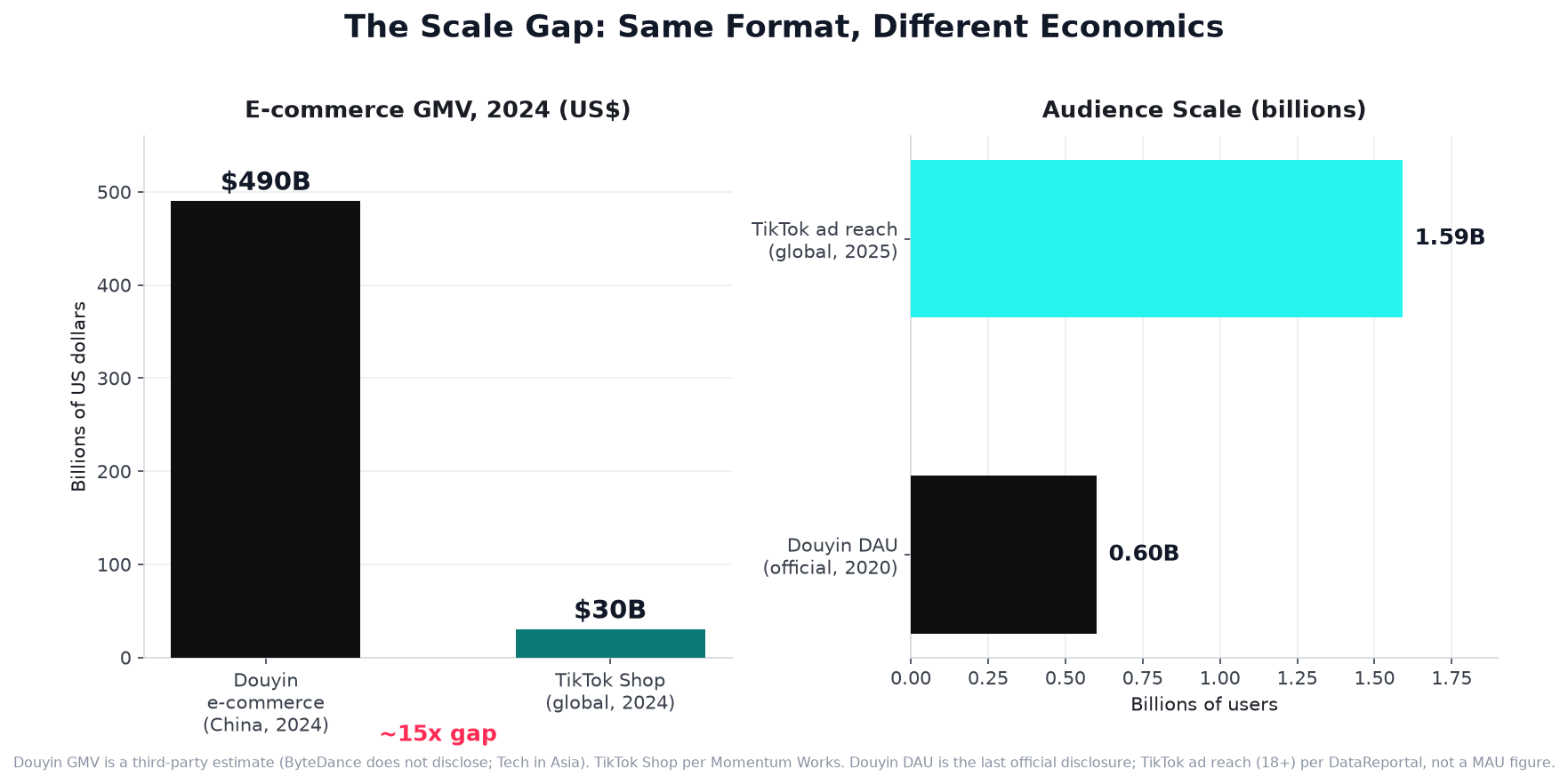
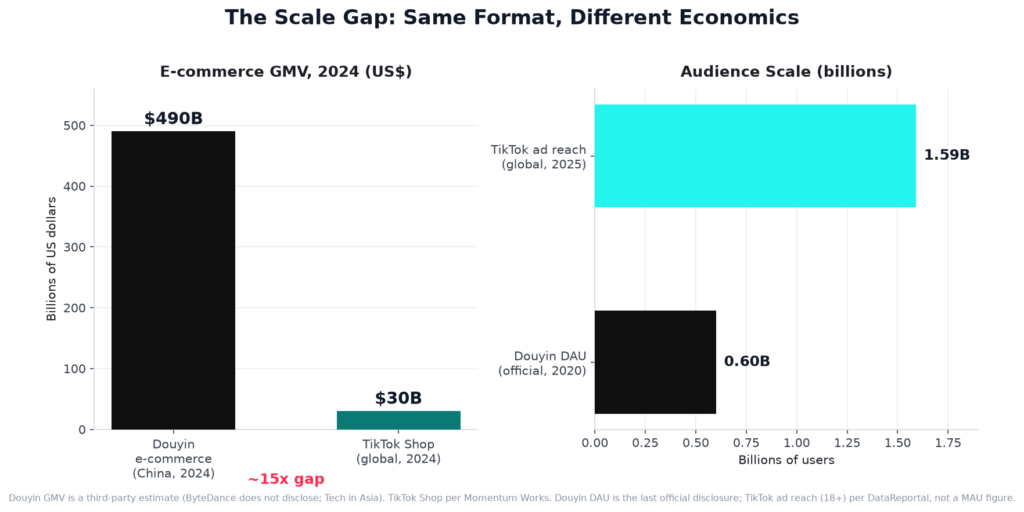
This is the single clearest line between the two platforms. On Douyin, the checkout lives inside the app. Douyin’s e-commerce engine closed roughly 490 billion US dollars in gross merchandise value in 2024, up about 30 percent from the prior year, according to Tech in Asia’s reporting on industry figures. To be clear, ByteDance does not publish an official Douyin GMV, so treat that number as a well-sourced third-party estimate rather than a company disclosure. But the order of magnitude is the point: hundreds of billions of dollars moving through a closed loop where the payment, the seller, and the buyer all stay inside Douyin.
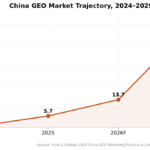
TikTok’s checkout story is younger and messier. TikTok Shop, the platform’s in-app commerce arm, surpassed 30 billion US dollars globally in 2024, and roughly 64 billion in 2025, according to Momentum Works, the Singapore-based e-commerce research firm that tracks this closely, with eMarketer separately confirming TikTok Shop’s fast rise within social commerce. That is impressive growth, but put it next to Douyin and the gap is stark: Douyin’s closed-loop GMV is on the order of fifteen times larger than TikTok Shop’s, even though TikTok’s global audience is bigger than Douyin’s domestic one. The difference is not the content. It is the checkout.
Livestream Commerce: Normal in One, Novel in the Other
If you have spent any time in China’s e-commerce world, live-stream selling is just how shopping works now. Merchant-led livestreams dominate Douyin’s commerce, with brands running daily streams the way Western brands run email campaigns. It is a mature, normalized behavior. Buyers expect it.
Outside China, live commerce is still finding its feet. TikTok has pushed live shopping hard, and the US numbers are finally moving, with TikTok Shop’s US gross merchandise value reaching about 15.1 billion dollars in 2025, up 68 percent year over year. But live selling in the West still carries a novelty, almost an event, quality to it. Brands treat a live stream as a special activation rather than an always-on channel. The gap between these two levels of maturity is not a flaw in TikTok’s product; it is a measure of how differently the two audiences have been trained to shop.
Advertising Products Compared
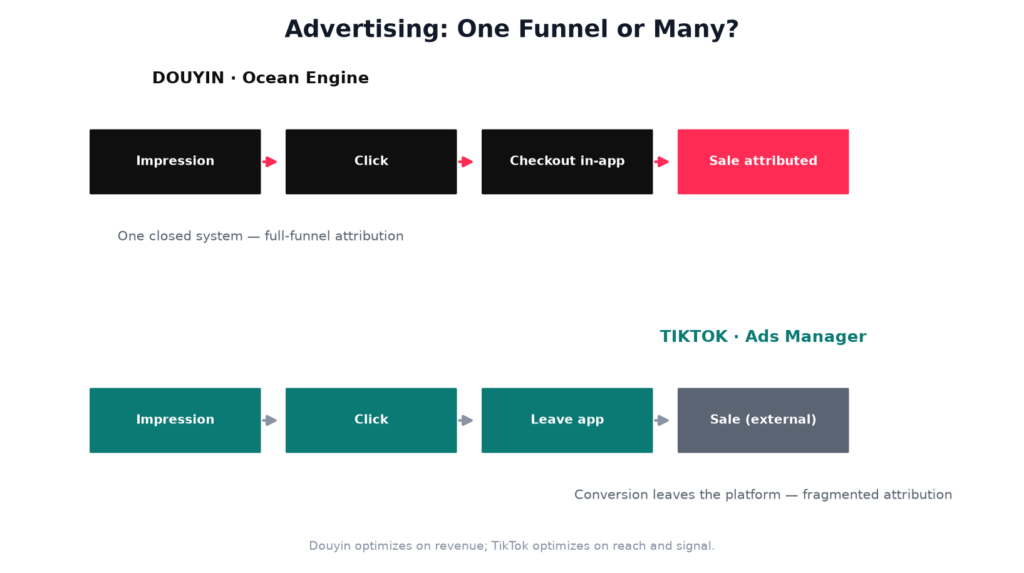
On the advertising side, the two apps share DNA but diverged in how the tools are packaged. Douyin’s ad ecosystem runs through Ocean Engine, ByteDance’s advertising platform, which bundles the app’s targeting, creative tools, and commerce attribution into one connected system. Because the transaction closes inside Douyin, an advertiser can trace a campaign all the way from impression to purchase in one place. That closed attribution loop is the quiet superpower of Douyin advertising. You spend, you see the sale, you optimize.
TikTok’s ad platform, TikTok Ads Manager, is powerful on reach and creative, but the conversion path is leakier. When the checkout lives on an external site, attribution gets fragmented. You can see the click, the view-through, the engagement, but connecting that to a final sale across a third-party site requires stitching together multiple systems. This is not TikTok failing; it is the structural reality of operating in a fragmented commerce environment. Marketers who come from Douyin often feel this as a loss of signal, and they are right to.
Regulation Shapes the Playbook
No serious cross-border marketer can ignore the regulatory layer, because it is not a footnote here, it is a live variable. TikTok’s existence in the United States, its single most valuable market with roughly 170 million users, has been the subject of repeated legal and political pressure over data security and ownership. At one point in early 2025, the app briefly went dark for US users before the enforcement was paused. That kind of event does not just change a platform’s roadmap; it changes how a marketer hedges, because you cannot build a long-term strategy on a channel that might be disrupted by forces outside your control.
Douyin operates in a very different regulatory climate. The pressure there is not about whether the app can exist, but about how commerce and content are governed: livestream compliance rules, data protection laws, advertising disclosure requirements. The risks are real but they are operational and predictable, not existential. A marketer on Douyin worries about compliance. A marketer on TikTok worries about the channel itself.
Creator Economics on Each Side
Creators are the engine of both platforms, but how they get paid differs in telling ways. On Douyin, a creator can monetize through a thick stack: livestream tips, brand collaborations through the platform’s Xingtu marketplace, e-commerce commissions from selling products directly, and in-app rewards. The commerce layer means creators are often small merchants themselves, running their own stores.
On TikTok, the paths are thinner and more uneven. The creator fund has been widely criticized for low payouts, so creators lean on brand deals, live gifts, and increasingly TikTok Shop affiliate commissions. Where Douyin blurs the line between creator and merchant, TikTok keeps them more separate, at least for now. The money follows the checkout, and on TikTok the checkout is still catching up.
What Marketers Get Wrong When They Translate
The most common mistake is treating the two apps as a localization project. Take the Douyin playbook, change the language, ship it. It fails because the assumptions baked into that playbook, closed-loop checkout, mature live commerce, a single payment rail, a dense logistics network, do not exist on the TikTok side. A live-commerce strategy built for Douyin’s always-on selling culture will underperform on TikTok, where audiences still treat live shopping as a novelty. A TikTok content strategy built purely for reach and brand lift will leave money on the table in China, where the feed is expected to convert.
The translation mistake cuts both ways. Western marketers entering China often bring TikTok habits with them, posting for reach and brand awareness, and wonder why they are not converting. The answer is the same: they are playing a reach game on a platform that is already wired for transaction.
A Side-by-Side Decision Framework
Put the two platforms side by side and the strategic differences snap into focus. Douyin is a closed loop: transaction, attribution, and audience all live in one place, which makes it ideal for direct-response and performance marketing where you can measure the full funnel. TikTok is an open reach engine: enormous discovery power, but a checkout and attribution path that extends beyond the app, which makes it better suited to awareness, demand generation, and top-of-funnel influence that you then capture elsewhere.
Neither is better in the abstract. They are better at different jobs. The marketer who succeeds is the one who matches the goal to the machine, not the one who tries to make one machine behave like the other.
When to Use Douyin, When to Use TikTok
Choose Douyin when your goal is conversion and you are selling into the China market. The closed loop means you can drive a transaction and measure it cleanly. Live commerce is mature enough that an always-on streaming operation can function like a sales channel, not a campaign. If you need predictable, attributable revenue from a short-video platform in China, Douyin is built for exactly that.
Choose TikTok when your goal is reach and demand creation, especially for Western or Southeast Asian audiences. The platform’s discovery power is unmatched, and it excels at putting your product in front of people who did not know they wanted it. Plan for the fact that the final purchase may happen off-platform, and structure your measurement accordingly. Use it to create the demand, then capture the demand through your own store, marketplaces, or TikTok Shop where it makes sense.
The One Thing Both Reward
For all their differences, the two apps reward the same underlying thing: native-feeling content that respects the feed. An ad that interrupts gets skipped on both platforms. A piece of content that earns its place in the feed gets watched. The formats, the pacing, the need to hook a viewer in the first second, these transfer cleanly across the border. What does not transfer is the strategy wrapped around the content, the assumption about where the money gets collected.
So the real lesson is not that Douyin and TikTok are opposites. It is that they are the same instrument played in two different rooms, and the room changes the sound.