Marvell Agreed to Pay $115 Billion. By the Closing Bell, the Paper Was Worth About $78 Billion.
On 2 November 2026 Marvell Technology agreed to acquire Lumentum in an all-stock deal with an implied enterprise value of $115 billion, exchanging 4.5 Marvell shares per Lumentum share at a 23.9% premium to the 28 October unaffected close; Marvell closed down 12.72% and Lumentum down 18.59%, cutting the offer’s paper value by roughly a third before the deal was a day old.
Marvell spent Monday morning describing a category it had just bought. The market spent Monday afternoon repricing the currency it had paid with.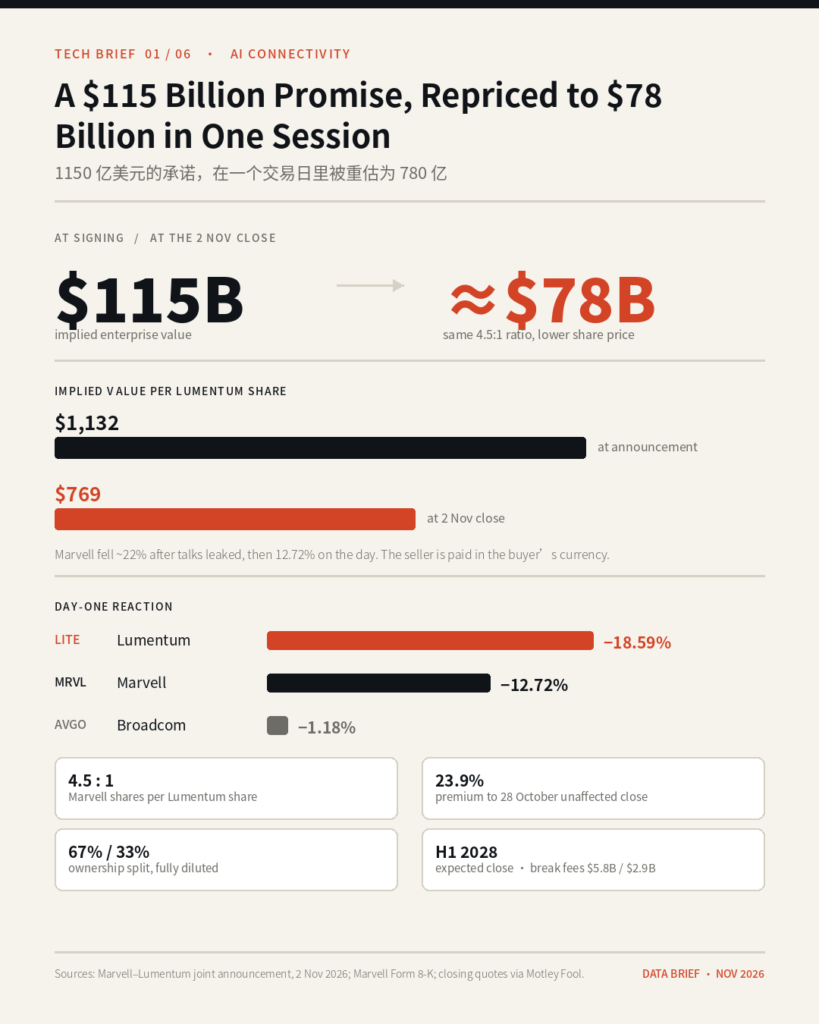
What was actually signed
The two companies announced a definitive agreement on 2 November. Marvell acquires Lumentum in an all-stock transaction with an implied enterprise value of $115 billion. Each Lumentum share converts into 4.500 Marvell shares, which the companies valued at roughly $1,132 per share — a premium of about 23.9% to Lumentum’s unaffected close on 28 October, the last trading day before speculation started. Marvell shareholders keep about 67% of the combined company on a fully diluted basis; Lumentum holders take roughly 33%.
The merger agreement is dated 1 November and uses a two-step structure with two Marvell acquisition subsidiaries. Matt Murphy stays chairman and chief executive. Michael Hurlston, Lumentum’s chief executive, plus two other Lumentum directors join a Marvell board that currently has seven seats. The companies put the combined addressable market at $550 billion and claim a path to more than $1 billion in annual run-rate cost synergies.
Those are the terms. Now the part that matters.
The currency moved while the ink dried
Marvell closed at $170.80, down 12.72%, on roughly 60 million shares — about 171% above its three-month average volume. Lumentum closed at $684.40, down 18.59%.
Multiply it out. At Monday’s close, 4.5 Marvell shares were worth about $769, not $1,132. The headline number did not shrink because anyone renegotiated anything. It shrank because a fixed exchange ratio turns the seller’s payout into a leveraged bet on the buyer’s share price, and the buyer’s share price fell double digits the moment the deal became real.
Lumentum now trades roughly 11% below the shares it has been promised. That gap is the market’s price for eighteen months of regulatory review, shareholder votes and integration risk.
Why a 24% premium produced a 19% decline
The instinct is to call this irrational. It is not.
A Lumentum holder who wanted out now owns a claim on Marvell — a much larger, much more cyclical company with a custom silicon business exposed to a handful of hyperscaler budgets. The premium is paid in a currency whose value is set by the market’s view of that exposure. On a day when the Nasdaq fell 1.07% and Broadcom slipped 1.18%, the market marked that exposure down hard.
And the deal does two things simultaneously that are individually defensible and jointly uncomfortable: it dilutes Marvell by a third, and it converts a components supplier’s growth story into Marvell’s consolidated problem.
The quarter underneath the multiple
Lumentum reported its fiscal first quarter, ended 26 September, the same day. Revenue was $1.263 billion against $533.8 million a year earlier — 136.5% growth. Adjusted earnings per share came in at $4.57. Guidance for the current quarter is $1.575 billion to $1.625 billion.
Those numbers are why the premium exists. They are also why the sell-off is interesting: the market was handed strong results and a strategic rationale in the same press release, and still marked both stocks down. When that happens, the argument being rejected is not about last quarter. It is about the price of the next five years.
Marvell has been telling this story for a month
At its investor day on 6 October, Marvell raised its fiscal 2028 revenue outlook to $20 billion and set a fiscal 2031 target of $70 billion to $90 billion. Murphy’s framing on Monday was architectural: “AI infrastructure is undergoing a fundamental architectural shift toward optical connectivity, creating an opportunity that comes along once in a generation.”
That is a reasonable description of what is happening inside AI clusters. Copper stops being practical well before the distances involved stop growing, and light does not.
The comparison that decides whether this works
Marvell’s competitor is not another optics vendor. It is Broadcom, which sells hyperscalers enough of an AI data centre that they can source most of it from one relationship.
Buying the missing piece is a coherent answer. It also invites the obvious customer question: do I now depend on a supplier that competes with me? Every merchant silicon vendor eventually hears it, and the answer usually involves qualifying a second source — which is precisely the dynamic that erodes the scarcity Marvell just paid for.
Eighteen months is not a formality
Closing is expected in the first half of calendar 2028, with an outside date of 1 November 2027 that can extend to February, May or August 2028 if required approvals are still outstanding. Marvell would owe $5.8 billion if it walks to a superior proposal; Lumentum would owe $2.9 billion. A separate $3.2 billion regulatory termination fee applies to specified approval failures.
Read the fee schedule as a risk map. The people who drafted it thought the regulatory path was the expensive one.
Bottom line
This is a well-argued acquisition priced in the most volatile currency available, announced into a tape that was already discounting AI infrastructure. The strategic logic — own both ends of the optical link — is sound. The financial logic depends on Lumentum’s triple-digit growth surviving long enough to justify a premium that the market has already marked down by a third.
FAQ
What is the deal actually worth? $115 billion in implied enterprise value at announcement, based on Marvell’s 28 October price. At the 2 November close the same exchange ratio implied roughly $769 per Lumentum share, cutting the paper value by about a third.
Why did Lumentum fall on its own takeover? Because the consideration is Marvell stock, not cash. A fixed ratio transmits the buyer’s decline straight to the seller’s payout.
Did Marvell overpay? It paid a 23.9% premium for a business growing 136.5% and guiding the next quarter to $1.625 billion. Whether that is expensive depends entirely on whether the growth rate holds.
What are the break fees? $5.8 billion payable by Marvell, $2.9 billion by Lumentum, plus a $3.2 billion regulatory termination fee in specified approval-failure scenarios.
What should customers watch? Whether qualified second sources for high-end optics survive the consolidation. That answer, not the deal price, determines what they pay in 2028.