Insight: Why the Market Grew Slower While Owners Spent More
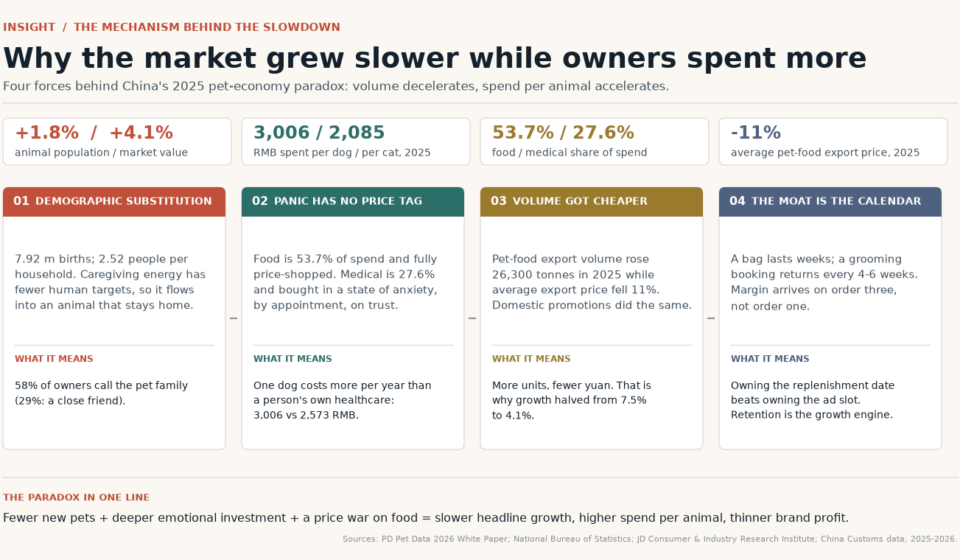
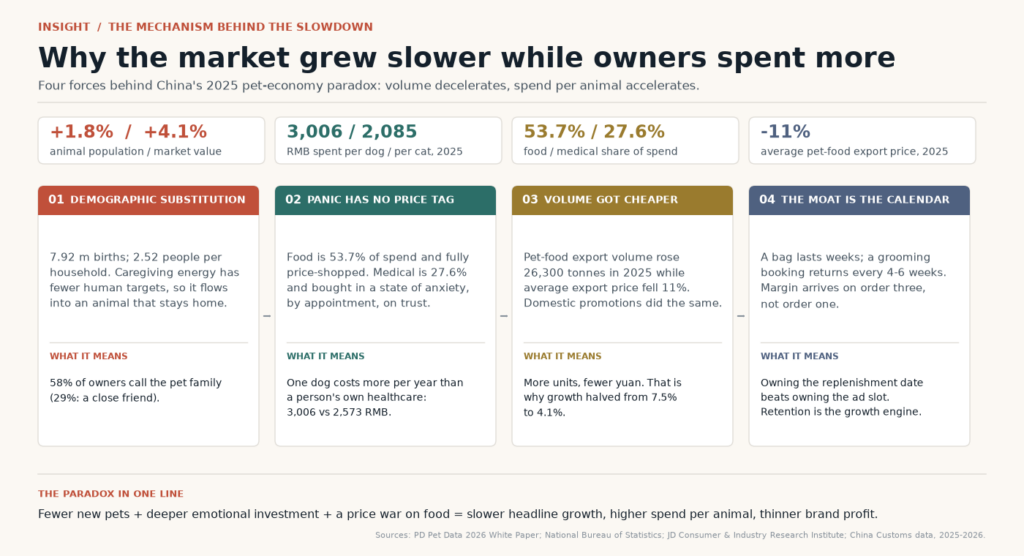
The 2026 white paper gave 2025 a name that much of the English-language coverage missed: “volume decelerating, spend accelerating”. That is the puzzle in a single phrase. China had 126 million urban dogs and cats, up 1.8%, while the market reached RMB 312.6 billion, up 4.1% — down from 7.5% growth in 2024. Average annual spend per animal hit a record: RMB 3,006 for a dog and RMB 2,085 for a cat, up 1.5% and 3.2%, respectively.
Most coverage read that as a premiumisation story. It is not, really. Four different mechanisms are pushing at once, and two have little to do with people feeling richer.
The caregiving instinct did not disappear. It changed address.
China recorded 7.92 million births in 2025, and the average household had shrunk to 2.52 people. With fewer people in the household, some owners may be directing more of their caregiving energy — the routines, the worry, the small daily expenditures — toward pets. A JD Consumer and Industry Research Institute survey found that 58% of owners see their pet as family and 29% as a close friend. You don’t “upgrade” that relationship. You keep spending within it, much as you would for a child, without treating every purchase as a cost-benefit calculation.
The 27.6% that nobody price-compares
Look at the spending split: food 53.7%, medical care 27.6%, supplies 12.2%, and services 6.5%. Food is easy to compare, coupon and discount. Veterinary care is different: an urgent visit can happen at 9 p.m., and owners may have little basis for judging what it should cost. That information gap gives providers a durable source of pricing power.
Here is the comparison that stopped me: annual spend per dog reached RMB 3,006 — more than the RMB 2,573 in per-capita healthcare consumption expenditure reported for Chinese residents in 2025. These are not like-for-like measures: one is average spend per pet, the other per person. Still, the contrast says something about where owners are willing to spend. This is not necessarily irrationality. It is what happens when a purchase becomes an act of identity rather than just another line item.
The price war hid inside the growth rate
Here is what the headline misses. In 2025, China exported 26,300 more tonnes of pet food, but export value fell to RMB 10.102 billion — down RMB 427 million — as average export prices dropped 11%. Promotions put similar pressure on domestic prices: more units moved, but fewer yuan came back per unit.
So growth did not slow from 7.5% to 4.1% simply because households tightened their belts. The industry moved more volume but captured less value. Gambol Pet’s 58.4% profit drop despite 8.2% revenue growth is the same equation, seen in one company’s income statement.
Why the moat moved to the calendar
A bag of food lasts a few weeks. A grooming appointment may come around every four to six weeks. If margins build only after a customer returns, the first sale is an acquisition cost, not a profit event. Once you see that, WeChat groups and paid memberships stop looking like marketing and start looking like assets that can compound through repeat purchases.
The discovery, then, is slightly uncomfortable. Loyalty in this market is not just a reward for a better product. It can also spare owners a price comparison they never wanted to make in the first place.