China Made 1,770 Short Dramas a Day in 2026. Creators Got the Bill.
China’s Micro-Drama Market Is Worth $14.9 Billion. The People Who Write It Are Not.
430,000 shows in eight months. More than nine in ten made with AI. When supply becomes infinite, the scarce asset stops being content — and becomes the right to decide who gets seen.
The number everyone quotes, and the one they leave out
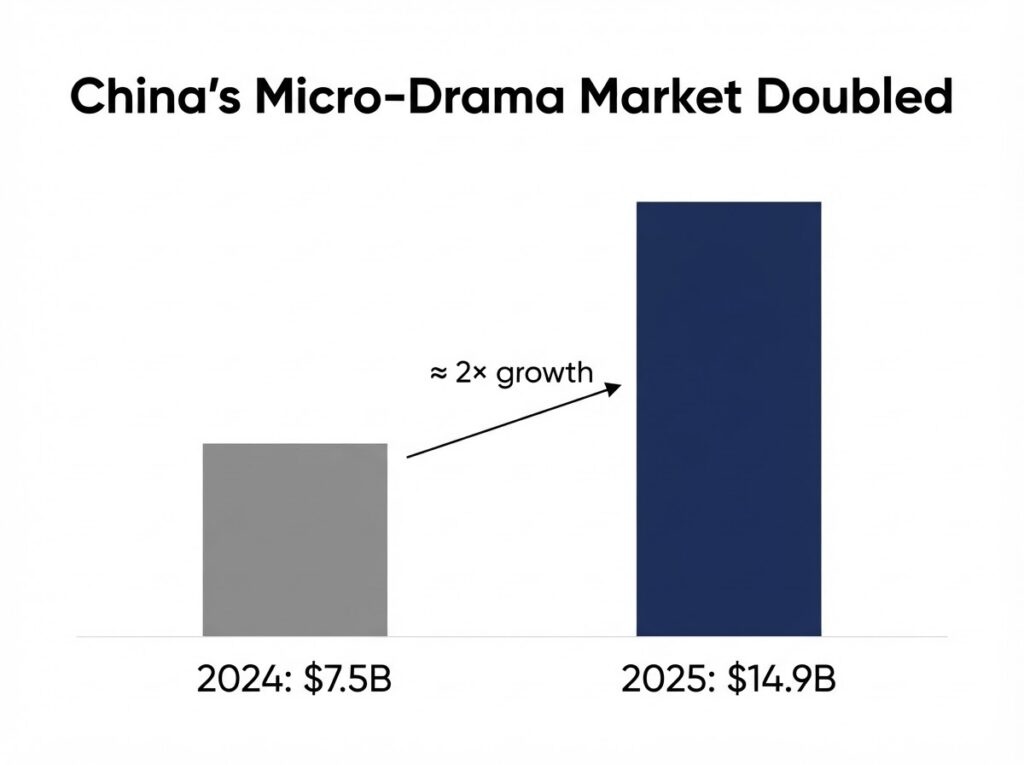
China’s micro-drama industry topped ¥100 billion — roughly $14.9 billion — in 2025, nearly double the ¥50.4 billion recorded in 2024. More than 800 million people watch the format, close to 57% of the country’s population.
Put that beside a harder fact: 2024 was the year micro-drama revenue first passed the total box office of every film released in domestic cinemas. A format that barely existed in 2018 now out-earns the movies. (The comparison is not apples-to-apples — “market size” and “box office” are different metrics — but the direction is unmistakable.)
Revenue, though, is not income. The gap between the two is the whole story.
Eight months, 430,000 titles, and a flood of machines
Between January and August 2026, Chinese platforms released 430,000 micro-dramas. The National Radio and Television Administration (NRTA) says that is 13 times the total for all of 2025 — which works out to roughly 33,000 titles across all of last year. More than 90% of this year’s releases were AI-generated.
Run the division: about 1,770 new shows a day, all chasing the same 800 million viewers and the same finite pool of advertising inventory. No market clears that kind of supply at a stable price per unit.
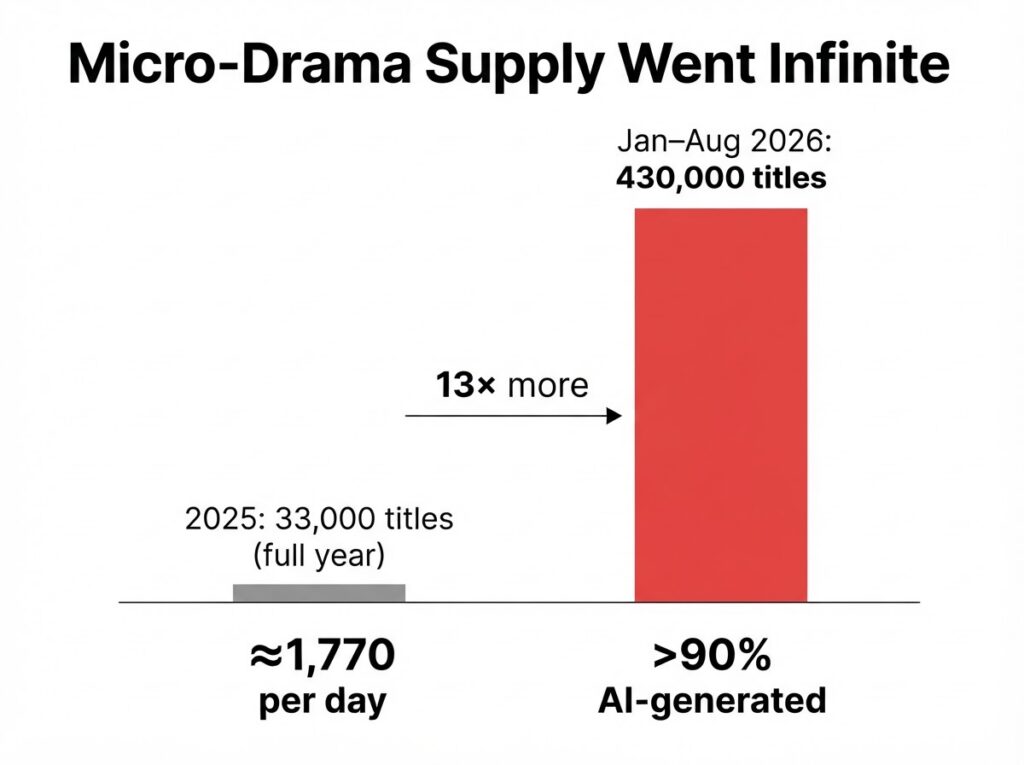
What infinite supply does to the price of a show
Production cost has collapsed. Scenes that once needed a location, a crew and weeks of post-production can now be generated on a workstation — a 33-year-old former screenwriter running an AI studio told the Global Times that everything from scene design to camera previews is now done on a computer. When marginal cost falls toward the price of compute and a prompt, the price of the finished product falls with it. Stock photography went through this. So did banner ads, and so did background music.
The cost that did not fall is the only one that matters: getting someone to press play.
The platform owns the only thing still scarce
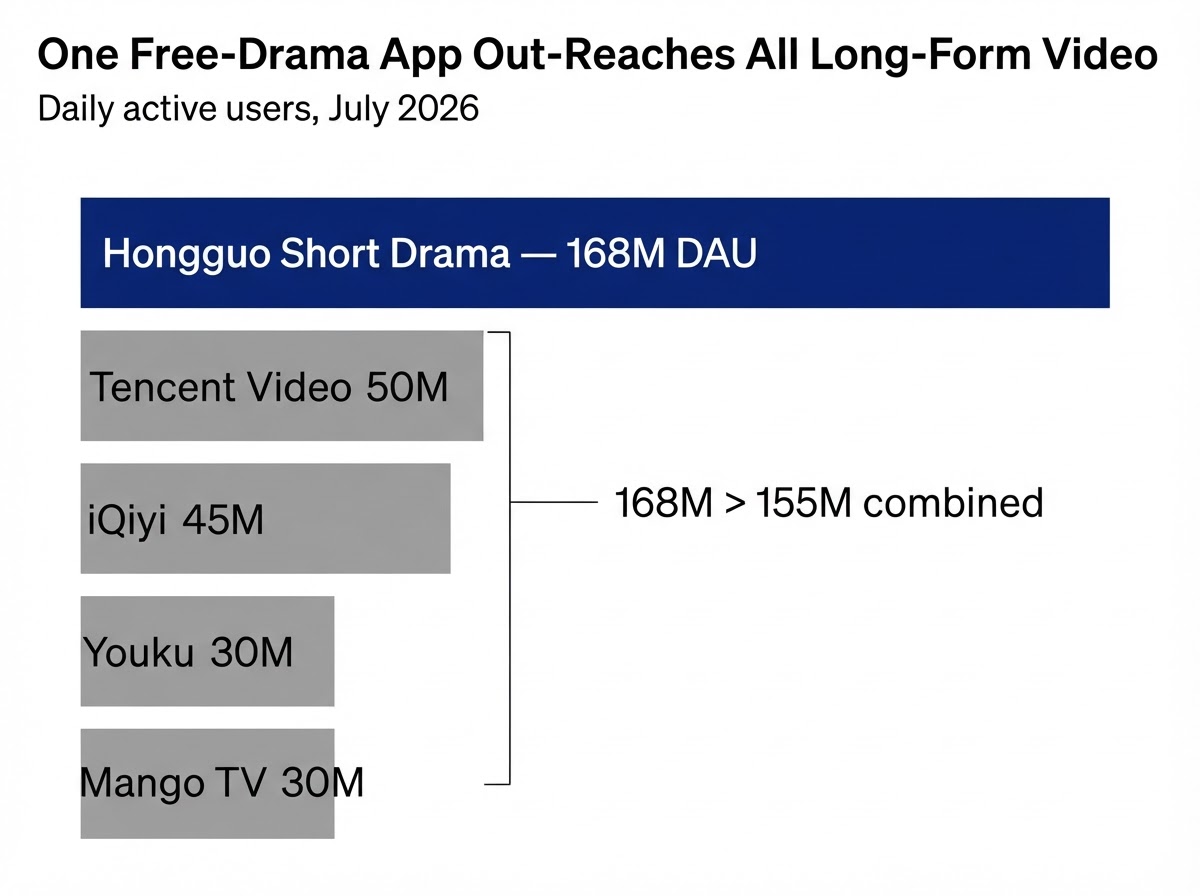
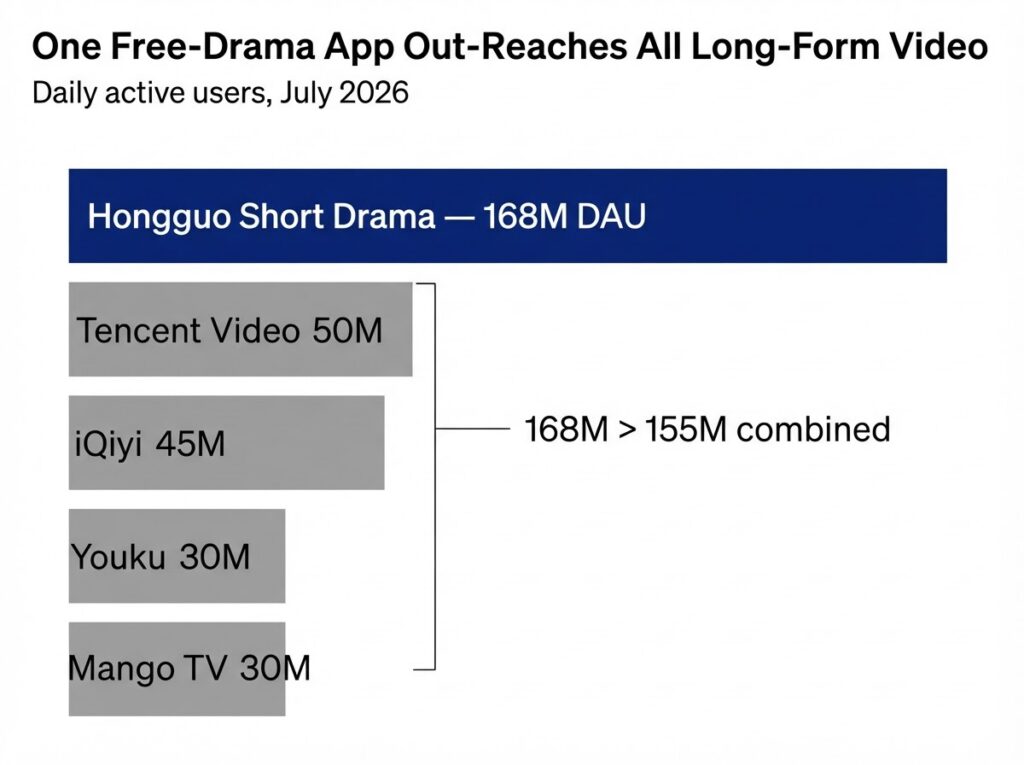
Hongguo, ByteDance’s free short-drama app, reached 168 million daily active users in July 2026, up 107% year on year. That single app now out-reaches the combined daily users of Tencent Video (≈50 million), iQiyi (≈45 million), Youku (≈30 million) and Mango TV (≈30 million). Its monthly active users hit 356 million in May this year, and in February 2026 its users averaged about 125 minutes per day on the app.
Two footnotes matter here. First, QuestMobile counts a “daily active user” as anyone who opened the app that day — and Hongguo’s sign-in bonuses and watch-for-coins mechanics pump that number. Treat it as reach, not engagement equivalence. Second, more than half of Hongguo’s new users arrive through Douyin’s traffic funnel: someone scrolls a short clip, taps, and lands in Hongguo to finish the episode. The distribution is the moat.
Those are not the numbers of a production company. They are the numbers of a distribution company that happens to be in the production business.
The model is simple and brutal. Shows are free to watch, advertising pays the bills, and a slice of that advertising is shared back with whoever made the show. The platform controls the feed, the ranking, the ad auction and the payment relationship. The producer controls a title.
Where the money actually stops
| Layer | Who holds it | What is scarce | Pricing power |
|---|---|---|---|
| Creation | Studios, freelancers, AI operators | Labour and taste | Low, falling |
| Aggregation | Apps and feeds | Attention and behavioural data | High |
| Monetisation | Ad auctions, payments, subscriptions | Verified demand and identity | High |
Every argument about AI and creative work eventually runs into this table. The technology improved the first row dramatically. It did almost nothing to the second and third, which is where the margin lives.
“Make better content” is not a strategy
Quality still matters — but only at the very top of the curve. With 1,770 titles arriving daily, the median show never gets a fair hearing. Ranking systems optimise for retention and completion, not for merit. A well-made series that loses viewers in the first four seconds is, to the algorithm, indistinguishable from a bad one.
That is why so many creators describe the same experience: the work gets better, the income does not.
Compliance is now a line item
In 2026 Chinese regulators removed 68,000 micro-dramas for rule violations.New rules require AI-generated shows to be labelled, and NRTA’s audiovisual-programming chief, Wang Xiaoliang, said platforms “must strictly respect portrait and voice authorization and conduct full-process vetting” before release.The underlying legal floor predates this: since 2023, editing someone’s face or voice using deep-synthesis technology requires notifying that person and obtaining their separate consent.
None of this is unreasonable. All of it is expensive. And fixed compliance costs always favour the party that can amortise them across thousands of titles. Platforms can. A three-person studio cannot.
The regulator’s own words undercut the AI-only story
Here is the nuance the “AI is replacing everyone” narrative misses. The same NRTA official who rattled off the 430,000-title figure also said this: “AI is a tool; people remain the main body of creation.” He added that live-action dramas remain “the main force of premium creation,” and that the regulator will guide platforms to open dedicated live-action sections and direct funding toward them.
Read that carefully. Even the government — which has every incentive to cheerlead the AI boom — is explicitly steering the industry back toward human-led, live-action work at the top of the quality curve. That is not a vote against AI. It is an acknowledgment that a market flooded with machine-made supply needs a scarce, defensible premium tier. And a premium tier is exactly what a lone creator cannot produce at 1,770 titles a day.
This is not a China-only pattern
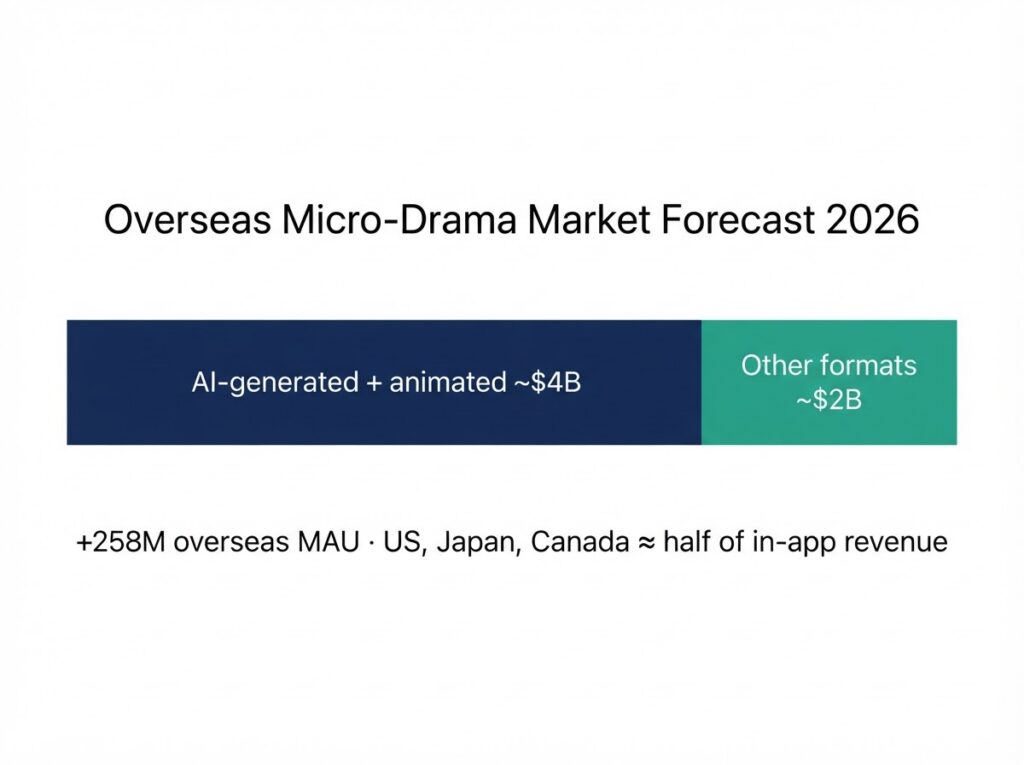
The export version of the same story is already forming. Monthly active users of overseas micro-drama apps reached 258 million by mid-2026, and research firm DataEye forecasts the overseas market will exceed $6 billion this year — with AI-generated and animated dramas contributing more than $4 billion, nearly 70% of the total.
AI did not invent this dynamic. Programmatic advertising compressed publisher CPMs while intermediaries took a larger share of every dollar. Mobile app stores settled on 15% to 30% of revenue as a routine cut. Music streaming pushed per-stream payouts to fractions of a cent while playlist placement became the real currency. AI just accelerated it — by making the supply side of every content market effectively unbounded.
What to do if you make things
Own a direct line to an audience. Email, a community, a paid membership, or a live format a prompt cannot copy.
Negotiate on revenue share, not per-title fees. A fee is a fixed cost the platform will grind down; a share is a claim on the upside.
Build assets that survive format changes. Characters, worlds and serialised formats can be re-licensed into new lengths, new markets and new languages. A single finished show cannot.
Treat AI as a margin tool, not a strategy. It lowers your costs. It lowers everyone else’s too.
What to do if you market things
If your brand’s content is now one of roughly 1,770 daily options, reach is no longer the scarce input — recall is. That argues for serialised, character-led, cheap-to-iterate formats rather than one-off hero films, and for measuring memory and search lift instead of impressions.
The uncomfortable conclusion
AI did not distribute the rewards. It distributed the attempt, and concentrated the payoff. The winners in this market are not the ones with the best generator. They are the ones who own the moment of choice.