Breadth Is Not Depth: What 21,000 AI Citations Reveal About Getting Quoted
The State of AI Search in 2026: Four Platforms, Four Different Tastes
A field guide to why the same brand is cited by one assistant, ignored by the next, and quietly reframed by a third — plus a workflow that scales across all of them.
Open four tabs. Get four different worlds.
Try this tomorrow morning. Take one real question your buyers ask — not a keyword, a question — and paste it into Doubao, DeepSeek, ChatGPT and Gemini. Then read the four answers side by side.
You will not get four phrasings of one truth. You will get four verdicts. One assistant names your competitor without blinking. Another cites six sources and refuses to commit. A third quotes a forum post from 2023 as if it were scripture. And a fourth doesn’t mention you at all — not because you rank badly, but because nothing in its retrieval path ever touched your page.
That is the part most marketing teams still get wrong. We keep saying “AI search” as if it were one channel with one set of rules. It isn’t. It’s a stack of at least eight consumer surfaces, each with its own audience, its own retrieval plumbing and its own taste in evidence. Optimize for “AI” and you optimize for a ghost.
So let’s do the unglamorous work: look at the scale, then the mechanics, then the workflow.
The numbers nobody reconciled
China: 499 million monthly users and a three-tier ladder
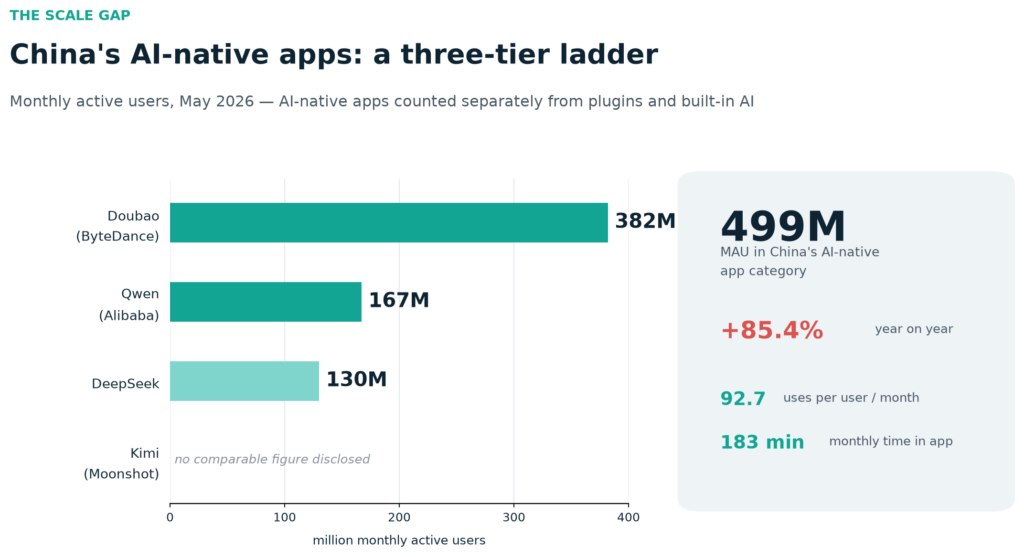
QuestMobile’s 2026 first-half report, released in mid-July, put China’s AI-native apps at 499 million monthly active users — up 85.4% year on year. Those users averaged 92.7 uses and 183 minutes per month. That isn’t browsing behaviour. That’s habituation.
Inside that category, the ladder is steep. Doubao sits at 382 million MAU, Qwen at 167 million, DeepSeek at 130 million. (Those per-app figures overlap — the same person often uses two or three of them — so they add up to more than the 499 million category total.) Kimi, the platform your research-minded colleagues love to cite, did not disclose a comparable app-level figure I could verify — so I’m not going to invent one for it.
The West: a billion-user club with a price list
ChatGPT crossed one billion weekly users during 2026, up from roughly 800 million weekly users in October 2025. Gemini reached 950 million monthly users in the second quarter of 2026 — more than double its level a year earlier — and crossed one billion monthly users later that year.
Two facts matter more than the milestones themselves.
First, the funnel is now an answer surface with a price attached. OpenAI expanded ChatGPT advertising to 89 countries in late October 2026. When the answer box becomes ad inventory, “organic” visibility starts competing with paid placement on the same surface — a dynamic SEO teams haven’t had to price since the top of the classic results page.
Second, the bundled distribution is doing the acquisition. Gemini’s adoption rides Google’s search, Android and Workspace defaults; Doubao rides ByteDance’s; Copilot rides Windows and Microsoft 365. The platforms with the sharpest native distribution win users without ever winning an argument about model quality.
Perplexity and Copilot, meanwhile, remain genuinely thin on public user figures. Perplexity is a citation-forward product by design; Copilot is a product family rather than a single search surface, and Microsoft doesn’t break out consumer search usage. Treat both as high-intent, low-disclosure channels — which is precisely why they reward direct testing over vendor decks.
Four platforms, four tastes: the Chinese stack
Doubao: the default for people who never asked for an AI
Doubao’s advantage isn’t model quality. It’s placement. It lives inside the ByteDance distribution machine, so it catches people who arrived for something else — a recipe, a tax question, a homework problem — and stayed for the answer.
Practically, that means breadth of intent and low tolerance for preamble. A Doubao user wants a usable answer in three lines. Content built for a Western “long-form authority” play often reads as slow here. Shorter, declarative, example-led passages travel better, and the questions arrive in spoken, colloquial Chinese rather than search syntax.
One caveat, because it’s the kind of thing that gets repeated as fact: I found no independent audit establishing which publishers Doubao’s answers prefer. ByteDance owning Douyin is not evidence that Doubao cites Douyin. Test it before you build a strategy on it.
Qwen: commerce in the bloodstream
Qwen’s consumer app sits inside Alibaba’s orbit, where shopping intent and assistant intent blur. That shapes the queries: “which one should I buy,” “is this worth it,” “compare these two.” Answers that carry structured comparison — specs, prices, trade-offs, named alternatives — have a natural home here.
The strategic read: if you sell anything, Qwen is less a research channel and more a consideration channel that happens to look like a chatbot.
DeepSeek: the technical filter
DeepSeek’s audience skews toward people who will check your work. That changes what “good content” means: claims need units, methodology and dates. A page that says “significantly faster” gets skimmed; one that says “17.3% higher citation rate across six engines” gets quoted.
Technical credibility is the currency here. Vague authority signals — a nice logo wall, a press page — buy very little.
Kimi: the long-document reading room
Kimi built its reputation on long-context reading: drop in a 200-page PDF, ask questions. Whatever its current scale, the behavioural signature persists — users arrive with documents, not curiosities. Content that survives being chunked out of a long document wins: clean headings, self-contained sections, definitions that don’t depend on the previous paragraph.
That is, conveniently, also what the retrieval research rewards. More on that in a minute.
The Western parallel
ChatGPT: the reasoning default with an ad slot attached
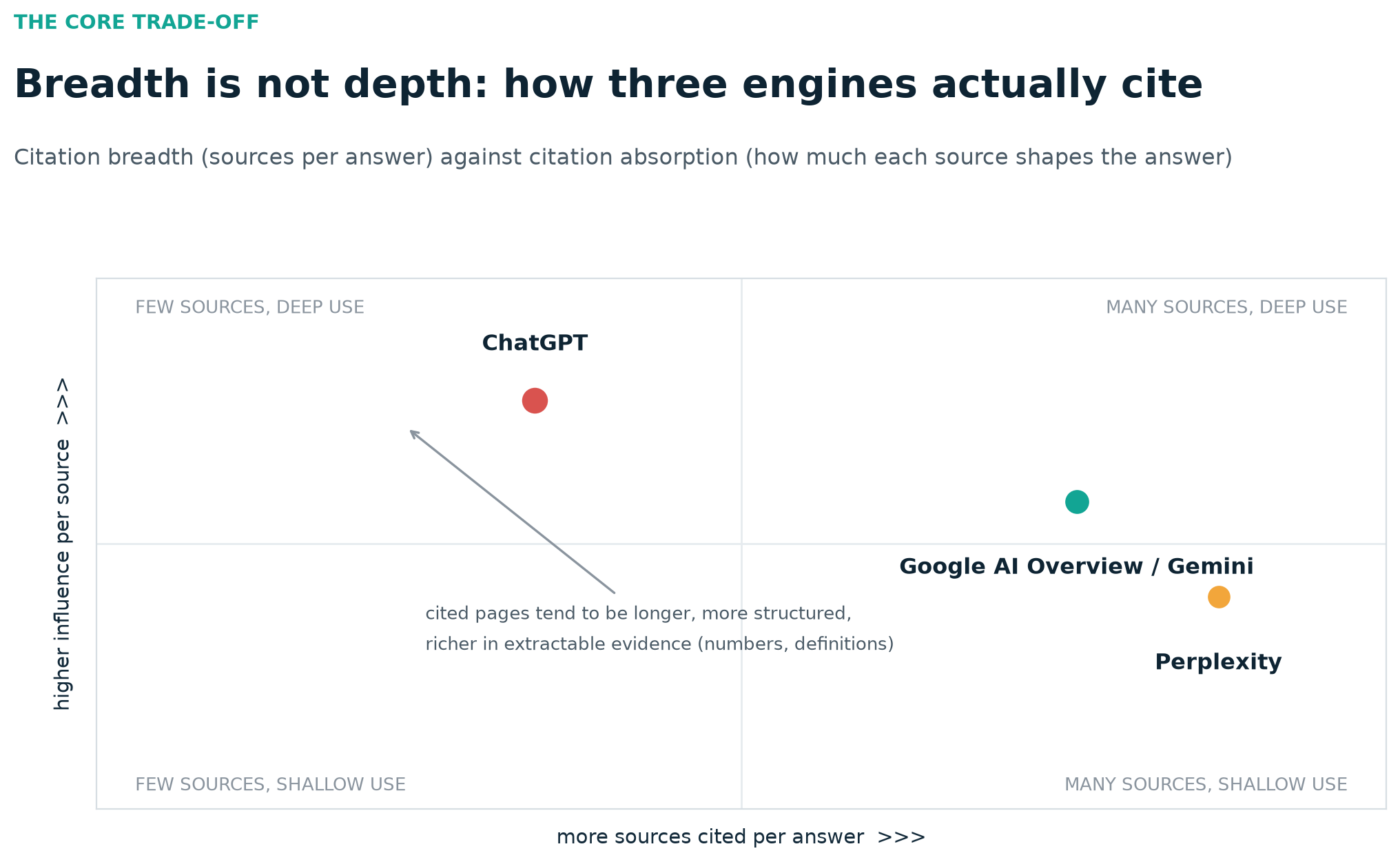
ChatGPT is where “search” quietly became “delegation”. People don’t ask it for links; they ask it to decide. A 2026 cross-platform citation audit found ChatGPT citing fewer sources per answer than its rivals, while those sources carried higher average influence.
Translation for marketers: you don’t need to be cited often. You need to be the one source that gets absorbed. But you now have company in the answer box — the ad slot — so the “absorbed source” position is becoming the only organic position that still exists there.
Gemini and AI Mode: the index giant
Google already owned the index; now it owns the answer. AI Overviews and AI Mode layer summarization on top of Search, which gives Gemini’s retrieval an unmatched pool of candidates and aggressive selection. Gemini’s billion-user scale makes it the single largest answer surface on earth.
The catch: Google publishes no stable citation formula, and domain authority alone doesn’t predict selection. What shows up repeatedly in the research is structure and extractability — the same things that survive chunking.
Perplexity: the citation maximalist
Perplexity’s whole product promise is transparency — visible sources, numbered, right there. In the same audit sample it cited more sources per answer than ChatGPT. For a brand, that’s a paradox: more chances to appear, less influence per appearance.
If your goal is presence and defensibility — “we were in the answer” — Perplexity is friendly ground. If your goal is being the answer, it’s a harder room.
Copilot: the workplace incumbent
Copilot’s retrieval leans on Bing and, in enterprise contexts, on documents the user is already authorised to read. That makes it the one platform where your own gated content can outrank the open web. Whitepapers, help centres and internal knowledge bases behave differently here than anywhere else.
What actually differs: four axes, not forty tactics
Strip away the branding and four variables explain most of the variance.
Audience and intent. Mass-market curiosity (Doubao), shopping consideration (Qwen), technical verification (DeepSeek), document work (Kimi), delegation (ChatGPT), existing search behaviour (Gemini), source-checking (Perplexity), workplace tasks (Copilot).
Source preference. A 2026 audit of mental-health queries found platforms differing “sharply in consistency and in the source types they favoured” — government, commercial health and academic sources each landed near 22% of citations, but not in the same proportions per engine.
Format tolerance. Ranked “best-of” listicles were the single most-cited content format at roughly 21% of citations, and about 78% of citations went to corporate websites. Among non-corporate sources, YouTube led, ahead of Reddit, editorial media and Wikipedia. That is a very specific taste, and it isn’t the taste most brand blogs are cooking for.
Citation mechanics. Breadth versus depth. Which brings us to the most useful distinction in this whole field.
Breadth is not depth
Here’s the finding I’d frame and put on the wall. Citation has two stages: selection (the engine decides to fetch you) and absorption (your page actually shapes the sentence the user reads). Most “AI visibility” tools measure the first and ignore the second.
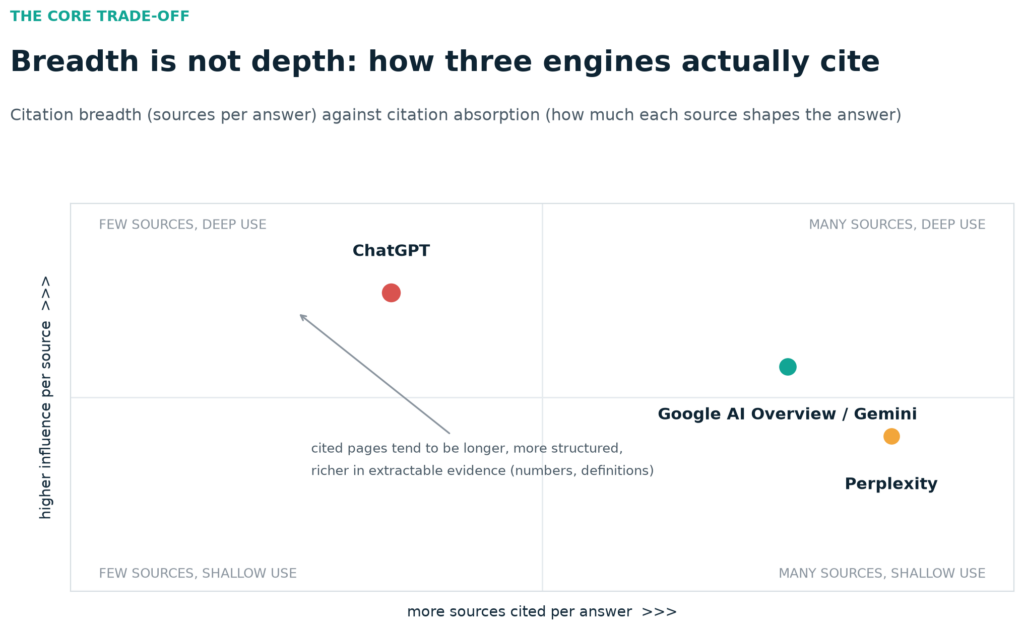
The absorption finding is actionable. High-influence pages were longer, more structured, semantically aligned, and richer in extractable evidence — definitions, numerical facts, comparisons, procedural steps. Not “better written.” Better quotable.
And structure isn’t decoration. A 2026 framework decomposing content into macro (document architecture), meso (chunking) and micro (visual emphasis) levels reported +17.3% citation rate and +18.5% subjective quality across six engines. The original GEO paper made the same bet two years earlier, with up to 40% visibility gains.
The ladder compounds, and that’s the uncomfortable part
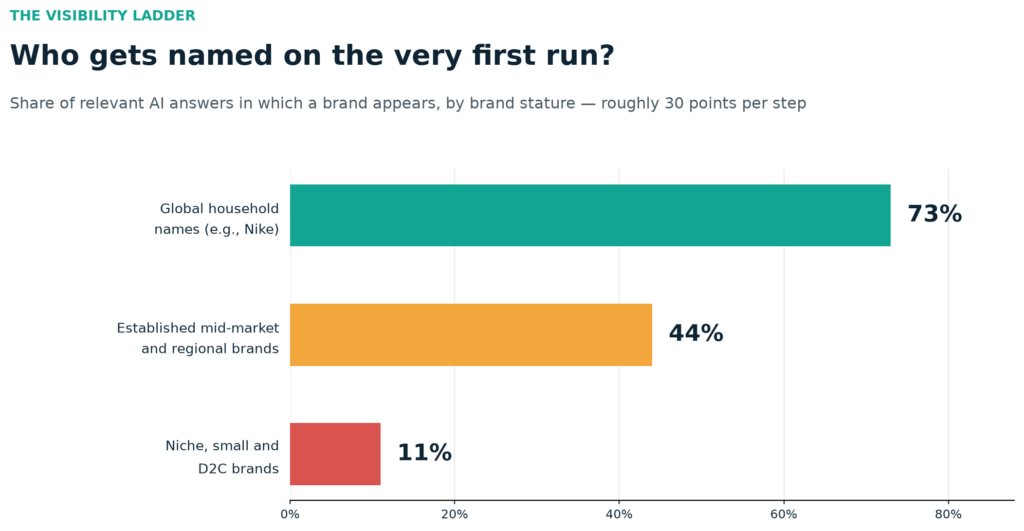
Read that again. A household name appears in 73% of relevant AI answers the first time it’s measured. A niche brand: 11%.
This is the least comforting number in the research, and the most strategically clarifying. AI answers inherit the authority hierarchy of the open web rather than inventing a new one. Which means the realistic goal for a challenger brand isn’t “dominate AI search” — it’s “move one rung,” because one rung is roughly thirty points of presence.
The click is collapsing — slower than the panic suggests
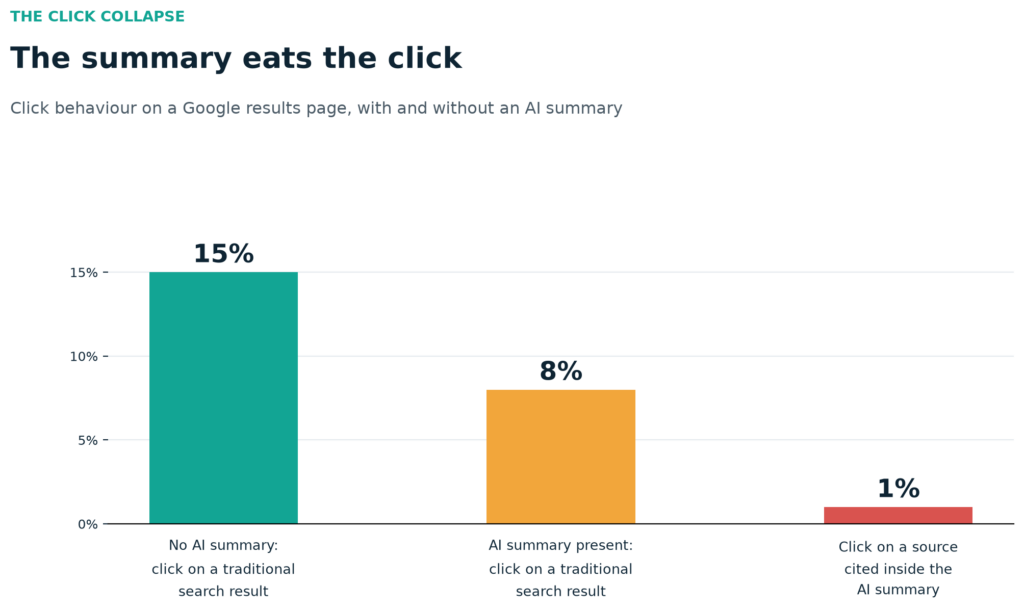
Pew Research Center’s 2025 browsing analysis found traditional-result clicks falling from 15% to 8% when an AI summary appeared, with only about 1% of summary visits producing a click on a cited source. A separate 2026 study of 900 U.S. adults over one month reproduced the ~1% figure and added the sting: AI overviews were associated with fewer clicks and higher rates of ending the browsing session.
So why keep optimizing? Because of what the 1% is made of. It isn’t proportional traffic — it’s the highest-intent slice you have, arriving pre-qualified by an engine that vouched for you. And because the 73/44/11 ladder is real, the absence of a mention costs more than the absence of a click.
Inside the citation pool
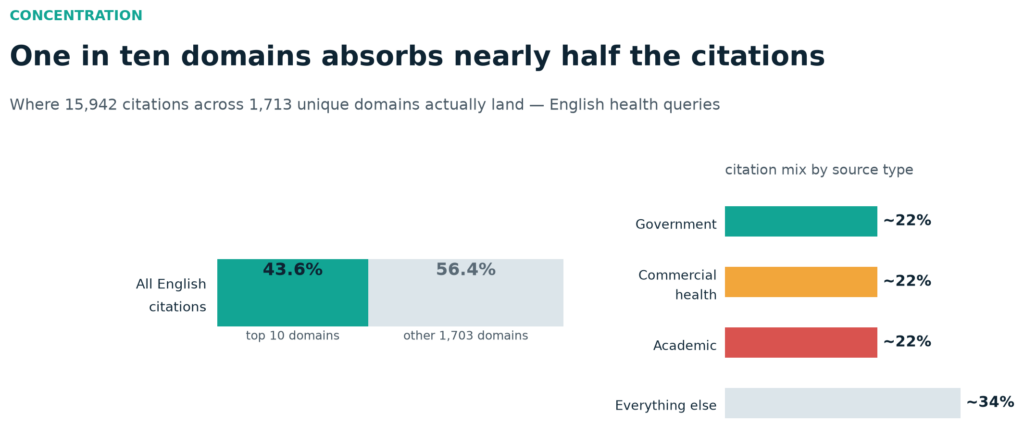
Concentration is the structural fact. A tenth of the visible web absorbs nearly half the citations. For brands, that’s both a warning and a map: the pool is small, but it isn’t closed.
There’s a second, quieter finding in that same audit worth flagging for anyone working in Chinese. Non-English queries surfaced fewer citations and were routed to language-appropriate resources at significantly lower rates. If your market is Chinese-speaking, that isn’t a footnote — it’s the business case for publishing native-language source material instead of translating an English page and hoping.
The variable that actually moves: sentiment
Mention is sticky. Framing is not. In the 100K-response study, whether a brand was described positively or negatively flipped about 6.7 times more often than whether it was mentioned at all.
Which means the thing to monitor weekly isn’t “are we cited.” It’s “how are we characterized” — because that’s the number that moves without warning, and the one that quietly sets your price.
One core claim, eight surfaces, one loop
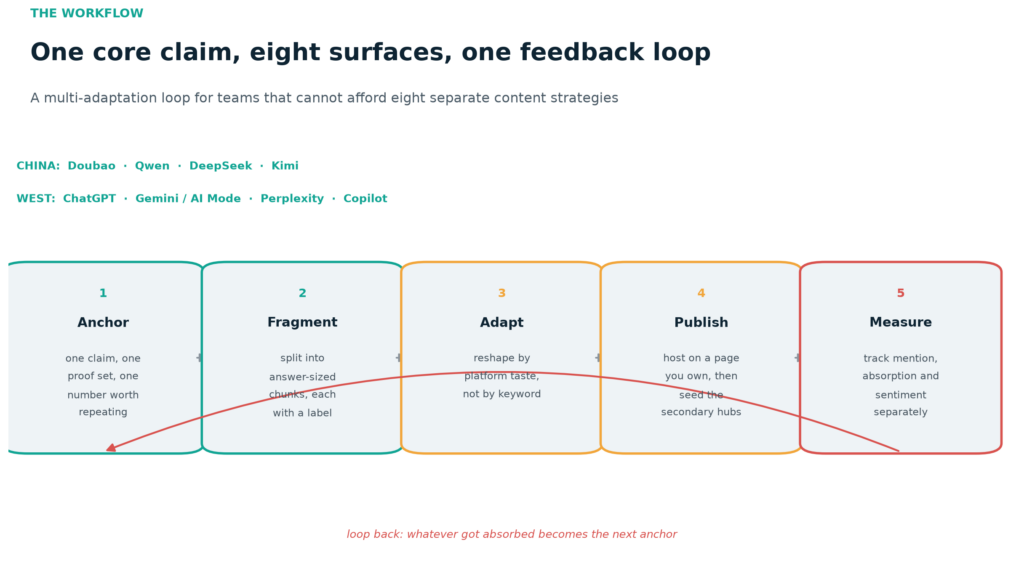
Here’s the workflow I’d actually run.
1. Anchor. One claim, one proof set, one number worth repeating. If your core claim needs three qualifiers to survive, it will not survive chunking anywhere.
2. Fragment. Break it into answer-sized pieces, each with a label that travels alone: a definition, a comparison table, a three-step procedure, a dated statistic with its source.
3. Adapt. Reshape by platform taste, not by keyword. Short and declarative for Doubao. Comparison-dense for Qwen. Units and methodology for DeepSeek. Self-contained sections for Kimi. One absorbable core for ChatGPT. Extractable structure for Gemini. Transparent sourcing for Perplexity. Gated depth for Copilot.
4. Publish. Own the canonical page. Then seed the secondary hubs the engines actually cite — because 78% of citations go corporate, but YouTube and Reddit carry the rest of the non-corporate share.
5. Measure. Three separate metrics, never blended: mention rate, absorption (does your language appear in the answer), and sentiment. Blend them and you’ll optimize for the wrong one.
Then loop. What got absorbed becomes the next anchor.
What I’d stop doing
Three habits deserve to die in 2027.
Chasing one “AI SEO” checklist. Structure travels. Tactics don’t. Every platform-specific hack decays within a quarter.
Reporting citation counts as success. Breadth without absorption is a vanity metric with a dashboard.
Treating translation as localization. The citation-routing data says otherwise, and it says it loudly.
What to measure weekly, honestly
A realistic Saturday-morning routine: twenty prompts per platform, the same twenty each week, run logged-out. Record three columns — mentioned, quoted, tone. Two prompts that changed. One sentence of interpretation.
That’s it. Anything more elaborate tends to produce prettier charts and worse decisions.
The bottom line
AI search in 2026 is not a channel. It’s a set of taste profiles attached to different retrieval stacks, sitting on top of an authority hierarchy that predates all of them.
The brands winning right now aren’t the ones with the cleverest prompt-engineering tricks. They’re the ones who realized the work is mostly the old work — clear claims, structured evidence, honest sourcing, native-language depth — executed against eight different palates instead of one.
Sound familiar? It should. It’s just SEO, with a much shorter attention span.
FAQ
If I rank #1 on Google, am I automatically visible in AI answers?
No. Ranking supplies a candidate pool; the engine still decides what to select and how much of it to absorb. A #1 page that opens with 400 words of throat-clearing can lose to a #6 page with a clean definition and a dated statistic. Rank is an input, not an outcome.
Can a small D2C brand realistically break into AI answers?
Yes, but not by outspending anyone. The 11% baseline for niche brands reflects authority inheritance, not a permanent ceiling. The reliable path is owning a narrow, high-specificity claim — a comparison, a procedure, a proprietary number — that no incumbent has bothered to publish in extractable form. One rung is about thirty points; that’s a reachable year.
Does optimizing for Doubao also help on ChatGPT?
Partly, and less than agencies claim. Structure, evidence density and self-contained chunks generalize. Language, length tolerance and query phrasing don’t. Build a shared spine and adapt the surface — the reverse approach produces content that’s mediocre everywhere.
How often do AI answers change, and how do I monitor without burning budget?
More often than rankings, less often than social feeds. Twenty fixed prompts per platform, weekly, logged-out, is enough signal to catch shifts. Sampling more broadly buys precision you won’t act on.
Do citations actually drive revenue, or just impressions?
Both, but not evenly. A cited-source click is roughly 1% of summary visits — tiny in volume, unusually high in intent, because the engine pre-vouched for you. The larger commercial effect is upstream: presence in the answer shapes consideration before anyone clicks anything. Measure it as brand demand, not as referral traffic.