537 Million Users, 44% of Them Cross-Shopping: What China’s AI Apps Mean for Your Brand in 2026
A Marketer’s Guide to China’s AI Platforms: Doubao, Kimi, DeepSeek, Qwen
Four platforms, four different marketing surfaces — and one mistake that keeps turning up in 2026 plans: treating China’s AI apps as a single “AI channel”.
Doubao, Qwen, DeepSeek and Kimi do not compete for the same attention, and they do not reward the same content. A brand that comes across well inside Doubao can be invisible inside Kimi. Not because one model is smarter. Because the people typing into them are doing different jobs.
What follows is the map: the numbers as they stood in late 2026, and what each platform changes for a marketing team.
The short answer
- Doubao is reach and transactions. About 382 million monthly users in June 2026, plus a checkout wired into Douyin’s commerce stack. Broad audience, short attention.
- Qwen is distribution, bought at scale. Alibaba moved from near-zero to roughly 167 million monthly users in a year, then plugged the assistant into Taobao.
- DeepSeek is depth without habit. Smallest of the top three by users, longest sessions, and influence that travels through open weights rather than an app store.
- Kimi is the specialist. Modest audience, unusually long documents, and a business built on developers and enterprises.
- Choose the platform by the decision you want to influence. Choosing by audience size is how budgets disappear.
Why “China’s AI market” is the wrong unit of analysis
Start with the base. QuestMobile counted 537 million monthly users of AI-native apps in August 2026, up from 287 million a year earlier. That is roughly a doubling in twelve months in a country of about 1.4 billion people.
Official statistics confirm the demand side. CNNIC, China’s state-backed internet statistics agency, put China’s generative AI user base above 700 million in the first half of 2026, with penetration past 50 percent. At the end of 2025 the figure was 602 million users.
Now the part most decks skip. In August 2026, 44 percent of AI app users opened at least three assistants. A year before, the figure was 32.5 percent. The share of users who touched only one app fell from 36.7 percent to 25.4 percent.
So the audience is not loyal to a single assistant. They shop across assistants the way people once shopped across supermarkets. That single fact breaks the old mental model of “picking the winning app”. Your job is not placement. It is being the answer that survives being checked in three different places.
There is a second shift underneath. China’s traditional search category is shrinking in usage, not merely in reputation. In May 2026, per-user search frequency fell 19.1 percent year on year and per-user time fell 13.5 percent, according to QuestMobile. QuestMobile’s analysts describe the mechanism bluntly: as assistants take over the decision, app content becomes raw material for AI retrieval, and value migrates toward whichever layer answers the question.
Read those two findings together and the strategic consequence is obvious. Discovery is moving into interfaces you do not own, cannot buy your way into, and cannot measure with a session count.
One caveat before the numbers get quoted. QuestMobile’s ranking covers AI-native apps only: standalone products someone deliberately downloaded and opened. Preinstalled handset assistants are counted separately, and that category reached 755 million monthly users in June 2026. If you are modelling total AI reach in China, 537 million is the floor, not the ceiling.
The 2026 scoreboard
| Platform | Owner | Monthly users, June 2026 | Reach among AI app users, Aug 2026 | What it rewards |
|---|---|---|---|---|
| Doubao | ByteDance | 382.3M | 77.2% | Clear facts and a fast path to purchase |
| Qwen | Alibaba | 167M | 29.4% | Offer data, merchant terms, service policies |
| DeepSeek | DeepSeek | About 129M | 22.8% | Technical proof and honest limits |
| Kimi | Moonshot AI | Not disclosed | — | Long documents, methodology, diligence |
Two notes on reading that table. First, the percentages overlap: a heavy user can appear in three rows at once, so they cannot be added together. Second, the June and August columns come from different reports and measure different things — absolute users versus share of the AI app population. Treat the table as a shape, not an audit.
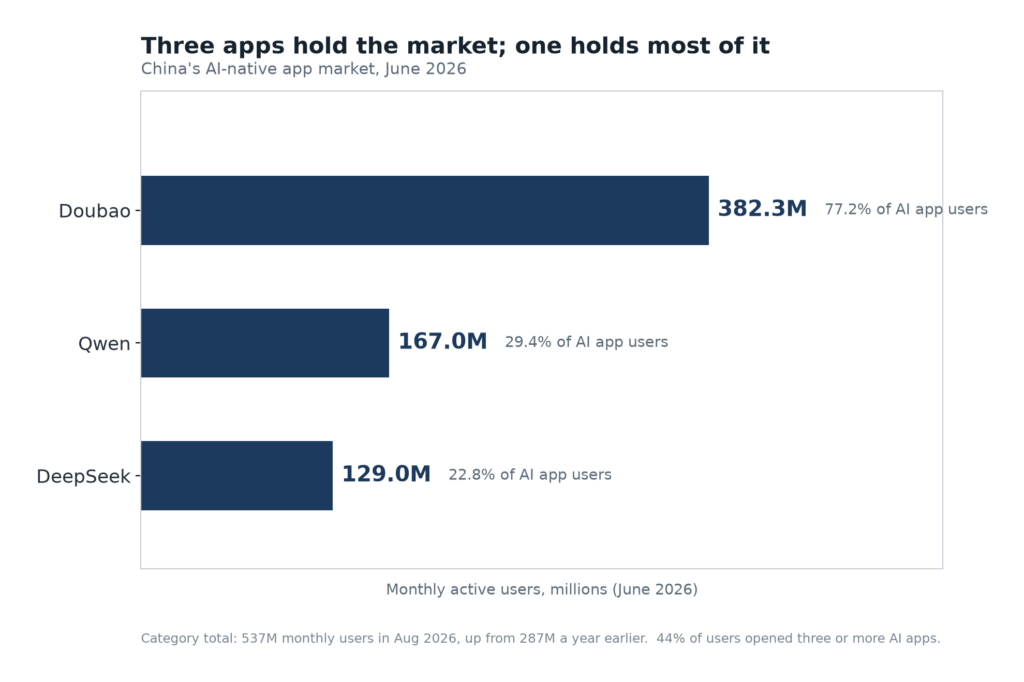
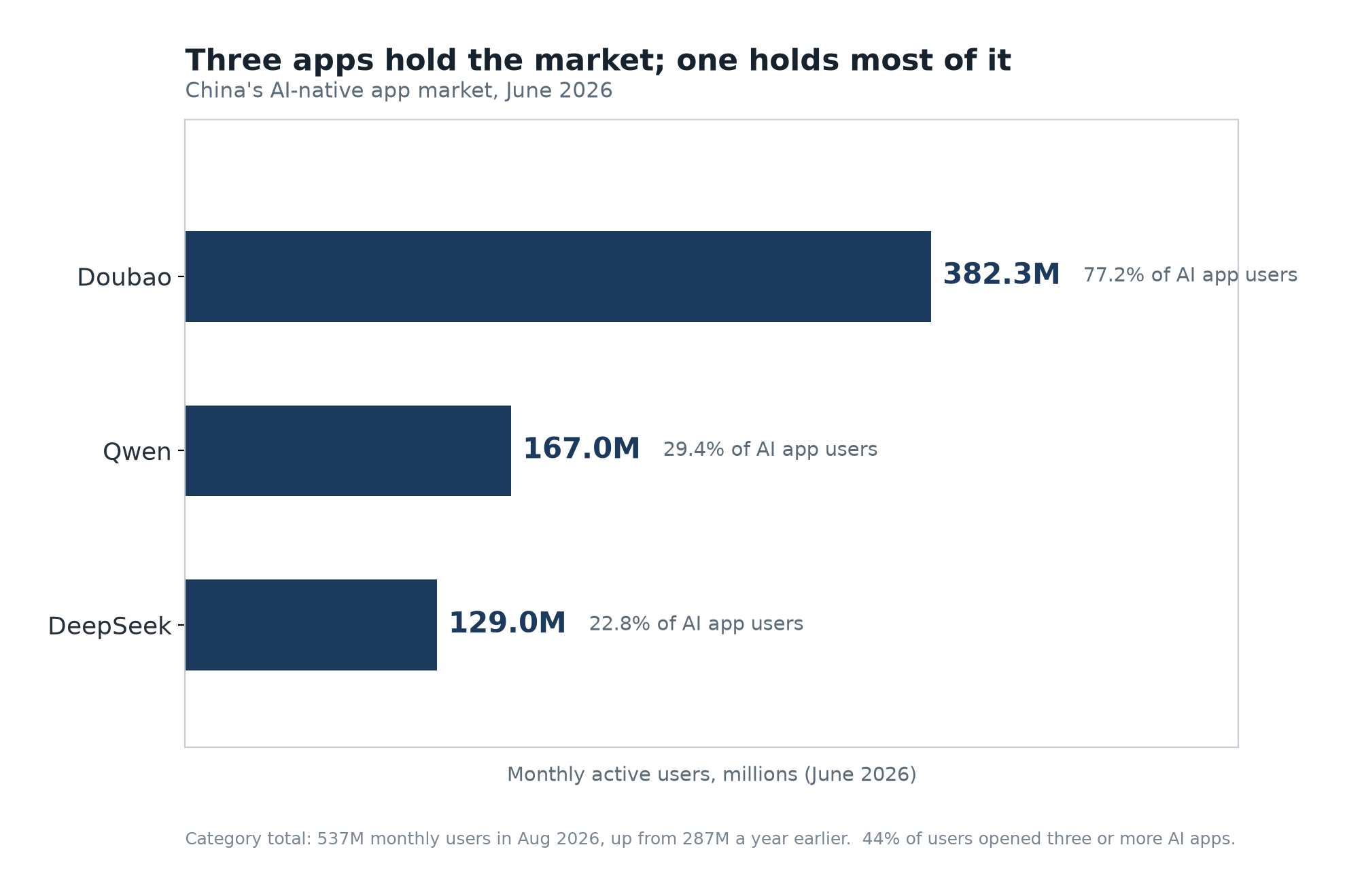
Even so, the shape is stark. Doubao, Qwen and DeepSeek account for more than 80 percent of the top ten apps’ combined user base. Everything below third place is, statistically speaking, a rounding error.
Doubao: the reach machine
What the numbers say
Doubao , ByteDance’s consumer assistant, finished June 2026 with 382.3 million monthly users, up 172.1 percent year on year. In the second quarter alone it added roughly 37 million people while the whole category added about 59 million users. One product absorbed close to two-thirds of the industry’s net growth in a single quarter.
Reach followed. By August 2026, 77.2 percent of all AI app users in China had opened Doubao that month, against 54.9 percent a year earlier.
What the behaviour says
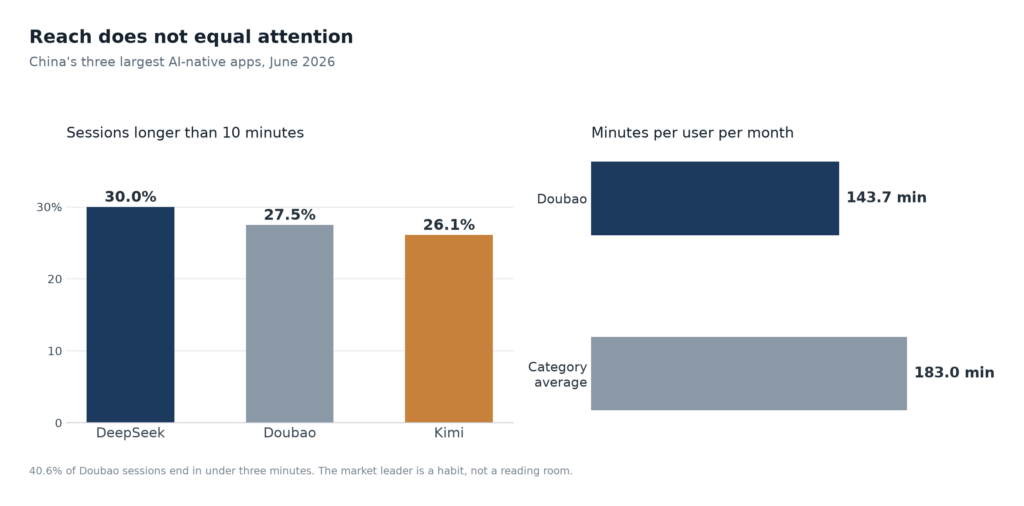
This is where the story gets more useful than the headline. Doubao users opened the app 76.7 times a month and spent 143.7 minutes in the app. The category averages are 92.7 opens and 183 minutes. So the market leader sits below average on intensity, and 40.6 percent of its sessions end within three minutes.
Translation: Doubao is a reflex, not a research desk. People check something, get an answer, and leave. If your content needs a paragraph of setup to be persuasive, this is the wrong surface for it.
Where commerce fits
ByteDance has spent 2026 turning that reflex into orders. A shopping entry point appeared in the app’s navigation in April 2026, wired to Douyin’s e-commerce system, with add-to-cart, payment and after-sales handled inside the conversation. By October, livestream rooms were being embedded directly into answers, so a user can watch a seller and place an order without leaving the assistant.
The economics are thinner than the reach suggests. Reporting by 21st Century Business Herald put Doubao’s own daily revenue below RMB 1 million in the first half of 2026, mostly e-commerce commission. Reach at that size, monetised at that level, tells you the commercial model is still being tested rather than proven.
Doubao also launched a paid subscription tier on 24 June 2026, aimed at office and productivity work. That matters more to B2B marketers than to consumer brands: it signals ByteDance’s push to move the assistant from entertainment toward work.
What it means for your brand
Two jobs, and they are different. First, be the obvious, quotable answer to a broad, low-intent question, the kind someone asks while half-distracted. Second, be purchasable at the moment the answer appears: accurate price, stock, variants, delivery terms.
Short-form video and clean product feeds do more work here than a white paper does. Clarity beats depth on this surface. Every time.
Qwen: distribution, bought and bundled
The growth is real, and it is purchased
Qwen is the model family; the consumer app is Qianwen (千问). It finished June 2026 with 167 million monthly users, the second-largest base in China. The oft-quoted growth rate of 5,792.9 percent is a base effect, not momentum: the standalone app launched in public beta on 17 November 2025 and passed 10 million downloads within a week.
What happened after launch is the interesting part. Alibaba bought distribution with unusual force. It committed roughly RMB 3 billion (about USD 431 million) to a Lunar New Year promotion in February 2026 that turned assistant usage into vouchers redeemable through Taobao’s instant-delivery network. Alibaba later said AI completed more than 120 million orders during the campaign.
The spending did not stop when the holiday ended. In June 2026, QuestMobile estimated that Qwen accounted for 77.7 percent of the media ad spend and 79.4 percent of the influencer spend across the three assistants it tracks. Paid reach, sustained month after month, is how a late entrant becomes a habit.
The bundle is the moat
Advertising explains the audience. Taobao explains the business. In May 2026, Alibaba connected Qwen to Taobao end to end: product discovery, order, payment, after-sales. The assistant stopped being a search box and became a checkout counter.
Distribution widened again in the autumn. China’s regulator cleared Apple Intelligence, which runs on Alibaba’s models, for launch in the mainland, with a rollout planned for December 2026 alongside iOS 27.3. Whatever you think of the feature set, that puts the assistant, preinstalled, on a large number of premium phones.
Meanwhile the open-weight Qwen models keep giving Alibaba something money cannot buy outright: developer default status. Teams building outside China often reach for Qwen weights before they reach for Qwen’s app.
What it means for your brand
Qwen is where search turns into a shelf. That makes merchant-grade data the price of entry: structured offers, discount logic, shipping and return terms, service hours, compatibility notes. Copy that sounds good to a human and vague to a parser is close to useless.
If you sell through marketplaces, assume your product data is already the content being quoted. Fix the feed before you rewrite the landing page.
DeepSeek: depth, not habit
By June 2026 DeepSeek stood at about 129 million monthly users, down 20.3 percent year on year, in a market that almost doubled. Per-user time in the app rose 109.8 percent over the same period. And 30 percent of its sessions ran longer than ten minutes, the highest share among the three leaders.
Fewer people, much longer visits. That is not a failure mode. It is a different job.
The structural reason is simple. DeepSeek owns no feed, no store and no messaging network through which to route traffic into its app. ByteDance has Douyin, Alibaba has Taobao, Tencent has WeChat. DeepSeek has a model and an API.
That is exactly why its influence outruns its app. DeepSeek ships open weights, and its October 2026 update to V4.1-Flash arrived with a Search API priced at USD 0.75 per thousand calls. Every team that builds on those weights, including teams with no interest in the Chinese consumer market, extends DeepSeek’s reach into products you may already be optimising for.
What it means for your brand
DeepSeek is the surface where scepticism lives. Procurement research, technical evaluation, side-by-side comparison, the “is this actually any good” questions. Content that survives that scrutiny is unglamorous: specifications, test conditions, failure modes, pricing tiers, limitations stated plainly.
Marketing prose gets filtered out here quite literally. A model summarising five sources will prefer the one with numbers and dates.
Kimi: the specialist
Kimi, built by Moonshot AI, is the one platform where the ranking table cannot answer the question. QuestMobile placed it inside China’s top ten AI apps but did not publish an absolute user figure, so there is no honest number to quote. What is published is behaviour, and the behaviour is distinctive.
In June 2026, 26.1 percent of Kimi sessions ran longer than ten minutes, up 8.4 percentage points year on year, the sharpest increase among the three apps QuestMobile compared. People bring Kimi documents, not questions.
The product has moved with them. Kimi K3.1 Pro, released in October 2026, has 2.8 trillion parameters, of which roughly 104 billion are active, a one-million-token context window, and a top-five ranking on an independent leaderboard. Moonshot also ships open weights, which keeps its models circulating in developer tooling far beyond its own app.
The business is no longer a science project. Moonshot passed USD 1 billion in annual recurring revenue in August 2026 and has signalled a USD 2 billion target, with a shift toward usage-priced coding and agentic work. In September 2026 it launched financial-services tooling and began moving toward a Hong Kong listing.
What it means for your brand
Kimi is where diligence happens: analyst work, vendor shortlists, long-document review, technical due diligence. That rewards the opposite of what Doubao rewards. Methodology sections, sourced ranges, footnotes, appendices. The material most brand teams cut for length is precisely what gets quoted here.
One practical warning: Moonshot has hit capacity limits more than once, including quota problems around the October launch. Any plan that assumes one specialist model will always be available is a fragile plan.
Four platforms, four content jobs
| Platform | Buyer state | Content that gets quoted | What to measure |
|---|---|---|---|
| Doubao | Browsing, price-aware, impatient | Specs, price, availability, offers | Answer presence, assisted orders |
| Qwen | Comparing, ready to act | Offers, merchant terms, policies | Referral quality, conversion |
| DeepSeek | Evaluating, sceptical | Benchmarks, architecture, limits | Branded search lift from technical buyers |
| Kimi | Researching, high stakes | Long analysis, documentation, method | Mentions in diligence-style questions |
Buyer state matters most. It decides content format, and content format decides whether you get quoted at all.
Why visibility now beats traffic
If the interface is the answer, the click is optional. The data has caught up with that intuition.
Adobe Analytics recorded AI-referred traffic to US retail sites growing 393 percent year on year in the first quarter of 2026. In March, those visitors converted 42 percent better than visitors from other sources, a full reversal from a year earlier, when they converted 38 percent worse. By September, AI-referred shoppers generated 83 percent more revenue per visit, spent 73 percent more time on site, viewed 25 percent more pages and added to cart at a 53 percent higher rate.
The forecast continues the line. Adobe projects USD 275.1 billion in US online holiday sales for 2026, up 6.7 percent, with AI-referred traffic to retail sites rising 130 percent year on year.
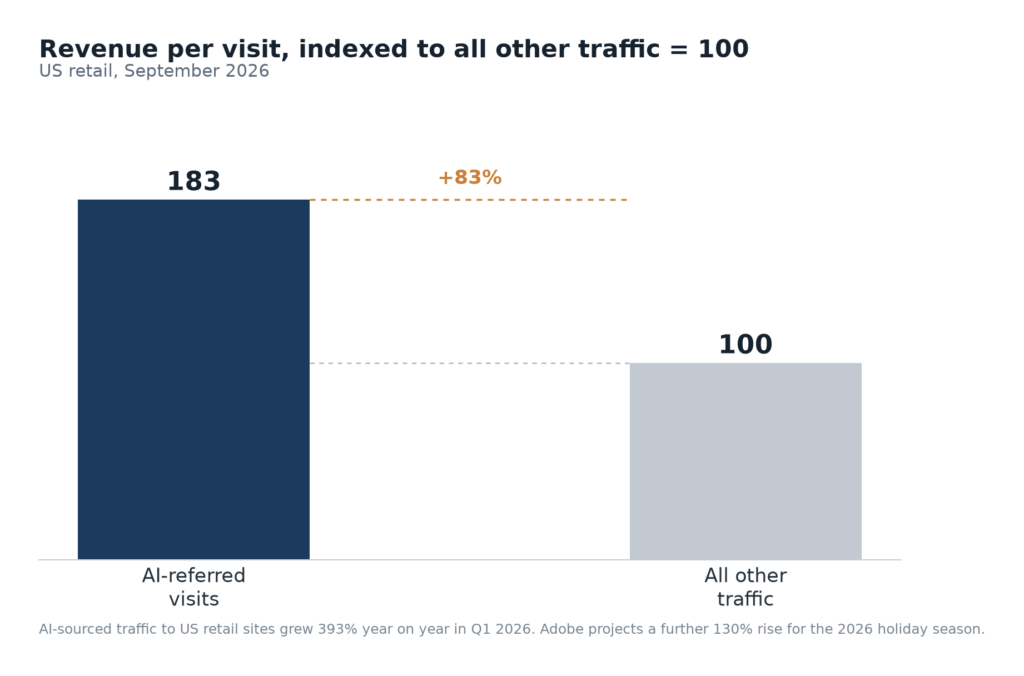
Fewer visits. Much better visits. A citation that never becomes a click still shapes a decision, and the visit that follows a citation arrives pre-sold.
That changes what you measure. Sessions and rankings still exist, but they capture a shrinking part of the journey. The more useful metrics are how often you appear in the answer, what the answer says about you, and whether branded search or direct demand moves afterwards.
It also changes what you publish. Models retrieve passages, not brand stories. A paragraph with a number, a unit and a date is usable. A paragraph about “pioneering excellence” is not.
A visibility checklist that survives platform churn
- Write facts before adjectives. Price, dimensions, lead time, coverage, compatibility, limits. Every claim should be one a stranger could verify.
- Hold the entity still. One brand name, one descriptor, one set of product identifiers, used identically on your site, in marketplaces, in press materials and on reference sites. Inconsistent naming splits your identity in retrieval.
- Win corroboration outside your own site. Assistants lean on third-party sources: trade press, review platforms, marketplace listings, industry directories. A claim that exists only on your domain reads as marketing.
- Build for extraction. One idea per paragraph. Short definitional sentences. Tables for comparisons. Stable URLs with dates. Nothing that matters should be locked inside an image.
- Localise the facts, not just the words. Model numbers, certifications and specifications break under machine translation. If a Chinese-language surface matters, have the spec sheet translated by someone who knows the category.
- Instrument what is observable. Referrer strings from assistants are inconsistent and often land in direct traffic. Use server logs, branded search volume and post-purchase surveys rather than assuming your analytics platform sees the whole picture.
- Measure share of answer quarterly. Model outputs vary from run to run. Weekly tracking produces noise and false confidence; a fixed question set, answered four times a year, produces a trend.
- Tie refreshes to model releases, not your editorial calendar. The four platforms shipped major updates in almost every month of 2026. Your fact base should move when theirs does.
What nobody can promise you
Four limits worth stating plainly, because vendors tend to skip them.
No one can guarantee inclusion in an AI answer. There is no ad slot, no submission form, no placement deal that controls what a model says. Anyone selling “guaranteed AI ranking” is selling you a screenshot.
The numbers move fast. Doubao’s August 2026 reach figure and its June user figure come from different reports measuring different things. Quote one, date it, and expect it to be wrong within two quarters.
App users are not API users. A consumer monthly-active figure says nothing about developer adoption, and vice versa. DeepSeek’s small app audience and large open-weight footprint are the clearest illustration.
Geography and regulation still restrict access. Apple Intelligence took a formal approval path before launching in China with Alibaba’s models. Consumer apps and enterprise endpoints also differ in availability, which is why international teams usually encounter these models through cloud APIs rather than consumer downloads.
Keeping this guide honest
Quarterly is the right cadence, and three checks are enough.
Re-pull the top-three ranking and the multi-app share. Re-pull the search-decline figures, since that is the trend on which the whole argument rests. Then take one commerce data point and one model release per platform.
Delete anything older than two quarters. A stale number in a fast market is worse than no number, because it looks like evidence.
Bottom line
China’s AI platforms are not four versions of one channel. They are four different rooms, with different acoustics.
Doubao gives you scale and a checkout, and asks for clarity. Qwen gives you a shelf and asks for merchant-grade data. DeepSeek gives you credibility and asks for proof. Kimi gives you attention and asks for depth.
The measurement question has changed too. Stop asking how much traffic an assistant sent you. Start asking whether you were in the answer, what the answer said, and what happened next.
FAQ
Do I need a Chinese entity to appear in these assistants?
Not for informational queries. Assistants retrieve from the open web and licensed sources, so a well-documented global brand can surface without local registration. Transactional presence is a different matter: selling inside Doubao or Qwen means operating inside Douyin or Taobao, which in practice requires a local merchant setup, local payment rails and local compliance.
If I only have budget for one platform, which one?
Follow the buying committee. For B2B software and industrial products, DeepSeek and Kimi reach the people who build shortlists, because that is where long evaluation sessions happen. For consumer goods sold through marketplaces, Qwen and Doubao are the only two that close a transaction in the same breath as the question.
Is optimising for these assistants just SEO under a new name?
At the fact layer, yes: accurate, structured, dated, verifiable information wins in both. At the packaging layer, no. Search used to reward pages that matched intent. Assistants reward passages that survive comparison with several other sources, which puts a premium on specificity and a discount on persuasion.
How much should I trust the monthly active user numbers?
Trust the direction, question the precision. QuestMobile is the most-cited source in this market, and its own methodology excludes preinstalled assistants and counts only apps someone opened. Individual app totals overlap and cannot be summed. Treat any single figure as a snapshot with an expiry date.
What is the one metric to report to a CMO in year one?
Share of answer on a fixed set of twenty high-intent questions, tracked quarterly, paired with branded search volume in the same period. The first tells you whether you exist in the interface. The second tells you whether anyone acted on it. Neither is perfect; together they are honest.