What a 53% Quarter and a 29% Crash Taught Me About Brand Equity
AI Answers Don’t Send You Traffic. People Still Go Somewhere to Check.
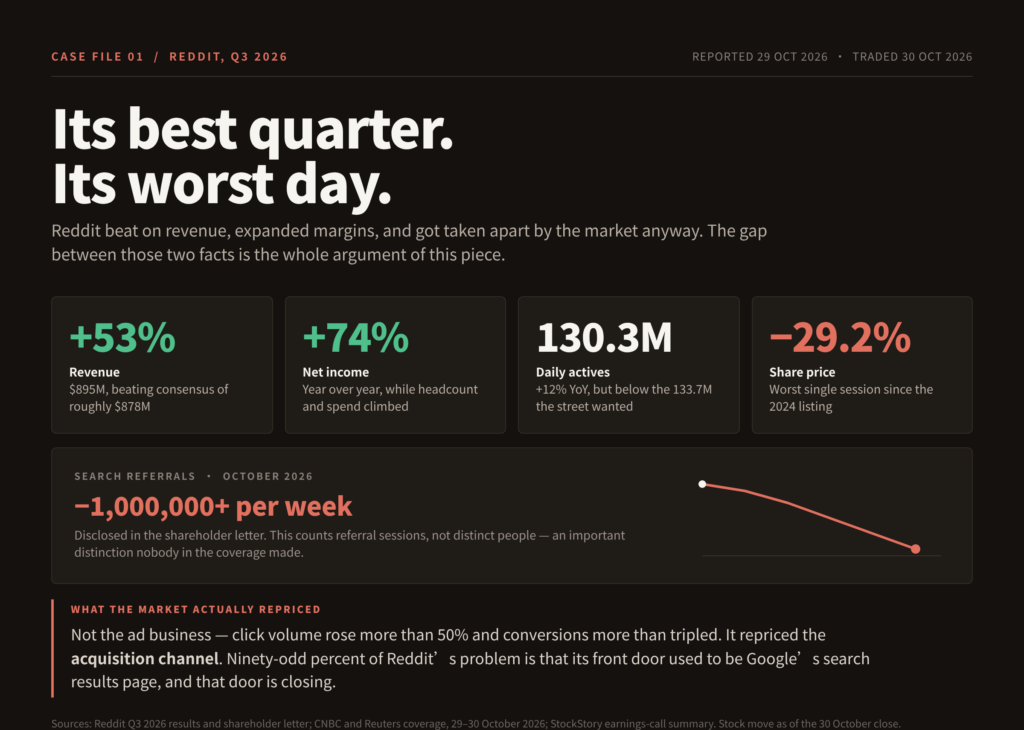
Reddit posted its best quarter in years and its worst trading day since listing — in the same twenty-four hours. A day earlier, Google logged its fastest search-query growth in five years and missed revenue consensus by about $1.6 billion. Neither is a coincidence.
The best quarter and the worst day, twenty-four hours apart
$895 million in revenue, up 53% year over year. Net income up 74%. Daily actives at 130.3 million — though US daily actives slipped 2% to 50.7 million.
Then, on October 30, the stock fell 29.2% in a single session to $91.73: the worst day Reddit has had since it listed. Wall Street was not impressed by the best quarter the company has ever reported.
Hold both facts in your head for a second. They are not in tension. They are the same fact, seen from two angles.
Here is what happened underneath the numbers. Reddit disclosed that search referrals fell by more than a million per week in October. Note the unit — referral sessions, not people. A referral session is a visit Google used to hand you for free and now mostly doesn’t. The CEO was blunt about why: Google’s AI Mode and AI Overviews, in his words, do not drive traffic. He called it a fundamental shift in how the product works, from being a traffic driver to “whatever’s going on now.”
The ad business is fine, by the way. Click volume rose more than 50%. Conversions more than tripled. More than 80% of monetization now comes from logged-in and app users, and ARPU came in at $6.87. What broke was not the selling. What broke was the arriving.
Google is running the same experiment from the other side
A day earlier, Alphabet reported. Search and other revenue: $63.35 billion, up 12%. Query growth: the highest rate in five years, according to the CEO. And search revenue still missed consensus by roughly $1.6 billion. The stock dropped more than 10% after hours, then more than 12% in the following session.
More questions than ever. Fewer dollars per question than expected.
Google’s chief business officer said the quiet part out loud on the call: AI Mode monetizes worse than classic search. That is not a bug they can patch in a quarter. It is a structural property of an interface that answers instead of listing. Google’s investor materials describe AI Mode queries as roughly three times longer than traditional searches — longer, more conversational, more expensive to serve, and harder to interrupt with an ad.
So the largest advertising business ever built is telling you, on the record, that the more useful its search becomes, the less money each search makes. Sit with that. Then ask why we still describe “more traffic” as the goal.
Zero-click was never zero-decision
The lazy reading is that people have stopped researching. They haven’t. They’ve stopped doing it in places that bill by the pageview.
For twenty-five years, we conflated two different things: the moment someone learns something, and the moment someone decides. Search engines happened to do both, so we built an entire industry — attribution models, last-click reports, content calendars — on the assumption that they always would.
They don’t anymore. The learning moved into a chat window. The deciding didn’t.
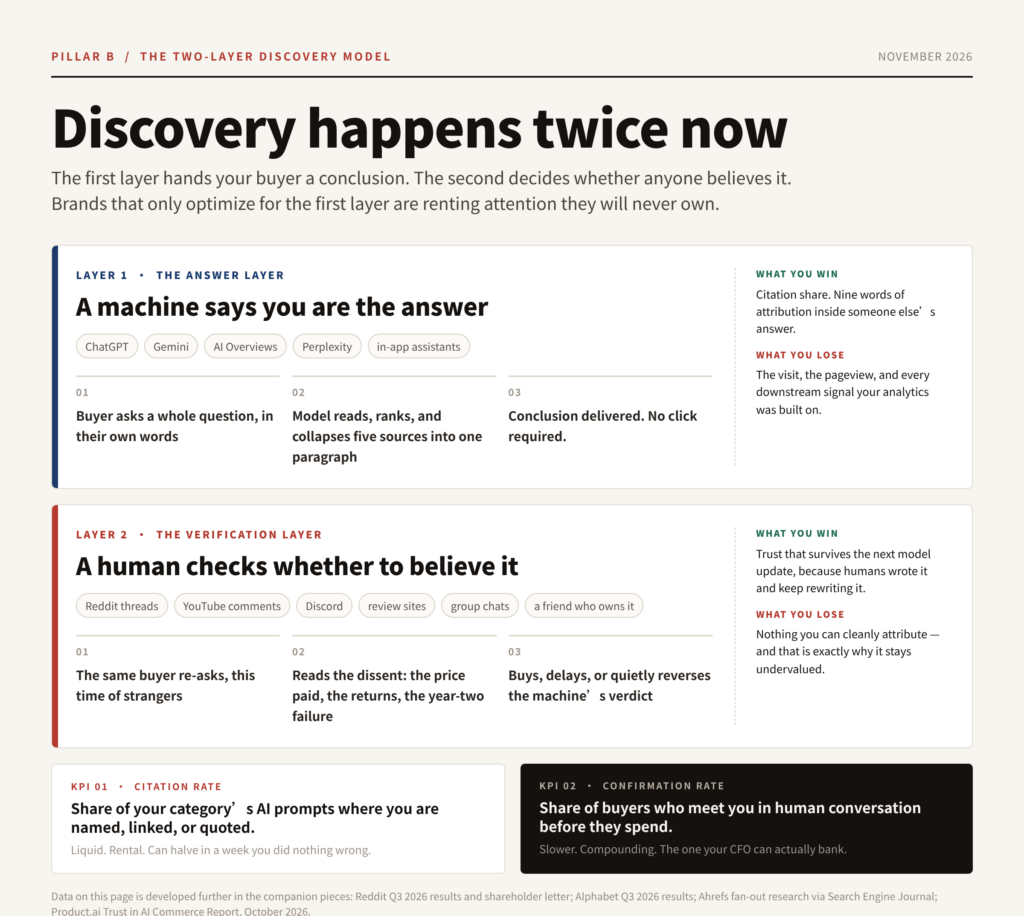
Discovery has split into two layers, and they behave nothing alike.
Layer one: the answer layer
Someone asks a whole question. A model reads, ranks, compresses five sources into a paragraph, and hands back a conclusion. No click. No visit. Maybe your name appears; maybe it doesn’t.
What you win here is citation share — nine words of attribution inside somebody else’s answer. It’s real. It’s valuable. It’s rented. And rent means the landlord can reprice you without notice.
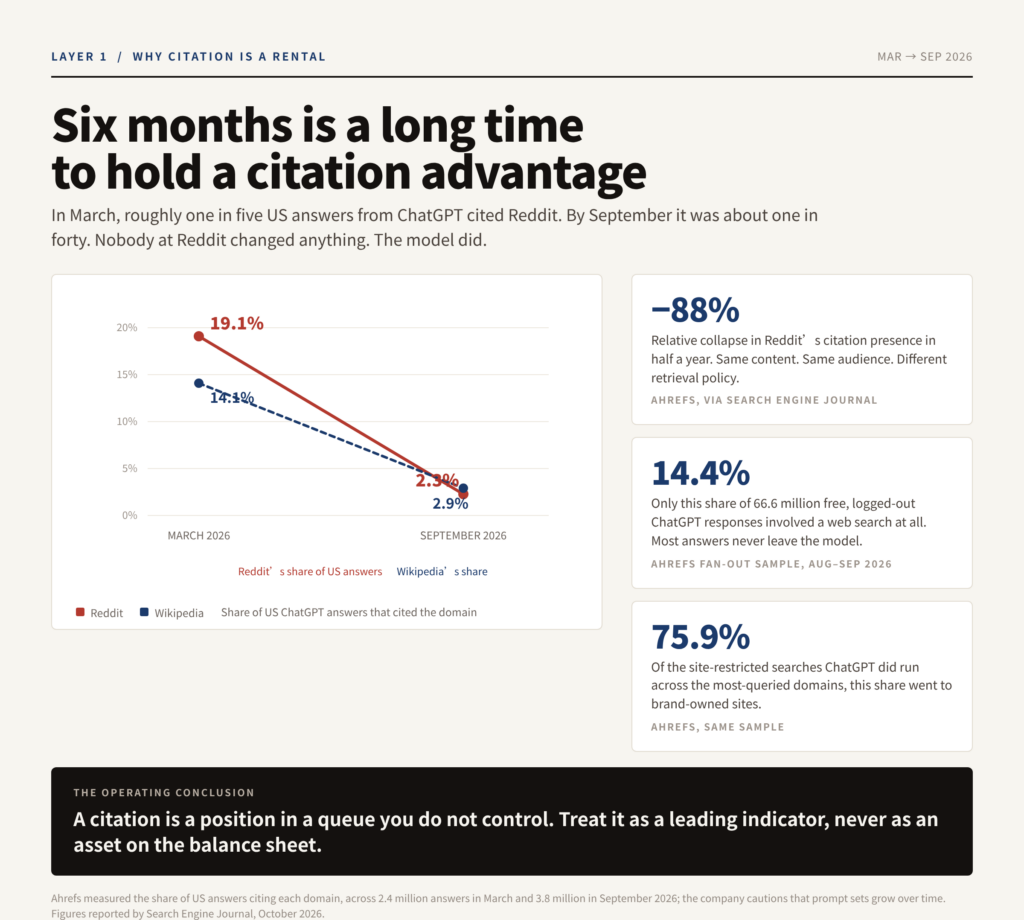
Consider what happened to Reddit itself as a source inside ChatGPT. In March 2026, Reddit appeared in roughly 19.1% of US ChatGPT answers. By September: 2.3%. Wikipedia went from 14.1% to 2.9% over the same window. Nobody changed the content. Nobody changed the audience. The retrieval policy changed, and six months of accumulated advantage evaporated.
The answer layer is also thinner than it looks. In Ahrefs’ sample of 66.6 million free, logged-out ChatGPT responses, only 14.4% involved a web search at all — most answers never leave the model. When ChatGPT did search and restricted itself to a single site, 75.9% of those searches went to brand-owned domains. The layer increasingly prefers primary sources, and it prefers them on its own terms.
That’s a channel, not an asset. Budget for it the way you’d budget for a placement you renew monthly, because that is what it is.
Layer two: the verification layer
Here is the part almost everyone gets wrong. The buyer doesn’t stop at the answer. They take it somewhere and check it.
Product.ai surveyed 1,493 US adults in October. Among the 550 who had used an AI shopping assistant, 89.9% said they verified its recommendation through another source before buying. That number was 85.7% in June. It is climbing, not falling. Meanwhile the share of shoppers who act on an AI recommendation without checking anything at all has dropped to 10.1% from 14.3% four months earlier.
Read those two numbers again, because they are the whole thesis. Adoption is rising. Trust isn’t keeping pace. The gap between them is where your brand either gets confirmed or quietly crossed off.
And where do people go to check? Not to your landing page. They go where someone with nothing to sell has already been angry in public. Reddit threads. YouTube comments. Discord servers. A friend who actually bought the thing. Reddit-commissioned research with WPP Media, reported by eMarketer in August, found that 79% of Reddit users say they use the platform for product research or purchase advice. It’s company-sponsored work, so weight it accordingly — but the direction matches everything else we see.
This isn’t a US-only pattern. On Xiaohongshu: an aspirational recommendation first, then a hunt for the negative review that says whether the thing survives a Shanghai summer. Douyin’s comment sections do the same job in a louder voice.
Here’s the loop most people miss. The two layers aren’t just sequential; they feed each other. The community posts that reassure your buyer tonight are the same posts a model will retrieve tomorrow. That is how Reddit reached a 19.1% citation share in the first place — not by optimizing for AI, but by being where the arguments happened. Verification-layer content is simultaneously your defense and the answer layer’s raw material.
The two-layer model, in one picture
Two layers, two audiences, two clocks. The first refreshes weekly and forgets you. The second moves in months and remembers.
Why the second layer is where brand equity now lives
Brand equity used to be a memory. You saw the ad, you remembered the name, you picked it off the shelf. Measurement was recall, and recall was bought with reach.
Now the shelf is a conversation you don’t get to attend. What survives it isn’t the jingle. It’s whether the people who already own your product describe it the way you’d want them to when nobody from your company is in the room.
That’s uncomfortable, because the community layer can’t be bought at the last minute. You can’t run an October campaign to fix eleven months of mediocre product experience. You can’t brief an agency to manufacture authentic dissent. The second layer is a lagging indicator of how you actually operate — which is why the market keeps underpricing it, and why it compounds for brands that feed it honestly.
There’s a pricing consequence too. When a category’s answer layer is saturated with competing claims, the only remaining differentiator is what the verification layer says. That is how brands stop competing on being found and start competing on being worth finding.
A working definition
Here’s the one I use. It is deliberately boring:
Brand equity in the AI era is the probability that a buyer, having received a machine-generated recommendation, finds enough human corroboration to act on it.
That’s it. Not awareness. Not sentiment. A probability attached to a specific step in a specific journey — which means it can be measured, and if it can be measured, it can be defended in a budget meeting.
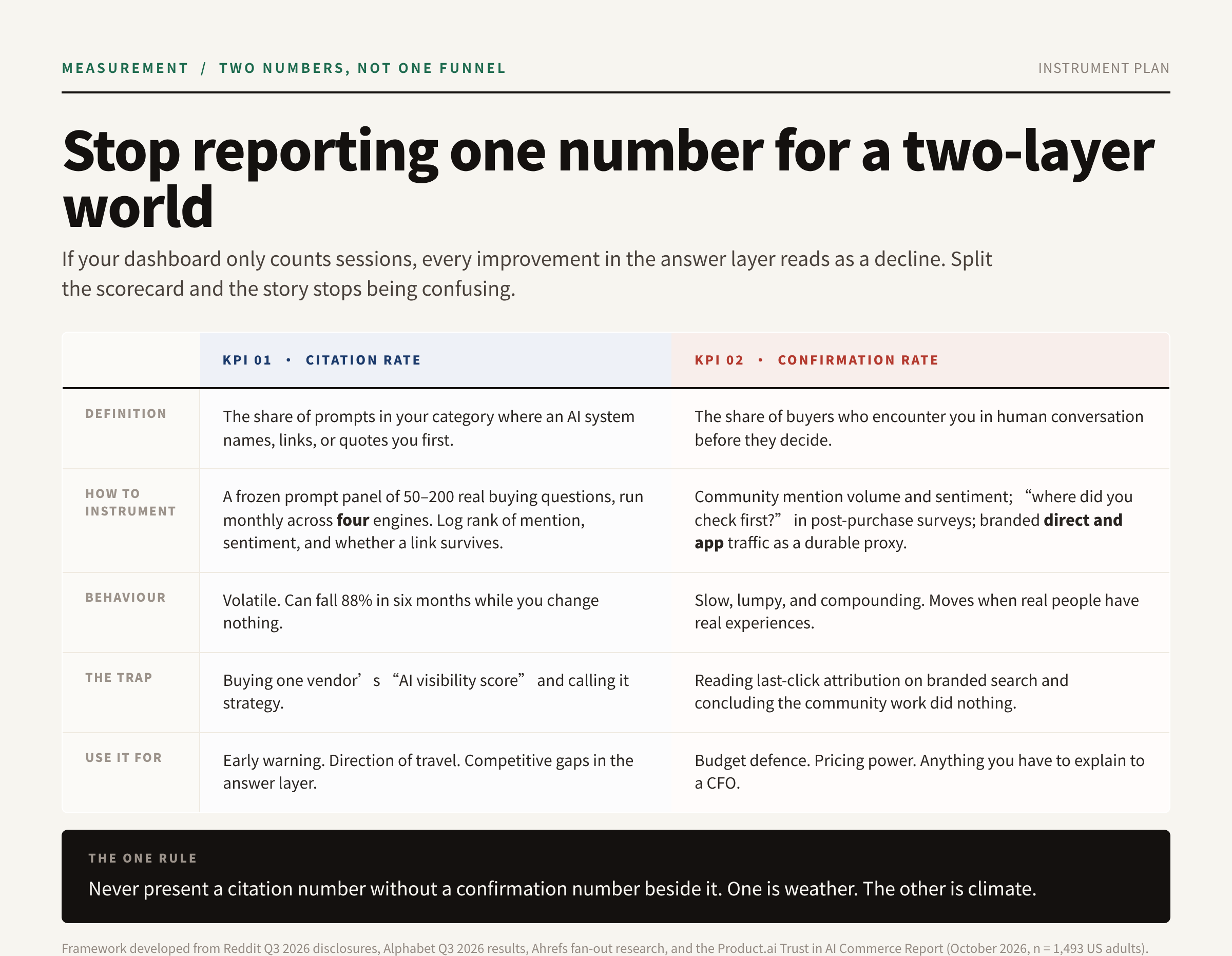
Two numbers, not one funnel
If you take one operational thing from this piece, take this: split your scorecard.
Citation rate tells you whether the machines know you exist. Confirmation rate tells you whether humans back them up. Different clocks, different failure modes.
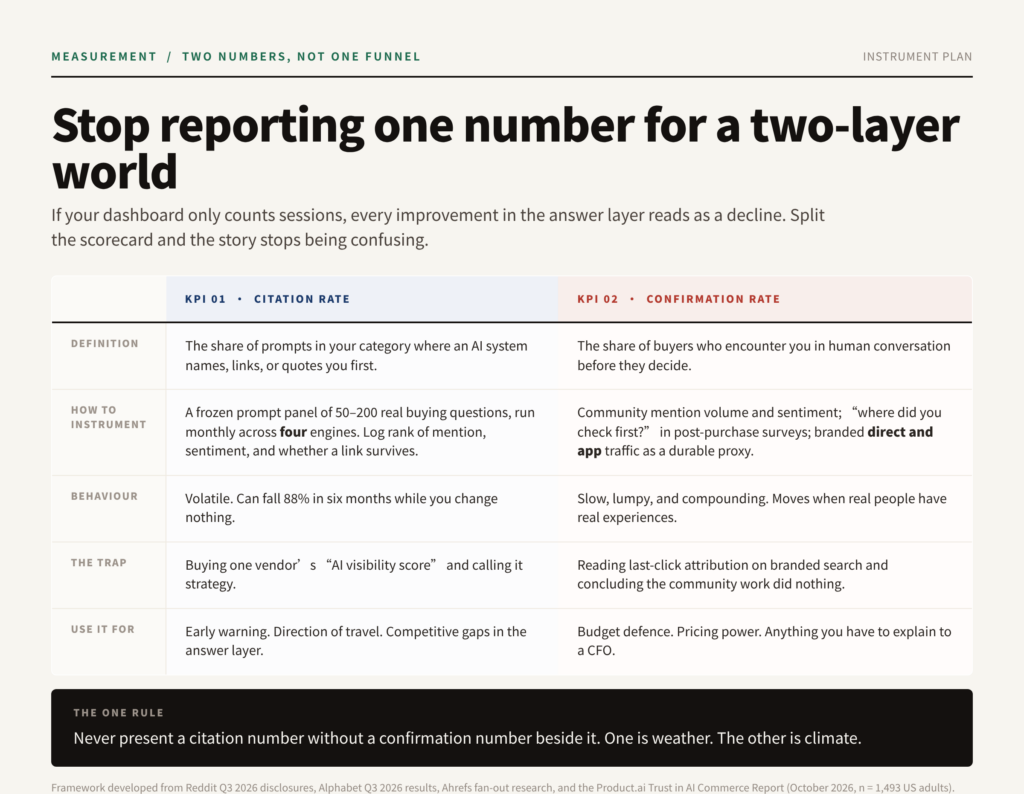
The failure mode I see most often: a team watches citation share go up, watches sessions go down, and concludes nothing is working. That isn’t a measurement problem. It’s a model problem. You’re running one KPI through a two-layer world.
What to instrument, and what to ignore
Instrument a frozen prompt panel. Fifty to two hundred real buying questions, written the way customers actually type them, run monthly across four engines. Log whether you’re mentioned, in what position, with what sentiment, and whether the link survives the next model update.
Instrument the community layer with something other than vibes. Mention volume, sentiment, and the one question that beats every dashboard: “Where did you check first?” Put it in your post-purchase survey. Watch branded direct and app traffic — the closest honest proxy for people who came looking for you on purpose.
Ignore anything that collapses into a single vendor score. Ignore impression counts inside AI answers — nobody has even agreed on how to define them. Ignore last-click attribution on branded search, which will insist your community work did nothing right up until the quarter it saves you.
The honest counter-case
I owe you the other side, because the numbers people cite for “AI is destroying publishing” are weaker than they sound. I went looking for the scariest estimates and mostly found directional evidence dressed up as causality.
What holds up: Pew Research found that when a Google search shows an AI summary, 8% of searches produce a click on a traditional result, against 15% when there’s no summary — and only about 1% click anything inside the summary itself. That is a real and large change in click behavior.
What doesn’t hold up so cleanly is the jump from clicks to money. Reuters Institute’s 2025 survey of 326 digital leaders across 51 countries found that 74% expected search referrals to decline. The same report, using Chartbeat data from roughly 2,000 news sites, found no aggregate decline in Google referrals yet — while Facebook referrals were down 67% and X down 50%. The traffic that actually vanished in that dataset left via social platforms, years before AI search finished the job.
So treat exposure estimates as directional, not causal. If someone hands you a five-year loss figure with a precise dollar amount and no methodology, set it down. The mechanism is real. The precision usually isn’t.
What I’d do on Monday
- Build the prompt panel this week. Not next quarter. Fifty questions, four engines, one spreadsheet.
- Write for quotability, not for keywords. One claim per heading. A number with a date and a source. The sentence you want lifted should be liftable.
- Go find your own dissent. Search your brand name plus “worth it”, “returned”, “stopped working”. Whatever you find is what the verification layer already says about you. You can’t fix what you refuse to read.
- Give the community layer an owner. A name, a budget line, and a mandate to answer unpleasant threads without turning them into marketing.
- Put both KPIs on one slide, every month. One is weather. The other is climate.
The short version
Reddit’s revenue grew 53% and its stock fell 29% because its traffic used to arrive through a door Google now keeps closed. Google’s queries hit a five-year high and its search revenue missed, because an answer that helps more people produces fewer billable moments. Neither company is failing. Both are being repriced by the same structural change.
The answer layer supplies the conclusion. The verification layer decides whether anyone believes it. Being cited is rented. Being confirmed is owned.
FAQ
1. What exactly is the two-layer discovery model?
It describes a journey that used to be a single step. Layer one is the machine that returns a conclusion: ChatGPT, Gemini, AI Overviews, Perplexity. Layer two is where humans validate that conclusion: forums, comment sections, reviews, group chats. Different audiences, different refresh rates, different failure modes — so they need different KPIs.
2. If zero-click search is growing, are people researching less?
No. They are researching in places that don’t bill by the pageview. The decline is in sessions, not in decisions. The learning moment and the deciding moment stopped happening on the same page.
3. AI citations are volatile. Doesn’t that make GEO a waste of money?
It makes GEO a channel rather than an asset. Reddit’s share of US ChatGPT answers fell from 19.1% to 2.3% in six months with no change on Reddit’s side. That doesn’t make citation work pointless — it means you budget for it like rent, renew monthly, and never book it as equity.
4. How do I measure confirmation rate without a research budget?
Start with one survey question — “Where did you check before buying?” — added to your post-purchase flow. Pair it with community mention volume and sentiment, and with branded direct and app traffic. None is perfect. Together they tell you whether the second layer is strengthening or eroding.