China’s Token Economy Is Being Sold Like Electricity
AI Video Is Eating the Token Budget. Just Not 55% of It.
A viral statistic about where AI compute goes turned out to be wrong. The direction it pointed in was right — but only if you keep your eye on the verified numbers underneath it.
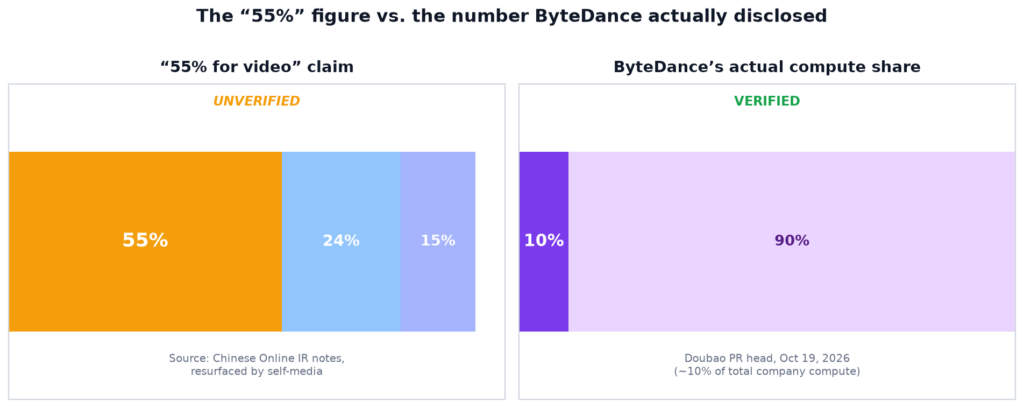
In October 2026, a set of figures tore through Chinese tech media: of every token the country consumed, 55% allegedly went to short-form drama and video generation, 24% to e-commerce and marketing, and a slim 15% to software development. The implied contrast with the United States — where the counterpart claim held that 58% of American tokens go to code — practically wrote itself. Two countries, two different AI futures, all in three tidy percentages.
Then the percentages fell apart under scrutiny.
At a glance
- ~10% — ByteDance’s share of compute used for video generation (training and inference), per the company itself
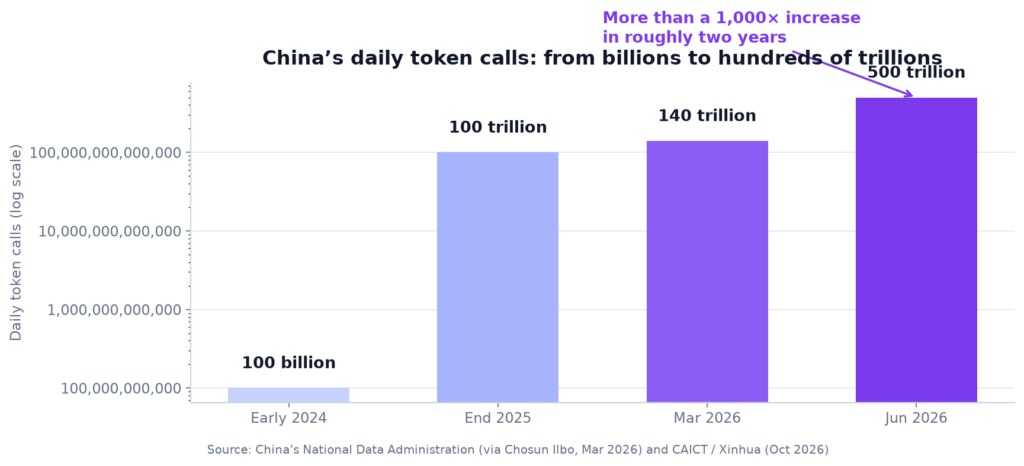
- >140 trillion — China’s daily token calls, March 2026 (against ~100 billion in early 2024)
- ~500 trillion — China’s daily token calls, June 2026 (roughly four times the December 2025 level)
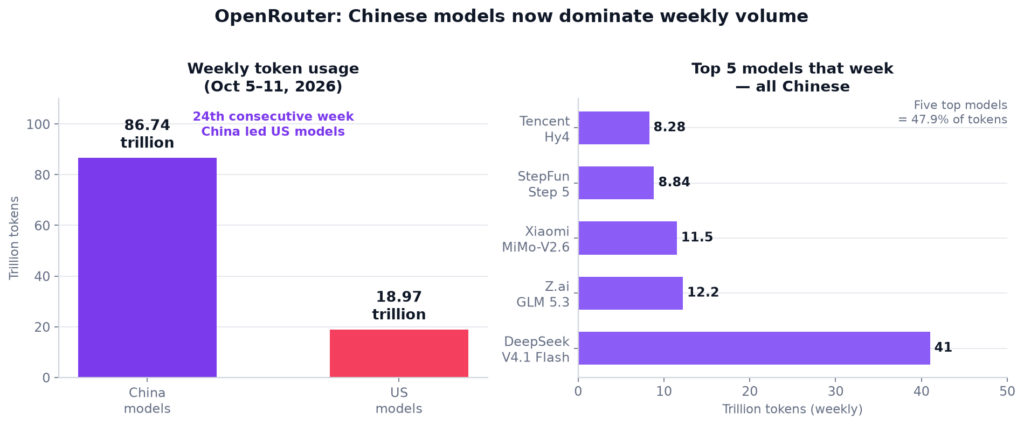
- 24 — consecutive weeks Chinese models led US models on OpenRouter, as of early October 2026
- 1.4 trillion/day — capacity of Beijing’s first “token factory,” phase one
Where the 55% came from
The figure traced back to no national statistical release. It surfaced in the investor-relations notes of a listed company with a heavy stake in AI short drama — Chinese Online, an A-share content group — whose minutes of institutional exchange estimated that 55% of domestic token consumption flows to short drama and video, 24% to e-commerce marketing, and 15% to software development. Those minutes were months old, and the company never published the research institution, survey coverage, or calculation model behind the estimate.
That did not stop the number from being scrubbed of context and repackaged into the macro claim that “half of China’s compute goes to making binge-worthy dramas.” One participant’s directional read had been re-circulated as a census.
ByteDance’s Doubao team pushed back publicly. On October 19, 2026, Doubao’s head of public relations, Liu Xing, said the claim “lacks factual basis”: within ByteDance’s total AI compute, only about 10% goes to training and inferring video-generation models — a figure that already includes frontier research on the underlying vision foundation models, not just consumer short-drama output.
There is a second problem, and it is structural rather than journalistic. Video generation is a ferociously dense task: a few seconds of output can burn more compute than a long document. Code assistance is comparatively frugal per unit of useful work. Comparing token shares in these two workloads therefore measures raw workload intensity — not strategic priority. A company that spends 10% of its tokens on video is not making video a smaller priority than one that spends 55%; it may simply be pricing that priority differently.
What the real numbers say
The verified numbers are large enough that they need no embellishment.
National Data Administration data reported in March 2026 put the country’s daily token call volume above 140 trillion — itself up more than 40% in three months from roughly 100 trillion at the end of 2025. Set that against the roughly 100 billion daily calls of early 2024, and you get a more-than-a-thousand-fold increase in about two years.
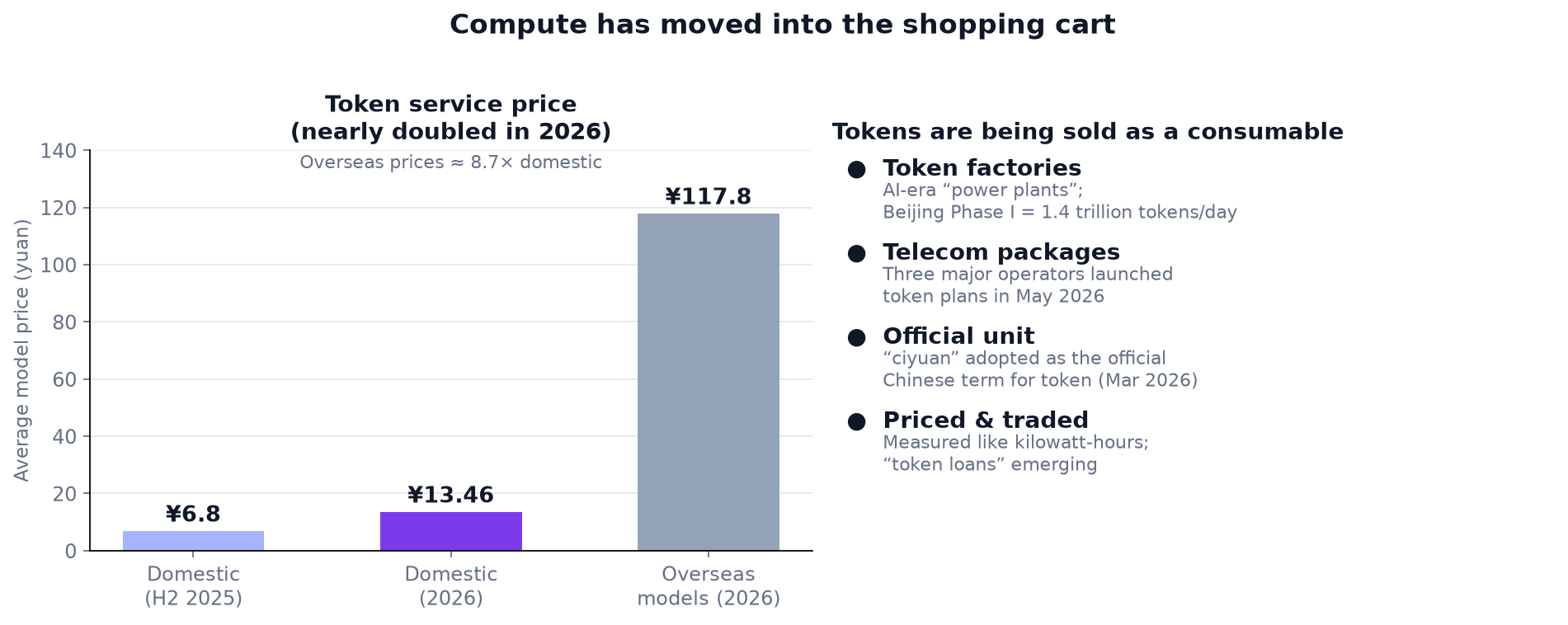
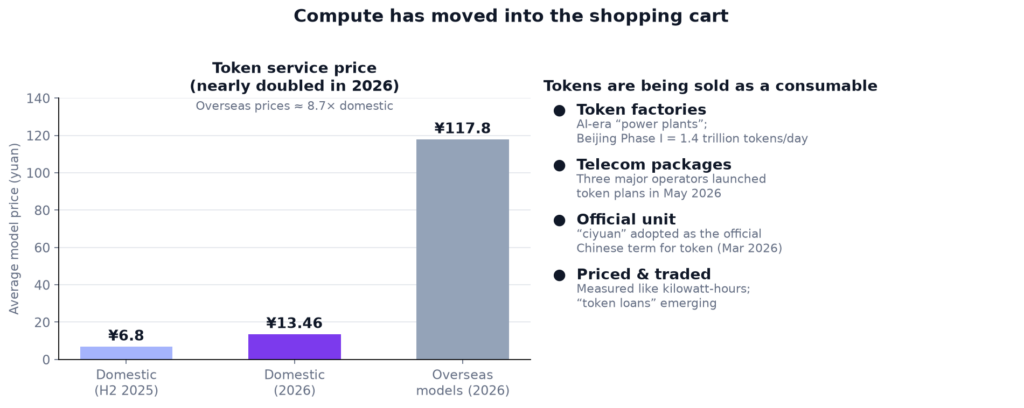
The trajectory did not flatten. By June 2026, the National Data Administration and a monitoring report from the China Academy of Information and Communications Technology (CAICT) placed daily token usage around 500 trillion — nearly four times the December 2025 level in the space of six months. Prices and volume climbed together: CAICT found the average domestic model price nearly doubled, from 6.8 yuan in the second half of 2025 to 13.46 yuan in 2026, even as usage tripled. Overseas models, for reference, averaged roughly 117.8 yuan on the same basis — about 8.7 times the domestic level.
An independent cross-check
Numbers from a single government or a single company are easy to wave away. So it matters that an outside platform tells the same story.
On OpenRouter, a US-based model-routing platform, Chinese models led US models in weekly token usage for 24 consecutive weeks, as of the week of October 5–11, 2026. That week the platform processed 172 trillion tokens; Chinese models accounted for 86.74 trillion of them against 18.97 trillion for US models. DeepSeek alone processed 41 trillion tokens in a single week. The top five models that week — DeepSeek, Z.ai’s GLM, Xiaomi’s MiMo, StepFun’s Step, and Tencent’s Hy — were all Chinese, and together they made up 47.9% of the week’s tokens.
The contrast looks sharper once you remember the starting point: as recently as February 2026, Chinese models represented only 6–13% of OpenRouter traffic. In under a year, the minority became the majority.
Two engines, not one
The growth is not a single-story phenomenon. Beijing municipal officials tracking the country’s token economy describe consumption rising fastest in AI-generated content and in programming — the two opposite poles of the market.
The programming side matters more than most marketing teams realise. A single chat exchange costs hundreds of tokens. An agent that plans, calls tools, checks its own output, and retries on failure can consume tens to hundreds of times more. When enterprises start running agents in production, the meter spins in a way a chatbot never did.
That is why video and marketing creative sit near the top of the consumption table without owning the majority of it. They are the most token-hungry visible applications — and visibility, not volume, is what gets measured.
Compute moved into the shopping cart
The most telling development here is not a statistic. It is a change in category.
In March 2026, China adopted “ciyuan” as the official term for token, giving AI usage a standard unit for measuring, settling, and tracking — the way electricity is counted in kilowatt-hours. Liu Liehong, head of the National Data Administration, framed tokens as “a settlement unit that links technological supply and commercial demand,” something that can be “measured, priced, and transacted.” Beijing then began operating its first “token factory,” an AI-era power plant that bundles electricity, chips, data, and models to produce tokens directly, with a first-phase capacity of 1.4 trillion tokens a day. Customers no longer rent raw computing cards; they simply pay for the tokens they use.
The packaging followed the analogy. In May 2026, China’s three major telecom operators rolled out token packages for individuals and enterprises, much as they once sold voice plans. Alibaba formed a dedicated Token Hub business unit, with CEO Wu Yongming personally leading the push. And CAICT’s monitoring shows model prices nearly doubling year over year — even as usage tripled. One Beijing engineer told Xinhua he now spends more than 200 yuan a month on tokens, more than his phone bill.
In other words: compute is being sold as a consumable, priced as a utility, and packaged as a subscription. That is a change in category, not a change in discount.
What this means for marketing procurement
Three practical consequences follow.
First, creative production is now a variable cost with a meter. A campaign’s asset volume translates directly into inference spend, and budget owners will need a cost-per-asset figure the way they once needed cost per thousand impressions.
Second, “we generate more variants” is no longer free. The marginal cost of the tenth variant is not zero — and at video scale, it is not small. Once tokens are a purchasable commodity with a published price, every marketing line item can be benchmarked against a listed rate. That is good news for finance, and uncomfortable news for anyone whose value proposition was simply “we use AI.”
Third, the measurement debate is about to become a pricing debate. As long as tokens had no visible price, “how much AI should we use” was a creative question. The moment tokens are sold in retail packages, it becomes a procurement question — and procurement questions have owners, line items, and budgets.
The lesson is in the correction
The original 55% claim was wrong in its proportions but right in its instinct: video genuinely consumes an outsized share of a ballooning token economy. What the correction teaches is less about percentages than about discipline. A number that cannot be traced to a methodology will drift — and in a market growing more than a thousand-fold in two years, a drifted number can be off by an order of magnitude while feeling completely specific.
JPMorgan’s forecast adds a final data point worth watching: China’s AI inference token consumption could grow roughly 370-fold between 2025 and 2030. Whether or not that figure holds, the direction is set. For anyone budgeting, forecasting, or marketing around AI over the next two years, the workable rule is straightforward: trust the meter, distrust the meme.