Why “AI-Powered” Stopped Selling: Regulators’ $25 Million Crackdown on Fake AI Marketing
The $25 Million Lesson in “AI Customer Acquisition”
Regulators have now spent more than two years building a body of case law around AI marketing claims. The pattern is remarkably consistent.
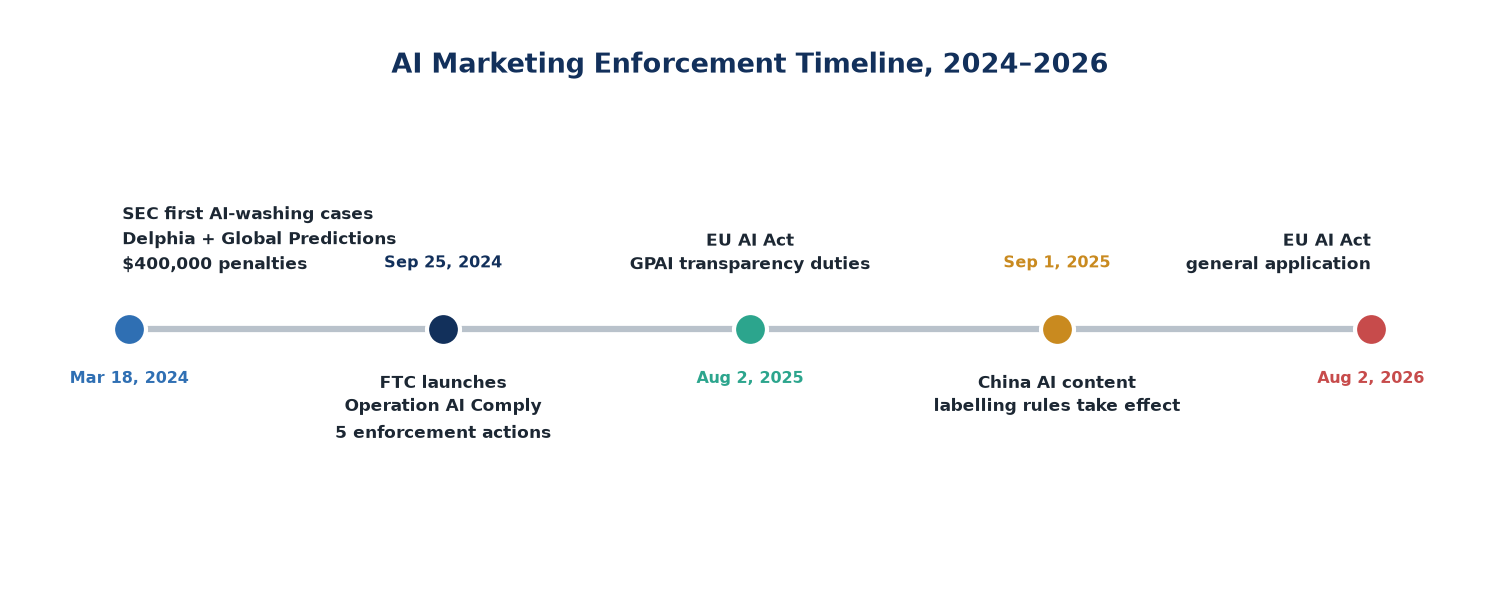
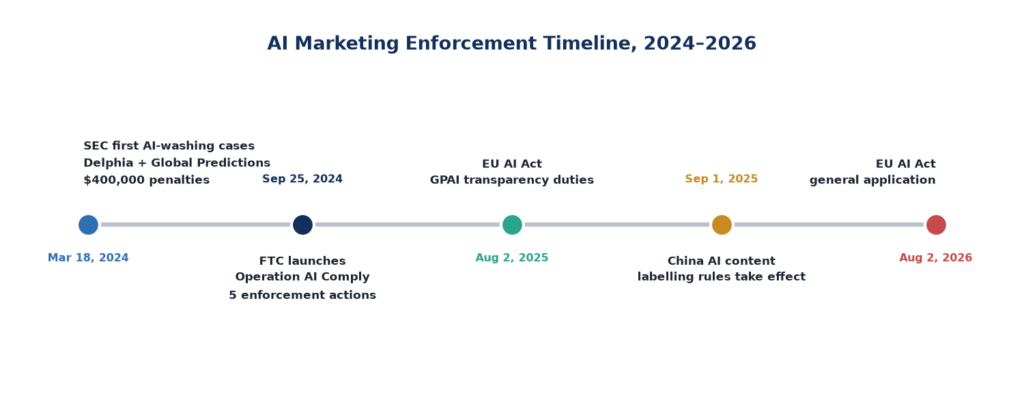
When the United States Federal Trade Commission launched Operation AI Comply on 25 September 2024, it announced five enforcement actions in a single sweep. The through-line was not that the AI was fake. In several cases the software existed and ran. The problem was the promise attached to it.
The largest target was a scheme operating under several names — most recognisably Ascend Ecom — which regulators allege defrauded consumers of at least $25 million by claiming AI-powered tools would build profitable online storefronts for them. A second action hit Ecommerce Empire Builders, which sold training programmes priced near $2,000 while promising an “AI-powered Ecommerce Empire,” and offered “done-for-you” stores for tens of thousands of dollars more. A third centred on DoNotPay, marketed as “the world’s first robot lawyer.” Rounding out the sweep were Rytr, an AI writing tool that let subscribers mass-produce fake product reviews, and FBA Machine, another storefront scheme regulators say cost consumers more than $15.9 million.
In each case the alleged deception was about outcomes, not capability. The tool did something. It just did not do what the sales page said.
At a glance
- FTC enforcement initiative launched: 25 September 2024, five actions on day one
- Alleged consumer harm in the largest e-commerce scheme: $25 million+ (Ascend Ecom)
- SEC’s first AI-washing settlements: $400,000 in combined civil penalties, 18 March 2024
- Related FTC actions since: a growing list, from Automators and Career Step to NGL Labs, Rite Aid and CRI Genetics
-
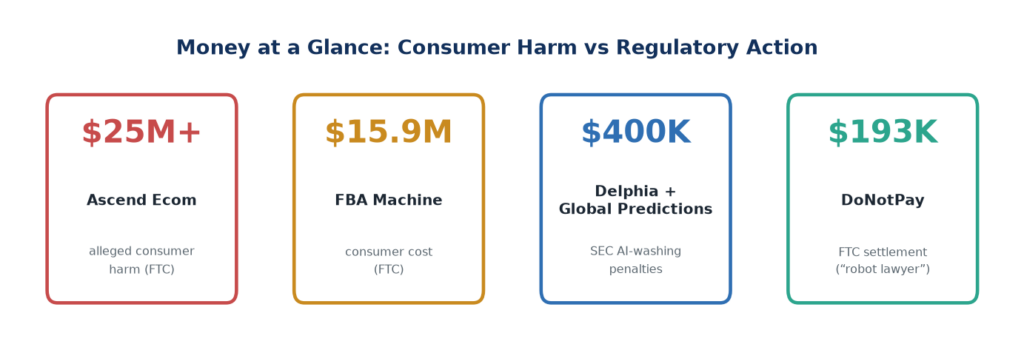
Insert here: four stat cards contrasting alleged consumer harm with the size of regulatory settlements. The pattern behind the pattern
Read enough of these complaints and the same three moves appear.
Move one: convert a tool into a guarantee. “Our AI generates leads” becomes “our AI generates revenue.” The second sentence is a performance claim, and performance claims require substantiation before publication, not after.
Move two: hide the human labour. Many “done-for-you AI” offers depend on contractors doing the actual work. When the labour is undisclosed, the buyer is paying for a machine that does not exist — and the seller is pricing an illusion.
Move three: price the promise, not the product. Training programmes in the low thousands of dollars, “systems” in the tens of thousands. The price signals seriousness while the deliverable stays vague.
Three red lines that apply almost everywhere
Substantiation. Any quantified outcome claim needs a reasonable basis in hand at the time it is made. Not a case study. Not a testimonial. Evidence. This is the principle FTC Chair Lina Khan compressed into plain speech when the sweep launched: there is no AI exemption from the laws already on the books.
AI-washing. Describing a rules-based or outsourced process as artificial intelligence is an enforcement risk in its own right. The US Securities and Exchange Commission made this explicit on 18 March 2024, settling with two investment advisers — Delphia and Global Predictions — for a combined $400,000 over exaggerated AI claims, and the logic transfers well beyond financial services.
Disclosure. If AI generates the content, the audience increasingly has a right to know. China’s rules on labelling AI-generated and AI-synthesised content took effect on 1 September 2025 and require both explicit and implicit marking. The EU AI Act’s transparency duties for general-purpose AI began applying on 2 August 2025, with the broader rulebook phasing in from August 2026 — and the most sensitive high-risk systems sliding further out toward late 2027 and 2028.
-
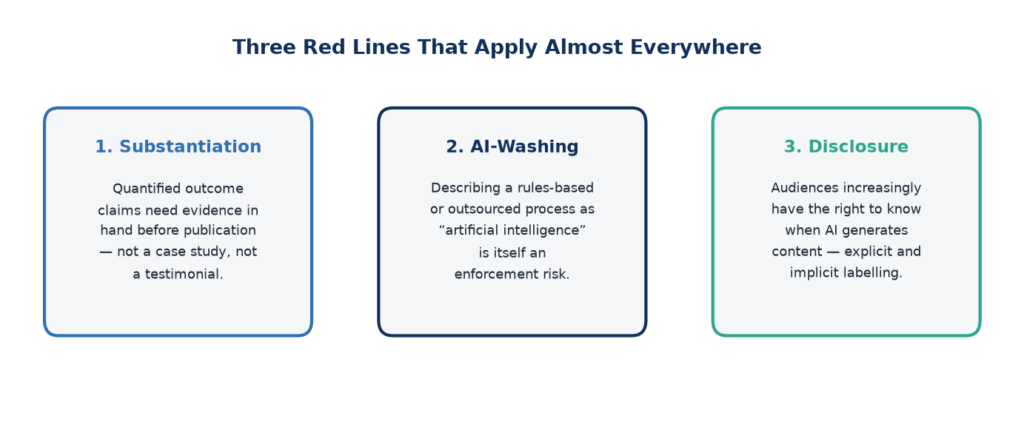
Insert here: a three-panel visual summarising Substantiation, AI-Washing and Disclosure. A due-diligence checklist before signing
Ask for the failure rate. What share of customers do not get the claimed result? A vendor with no answer has not measured its own product.
Separate capability from outcome in writing. Make the contract state what the system does, not what the buyer will earn.
Identify who touches the work. If humans produce the deliverable, the pricing should reflect labour — and the contract should say so.
Demand the data source. Claims about “our model trained on X” should come with the provenance of X.
Check the AI claim. Is there a model, or is there a spreadsheet with a chatbot interface?
Verify jurisdiction-specific labelling and disclosure duties before the campaign ships, not after.
Get the refund path in writing. Enforcement cases cluster around offers where the exit was blocked.
-
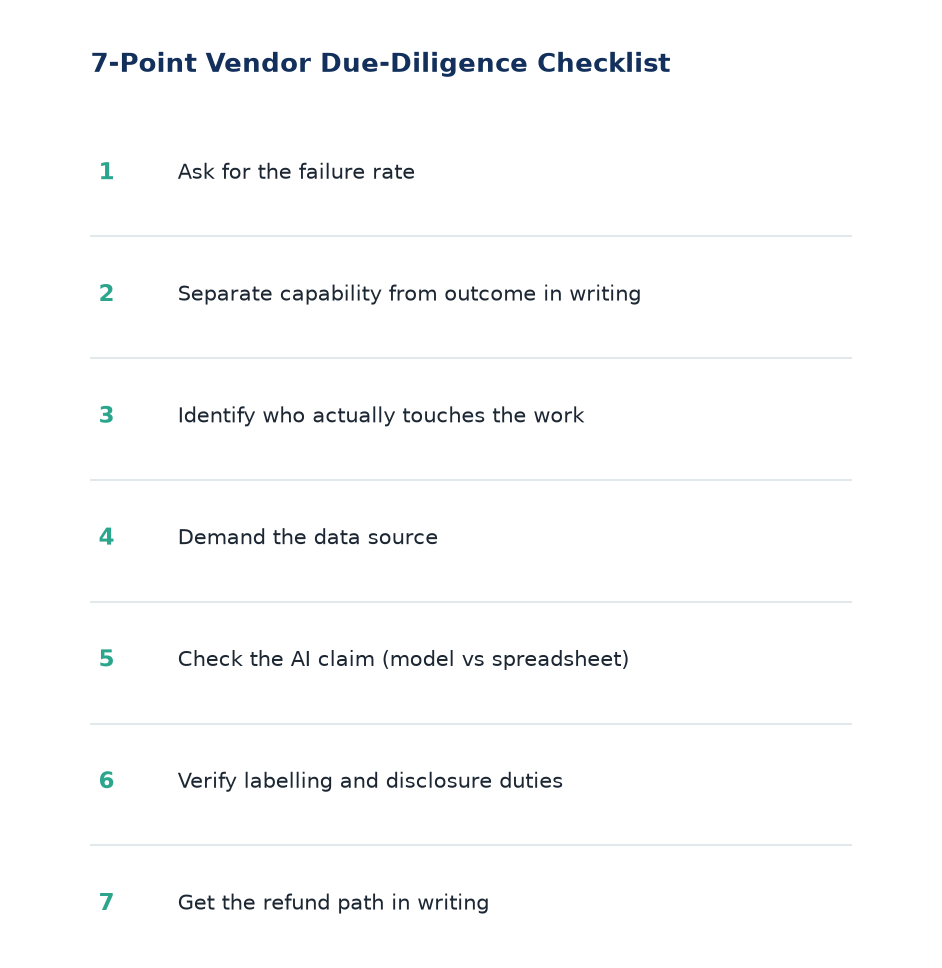
Insert here: a numbered checklist graphic of the seven checks above. Why the market keeps producing this
Because the demand side is genuinely confused, and confusion is a business model.
A large buyer can hire an analyst to separate a real system from a repackaged one. A small business owner cannot, and that owner is exactly who these offers target. Until the cost of verifying an AI claim falls, the supply of unverifiable claims will keep finding buyers.
The uncomfortable implication for legitimate vendors: “AI-powered” has stopped functioning as a differentiator and started functioning as a warning sign. The vendors winning enterprise contracts in 2026 rarely lead with the model. They lead with the measurement.