AI Won’t Mass-Fire America. It Will Quietly Downgrade Its Middle Class
Workers Displaced by AI Face a Slower, Cheaper Comeback
Two Goldman Sachs research notes, published six months apart, answer two halves of the same question: how many jobs will AI take, and what happens to the people who lose them?
Start with the second half, because that is where the numbers are hardest.
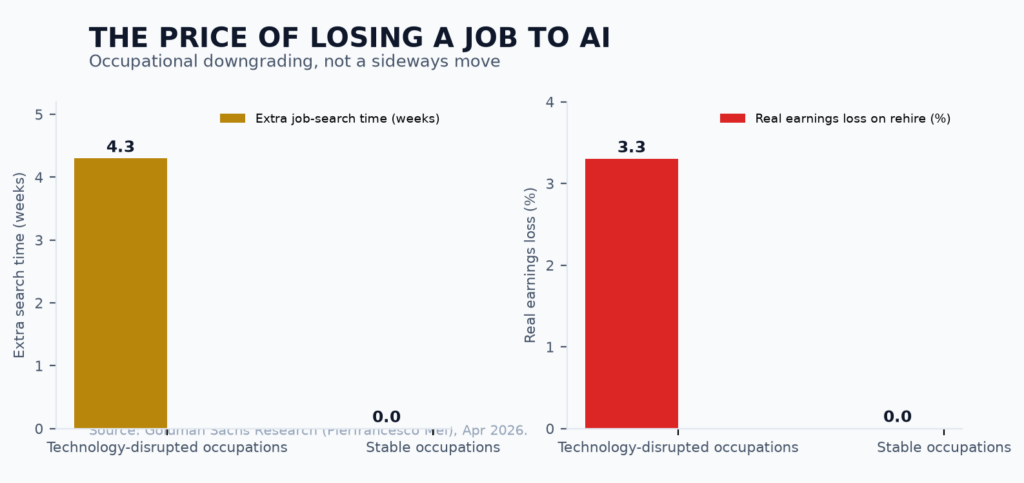
Workers pushed out of technology-disrupted occupations face a tougher short-run path back into work. On average they spend about one month longer landing their next job, and once they land it they absorb a real earnings loss of more than 3%. Workers displaced from stable occupations, by contrast, take almost no pay penalty at all.
Goldman strategist Pierfrancesco Mei has a name for the mechanism — occupational downgrading. People do not slide sideways into comparable roles. They step down into jobs that draw less on the analytical and interpersonal skills they built up over a career. The same technology that ended the last job has also thinned the market for the experience that once priced it.
At a glance, the numbers behind both notes:
- About 1 month — additional job-search time for workers displaced from technology-exposed occupations
- More than 3% — real earnings loss on re-employment; negligible for workers displaced from stable occupations
- 9%, roughly 1 in 11 — share of US workers Goldman estimates could eventually be displaced by AI
- 23% — share of US establishments that have wired AI into regular workflows
- 87,714 — US job cuts attributed to AI in the first five months of 2026
The 1-in-11 figure carries a timing condition
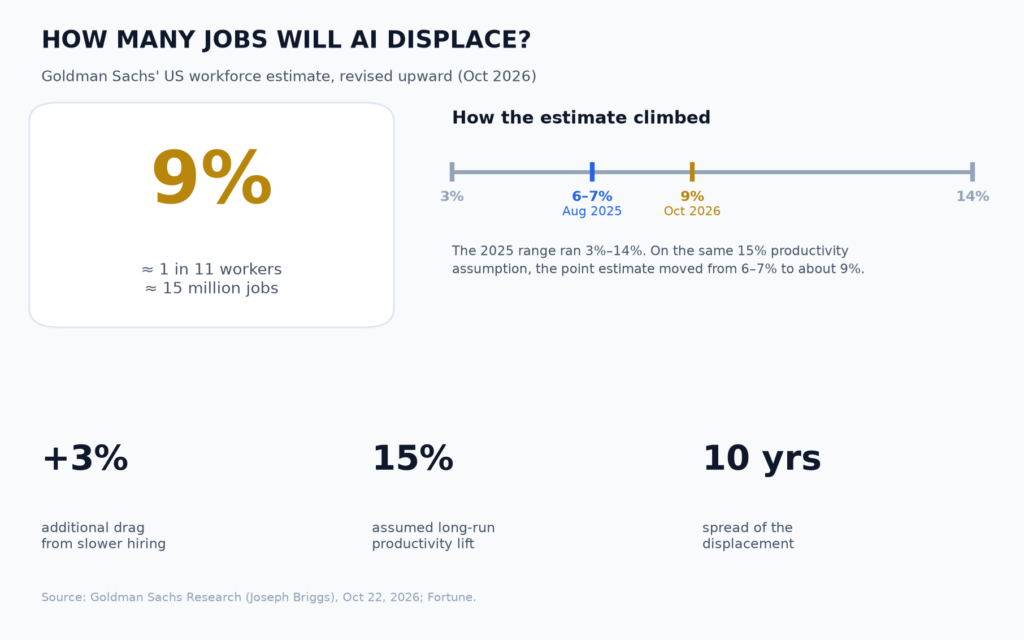
On October 22, 2026, Goldman economist Joseph Briggs put potential displacement at up to 9% of the US workforce — about one in eleven, or roughly 15 million workers — with weaker hiring weighing on employment by a further 3%. The estimate rests on the bank’s forecast that AI eventually lifts productivity by roughly 15% in the US and other developed economies.
It is also a moving target. In August 2025, Briggs and economist Sarah Dong placed the central estimate at 6% to 7%, within a 3% to 14% range. By June 2026 he was at about 9%, and Thursday’s note formalised the revision.
The more interesting finding, though, is about when those losses arrive. Automation-driven disruption stays contained while the economy is healthy and accelerates during cyclical slowdowns. The share of Americans in routine work — clerks, secretaries, machine operators — held flat through expansions, then dropped in the downturns of the early 1980s, 2001, 2008 and 2020.
“A more concerning takeaway from our analysis is that a cyclical slowdown would likely accelerate AI-related automation and job losses, thereby amplifying the broader business cycle,” Briggs wrote.
Two caveats sit inside that warning. First, the 9% is a gross displacement measure, not an unemployment forecast — the jobless rate hides people who exit the labour force or land elsewhere quickly. Second, Briggs treats the losses as temporary. Historically, roughly 85% of job growth has come from the creation of new occupations, and he expects the same reabsorption to play out again. The real question is whether new-job creation picks up fast enough to smooth the transition.
History also supplies a yardstick. Across 25 occupations upended by earlier technology — file clerks, proofreaders, photo processors and bank tellers among them — employment fell 25% on average in the five years after its decline began. Briggs calls that a likely upper bound for what AI does next, since he deliberately picked the cases where technology hit hardest.
Adoption explains the quiet
Only 23% of US establishments have built AI into regular workflows, and job growth in the most AI-exposed industries has run about 10,000 below its long-run trend over the past three months — roughly offset by hiring for AI-related construction. Most of the productivity gains from AI, in other words, still lie ahead of us.
One sector has already bolted ahead. Goldman put US call-centre employment about 39% below trend in a recent note on AI’s spread across white-collar work — a steep drop that previews what a downturn could do at scale.
What the layoff counters show, and what they miss
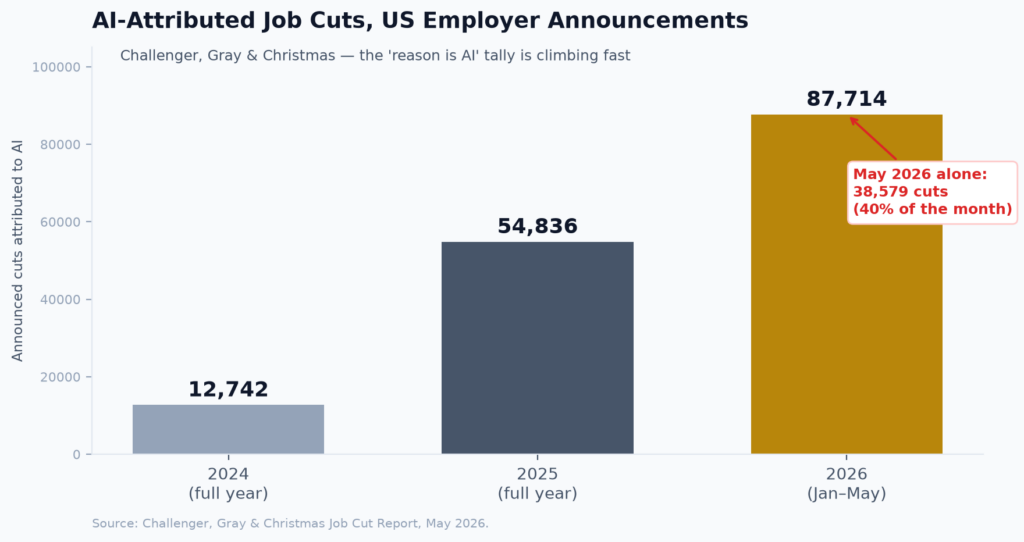
Challenger, Gray & Christmas recorded AI as the leading reason US employers gave for job cuts in 2026. AI-attributed announcements reached 87,714 in the first five months, against 54,836 for all of 2025 and 12,742 in 2024. May alone produced 38,579 AI-linked cuts — the highest monthly reading since the firm began tracking the category in 2023 — and AI’s share of announced cuts climbed from 7% in January to nearly 40% in May. Total May announcements reached 97,006, the heaviest for that month since 2020, while planned hiring through May sat at 80,472, still historically low by pre-pandemic standards. The technology sector alone reported 38,242 cuts in May, its highest monthly reading since 2023.
“AI is now the leading reason companies give for cutting jobs,” said Andy Challenger, the outplacement firm’s chief revenue officer.
Plenty of researchers are unwilling to take that attribution at face value. Payrolls still grew by 172,000 in May, according to the Bureau of Labor Statistics — more than double the consensus estimate. Columbia Business School’s Daniel Keum argues that AI’s effect remains concentrated in technology rather than spread across the wider labour market, while Daniel Zhao, chief economist at Glassdoor, questions whether companies that cite AI are genuinely substituting machines for the roles they eliminate. Thomas Thompson, chief economist at Havas Edge, framed the mismatch in one line: “The jobs that are open aren’t replacing the jobs that are lost.”
Goldman’s own reading is that AI-attributed layoffs have pulled back sharply from their spring peak.
Inside companies, jobs change before headcount does
Workday’s October 2026 Global Workforce Report shifts the lens from layoff announcements to what employers actually plan. Forty percent of business leaders expect AI to get more output from the people they already have; only 28% expect it to cut headcount. The movement that has stalled is internal: moves to new roles inside the same company fell at 57% of employers, promotions stayed flat, and nearly four in ten employees said their company had gone through a reorganisation in the past year.
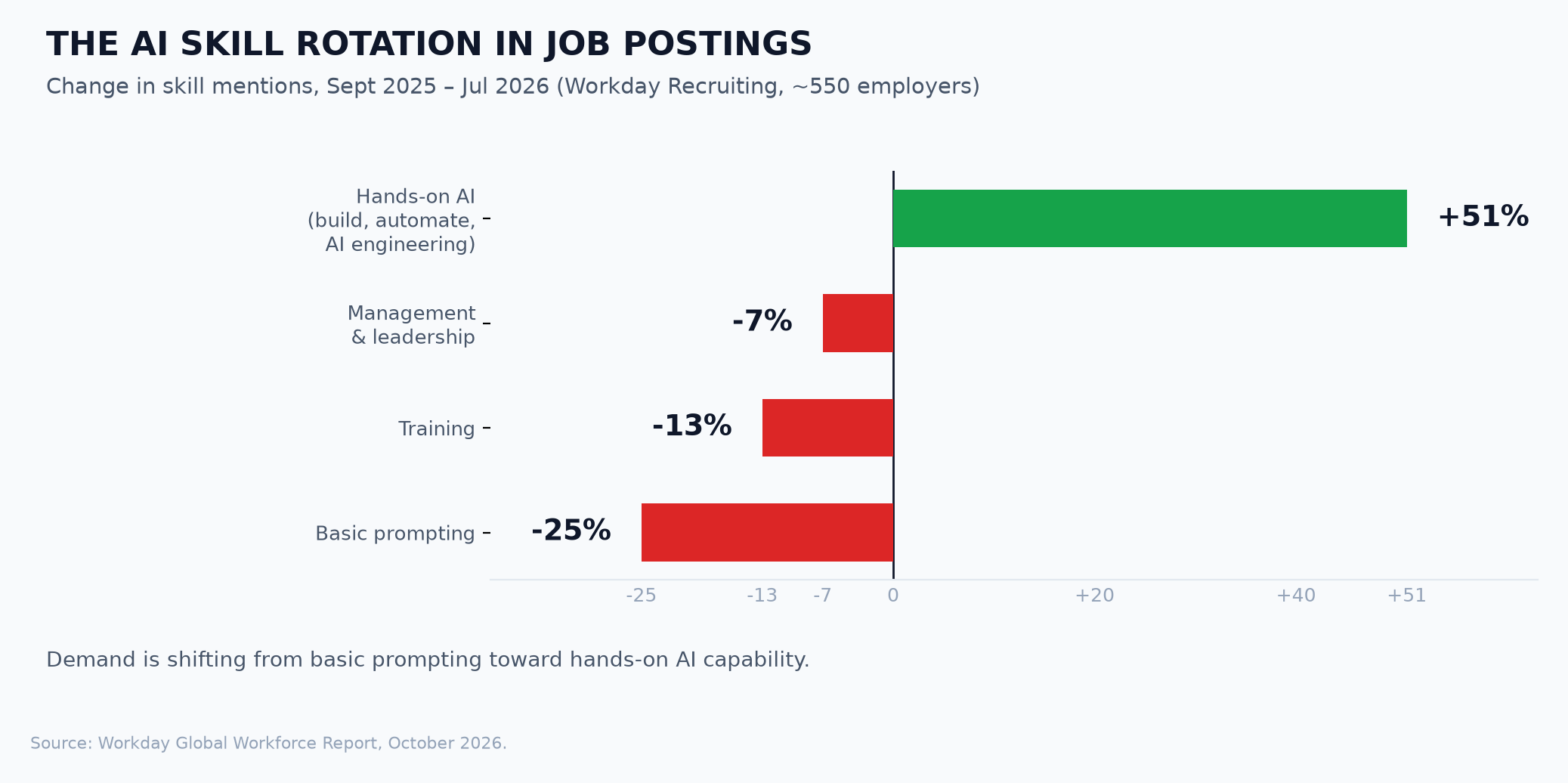
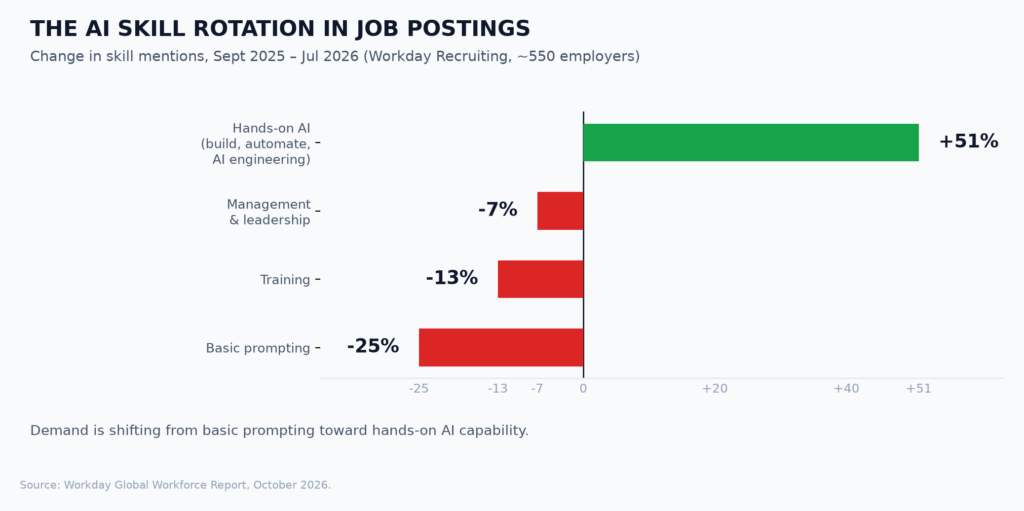
Skill demand is rotating fast. Postings data across some 550 employers show demand for basic AI skills — simple prompting — peaking in January 2026 and then falling 25%, while hands-on capability such as building AI tools, automating workflows and AI engineering rose 51% between September 2025 and July 2026. Mentions of management and leadership skills dropped 7%, and training skills dropped 13%.
Job seekers are adapting on their own. In Workday’s survey, 84% said they used AI during their search, and the median number of applicants for each filled role rose to 69 from 58 a year earlier. Filling a role still takes roughly 60 days, because volume is not quality. Competition tightened most in financial services, up about 27% in applicants per hire, and in technology and media, up about 40%.
“Employees may not be changing jobs, but their jobs are changing around them,” said Phil Willburn, vice president for people systems at Workday. “Leaders need to be honest about what’s different and give people a way to keep up.”
Retention tells its own story. Voluntary turnover sits near 16% a year, and about 70% of employees remain with the same employer after two years — yet employees who plan to stay are measurably less likely to recommend their employer, a gap that reaches 11 points in the public sector.
Why marketers should read these notes
The rehiring penalty is not just a labour story. It changes four things marketers run.
Employer brand stops being decoration. With turnover low and sentiment soft, hiring volume matters less than the quality of the people who stay. Recruitment content that explains career paths — including lateral moves and reskilling — earns its place next to job ads.
The pay penalty is a demand signal. Workers who re-enter at 3% less in real terms cut discretionary spending first, and occupational downgrading reshuffles which segments feel confident. Premium positioning that assumes a stable professional middle class needs a stress test.
Training is a marketing surface. Workday found 79% of workers know which skills they need, but only 66% say their employer helps them get there. A 13-point gap is an audience — for content, courses and tools that help people make the move from prompting to building.
B2B buying committees get thinner. Fewer middle managers and fewer internal moves mean fewer approvers walking a long funnel, and more weight on practitioner-level proof.
What to watch next
Track the Challenger monthly share: whether AI stays near 40% of announced cuts or fades as the spring peak rolls out of the comparison. Watch whether a slowdown converts Goldman’s timing thesis into data — that is the note’s real claim. On the skills side, the prompt-to-build rotation is the leading indicator for agency and in-house team structures. And keep an eye on China, where the State Council’s AI+ action plan, issued in August 2025, frames AI as a driver of modernisation across six priority areas — spanning science and technology, industry, consumption, livelihoods, governance and global cooperation — rather than as job subtraction. It is a different political vocabulary for the same technology.