WorkBuddy Has 60% of China’s Top 100. The Harder Part Is What Comes Next.
Tencent Put Its Whole Office Suite Behind One Agent. Sixty Percent of China’s Top 100 Companies Are Already Inside.
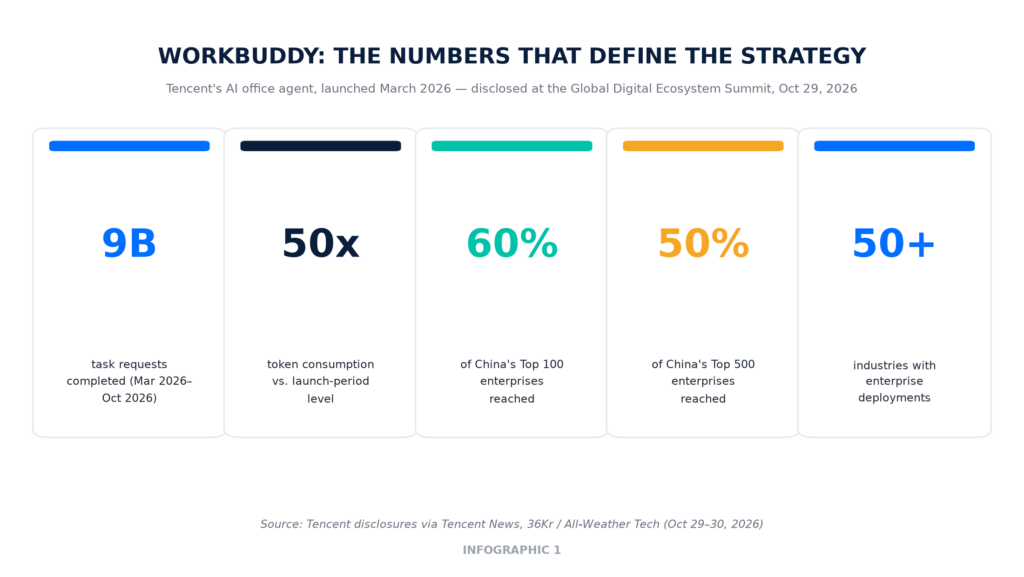
WorkBuddy launched in March. It has absorbed nine billion task requests, and it is now the interface to Meetings, Docs, ima and Cloud Drive.
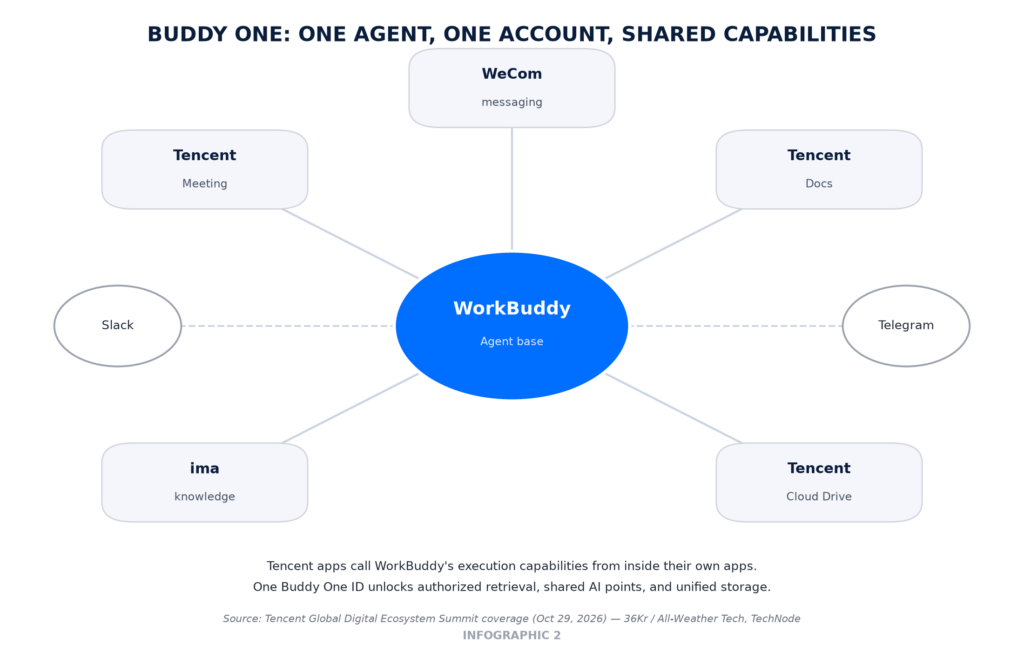
Tencent spent years building separate office products: Meetings, Docs, ima for knowledge, WeCom for messaging. On October 29, at its Global Digital Ecosystem Summit, it stopped treating them as separate destinations and built a system called Buddy One around WorkBuddy, the agent it launched in March.
The mechanics matter less than the direction. Bind a Buddy One ID and WorkBuddy can retrieve authorized Tencent Docs, meeting records and ima knowledge-base content, then answer with sources attached. Docs, ima and Cloud Drive now connect to WorkBuddy’s agent base and call its execution capabilities from inside their own apps. A newly released Cloud Drive supplies shared storage so material and results stay usable across the system. Separate AI point balances have merged into one Buddy One currency that works across all four products.
Dowson Tong, Senior Executive Vice President of Tencent and CEO of Cloud and Smart Industries Group, went further than plumbing. He told reporters that if users stop opening the standalone Tencent Meeting client because they handle meeting work inside WorkBuddy, Tencent may reconsider whether that client needs to exist at all.
The One Number That Explains the Strategy
WorkBuddy has completed nine billion user task requests since March. Token consumption, disclosed by Tencent Cloud CTO Wang Huixing, has climbed fifty times above the launch-period level. The enterprise edition has been deployed across more than fifty industries and, by Tencent’s figures, reaches sixty percent of China’s top one hundred enterprises and half of its top five hundred.
That penetration is why this is a platform story rather than a product launch. An agent already sitting inside the largest Chinese enterprises does not need to win a new budget line. It needs to become the place where existing work happens, so the surrounding tools become capabilities rather than destinations. The product has also reached more than forty countries and regions, connecting to international collaboration tools in the process.
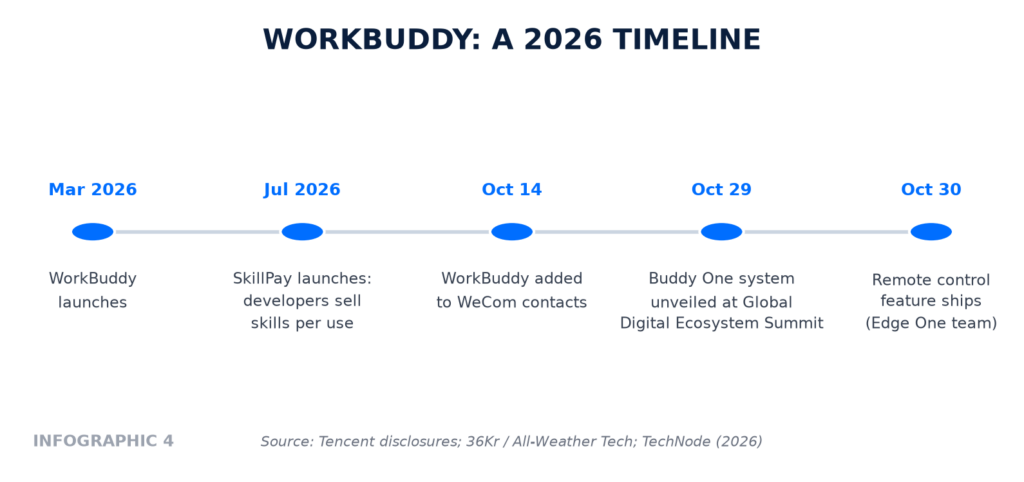
On October 14, Tencent pushed WorkBuddy into WeCom’s contact list. Employees assign it tasks the way they message a colleague, and with authorization it can reach messages, documents and meetings, then send results back into the chat app.
On October 30 it added remote control, built on Tencent’s Edge One infrastructure. From a phone, a user can watch the desktop an agent is working on and step in when it stalls: an expired connector authorization, a logged-out account, the wrong window. Tencent limits each computer to one authenticated device, encrypts the channel, and says it neither records input nor stores screen footage. Remote-control traffic does not consume the agent’s token quota. Tiered permissions and audit logs are promised for later versions.
Where the Walls Are
Cross-app capability stops at data boundaries Tencent cannot dissolve, several of them inside its own building. WeCom runs a separate chat-record agent specifically so WorkBuddy cannot read other employees’ conversations. The two exchange information only under full authorization.
A real-world example shows what this looks like in practice. Zhongshun Jierou, a major Chinese tissue-paper enterprise, had opened nearly 1,300 WorkBuddy accounts by early October. Yet the company has not connected its core operational database to the agent. Instead, it built an independent data environment, allowing WorkBuddy to access only screened data with role-based permissions varying by employee identity. This is not resistance to the technology — the company has deployed it widely — but a governance decision built around data boundaries that the CEO cannot simply override.
External customers are more cautious still. Opening a core operational database to an agent is a governance decision rather than a feature toggle, and Chinese enterprises have spent two years being told exactly that by auditors and regulators.
This is the honest constraint on the design. Buddy One today delivers account linking, authorized retrieval, shared points and unified storage. Cross-application memory, the thing that would make the system feel genuinely intelligent, is still in progress.
The Pricing Experiment
Tencent is not pretending the economics are settled. Tong said the WorkBuddy team has no clear revenue target and that commercialization is being weighed mainly as a way to fund product and service development.
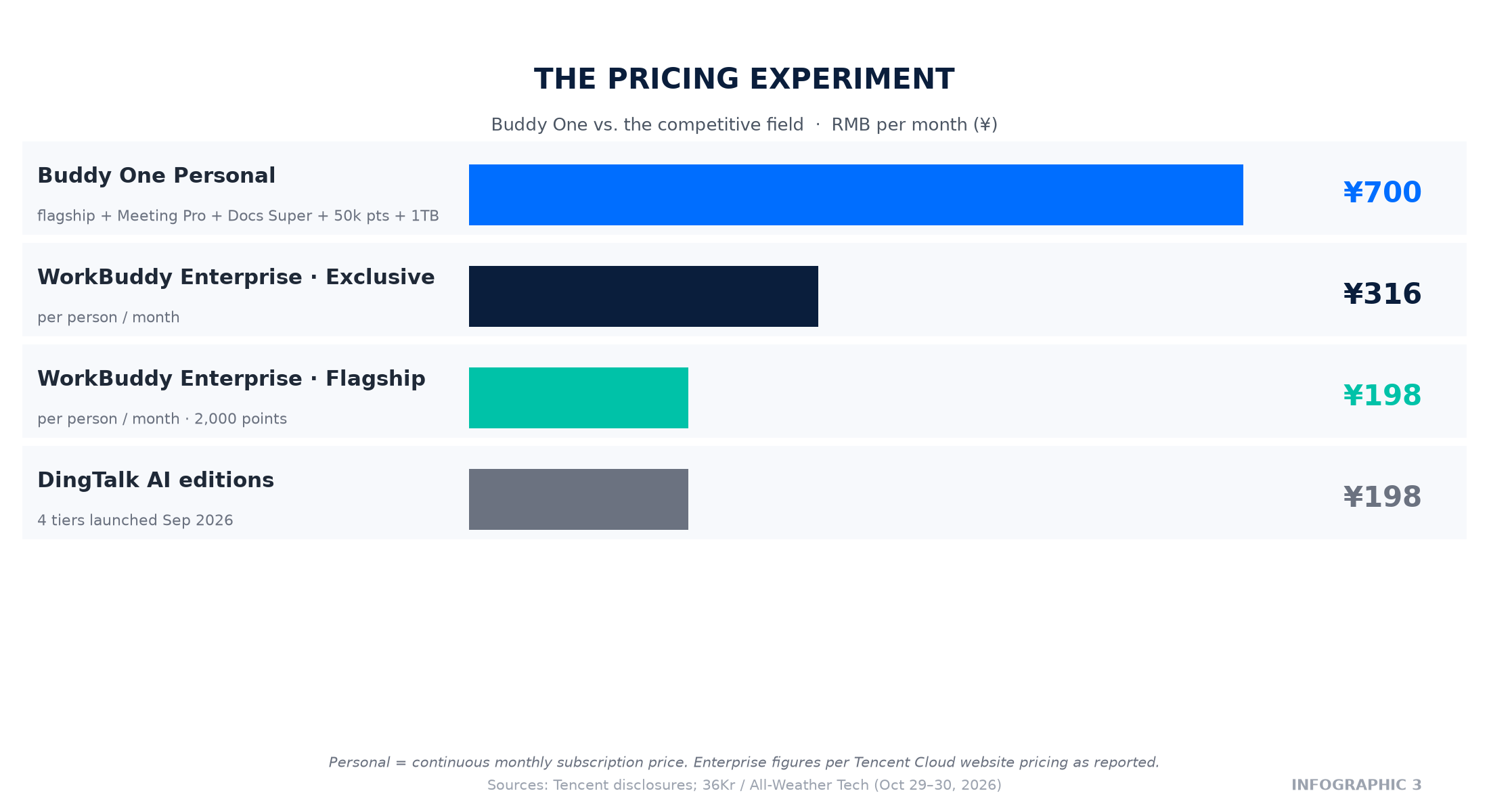
The price card is nonetheless specific. Buddy One personal membership, as a continuous monthly subscription, runs seven hundred yuan a month, bundling WorkBuddy’s personal flagship tier, Tencent Meeting Professional, Tencent Docs Super Member Plus, fifty thousand AI points and one terabyte of shared storage. Enterprise editions are listed at one hundred ninety-eight yuan per person per month with two thousand points for the flagship tier, and three hundred sixteen yuan for the exclusive tier.
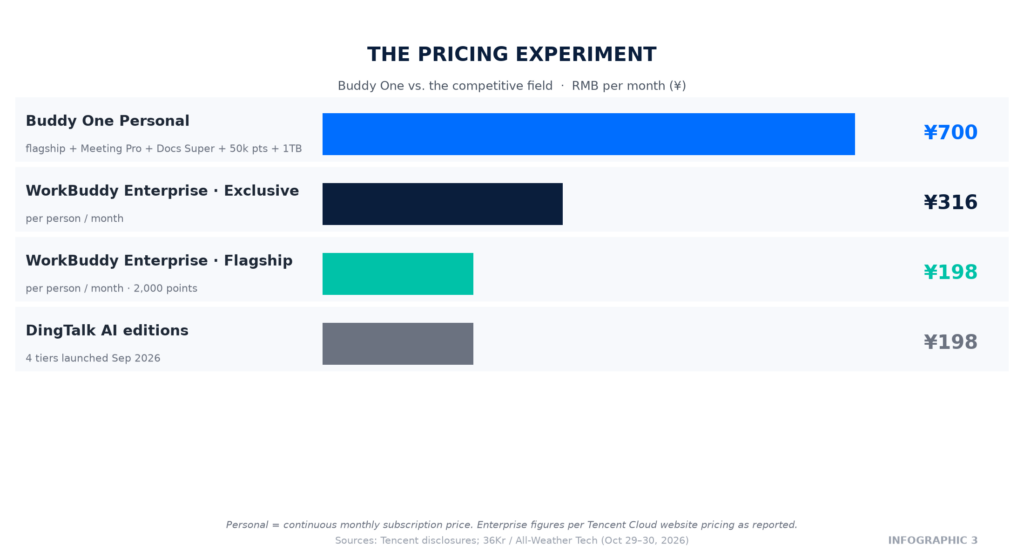
Those numbers sit inside a market that has already converged on similar pricing. Lark’s Doubao work partner is at one hundred ninety-eight yuan per seat. DingTalk released four AI commercial tiers in September. Office agents are turning into a line item inside collaboration bundles, which moves the fight to renewal attach rates rather than list prices.
Enterprises are not just buying seats; they are starting to manage AI like a cost center. Suning.com analyzed task execution trajectories through WorkBuddy’s observability center, adjusted prompts, models and tool configurations, and reduced token consumption by ten percent. H3C employees hold 1.3 million conversations with WorkBuddy every day, and the management team now adjusts token allocation and incentive strategies according to usage patterns. These are not vanity metrics: they are the early shape of enterprise procurement logic for AI agents.
The Open Platform Is the Other Half of the Model
Tencent says WorkBuddy’s developer platform has gathered more than fifty thousand partners and developers with over two hundred thousand skills listed, distributed through SkillHub. SkillPay, launched in July, lets developers sell capabilities per use. WorkBuddy also connects to Slack and Telegram, so an enterprise that never buys the Tencent office suite can still route work through it.
At the same conference, Dowson Tong announced that WorkBuddy will fully open its product architecture to support self-developed enterprise agents, third-party agents, and third-party instant messaging systems. He framed the ambition as building an “enterprise intelligent hub” — a network of agents that can execute tasks across systems, not just within Tencent’s own walls.
The ambition is coherent. Whether the incentive model works equally for everyone whose agent gets consumed through that hub remains an open question. Tencent Maps, for instance, is already opening its capabilities to other agents through MCP and Skills. Zhong Xiangping, Tencent’s Vice President of Smart Mobility, acknowledged that beyond existing interface-call fees, revenue models such as traffic commission and pay-for-performance could emerge — but nothing is settled. The same unresolved commercial logic applies to every third-party developer listing on SkillPay, and to every office product whose relationship with the user could be mediated by WorkBuddy instead of direct.
Why This Is a Procurement Story, Not a Product Story
Three conditions have to hold for the model to scale. The agent has to reach systems holding real business data. The enterprise has to be willing to let it. And the price has to survive a budget review that compares it against headcount rather than against a chatbot subscription.
Tencent has solved the first, is negotiating the second, and is testing the third. The unresolved one decides everything: an agent that cannot see the core database is an excellent assistant and a very limited colleague.
Key Numbers
- WorkBuddy launch: March 2026
- Cumulative task requests: Nine billion
- Token consumption: 50× the launch-period level
- Enterprise reach: 60% of China’s Top 100, 50% of Top 500, 50+ industries, 40+ countries and regions
- Personal membership: ¥700 / month (continuous monthly subscription)
- Enterprise flagship: ¥198 / person / month (2,000 AI points)
- Enterprise exclusive: ¥316 / person / month
- Developer ecosystem: 50,000+ partners and developers, 200,000+ skills
- Key dates: SkillPay (July 2026), WeCom integration (October 14, 2026), Buddy One launch (October 29, 2026), Remote control (October 30, 2026)
Bottom line: Tencent turned a fast-growing agent into the front door of its office business, and the installed base hands it distribution most rivals would pay dearly for. What it has not resolved is the question enterprise buyers actually ask: how much of the business are you willing to let the agent touch.