White-Label AI Glasses: The $28 Shenzhen Threat to $449 Big Tech
The $28 AI Pair: How Huaqiangbei Underpriced Amazon’s Smart-Glasses Aisle
For most of the past year, the cheapest way to put a camera and a language model on your face was not to buy from Meta. It was to buy a white-label pair from Shenzhen for $20 to $60.
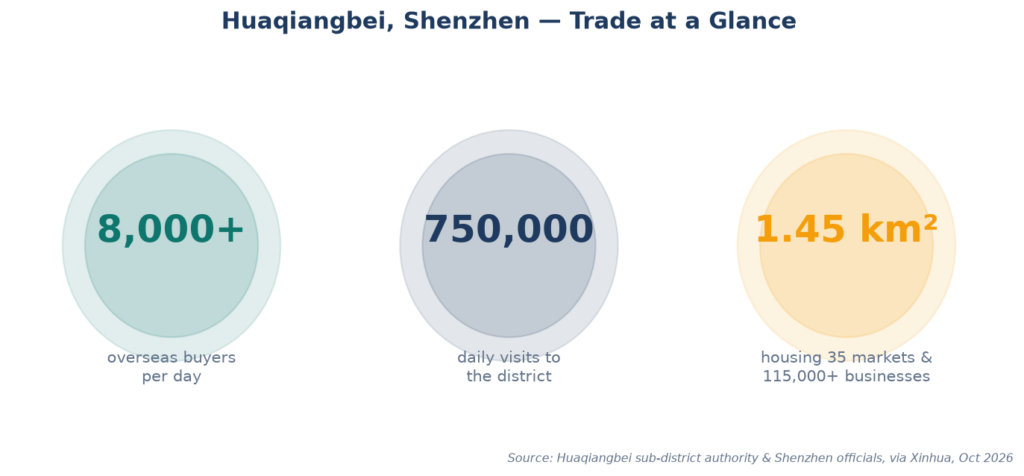
The sourcing hub behind that price is Huaqiangbei, the electronics district in Shenzhen’s Futian district. Sprawling across just 1.45 square kilometers, it crams 35 specialized markets and more than 115,000 registered businesses into a single neighborhood, stocking over a million kinds of parts and finished goods. It has turned into one of the world’s largest shipping points for AI eyewear, and for a simple reason: nothing in the chain is precious.
The Price Tag, in Both Currencies
On the street, an audio-only pair — music, calls, live translation — retails for roughly 100 to 200 yuan, or about $14 to $28. A camera model that records footage and translates more than 160 languages sells for approximately 420 yuan, near $59. Across the district, white-label smart glasses sit in a 100-to-400-yuan band, stacked on the same counters that sell earbuds, power banks, and smart watches.
Export pricing adds freight, marketplace fees, and duty. Strip those out and the impression most overseas shoppers get is a $30 pair that claims to do what a $449 device does — only worse.
How a 200-Yuan Pair Gets Built
The product architecture is remarkably thin: the frame collects and transmits, the phone app and a cloud model do the thinking. It is cheap to launch and hard to defend, because any counter can copy the same components the same week.
Chinese tech media and industry reporting have chronicled this dynamic repeatedly. Merchants describe sourcing a full bill of components — lenses, battery, speaker, mainboard, chips — within days, and moving from design to a first production run in weeks. The supply chain’s density is the real moat: designers, component suppliers, prototyping workshops, and exporters all operate in close physical proximity around Huaqiangbei, creating an environment where a new product idea can move from concept to market faster than a Western brand can clear a legal review.
A senior product manager at Shenzhen Macrotellect, a brain-wave wearable maker based in the district, told the Global Times in August 2026 that overseas clients make up 60 percent of his company’s customer base. His explanation, echoed by other merchants in the area, was simple: thanks to the region’s clustered supply-chain resources, everything from circuit-board production to finished prototypes can happen within a single week.
Yang Chaohua, CEO of AI box manufacturer Three-Body Intelligent Technology, told the same outlet that his firm processes five to six batches of overseas orders every day, adding that domestically developed AI hardware is priced at roughly one-third of equivalent foreign products.
Huaqiangbei’s Own Numbers
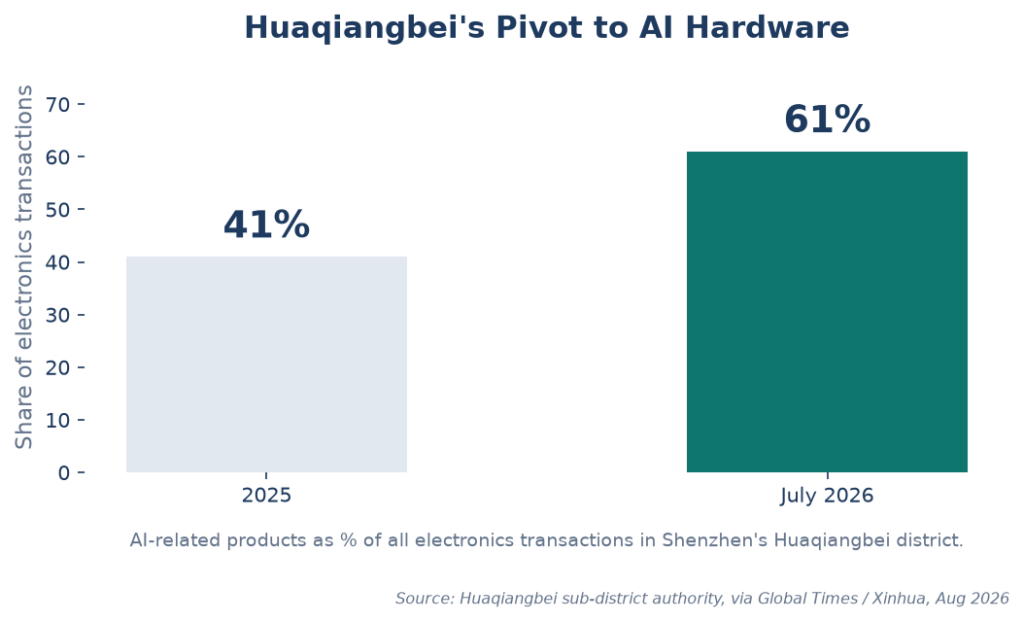
The district’s shift is measurable — and the data is striking. According to official figures from the Huaqiangbei sub-district authority, AI-related products accounted for 61 percent of all electronics transactions by July 2026, a dramatic jump from 41 percent in 2025. That is a complete reversal of the district’s old identity as a bulk-components bazaar: in less than two years, AI hardware has become the absolute mainstream of China’s most famous electronics marketplace.
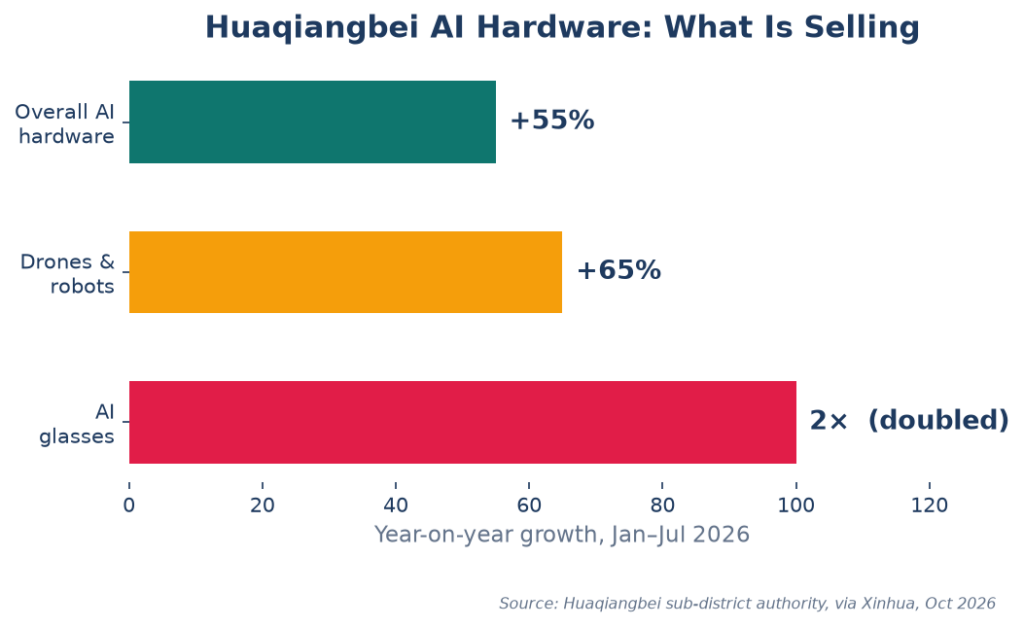
From January to July 2026, total sales of local AI hardware products jumped more than 55 percent year on year. Within that, AI glasses sales doubled, while drone and robot sales each rose 60 to 70 percent. More than 60 percent of local store owners have pivoted to AI hardware operations, and consumer inquiries for intelligent products have tripled, according to sub-district data reported by Xinhua and the Global Times.
Amazon Is Where the Price Shows Up
On the global marketplace side, the cheap tier is not a niche — it is the visible surface of a supply chain that moves through Shenzhen customs at extraordinary volumes. Shenzhen Customs data show the city’s imports and exports of high-tech products reached 1.7 trillion yuan (roughly $252 billion) in the first half of 2026, ranking first among all Chinese cities and contributing more than 60 percent of the city’s total foreign trade growth. AI-related trade alone exceeded 1 trillion yuan, with a year-on-year increase of more than 50 percent.
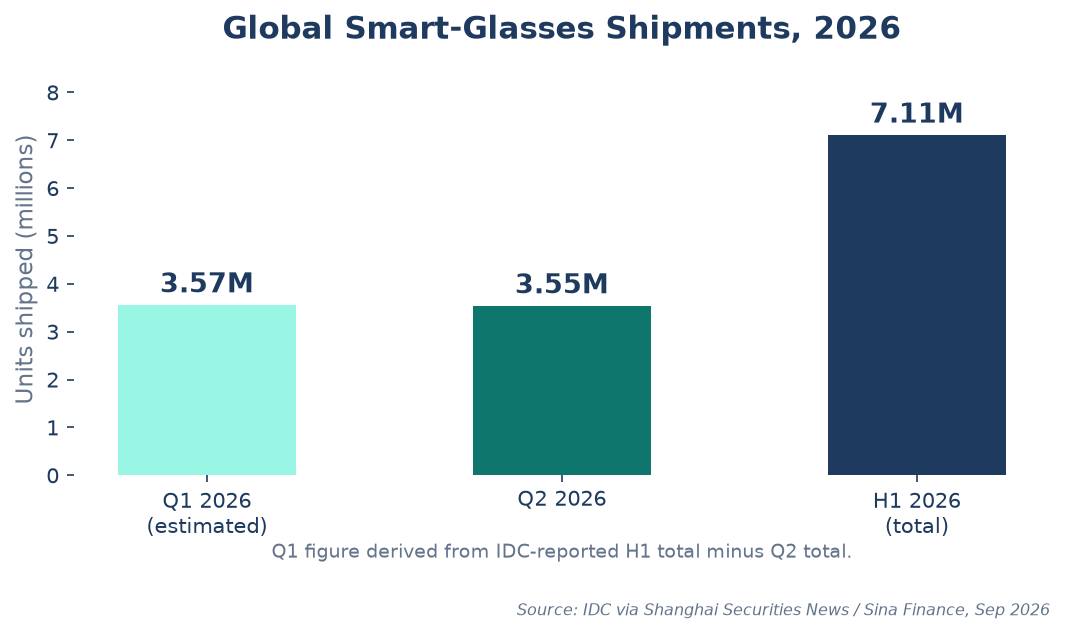
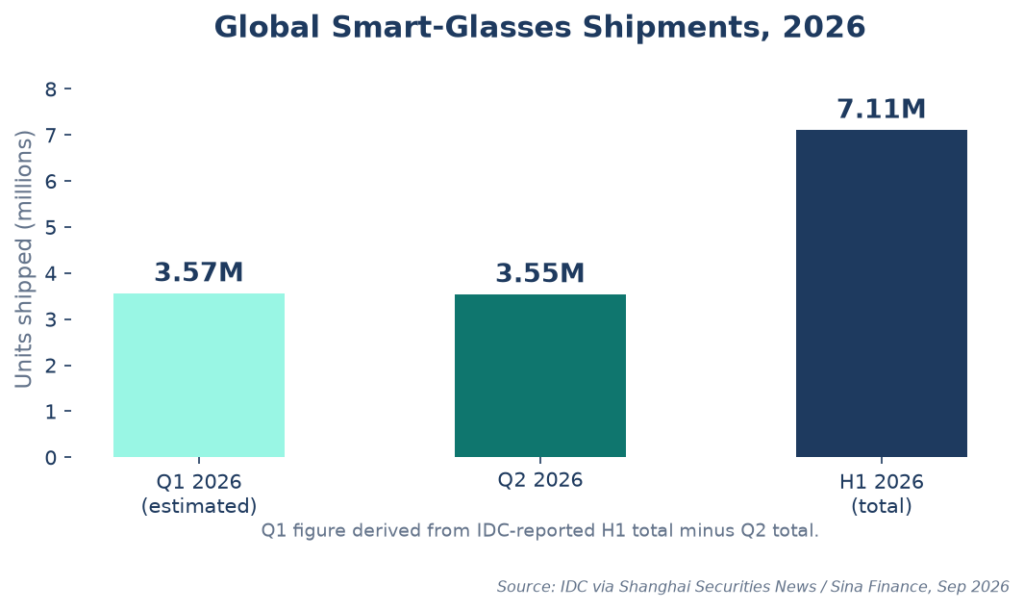
Market research firm IDC reported that global smart-glasses shipments reached 7.114 million units in the first half of 2026, with 3.547 million of those coming in the second quarter alone. That puts the first-quarter contribution at roughly 3.567 million units. The trajectory is unmistakable: what was once a novelty category is now shipping at a scale that rivals mature consumer electronics segments.
On the retail front, distribution is increasingly creator-led. Affiliate videos promote the cheap tier as affordable alternatives — typically $40 to $100 — and some creators have even marketed the absence of a recording indicator light as a feature rather than a privacy flaw. The economics are straightforward: a lower unit price leaves more room for affiliate commissions, so the cheapest pairs generate the most content.
Demand Has a Quality Problem
The category is growing fast, but growth has an uneven quality. Before Spring Festival 2026, the lowest-priced white-label pairs in Huaqiangbei markets hit a wall: merchants described pulling them at scale because they simply stopped selling. Wear discomfort, weak feature sets, and after-sales problems did what price alone could not — they ended the novelty for a meaningful share of first-time buyers.
According to media reports citing data from Chinese market research firm RUNTO Technology, global smart-glasses shipments excluding ultra-low-price white-label products are expected to surpass 13 million units in 2026, representing year-on-year growth of around 44 percent. The gap between that figure and the broader category estimates from other research firms reflects the enormous — but volatile — white-label tail that sits beneath the branded market. Buyers who return for a second pair tend to want a display, or at least something that does not feel like a brick on the ear; industry designers routinely cite a comfort threshold near 30 grams for all-day wear.
The Cost Floor Is Moving Up
Cheap cross-border shipping is no longer cheap. The United States closed its de minimis exemption for parcels under $800 on August 29, 2025 — a policy shift that removed the duty-free lane that had made ultra-low-price cross-border commerce viable for thousands of small exporters. On August 13, 2026, the U.S. Court of International Trade upheld the administration’s authority to close that exemption, effectively locking in the new cost structure for the foreseeable future.
Across the Atlantic, the European Union ended its own 150-euro duty-free threshold in July 2026, replacing it with a flat 3-euro charge on low-value parcels entering the bloc. Multiple reports indicated that Chinese import volumes into the EU dropped 30 to 40 percent in the weeks that followed.
Run the math on a $29 pair with duty, marketplace commission, fulfillment, and returns, and the margin disappears before advertising. The low end still exists, but the volume zone is drifting toward $80 to $200, where a seller can fund compliance, customer service, and a return policy.
Compliance and Privacy Are Now Part of the Product
Two developments in recent months have reset the risk profile of the category — one around physical safety, the other around data privacy.
On September 24, 2026, the U.S. Consumer Product Safety Commission, together with Health Canada, announced a recall of INMO AIR3 smart glasses after the company received ten reports of overheating. Some users described a burning sensation on the face and the left side of the ear. The affected units — about 1,643 sold in the United States and roughly 120 in Canada — were priced between $900 and $1,300 and sold through Amazon, INMO’s own website, and Kickstarter between December 2025 and August 2026. Owners were told to stop wearing them immediately and install firmware version V3.16 before using them again.
That recall landed on a premium product, not a $30 white-label pair. But the signal it sends to regulators and platforms is the same: a device that sits against the skin near the eyes and ears for hours, often while the wearer is translating a conversation or streaming video, needs thermal management that can survive a long flight or a full workday.
Meanwhile, in Australia, Reuters reported in October 2026 that the national privacy regulator had opened an investigation into Shenzhen Qingcheng Future Technology, the developer of the HeyCyan companion app used with certain smart-glasses products sold through Australian retailer Kmart. Separately, the Australian federal government confirmed it is considering restricting or banning camera-equipped glasses in government workplaces over privacy and security concerns. The marketing of indicator-light blockers as a selling point — a tactic some white-label promoters have used online — has drawn attention from platforms and regulators alike, creating a reputational risk that lands on the entire category, brand and white-label together.
What to Watch
The upgrade path. White-label sellers are trying to become brands, and the most credible route runs through display-equipped frames at mid-tier prices. Whether that works before Apple’s expected entry, Google’s and Samsung’s planned launches, and Meta’s next pricing move will determine how much of the cheap tier survives. Media reports citing RUNTO data suggest the display-equipped segment is growing faster than the audio-only category, and the number of brands competing in the camera-glasses space has already begun to shrink — from roughly 90 in late 2025 to around 64 by mid-2026 on major Chinese e-commerce platforms.
Marketplace enforcement. Amazon and other platforms face growing pressure on safety documentation and category gating for eyewear that records. Tighter rules will hurt the smallest sellers first, and platform policy changes have historically consolidated market share toward better-capitalized sellers with compliance teams.
Two demand engines. While China’s domestic market has its own growth dynamics — including reported consumer subsidy programs that may have extended to smart devices — the export demand that drives Huaqiangbei runs on a different clock. Currency moves, trade policy shifts, and platform enforcement actions in destination markets all affect Shenzhen’s factory lines more directly than Beijing’s domestic consumption policies.
The visibility problem. The backlash against smart glasses — what some media have labeled the “pervert glasses” narrative — is not a passing social-media storm. Pubs, theaters, courthouses, and other venues across the UK, the US, and Australia are beginning to post explicit bans. When the most viewed content about a product category is about how to spot it in a changing room, new buyers hesitate. That hesitation is felt most acutely at the bottom of the price ladder, where trust was already thin.