DeepSeek Unveils a New Agent Architecture Built Around Events, Not Chat Windows
The design separates routing, execution, and state across five components. DeepSeek says an internal instance is already running in production — while conceding the hard problems, memory and security among them, remain open.
DeepSeek’s Harness team used its October 31 technical paper to make a narrow, technical argument with broad implications: the chat session is an artifact of API design, not a requirement of how agents should work.
The paper, Super-agent Design Exploration: Towards a More Autonomous Agent System, lays out an architecture in which a persistent coordinator receives events from many channels, dispatches work to isolated executors, and reports back through a single interface. An accompanying GitHub prototype, dsh-superagent-prototype, implements parts of the design.
Here is what is actually in it.
From sessions to a continuous service
The premise is straightforward. Current agent products treat a session as the atomic unit: one context, one task, one thread of state. Parallel work means parallel sessions, and parallel sessions mean a user juggling windows.
DeepSeek lists the failure modes that follow — blocking while a long tool call resolves, context confusion across tasks, and work that stops entirely when the local device disconnects. Extending an agent through CLI hooks, MCP servers, or external connectors does not fix the underlying model of work; it just adds more places to manage.
The proposed replacement is an agent that behaves like a service: continuously online, multi-channel, event-driven, and recoverable.
Component one: the two-tier hierarchy
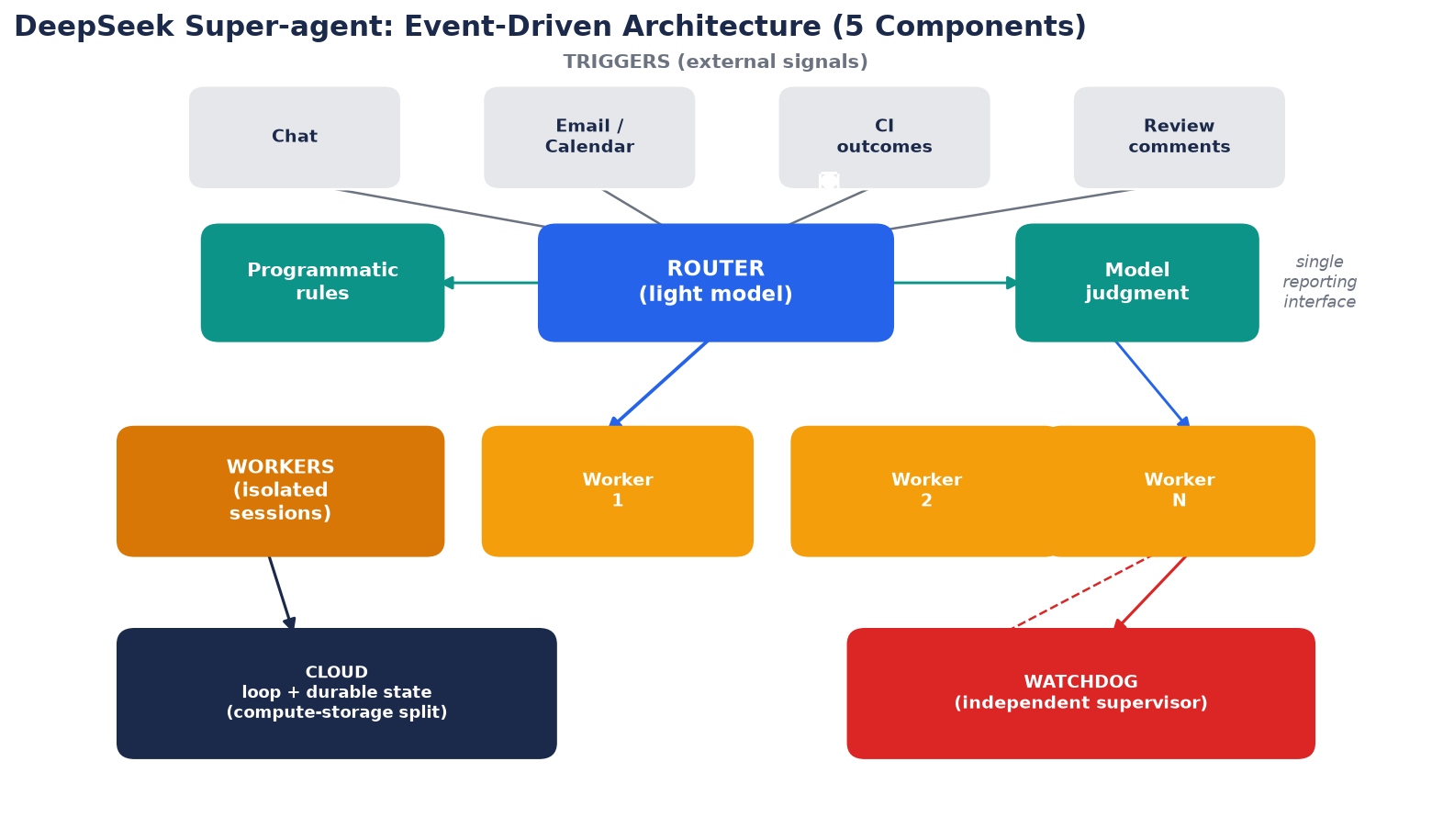
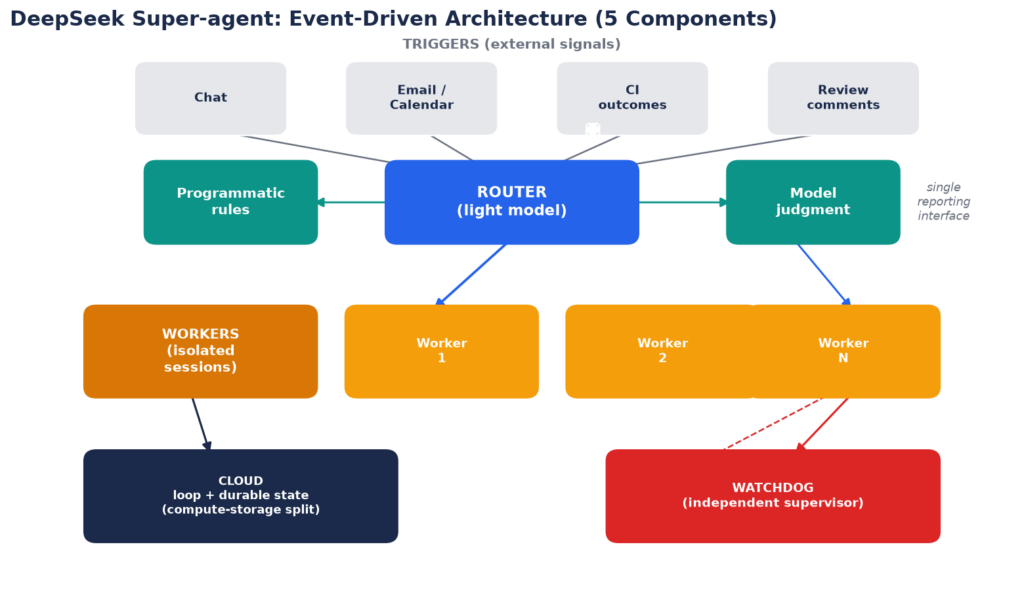
A Router layer absorbs all human input, maintains global context, and dispatches. Worker layers execute in isolated sessions. Workers report to the Router rather than the user, so the human-facing surface stays singular even when many processes run at once.
The design assumes asymmetric models. Routing is a lighter cognitive job than execution, so a smaller model can own the Router while stronger models run Workers. DeepSeek argues this also corrects a habit inherited from model APIs — forcing users to manage sessions manually because that is how the underlying interface was shaped.
A subscription mechanism keeps the Router from becoming a bottleneck: once a Worker is bound to a thread, subsequent related events skip the Router entirely.
Component two: event-driven triggering
External signals — chat messages, mail and calendar reminders, review comments, CI outcomes — are modeled as triggers.
Filtering happens in two passes. Programmatic rules eliminate the bulk of irrelevant traffic cheaply, then a model evaluates what survives against context. The ordering matters: running a model over every message would be both slow and expensive, and most of that stream never warranted attention.
This is the layer that produces the most visible behavioral difference from conventional assistants. A standard assistant waits for a prompt. An event-driven system can initiate work because something in the environment changed, not because someone typed.
Component three: interaction designed for waiting
DeepSeek replaces the synchronous ReAct loop with an asynchronous variant. Long tool calls become start() and stop() operations. The agent returns a started state immediately, keeps the foreground conversation responsive, and injects the background result later as a new event.
The practical effect is that a user can redirect or cancel work mid-flight instead of waiting for a blocking call to return. DeepSeek notes the mechanism is implemented in DeepSeek Harness but not enabled by default.
Component four: compute, state, and environment pulled apart
Borrowing the logic of compute–storage separation, the system puts the agent loop and durable session state in the cloud while leaving the execution environment on the user’s machine. Only a lightweight daemon runs locally, receiving commands and returning results.
This yields three deployment options: bring your own machine, connect a cloud-hosted box, or spin up compute on demand. It also means a task interrupted by an offline laptop can resume when the device returns, rather than dying with the connection.
Component five: an independent watchdog
Outside the main architecture sits a separate Watchdog session, a control loop with its own context. It checks infrastructure health — API errors, failed state recovery — and also judges whether a Worker is making real progress or drifting from the objective, intervening when it is not.
DeepSeek’s reasoning is worth noting: an agent supervising itself is a conflict of interest. The oversight has to live outside the process being supervised.
Context management: what stays in the window
Two mechanisms handle memory within a run. Inline and Spill keeps near-term, likely-needed information directly in the context window while parking over-budget or low-frequency content outside it for on-demand retrieval. Chain of Recall reconstructs older task history by walking reference relationships between triggers, threads, and worker sessions — following identifiers rather than hoping a summary retained the detail.
Neither solves long-horizon memory. DeepSeek says recovering accurate context across weeks or months of accumulated work remains an open problem, which is an unusually candid admission for a paper of this type.
Speculative execution
One of the more consequential ideas is lifted from processor design. Rather than waiting for certainty, the system can spend background compute on speculative work and surface only the results that turn out useful.
The stated policy is conservative: act in the background, stay silent unless the work reaches a defensible conclusion, and discard the rest. DeepSeek describes one internal configuration that attempts to reproduce and fix reported defects before anyone assigns the task — a design that only works if the false-positive rate stays low, since a noisy proactive agent is worse than a passive one.
What the benchmark shows
The reported test: about 300 messages per run, roughly 20 of them genuine work requests, five repetitions per configuration, synthetic load, simulated tool durations, timings scaled to a quarter.
Super-agent: 12.4 minutes median, 15.7 minutes p95. Single session plus sub-agents, neutral prompt: 29.5 minutes p95.
The mechanism behind the difference is the finding. Under neutral prompting, the baseline never invoked its sub-agents across five runs — delegation was optional, and the model declined it. Making dispatch structural rather than discretionary produced the gain.
Two costs are disclosed. Cache-read tokens rise because multiple isolated contexts must be maintained; stripping event pass-through increased Router decisions by roughly 30% and total cache reads from 23.23 million to 31.77 million tokens. And Router behavior under burst load trades per-request latency for throughput — from 1 to 40 triggers per minute, batch size went 1.0 to 2.8, request latency 2.5 to 3.9 seconds, and per-decision inference time fell from 6.4 to 1.6 seconds.
DeepSeek states the limitation directly: the experiment evaluates scheduling and collaboration, not task execution quality.
What is shipped and what is not
An internal Super-agent instance built on DeepSeek Harness has been running continuously, handling defect reproduction, code review response, and iteration on Harness itself, according to the team. The public prototype is a plugin. Neither constitutes a product.
The paper also concedes intellectual honesty on its own terms: no new theory, only classical systems thinking — scheduling, cache hierarchy, event-driven architecture, compute-storage separation — reapplied to agents.
Where the architecture meets the market
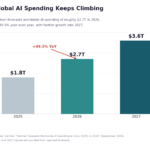
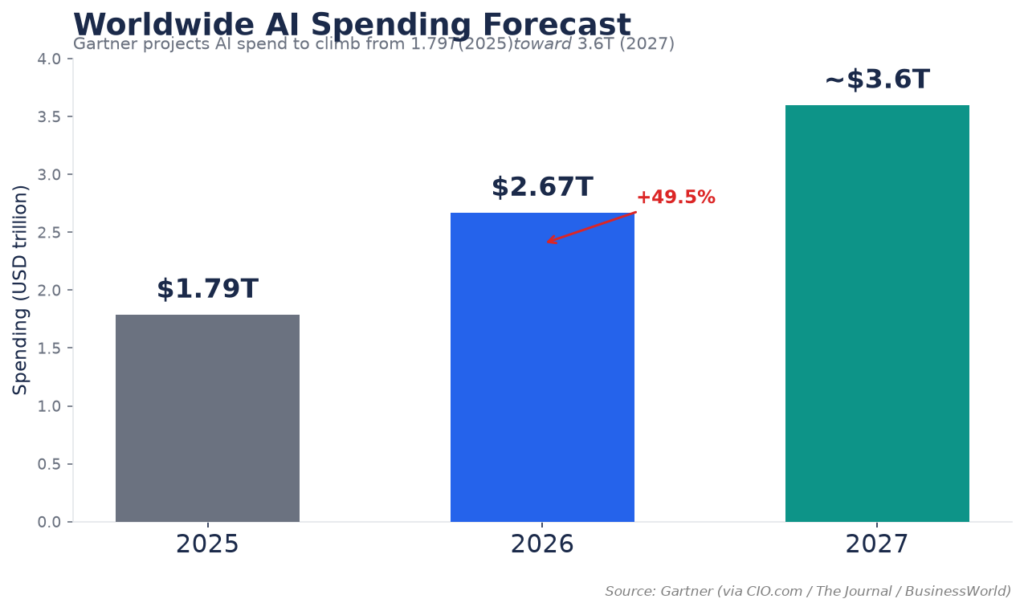
Gartner’s latest forecast puts worldwide AI spending at USD 2.67 trillion in 2026, rising roughly 49.5% from USD 1.79 trillion in 2025, and projected toward USD 3.6 trillion in 2027.The growth is fast from an already large base, and the bulk of it is absorbed by infrastructure rather than applications.
Gartner also expects more than 40% of agentic AI projects to be scrapped by the end of 2027 — canceled because of escalating costs and unclear business value — and warns that, through 2027, uncapped, token-based pricing for IT operations agents will push enterprise costs more than 50% above initial estimates. By 2030, it expects half of all organizations to run IT operations agents with minimal human involvement, up from almost none today.
That combination — heavy infrastructure spending, modest application spending, high project failure rates, and cost overruns — defines the problem DeepSeek’s paper is aimed at. Multi-agent designs fail in operations, not in demos, and the usual causes are coordination cost, unclear ownership, and no way to tell whether a running task is progressing.
The risks the paper names
DeepSeek’s own list: Router scalability at task scale, memory across months, human collaboration models that do not depend on sessions, agent-to-agent communication between separate instances, and security.
Security is the sharpest. A cloud agent with access to local devices widens the attack surface to prompt injection, endpoint credential exposure, and cross-device permission creep. Any organization adopting this pattern inherits those risks immediately, well before the architecture matures.
For marketing and digital teams evaluating agent platforms this cycle, the paper functions as a checklist. Ask how the system routes work, where state lives, what happens when a task stalls, what the coordination cost looks like at volume, and who approves an action the agent initiated on its own. Vendors that cannot answer those five questions are selling a chat window with a scheduler attached.