The Incentive Behind the Idle Stack: Why Shelfware Survives Every Audit
A utilization problem that is really an accounting problem.
Start with the number everyone quotes and almost nobody explains. Gartner’s 2025 survey found teams use just 49% of their martech capability. The reflex is to blame the tools, or the training, or the CMO’s discipline. All three miss the mechanism. Shelfware is not what happens when software is bad. It is what happens when buying is rewarded and idleness is free.
Someone gets credit for the purchase. No one gets billed for the waste. A new platform arrives with a launch, a demo, a slide in the quarterly review. The person who championed it is visible and praised. The cost of not using it lands nowhere: it auto-renews inside a budget line nobody itemizes, owned by a department, not a person. Zylo’s 2026 index puts the split in plain figures — business units control 81% of software spend while IT directly manages 15%. Bought everywhere, governed nowhere. When accountability is diffuse, waste is nobody’s failure, so it is never corrected.
The default is the whole game. Renewals are 87% of total software spend, and the average organization manages 211 of them a year — roughly one every business day. A renewal is not a decision; it is the absence of one. Unless a human actively intervenes, the contract continues, the seats perpetuate, and the unused license bills again. Shelfware compounds not because anyone chooses it but because the system’s resting state is keep paying. The 36% of licenses Zylo measures as unused against recommended levels is the balance that default produces.
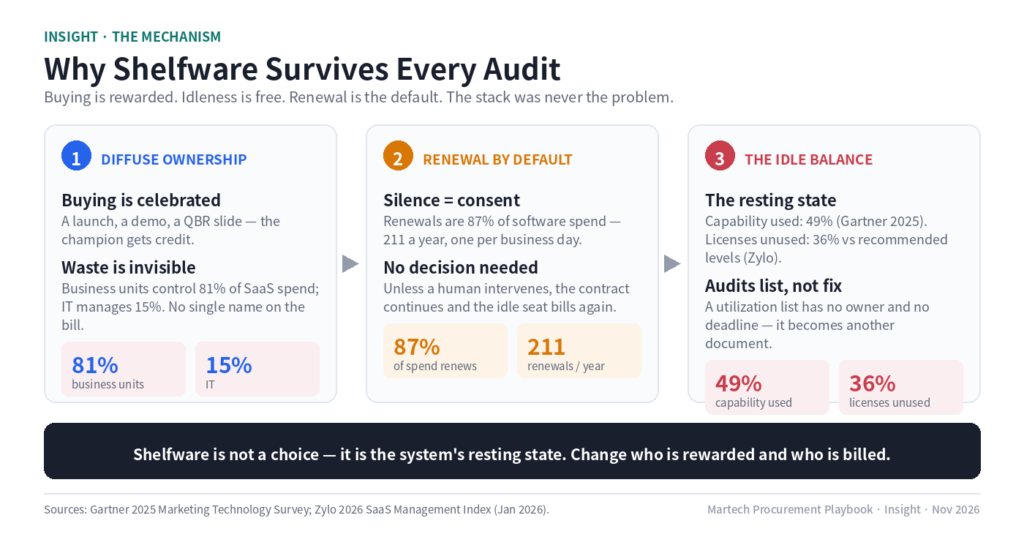
Why audits don’t fix it. A utilization audit produces a list. A list has no owner and no deadline, so it becomes a document, and the document becomes shelfware about shelfware. The audit measures the symptom — logins — while the cause is an incentive gradient that still points toward buying and away from cancelling. Cancelling is effortful, slightly embarrassing, and saves money that shows up on someone else’s line. Buying is easy, celebrated, and costs money that shows up on no one’s.
The fix is not a better dashboard. It is moving the default: name one accountable owner per tool, make renewal require an affirmative justification rather than silence, and put the saved dollars back on the budget of the person who did the cutting. Change who is rewarded and who is billed, and the 49% starts to move. Leave the incentives alone, and the next audit will find the same half-empty stack — because the stack was never the problem. The accounting was.