Attention Beats Frequency 8-to-1 — and Now There Are Numbers for How Many Seconds Each Brand Goal Needs
A 270-campaign, seven-country study from Amazon Ads, Lumen and Cint puts thresholds on the attention debate: 21 seconds for awareness, 47 for purchase intent.
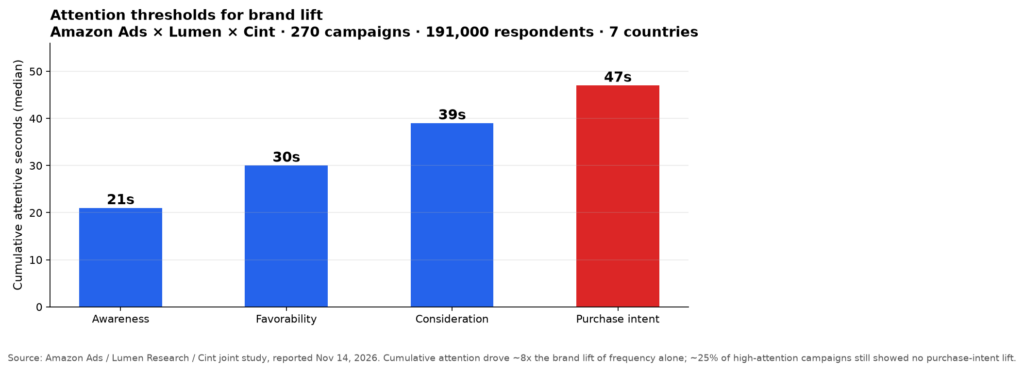
The advertising industry has argued for years that attention matters more than impressions. A joint study from Amazon Ads, Lumen Research and Cint — covering 270 campaigns and 191,000 respondents across seven countries, reported November 14, 2026 — now puts specific numbers on the claim: cumulative attention, the total attentive seconds a campaign earns across channels, drives roughly eight times the brand lift of simply raising ad frequency. And it names the thresholds: a median of 21 attentive seconds for awareness, 30 for favorability, 39 for consideration, and 47 for purchase intent.
Sequencing is the second finding
The study also measured order effects: campaigns that ran a high-impact streaming TV ad on Prime Video before smaller banner ads performed 30% better than campaigns that ran the banners first. The implication for media planning is concrete — a big-attention opener appears to prime the smaller formats that follow, rather than the reverse.
Meanwhile, frequency-only campaigns didn’t just underperform; they went backwards. Across the sample, campaigns that relied on repetition without building attention saw awareness fall 4%, favorability fall 7%, and consideration fall 6%. That is the quantitative version of what every over-served audience already knows: seeing the same ad again is not the same as being reached again.
Read it with the honest caveats
Two limits matter. First, attention raises the odds of lift; it does not guarantee it — roughly a quarter of the highest-attention campaigns in the study still showed no purchase-intent lift. Second, this is a vendor-adjacent study: Amazon Ads sells the Prime Video inventory the sequencing finding favors, and Lumen sells attention measurement. The sample is large and the thresholds are useful planning heuristics, but they are medians across heterogeneous campaigns, not laws of physics.
It is also worth placing the finding next to Meta’s related research, which the company’s Peter Buckley connected to the study: multiple short views drove 21% more sales lift than one long continuous view in Meta’s own work. The two results are compatible — cumulative attention can be assembled from many short exposures — but they warn against reading “47 seconds” as “one 47-second view.”
What changes in the media plan
- Buy seconds, not impressions. If your platform can report attentive seconds (Lumen, TVision, and increasingly the walled gardens’ own attention products), make cumulative attention a planning currency alongside reach.
- Sequence for attention. Lead with the highest-attention format you can afford, then retarget with lighter formats — the 30% sequencing gap is large enough to justify restructuring a flight.
- Cap frequency where attention is dead. The negative lifts on frequency-only campaigns are an argument for creative refresh (see Viant’s Waymark bet this same week) rather than more repeats.
- Set stage-specific goals. 21/30/39/47 gives teams a shared vocabulary: an awareness campaign doesn’t need purchase-intent seconds, and a consideration campaign shouldn’t be graded on awareness alone.
The debate about whether attention matters is over. The operational question — how to buy, sequence and measure it across channels — is where the next two years of media planning will be won.