China’s Biggest AI Round, and an Allegation It Can’t Ignore
China’s largest AI funding round is now entangled with the same governance crisis that took down Nvidia’s CEO — through a single-source report that neither side has answered.
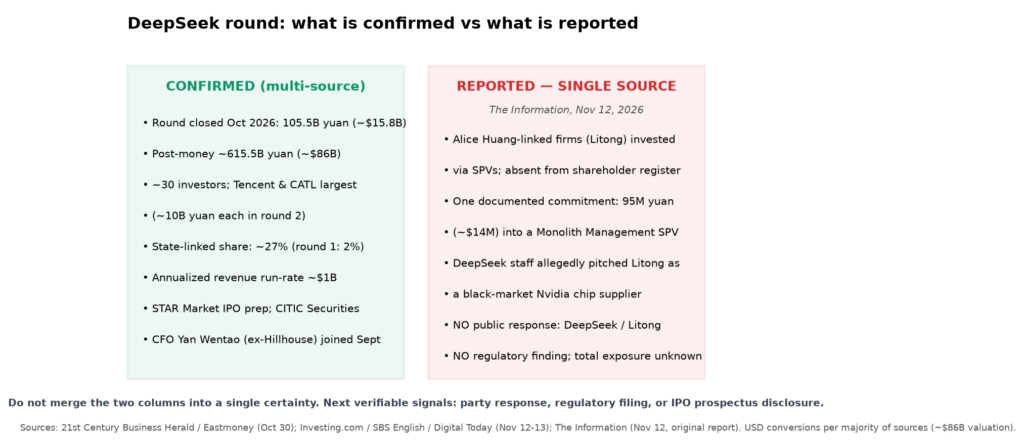
DeepSeek’s second funding round, closed in October 2026, raised 105.5 billion yuan (about $15.8 billion) at a post-money valuation of roughly 615.5 billion yuan (about $86 billion) — the largest single venture round in Chinese AI history. About 30 investors participated; Tencent and CATL were the biggest, each committing around 10 billion yuan in the round. State-linked investors supplied roughly 27% of the round, up from 2% in the first — a shift that reads less like portfolio allocation and more like Beijing classifying DeepSeek’s open models as strategic infrastructure.
Then, on November 12, The Information reported something that complicates the story: companies connected to Alice Huang — the former Megaspeed executive at the center of the allegations surrounding Jensen Huang’s resignation from Nvidia — invested in DeepSeek through special-purpose vehicles, and DeepSeek employees allegedly pitched those companies to other investors as a channel for obtaining Nvidia’s export-restricted Blackwell chips via the black market.
Everything in that paragraph is a single-source report. Neither DeepSeek nor the companies involved has publicly responded. No regulator has made a finding. It should be read as an allegation with a named source, not an established fact.
What the report actually says
According to The Information, the entities are Century Litong and its Shanghai-listed parent Jiangsu Lettall Electronics — collectively “Litong.” Because the investment ran through SPVs set up by participating investors, Litong does not appear on DeepSeek’s shareholder register. One commitment identified in corporate records: 95 million yuan (about $14 million) from Lettall into a vehicle managed by Monolith Management, DeepSeek’s third-largest investor. The group’s total commitment is unknown.
The report says DeepSeek employees told prospective backers during the July–October round that Litong deserved an allocation because it supplied large quantities of Nvidia AI chips through gray-market channels. The Information also reports that Alice Huang herself never held shares or executive roles at the Litong companies; the connection was traced through family shareholding history and transactions.
Context matters here. Megaspeed, the Singapore-based firm where Alice Huang was an executive, is already the subject of export-control scrutiny: U.S. investigators believe chips barred from export to China moved through shell companies, Megaspeed denies illegal transfers and says it is cooperating with a Commerce Department inspection, and Singapore has been examining the company since February 2025. Nvidia’s board launched an independent inquiry on November 8 into whether Huang was targeted by a foreign intelligence service. None of these inquiries has produced findings.
Why the funding round itself is the bigger story
Set the allegation aside and the round still redraws the map. DeepSeek’s annualized revenue run-rate is about $1 billion — doubled from a few months earlier — against roughly 475 million yuan of revenue and 715 million yuan of net loss in the first seven months of the year. The company is preparing a STAR Market IPO with CITIC Securities, and hired Yan Wentao, a former Hillhouse partner, as CFO in September.
The investor list is an industrial-policy document: chipmakers (CXMT, SMIC), manufacturers (Geely, Midea, Luxshare, vivo), consumer platforms (Meituan, Xiaohongshu, Trip.com), telecoms and state financial institutions. The founding structure — external money entering through vehicles controlled by founder Liang Wenfeng, with five-year locks and no voting rights for most outsiders — kept control intact while absorbing $15.8 billion. If the IPO lands, Chinese model valuations will be repriced by public-market margins rather than private-market narrative.
The uncomfortable intersection
If the Litong report is accurate, it means the export-control scandal that cost Nvidia its CEO also touched the cap table of China’s most important open-model company — via a chip-supply pitch made during a funding round. That would give Washington’s export-control hawks a concrete case study for the “cloud and gray-market loophole” legislation already moving through Congress.
But the honest position today is narrower: one publication, anonymous sources, corporate records for a single $14 million commitment, and silence from every named party. The next verifiable signals would be a response from DeepSeek or Litong, an SEC or Commerce filing reference, or a change in DeepSeek’s IPO prospectus disclosures. Until one of those appears, this is a reported allegation attached to a confirmed funding round — and the two should not be merged into a single certainty.