Microsoft Says Services Fully Restored After Two-Day Global Outage — and Insists AI Wasn’t the Cause
74 countries, roughly 7.4 million outage reports, hospitals and courts affected — and a root cause that traces back to a routine capacity upgrade.
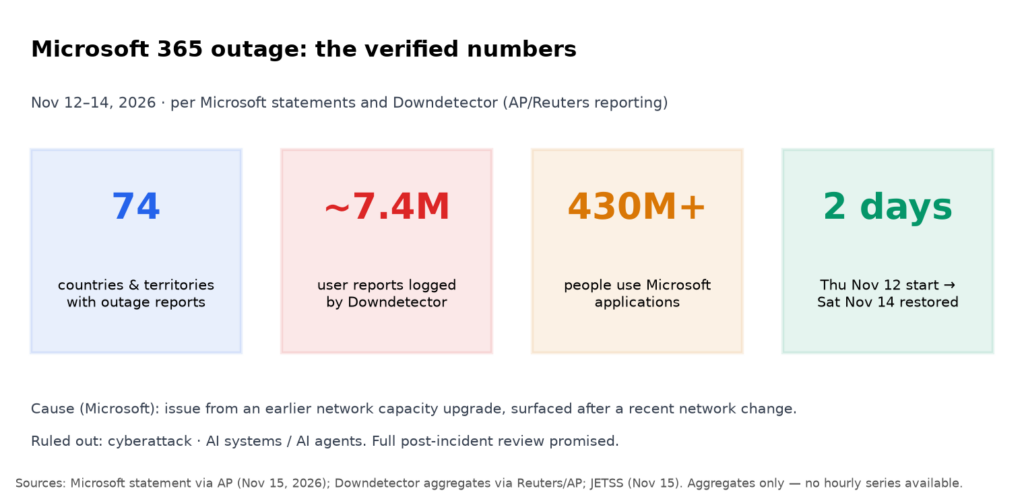
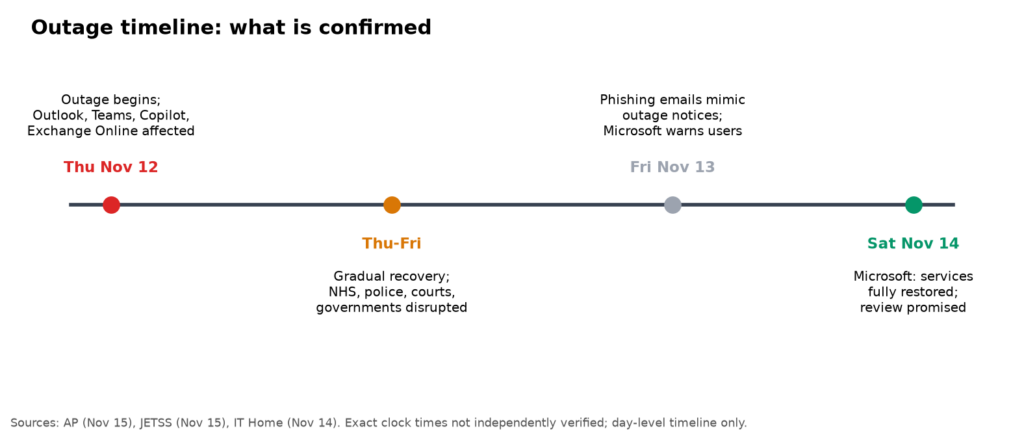
Microsoft said on Saturday, November 14, 2026 that it had fully restored its services after a global outage that began Thursday, November 12 and disrupted Outlook, Teams, Copilot and other Microsoft 365 tools for users in 74 countries and territories, according to outage tracker Downdetector, which logged roughly 7.4 million reports over the episode. The company said the problem “was introduced by an issue during an earlier network capacity upgrade that surfaced” after a recent network change — and explicitly ruled out a cyberattack, adding that the disruption was not connected to artificial intelligence systems or AI agents.
That last clarification was not incidental. The outage landed in a week already saturated with AI anxiety, and Microsoft moved early to separate a mundane infrastructure failure from the larger narrative. The recovery itself was gradual: engineers fixed problems affecting servers and components of Exchange Online, and the unavailability of some servers made it harder to restore network traffic and normalize email delivery. Even after initial fixes, some users still could not open inboxes or send messages.
The blast radius was institutional, not just personal
The disruption reached well beyond annoyed office workers. In the United Kingdom, it affected National Health Service operations and police communications, including the online receipt of incident reports; a trial in Manchester was temporarily paused because of system delays, and the National Pharmacy Association warned of possible delays in issuing and forwarding prescriptions. Governments in Japan, Australia and Singapore reported effects on administrative work. Airlines had problems with customer-service channels; financial firms struggled to access and share information. Some organizations fell back to phone calls, paper documents and fax machines.
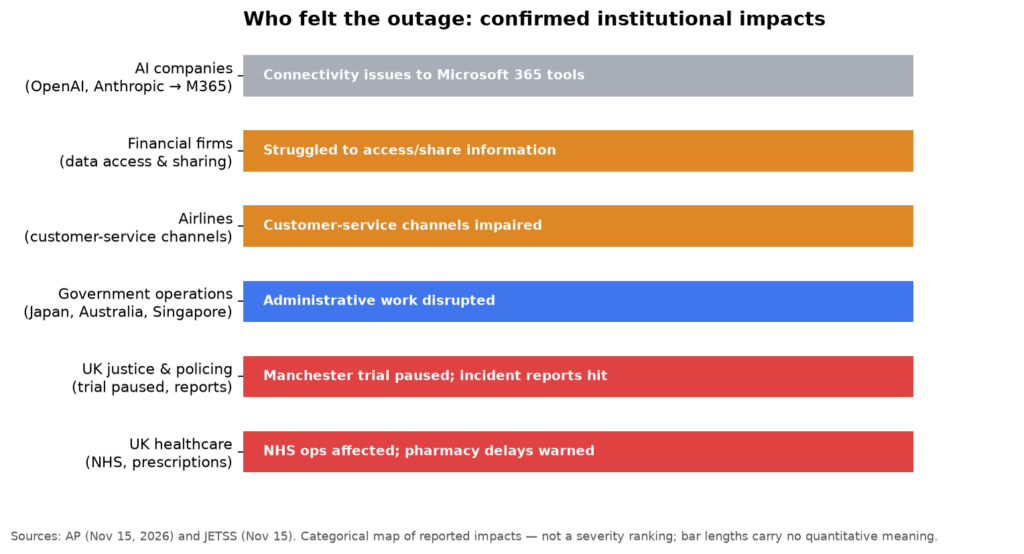
Even other AI companies felt it: services from OpenAI and Anthropic experienced difficulties connecting to Microsoft 365 tools. Microsoft says more than 430 million people use its applications for administration, business communications, file storage and scheduling — a dependency footprint that turns any multi-day failure into a cross-sector event.
The company also warned that malicious actors were sending phishing emails disguised as outage notifications, a familiar secondary hazard of high-profile incidents.
What the root cause tells you
Microsoft’s explanation — a latent defect from a capacity upgrade, exposed by a later configuration change — is one of the most common failure patterns in large networks, and one of the hardest to test for. The change that triggers the outage is often not the change that caused it. Microsoft said it would publish a full post-incident review; the timing and detail of that report will matter more to enterprise customers than the apology.
For IT and marketing-operations teams, the episode is a concrete argument for three things: multi-provider redundancy for critical communications, documented fallback workflows (the organizations that switched to paper and phone kept moving), and monitoring that distinguishes “vendor says resolved” from “our workflows actually work.” The gap between those two states lasted hours for many customers even after Microsoft’s first recovery announcements.
The week context, briefly
The outage coincided with a U.S. nationwide air-travel ground stop on Friday caused by an air-traffic-control technology upgrade, and with the governance turmoil at Nvidia following Jensen Huang’s resignation. Officials attributed each event to separate technical or corporate causes; the FAA and Microsoft both said there were no signs of malicious activity. The clustering was coincidence — but it exposed how much daily operation now rests on a small number of upgrade windows going right.
Microsoft’s consumer-facing services are back. The harder question — what the post-incident review will say about change management at hyperscale — is still open.