Nvidia’s Sixth Straight Weekly Loss: Investors Are Buying the Dip While 130,000 People Sign a Petition the Board Can’t Act On
The filing says almost nothing. The market says $573 billion. And a petition with no identity verification has become the loudest voice in the succession debate.
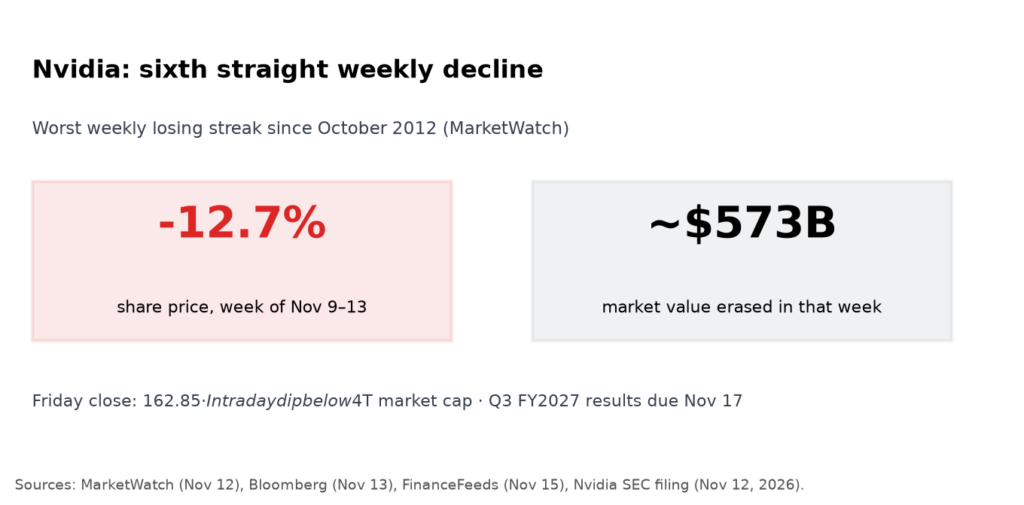
Nvidia closed Friday, November 13, 2026 at $162.85, down about 12.7% on the week — its sixth consecutive weekly decline, the longest losing streak since October 2012, according to MarketWatch. Roughly $573 billion in market value disappeared in that single week, and the stock briefly pushed the company’s valuation below $4 trillion. All of it followed the November 12 announcement that Jensen Huang had resigned as president, CEO and board member, effective immediately.
The official record is deliberately sparse. Nvidia’s SEC filing confirms three things: Huang’s departure, CFO Colette Kress serving as interim CEO while keeping her finance role, and Harvey C. Jones — the former Synopsys CEO — becoming the company’s first-ever chair of the board. The filing gives no reason. Everything else — the reported relationships, the intelligence allegations involving a former Megaspeed executive, the board’s independent inquiry — rests on reporting, not findings, and none of it has been established as fact.
Two shareholders wrote a letter. 130,000 people signed a form.
The pressure campaign has two very different tiers, and conflating them is the most common error in coverage so far.
The first tier is institutional. Brad Gerstner of Altimeter Capital and Gavin Baker of Atreides Management — whose firms held roughly 9.4 million and 1.2 million Nvidia shares respectively at the end of June — published an open letter asking the board to verify all facts before deciding Huang’s status, and to keep open the possibility of his return. They explicitly said they would respect the board’s decision if a return is judged against shareholders’ interests. That is a governance request, not a demand.
The second tier is the “Stand With Jensen” online petition, which passed 130,000 signatures by Sunday, November 15 (about 126,500 at noon per Korea Times; later counts exceeded 132,000). Elon Musk, Tim Sweeney, Garry Tan and Aidan Gomez are among reported signatories, and Musk argued publicly that many of Nvidia’s supply-chain deals were sealed on personal trust rather than paper. But the petition’s organizers have acknowledged the site is open-entry with no identity verification; fabricated and joke entries have appeared in the list. Treat the count as a sentiment indicator, not a verified shareholder mandate — and treat individual celebrity signatures as reported unless confirmed by the person.
The board, for its part, told CNBC it is still selecting a CEO search firm and has formally engaged no candidates. A Financial Times report that the board had approached Arm CEO Rene Haas was denied by the board as premature. Internal names circulating in analyst commentary — Ian Buck, Bryan Catanzaro, Kress herself — are speculation, not process.
The money question behind the noise
The reason this governance story moves markets is that Nvidia is not just a chip vendor; it is a balance sheet underwriting parts of the AI buildout. Nvidia invests in infrastructure customers and, in some cases, commits to buy capacity they cannot sell elsewhere. CoreWeave’s filings disclose a Nvidia backstop arrangement with an initial order value of $6.3 billion running through 2032; CoreWeave’s total debt rose from about $21.4 billion at year-end to about $46.9 billion by September, with quarterly interest expense of $846 million.
If lenders’ comfort depends partly on Nvidia’s willingness to stand behind its customers, doubt about that willingness raises funding costs across the “neocloud” sector. But two counterweights are real: demand is growing (CoreWeave revenue up 168% year over year; backlog $132.5 billion), and financing is shifting toward customer contracts and prepayments rather than Nvidia’s credit — Nebius says prepayments covered more than 100% of related capex on Q3-signed contracts. The sell-off also began before the scandal: Nvidia’s market value was already down about $2 trillion from its October 6 peak.
Nothing reported so far shows Nvidia cutting investments or guarantees because of the resignation. Kress, who has been CFO since 2013, built the current structure; continuity is at least as plausible as rupture.
What actually resolves this
Three dates matter more than any petition count:
- November 17, 1:20 p.m. PT — Nvidia’s Q3 fiscal 2027 results, the first guidance under interim leadership. Watch how the company describes customer-support commitments, guarantees and investment holdings.
- The inquiry’s findings — the board’s independent review (reported to be led by outside counsel) into whether Huang was targeted by a foreign intelligence service. Nvidia says it has no reason to believe national security or company secrets were compromised. No timeline given.
- Congressional testimony — House Foreign Affairs Chair Brian Mast says Huang agreed to testify before Thanksgiving; Senate Banking Chair Tim Scott has asked for December 3. No confirmed date.
Until then, the honest summary is: a confirmed transition, an unconfirmed scandal, a verified sell-off, and a succession process that has not formally started. The petition is loud. The filing is quiet. The filing is the one with legal weight.