Cloud Doubled, Search Slowed, and the Stock Fell 12.6% — Decoding Alphabet’s Q3
Alphabet’s AI Search Is Winning Users and Losing Revenue
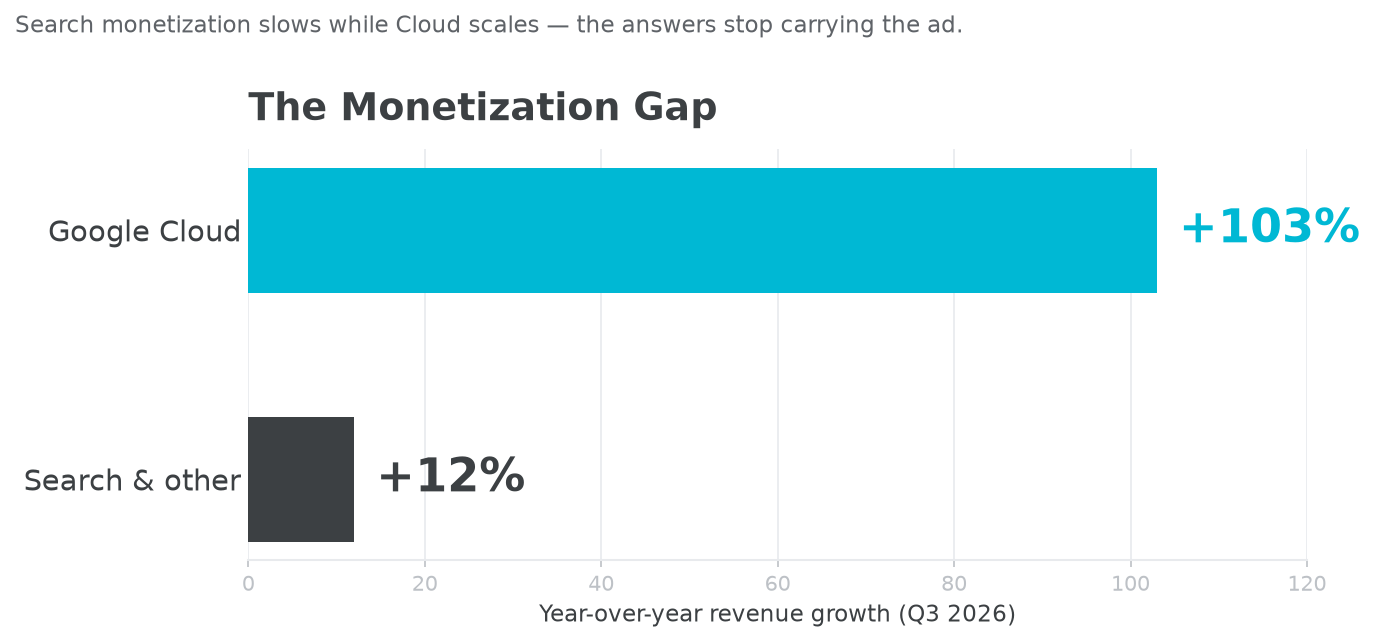
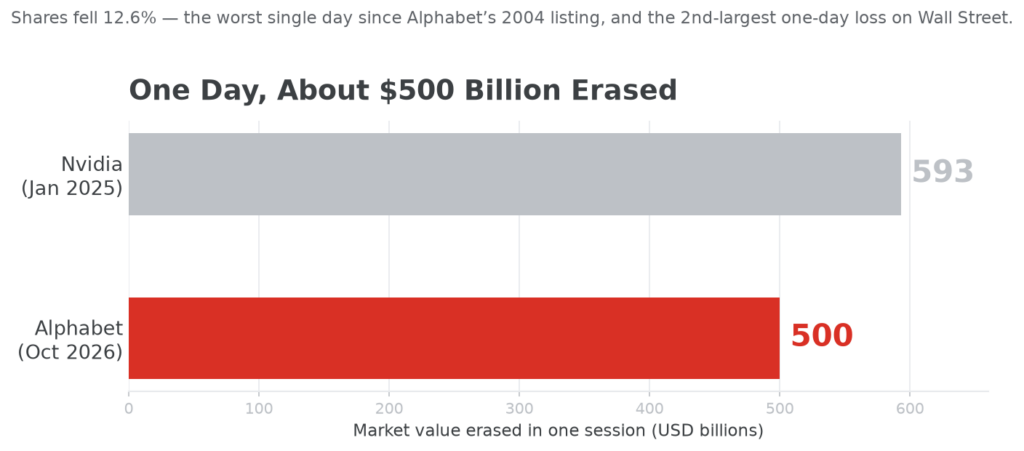
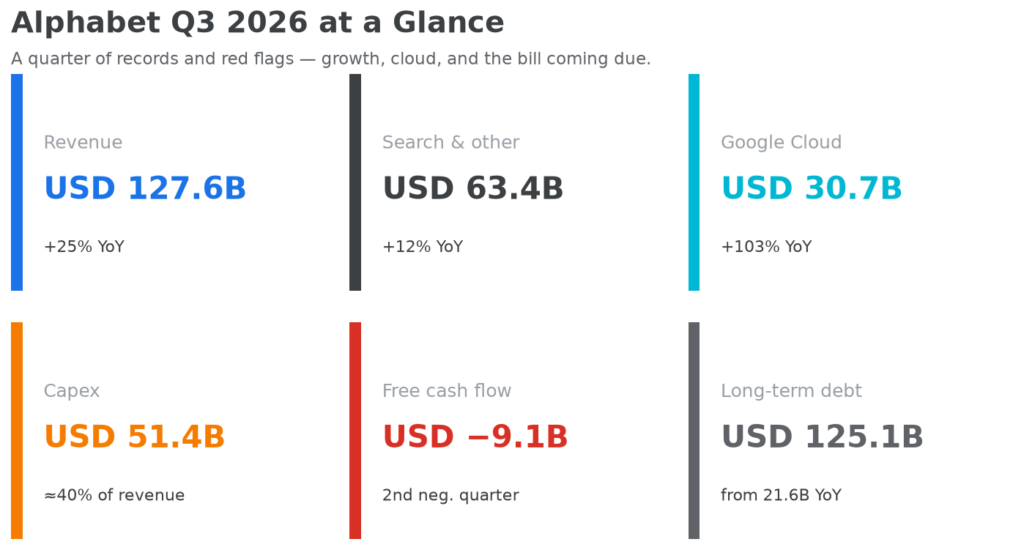
Alphabet turned a record quarter into its worst day on the market in more than two decades. Third-quarter 2026 revenue reached USD 127.6 billion, up 25 percent year over year. Google Cloud doubled to USD 30.7 billion on 103 percent growth, and its operating margin climbed from 23.7 percent a year ago to 36.2 percent. The Gemini app crossed 1 billion users. None of it mattered to investors: the stock dropped 12.6 percent the following session to USD 283.82, its sharpest single-day fall since the 2004 listing, erasing about USD 500 billion in value — the second-largest one-day loss in Wall Street history.
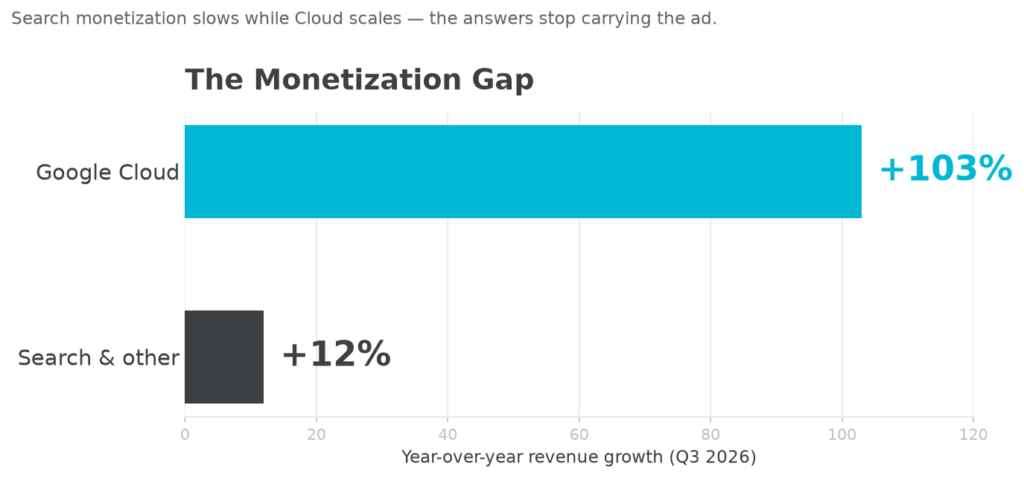
The number behind the sell-off sat inside the search business. Search and other revenue grew just 12 percent to USD 63.4 billion, decelerating from 17 percent in the prior quarter. This was not a demand problem. Sundar Pichai said AI investments drove the highest year-over-year query growth Google has recorded in five years. People are asking more questions than ever. They are just clicking less.
That is the monetization gap in one sentence. AI-generated answer surfaces consume the click that used to carry an ad. When a query resolves on the results page, the auction never runs. Management acknowledged the arithmetic outright: AI query experiences monetize below traditional search. Google is winning the question and quietly losing the ad slot attached to it. The pattern is not exclusive to Silicon Valley. In China, AI now accounts for roughly half of Baidu’s core business revenue, yet the company’s total revenue still declined 4 percent year on year in its latest reported quarter. Answer engines grow engagement faster than they grow ad inventory, everywhere.
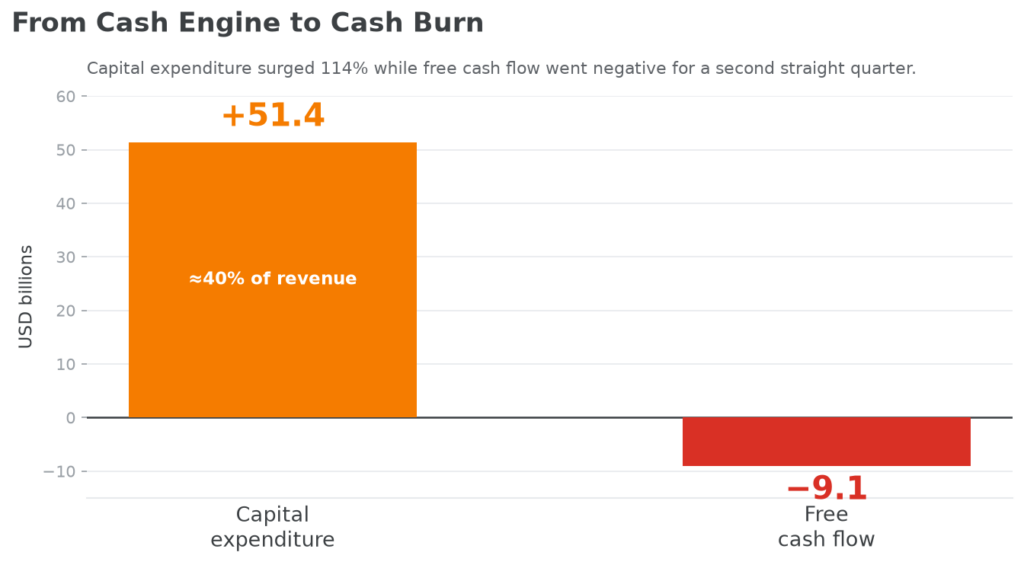
The cost side sharpened the picture. Capital expenditure rose 114 percent year over year to USD 51.4 billion, roughly 40 percent of revenue. Free cash flow swung to negative USD 9.1 billion — the second consecutive quarter in the red. Long-term debt ballooned from USD 21.6 billion a year earlier to USD 125.1 billion, and the company disclosed more than USD 1 trillion in forward commitments for data centers, leases and energy. Full-year capex guidance holds at USD 195 to 205 billion, with chief financial officer Anat Ashkenazi signaling a further significant increase in 2027.
Here is how to read what just happened. The market is repricing Alphabet from a high-margin search franchise into a capital-intensive infrastructure company. The cloud profit story is genuine — operating margin jumped to 36.2 percent — but in absolute dollars the cloud profit pool remains smaller than the search profit pool now being compressed. Investors have stopped asking whether AI works. They are asking who pays for it.
The unresolved variable is pricing. No one has published credible unit economics for AI-native ad inventory. The cost of generating an answer is measurable; what an advertiser should pay for a placement inside an answer is not yet a market-clearing price. Until Google discloses ad load and take rates inside AI Mode, every search-growth number gets read as erosion in disguise.
Worth watching: Q4 search growth, the first concrete AI Mode monetization disclosures, and whether 2027 capex guidance gets walked back at the February call. Frontier model leadership and negative free cash flow now coexist inside the same company in the same quarter. That is the signal — the binding constraint on the next generation of AI has shifted from capability to capital efficiency.