China Just Passed 700 Million AI Users — Here’s What That Means for Western Marketers
China’s 700 Million Generative AI Users: What They Reveal About the Next Phase of Marketing
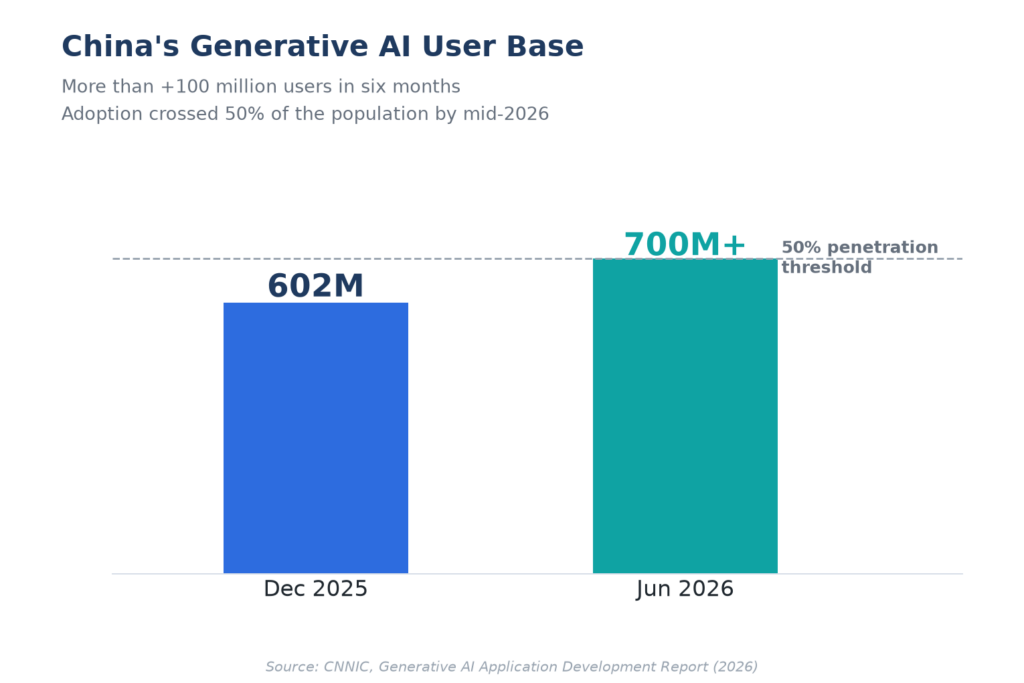
China passed 700 million generative AI users by June 2026, and 76 percent of them now let AI answer questions directly instead of searching and clicking through to links. That single behavior shift — measured by the China Internet Network Information Center (CNNIC) in its Generative AI Application Development Report 2026 — is the clearest preview available today of what Western marketing must become. Adoption passed 50 percent of the population, up from 602 million users at the end of 2025, meaning roughly 100 million new users arrived in six months. No other market on earth has reached AI-native mass behavior at this scale.
Western teams still treat generative AI as an optimization problem layered on top of search marketing. China treats it as the new default interface between people and information. That difference is worth studying closely, because the gap between the two mindsets is where the next decade of marketing advantage will be won or lost.
The Scale: The World’s Largest AI-Native Consumer Base
CNNIC’s mid-2026 figures place China’s generative AI user base above 700 million people, with adoption reaching more than 50 percent of the population. The growth curve matters more than the headline: from 602 million at the end of 2025 to over 700 million by June 2026, the market added more than 100 million users in a single half-year.
For comparison, ChatGPT alone reports more than 1.2 billion weekly users globally, and OpenAI has stated that more than 100,000 advertisers have run campaigns on the platform since ads launched in early 2026, now available across 89 countries. The West is adopting AI quickly. But China is the first market where AI usage has crossed majority penetration of an entire population — which changes what normal consumer behavior means for every brand selling there, and previews what normal will mean everywhere else.
One hundred million people adopted generative AI assistants in China during roughly the same window that Western marketers were still debating whether AI search traffic deserved its own line in the budget. When a behavior reaches half a nation, it stops being an early-adopter story and becomes infrastructure.
The Behavior: What 700 Million People Actually Do With AI
China’s users are not primarily experimenting with AI as a creativity toy. The CNNIC report shows a strikingly transactional, answer-seeking population:
- 76% use generative AI to answer questions — the dominant use case in every market
- 47.8% use it to generate images and video
- 37.6% use it for text generation
- 32.5% use it to summarize work reports, meeting minutes, and slide decks
-
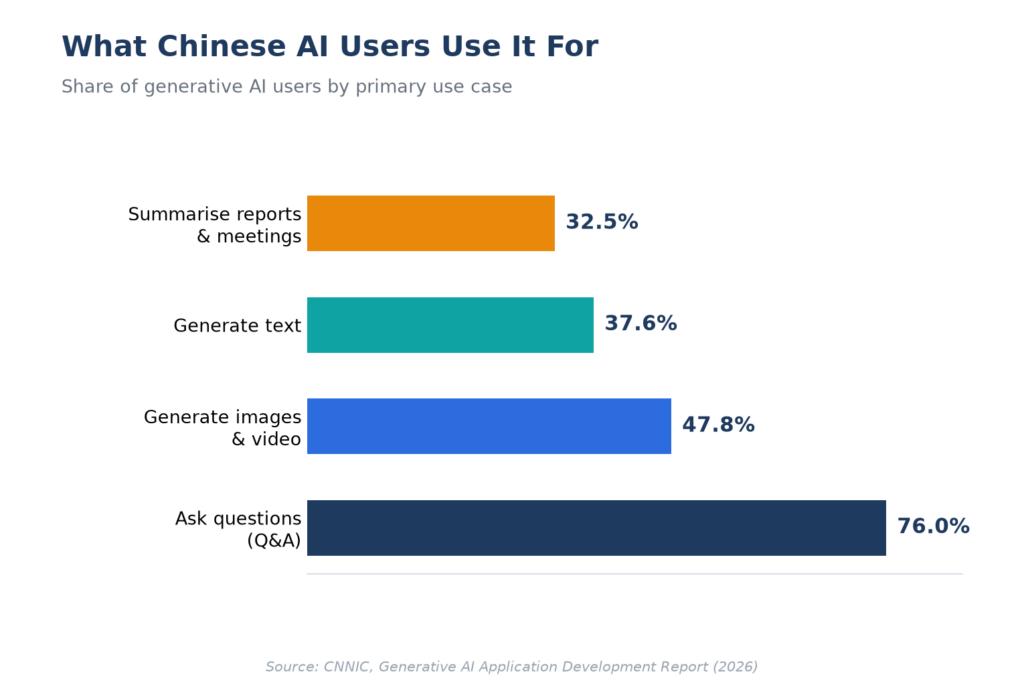
What Chinese AI Users Use It For — Q&A at 76 percent leads, followed by image and video generation, text generation, and work summarisation. Measured by how often users accessed different apps over the past six months, usage of general-purpose AI assistants and AI productivity tools each grew more than 100 percent year-on-year. As of July 2026, the three most-used product categories were AI general assistants, AI search engines, and AI life assistants — far ahead of every other software segment in monthly active usage.
The hardware side tells the same story of mainstreaming: 38.7 percent of Chinese internet users bought smart hardware devices online in the past six months, with 20.2 percent purchasing smart wearables such as watches, fitness bands, wireless earphones, and smart glasses, and 18.2 percent buying smartphones, tablets, and other consumer electronics. AI is not a screen-only phenomenon in China; it is being worn, carried, and placed in living rooms.
Platform Signal One: The Advertising Stack Is Being Rewired
The dominant platforms in Chinese social, search, and commerce have moved from AI features to AI-driven core operations. Tencent, whose ecosystem spans WeChat and the largest advertising business in Chinese social media, reported second-quarter 2026 revenue up 11 percent year-on-year to RMB 204.8 billion, with growth driven by games, marketing services, and AI. At the same time, the company’s capital expenditure is more than doubling as it pours billions into AI infrastructure — raising well over four billion dollars in fresh debt financing in late 2026 specifically to fund that expansion.
The WeChat layer itself is quietly becoming AI-driven. A native AI assistant has begun small-scale testing inside Weixin, and AI agents are rolling out across the enterprise side of the ecosystem. When the world’s most indispensable messaging app starts routing users through an AI intermediary, every brand touchpoint behind that app — mini programs, official accounts, group chats, and search — faces the same fate awaiting Western brands inside ChatGPT and Gemini: the assistant becomes the storefront.
Alibaba has poured hundreds of millions of dollars into user acquisition for its Qwen assistant, including Lunar New Year promotion budgets, and both Alibaba and ByteDance have begun converting their consumer AI apps into subscription products. That is a signal that Chinese platforms believe AI assistants are valuable enough that users will pay — and important enough to monetize directly rather than funnel back into search ads.
Platform Signal Two: GEO Stopped Being Optional
Europe has now formally caught up with what China operationalized earlier: the European Commission has designated ChatGPT a Very Large Online Search Engine under the Digital Services Act, placing it legally alongside Google and Bing. Once a regulator calls an AI assistant a search engine, optimizing for it stops being speculative and becomes table stakes.
The measurement science matured at the same moment. Semrush’s 2026 AI Visibility Index, built from 2.5 million monthly UK prompts and 25 million US prompts across ChatGPT, Gemini, Google AI Mode, and Google AI Overviews, found that being mentioned by AI and being cited by AI are two entirely different games. Across 22 categories and four platforms, fewer than half of the top-100 mentioned brands also appear among the top-100 cited domains — in the UK, the overlap ranged from just 36.7 to 45.3 domains out of 100. Visibility on one platform does not transfer to another, and a strategy built for US AI answers does not automatically work in the UK — and neither maps to China, where the platform set is Doubao, DeepSeek, Qwen, and Yuanbao.
-
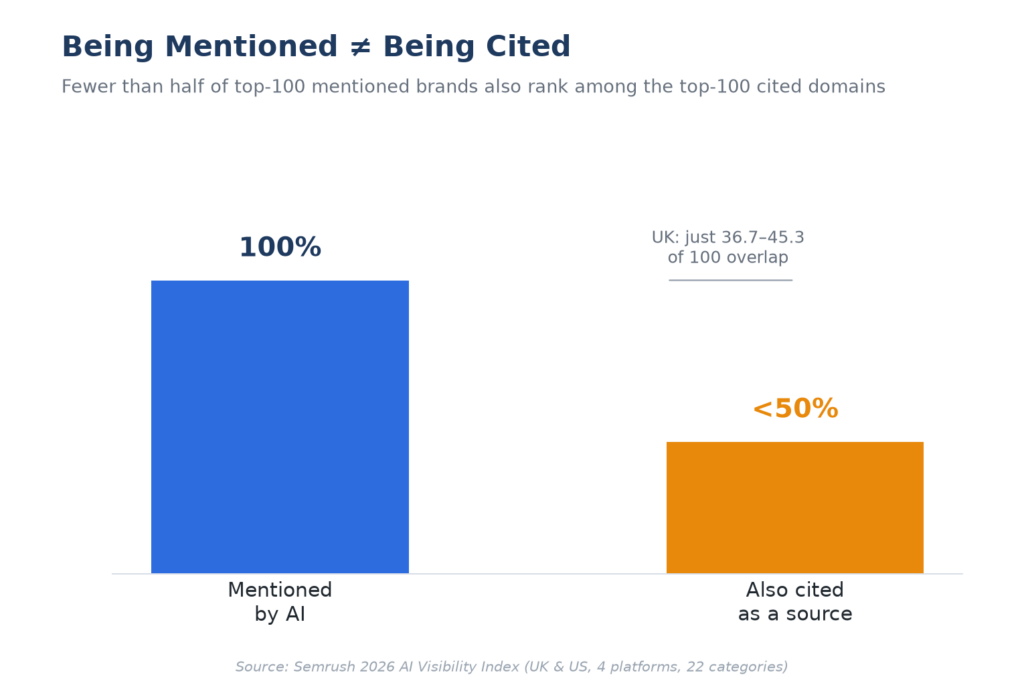
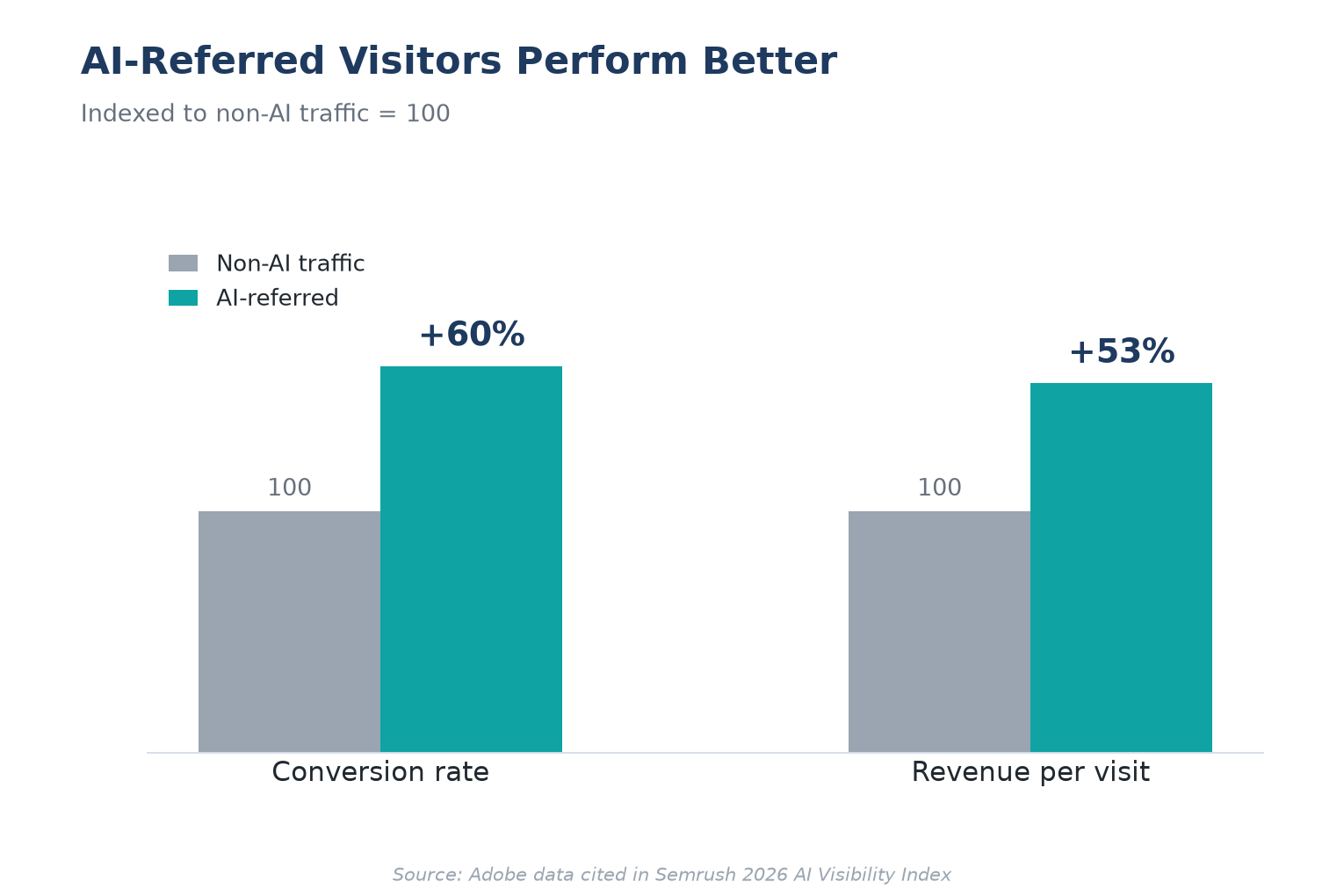
Being Mentioned Is Not Being Cited — fewer than half of the top-100 mentioned brands also rank among the top-100 cited domains in AI answers. The commercial stakes inside AI answers are now measurable: AI-referred visitors convert about 60 percent better and generate around 53 percent more revenue per visit than non-AI traffic, according to Adobe data cited in the Semrush index. OpenAI began serving ads in ChatGPT in February 2026 and expanded the program through Europe, Asia, and Latin America over the following months, confirming that AI answers are becoming a paid channel as well as an organic one.
In China, none of this waited for a study. Brands there have been optimizing content for AI answer engines as a routine marketing discipline for over a year, because with 76 percent of users letting AI answer directly, a brand absent from AI responses is simply absent from the consideration set.
Platform Signal Three: AI Is Already Selling at Industrial Scale
Livestream commerce — China’s signature retail format — has become the proving ground for AI-native selling at a scale the West has not attempted. Baidu reports that more than 100,000 AI digital humans are now active across Chinese commerce, and that companies using them cut livestream operating expenses by more than 80 percent while lifting transaction volume by an average of 62 percent. Digital hosts stream around the clock at a fraction of the cost of human presenters.
The regulatory architecture kept pace rather than lagging. China’s rules requiring clear labeling of AI-generated synthetic content took effect in September 2025, so consumers know when they are watching a synthetic host. Even the industry’s biggest human star publicly frames the future as complementary — an AI version of himself holding the audience overnight while he rests — rather than as replacement. The emerging pattern is a division of labor, not a takeover.
-
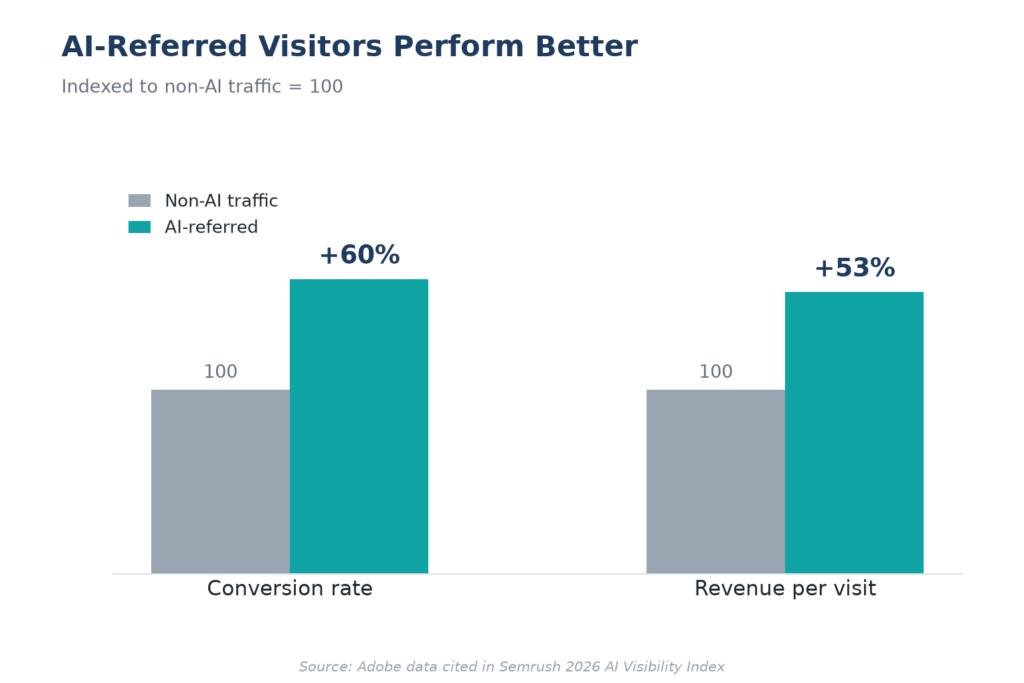
AI-Referred Visitors Perform Better — AI-referred traffic converts about 60 percent better and generates roughly 53 percent more revenue per visit than non-AI traffic. On the supply side, China’s generative AI industry recorded 1,255 financing deals worth about RMB 250.14 billion in the first half of 2026 alone — already 182 percent of the full-year 2025 total. Domestic open-source models from DeepSeek and Qwen continue to gain global influence. The marketing technology stack is being rebuilt with Chinese models running on Chinese chips, which is why Western marketers comparing notes with Chinese counterparts increasingly discover they are describing two different internet architectures.
What the Global Picture Looks Like From Here
The West is traveling the same road on a delayed clock. Global Payments’ agentic commerce research, surveyed across seven markets including the US, UK, France, Brazil, China, Singapore, and Australia, found that consumers now expect AI agents to make 15 percent of their purchases within five years, up from 9 percent one year earlier. Nearly half of Americans have used or would consider an AI shopping agent, and 69 percent already use AI to find better deals. Comfort with letting AI spend up to 50 dollars on everyday categories more than doubled year-on-year, even as half of consumers remain worried about payment security.
That is the sequence China made concrete: first consumers let AI answer, then they let AI recommend, then they let AI buy. Every stage shrinks the surface area of traditional marketing — the results page, the display ad, the landing page — and enlarges the surface area of structured knowledge, machine-readable data, and earned presence inside model training sets and retrieval pipelines.
Three Principles Western Teams Can Import Now
Principle One: Optimize for the Answer, Not Just the Click
When three-quarters of a population takes AI’s response as the final answer, the marketing objective shifts from winning a click to winning a citation. The practical version of this principle is already measurable: brand mentions and domain citations in AI answers are separate key performance indicators that require separate strategies, and citation share is concentrated so heavily that a handful of platforms and source types dominate each market’s answers.
- Publish original data, precise statistics, and clear definitions — the exact formats AI retrieval layers quote
- Treat FAQ pages, comparison tables, and schema markup as answer-engine inventory, not leftover search-engine optimization
- Track visibility per platform and per market; a single aggregate AI visibility score hides more than it reveals
- Build third-party signals — publishers, communities, and marketplaces — because AI answers weigh what others say about you as heavily as what you say about yourself
China’s marketers discovered the hard way that when the assistant becomes the interface, being crawlable is not enough; you must be citable.
Principle Two: Automate the Marginal, Preserve the Human at the Trust Moment
China’s livestream industry ran the experiment the West is only proposing: let AI take the long, always-on tail of selling at 80 percent lower operating cost, and keep humans where judgment, nuance, and trust close the sale. The lesson is not that robots replace presenters — the industry’s own data shows audiences still reward authenticity, and regulators now require synthetic hosts to say they are synthetic. The lesson is a division of labor.
- Move always-on, routine, and after-hours interactions to AI: storefronts, support, media selling, and first-draft creative production
- Keep humans in the moments that build trust — complex advice, controversy, brand voice, and anything emotionally load-bearing
- Label AI-generated touchpoints clearly and early; the EU and China converged on disclosure independently, and consumer trust data everywhere shows people want to know when they are talking to a machine
- Let automation collapse marginal cost so experimentation becomes nearly free — the real prize is testing twenty campaigns where you used to run two
Principle Three: Sell Inside the Conversation, Not Adjacent to It
Chinese platforms turned their AI assistants into transaction surfaces — shopping inside the chat, life services inside the assistant, subscriptions on the assistant itself — and Tencent, Alibaba, and ByteDance all spent real money getting there first. The Western echo is arriving at speed: ChatGPT shopping integration, ads across 89 countries, payment networks standardizing agent transactions, and checkout being wired directly into conversations.
The marketer’s job changes accordingly: the conversion funnel no longer starts on your website. It starts inside someone else’s conversation, product feed, and retrieval index.
- Get structured product data — feeds, schemas, and machine-readable catalogs — into the pipelines AI agents draw from
- Buy attention where it now lives; AI platforms are opening paid channels with formats Western teams have never purchased before
- Redefine the owned channel to include your presence in training data, retrieval sources, and agent tool lists
- Measure from the AI answer forward, attributing conversions to AI-referred visitors rather than relying on referrer-based analytics that increasingly report direct traffic when an assistant did the browsing
Where This Leads
The deeper reading of China’s numbers is not that Chinese consumers are faster adopters. It is that China’s platforms, regulators, and merchants built the full stack simultaneously: models, agents, synthetic sellers, labeling rules, advertising channels, and now agent payments. Western marketing has each piece advancing on a separate timeline — which is precisely why coordination across content, commerce, measurement, and compliance will decide who looks native in 2028.
Expect the answer-engine share of discovery to keep climbing in Western markets the way it did in China — slowly, then past the majority line inside eighteen months. Expect AI visibility reporting to enter the standard marketing dashboard alongside search and social analytics. Expect the first real budget shifts from optimizing for Google to budgeting for answers. The teams that rehearse these moves against China’s timeline will not be guessing at the inflection point when they reach their own markets.
Key Takeaways
- China passed 700 million generative AI users by June 2026, with penetration above 50 percent; answering questions dominates usage at 76 percent.
- Being mentioned and being cited are separate games: fewer than half of brands mentioned in AI answers also earn citations there.
- AI-referred visitors convert about 60 percent better and generate roughly 53 percent more revenue per visit.
- China’s livestream commerce runs on AI digital humans that cut operating costs by more than 80 percent, under labeling rules effective since September 2025.
- ChatGPT carries ads in 89 countries with more than 100,000 advertisers, and global consumers expect AI agents to complete 15 percent of purchases within five years.
Frequently Asked Questions
How many people in China use generative AI?
Over 700 million as of June 2026, according to the China Internet Network Information Center (CNNIC), exceeding 50 percent of the population. The base grew from 602 million at the end of 2025, adding more than 100 million users in six months.
What do Chinese consumers use AI for most?
Answering questions dominates at 76 percent of users, followed by image and video generation (47.8 percent), text generation (37.6 percent), and summarizing work reports, meeting minutes, and slides (32.5 percent). General-purpose assistants, AI search engines, and AI life assistants were the three most-used product categories by July 2026.
Should Western marketers optimize for AI answer engines?
Yes. The European Commission has officially designated ChatGPT a very large online search engine, ChatGPT ads now run in 89 countries, and AI-referred visitors convert about 60 percent better than ordinary traffic. Brands should track AI mentions and citations per platform as distinct metrics and invest in structured, quotable content.
Is AI replacing human salespeople in China?
Partially, at industrial scale: more than 100,000 AI digital humans run around-the-clock livestreams at more than 80 percent lower operating cost, according to Baidu. But Chinese regulators require synthetic hosts to be labeled, leading industry figures insist human trust still closes sales, and the emerging pattern is a division of labor — AI for the always-on tail, humans for high-trust moments.
What is the difference between GEO and traditional SEO?
Traditional search engine optimization wins rankings and clicks on a results page. Generative Engine Optimization wins mentions and citations inside AI-generated answers that end the search without a click. GEO rewards original data, clear definitions, structured formats, and third-party authority — and because answer engines disagree with each other heavily, it requires per-platform, per-market measurement that aggregate rankings never demanded.