AI Marketing in China, Explained With Data: 5 Tools That Earn Their Place
5 AI Marketing Tools Chinese Marketers Actually Use in 2026
What the working stack looks like now that more than half of China’s internet users prompt a model — and where the missing layer still costs teams money.
What this list has to prove
Most write-ups of China’s AI marketing stack are launch announcements with a listicle stapled on. You can tell by the tense. Everything is about to change, and almost nothing is measured.
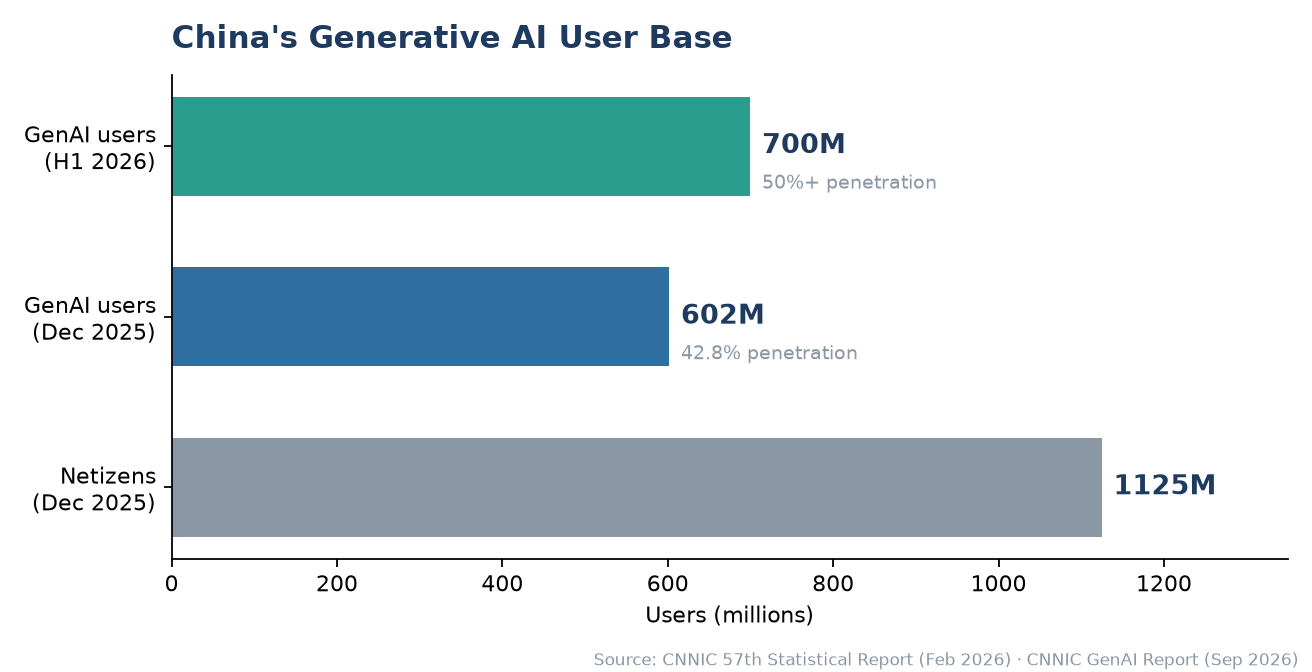
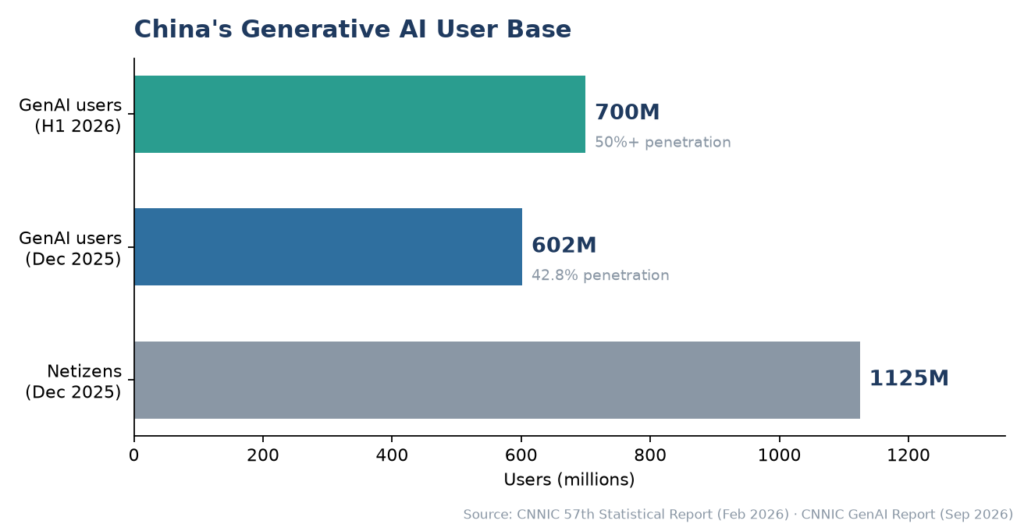
This one starts from usage. The China Internet Network Information Center has tracked generative AI in its national internet surveys since 2024, and the curve it recorded is not subtle. At the end of 2025, 602 million people in China were using generative AI, up 141.7% in twelve months. By mid-2026 the figure had passed 700 million, or more than half the country’s internet population.
So the interesting question is no longer whether Chinese marketers use these tools. It is which ones survived contact with a deadline. Five did, and each earns its place by owning a specific job rather than by having the best demo.
Five numbers to hold onto
1.125 billion. China’s internet users at the end of 2025, at 80.1% penetration, according to the 57th national statistical report released by the China Internet Network Information Center in February 2026.
42.8% to 50%+. Generative AI penetration among Chinese netizens moved from 42.8% in December 2025 to above 50% by June 2026. That is roughly 602 million to 700 million people in six months.
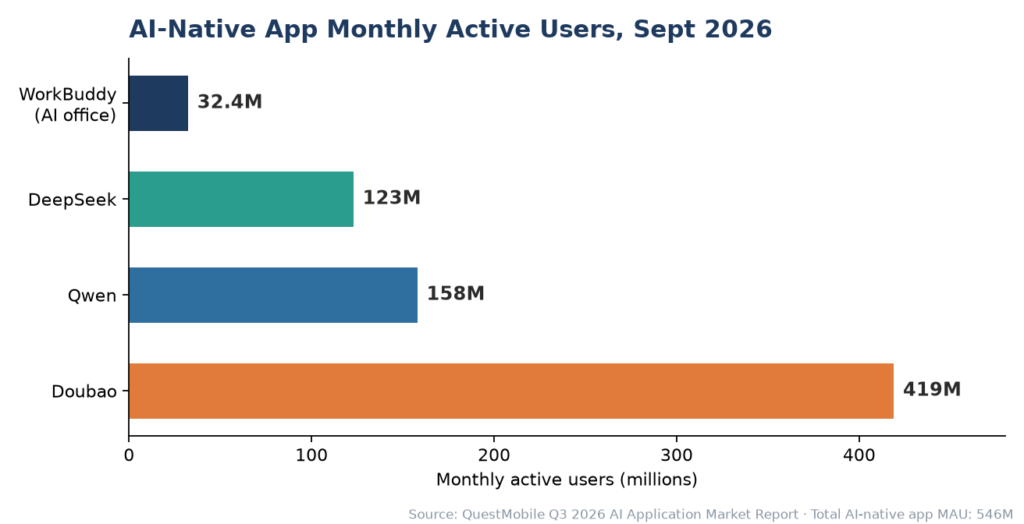
546 million. Monthly active users on AI-native apps in September 2026, up 82.1% year on year, per QuestMobile’s quarterly AI application market report. Add vendor-built assistants and the number climbs further: 783 million for phone-maker AI apps and another 26 million on desktop clients.
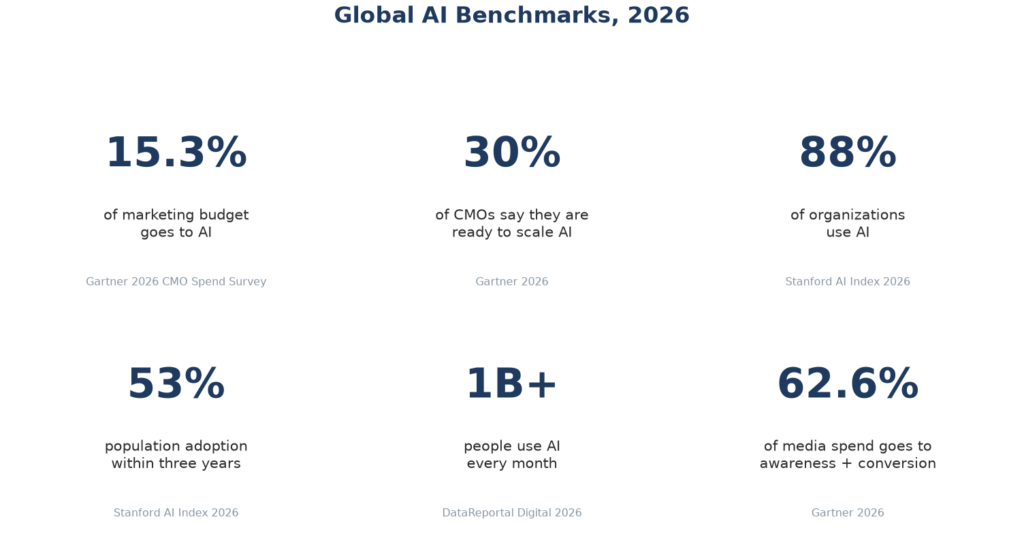
15.3%. The share of marketing budget that chief marketing officers worldwide now put into AI initiatives, from Gartner’s 2026 CMO Spend Survey. Only 30% of them say their organisation is ready to scale that spend.
88%. Organisational AI adoption globally, from Stanford HAI’s 2026 AI Index. The same report finds generative AI reached 53% population adoption within three years, faster than either the PC or the internet. The global counterweight is equally heavy: DataReportal’s Digital 2026 overview counted more than six billion internet users, with over one billion people using AI at least monthly.
Stack the Chinese and global figures next to each other and the pattern is clear enough. Consumer behaviour in China has already crossed the chasm. Tooling maturity, which is what Gartner is measuring, has not. That gap is the whole reason an “actually use” list is more useful than a “best of” list.
Why the Chinese stack diverges from the Western one
Distribution lives inside chat
Western marketing stacks assume a browser and an email inbox. Chinese ones assume WeChat. Customer conversations, service records, group chats and payments all sit inside one app, and enterprise WeChat, known locally as WeCom, extends that surface into the company.
The shift shows in the numbers. QuestMobile’s autumn 2026 report found per-user monthly sessions in search apps down 21.7% year on year, with time spent down 17.2%. Search did not collapse overnight; it lost the default position it had held for a decade.
Everything starts free, then tiers
China’s AI office tools spent 2024 and most of 2025 giving features away. In the third quarter of 2026 the pattern flipped. QuestMobile describes a four-step ladder now in place: a free tier that teaches usage, an entry subscription that anchors individuals, a heavy tier that replaces professional software, and enterprise contracts with private deployment. Doubao and Qwen both launched paid value-added versions and held their user base while doing it.
Filing is part of the spec sheet
Every generative AI service offered to the Chinese public needs a filing with the Cyberspace Administration of China, or a local registration when it merely calls an already-filed model through an API. By 30 June 2026, 988 services had completed national filing and 598 applications had registered locally, a figure CNNIC repeats in its 2026 report. Another 124 filings landed in July and August alone.
Labelling runs on the same rails. The Interim Measures for the Labelling of AI-Generated Synthetic Content, in force since 1 September 2025, require explicit visible labels and implicit markers written into the file itself. Practically, that means every asset a marketer ships from a generative tool needs a visible or embedded marker, and the fixed cost of that is close to zero only if you build it into the template.
The model layer is domestic and open
CNNIC notes that the six most-called models on global leaderboards now come from Chinese teams, and that DeepSeek and Moonshot have both released trillion-parameter open models. For a marketing team, the consequence is unusual: you can rent a model cheaply, or own one outright and run it behind your own firewall. Few markets offer both options at the same time.
The five tools, by job
| Job to be done | Tool | What it replaces | Typical buyer |
|---|---|---|---|
| Research and first drafts | Doubao | Twenty browser tabs and a junior writer’s afternoon | In-house content team |
| Reading long documents | Kimi | Manual PDF reading, transcript scanning | Strategists, analysts |
| Reasoning at scale, self-hosted | DeepSeek | An in-house NLP vendor contract | Brands with data constraints |
| Visual production | Jimeng and Kling | Stock libraries, reshoots, freelance retouchers | Social and e-commerce teams |
| Customer retention and service | WeCom AI with WorkBuddy | Third-party SCRM seats | Sales operations, CX |
1. Doubao: the front door
ByteDance’s assistant is not the most sophisticated model in China. It is the one people open without thinking, which is a harder thing to build.
By September 2026 it held 419 million monthly users and 181 million daily users, roughly three times the next AI-native app in QuestMobile’s ranking. Qwen sat at 158 million and DeepSeek at 123 million. Usage shape matters more than headline size: Doubao users open it 72 times a month for a combined 132.5 minutes. High frequency, medium duration. That is research and drafting behaviour, not deep co-writing.
What it is used for. Question answering, outline generation, first-pass copy, image edits, and a work agent that runs inside Feishu, where it pulls chat, documents and org context into one thread. For a content team, the practical gain is the first 40% of a draft and the competitive scan that used to take a morning.
What it costs. Free at entry. Paid value-added tiers arrived in 2026, with the heaviest tier positioned against professional software rather than against other chatbots. Enterprise access runs through the cloud API, with private deployment available at contract level.
Where it stops working. Doubao optimises for a finished answer, and QuestMobile’s review of citation behaviour found it trims references for speed where Kimi keeps them. If your deliverable is a claim that has to survive a legal review, the trimming is a cost you absorb downstream. Treat the output as raw material, never as the record.
2. Kimi: the reading room
Moonshot’s assistant has one clear advantage and it is not charisma. In the same citation review, QuestMobile found Kimi returning the densest reference coverage of the five assistants it compared.
For a marketer, that translates into document work: competitor filings, a 90-page category report, a two-hour customer interview transcript, a tender document with the specs buried on page 60. Kimi’s long-context handling means you can paste the whole thing instead of chunking it, and the answer comes back with the passage it came from.
What it costs. A free tier, a subscription, and API access. The paid tier buys context length and speed rather than features the free version hides.
Where it stops working. It is a narrow tool by design. Nobody opens Kimi to write a campaign brief from nothing, and it does not pretend to manage your customer data. It is the second tab in a workflow that Doubao or Qwen started.
3. DeepSeek: the engine you can own
DeepSeek looks least impressive in a usage chart and matters most in a procurement meeting. Its 123 million monthly users open it 65.9 times a month but stay for 136.7 minutes, the longest session length among the three leading assistants. Low frequency, long duration. Batch analysis, not casual chat.
The reason it ends up in marketing stacks is structural. The weights are open, which means a brand with customer data it cannot export can run the model inside its own environment. The hosted API is metered per token, with off-peak pricing at roughly half the peak rate, and from November 2026 search and fetch calls are billed per request rather than bundled free. For teams doing bulk classification, tone-of-voice scoring or call-transcript tagging, the arithmetic is what sells it.
What it costs. A free consumer app, plus API pricing low enough that cost modelling becomes a rounding exercise at small volumes.
Where it stops working. There is no workflow, no CRM connector, no interface your account managers will enjoy. You get a model and a rate card. Everything above that layer is your build.
4. Jimeng and Kling: the visual line
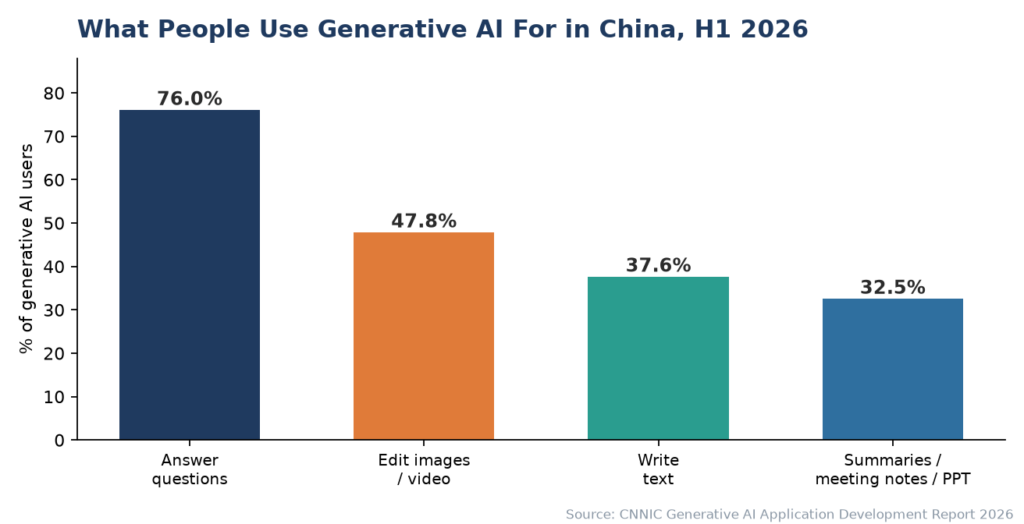
Visual work is where Chinese adoption is widest and least discussed. CNNIC’s 2026 report puts image and video processing at 47.8% of generative AI users, second only to plain question answering at 76.0%. Separately, QuestMobile recorded AIGC apps at 537 million monthly users in August 2026, up 87.5% year on year.
The two names that come up in agency conversations are ByteDance’s Jimeng and Kuaishou’s Kling. Both cover text-to-image, image editing, and short video generation, and both are priced as subscriptions with credits, which makes them easy to pilot and easy to overrun.
What the team gets. Product visuals without a studio booking, variant sets for paid social, storyboard frames before a shoot, and a fast way to test a visual idea before committing budget to it.
Where it stops working. Two places. Brand consistency, because a model will happily invent a packaging detail that does not exist. And review load, because generating 200 assets moves the bottleneck from production to approval. Teams that skip the rights checklist and the brand-guide prompt file end up paying for both.
5. WeCom AI with WorkBuddy: the only layer that touches revenue
This is the tool most Western teams underestimate, and the one Chinese teams actually run daily.
QuestMobile put AI office tools at 142 million monthly users in September 2026, up 50.6% year on year. Tencent’s WorkBuddy alone reached 32.35 million, ahead of Baidu’s assistant at 9.77 million and Qwen’s office product at 7.9 million. What separates WorkBuddy is where it sits: WeChat and WeCom are its front end, so instructions, execution and results all happen inside the conversation channel a customer already uses.
WeCom’s own AI surface is narrower and more useful than the label suggests. There is an assistant, smart bots for internal queries, meeting notes that identify speakers, smart search over chat history, and a weekly service summary generated automatically from each member’s conversations with WeChat customers. That last one is the interesting piece. It turns a service relationship into structured text a manager can read, without asking the sales rep to fill in a form.
What it costs. Priced per seat, bundled with the collaboration suite, with private deployment available for larger organisations.
Where it stops working. It is a company asset. An agency cannot take it home, and a brand cannot port the conversation history to a competitor’s CRM. The value accrues to whoever owns the account, which is a strategic fact, not a product flaw.
The sixth job nobody sells well: attribution
The original outline for this article reserved a slot for AI analytics and attribution tools. After checking what is actually deployed, that slot is better described as a gap.
Chinese performance marketing runs across walled gardens. WeChat, Douyin, Alibaba’s properties and Xiaohongshu each hold their own identifiers and report in their own dashboards. Cross-platform, user-level attribution is not something a vendor can simply productise, because the data does not reconcile at that depth.
So teams improvise. Platform-native reporting covers channel-level efficiency. WeCom-side fields capture first touch inside the conversation. Coupon codes and offline redemption close the loop where a link cannot. What gets marketed as AI attribution is usually anomaly detection on top of channel-level numbers, useful and honest, but not the same thing as multi-touch truth.
The commercial pressure points the same way. Gartner’s 2026 research finds 62.6% of media spend now directed at awareness and conversion, up ten percentage points on 2024, with personalisation and AI-optimisable channels named as the biggest influences on channel mix. Budgets are consolidating around the channels that can be measured and optimised, even where the measurement stops short of a person.
What the stack costs, structurally
Exact prices move too often to print, but the structure is stable and worth knowing before a budget conversation.
| Tool | Entry point | Paid structure | Enterprise route |
|---|---|---|---|
| Doubao | Free consumer app | Value-added subscription tiers; metered API | Cloud API, private deployment |
| Kimi | Free tier | Subscription for context and speed; API | API |
| DeepSeek | Free app | Per-token API, off-peak discounts, per-request search | Open weights, self-hosted |
| Jimeng and Kling | Free credit allowance | Subscription plus credit packs | Commercial licence and API |
| WeCom AI and WorkBuddy | Bundled with seats | Per-seat subscription | Private deployment |
Notice what is missing from that table: per-seat pricing on the assistants. The assistants charge for usage and capability, the collaboration tools charge for people. That split explains why AI budgets in Chinese companies often sit partly in marketing and partly in IT.
What to take, and what to leave
Take the workflow, not the model
Every one of the five is wrapped in something that closes a loop. Doubao sits inside Feishu. Qwen’s office product sits inside DingTalk. WorkBuddy sits inside WeChat and WeCom. The model is the commodity; the wrapper is the product.
Western teams tend to buy the model and then rebuild the wrapper as an internal prompt library. That library decays in about a quarter, because nobody owns it. Buying or building the connector is the part that lasts.
Take the delivery test
QuestMobile’s framing for 2026 is blunt: growth went to products that can deliver a finished job, not to products that answer a question. Applied to a marketing stack, that becomes a single screening question. Does this tool end with an artefact someone can approve, send, or file? If the answer is no, it belongs in the experimentation budget, not the operating budget.
Leave the compliance shortcut
It is tempting to treat China’s filing and labelling regime as a local quirk that only applies inside the market. It does not. The moment a campaign built with these tools runs outside China, a different set of disclosure rules applies, and the internal habit of labelling at source is the cheaper one to keep. Brands that build the label into the asset template spend nothing extra later.
A 30-day sequence that works
Week one: count jobs, not tools. List every recurring marketing task and how often it happens. Two usually dominate: first drafts and customer replies. Start there.
Week two: run real briefs, keep a log. Put Doubao on research and drafting, Kimi on the documents nobody has read. Keep one shared prompt file the whole team edits, so the knowledge stays in the company rather than in someone’s chat history.
Week three: move low-risk visuals in-house. Product shots and variant sets first, campaign films last. Build a rights checklist before the first asset ships.
Week four: wire one service metric. Connect WeCom’s auto-generated service summaries to a single number, reply time or lead-to-quote rate, and review it weekly.
Then stop. Four weeks is long enough to know what stuck, and short enough to avoid a stack nobody can explain in a budget review. Gartner’s finding that only 30% of CMOs feel ready to scale is less a warning about technology than about this exact stage: buying faster than you can absorb.
Bottom line
China’s AI marketing stack is not a smaller copy of the Western one. It grew inside chat apps, under a filing regime, on a wave of free usage that has only just started charging. The tools that survived are the ones that finish a job: Doubao for the first draft, Kimi for the document, DeepSeek for the reasoning you want to own, Jimeng and Kling for the visual line, WeCom for the customer relationship. Attribution is still the open wound, and any vendor claiming otherwise is selling dashboards. Copy the wrapper, not the model, and the lesson travels further than the tool list does.
Download the tool comparison table to see the five tools side by side with job fit, cost structure and adoption risk.