Discovery Is Being Rebuilt: How AI Agents Became the New Front Door to Your Brand
The Great Quiet: What Happens to Discovery When an Agent, Not a Human, Browses Your Site
A shopper tells an assistant she needs waterproof hiking boots under $150 that can arrive by Friday. The machine checks four retailers in parallel, weighs prices, filters reviews, confirms stock, and hands back two options. She picks one. No storefront ever rendered on a human screen. No logo appeared. No banner was seen. Nothing about the careful design work on the page was witnessed by the person who bought it.
That is not a scenario set five years out. It became a live product category across 2025 and 2026, when OpenAI, Meta and Anthropic each shipped proactive personal agents, and a trusted machine stepped between the customer and the checkout.
The core question every brand now faces has flipped. It is no longer “why am I not ranking?” It is “what happens to discovery when an agent, not a human, browses my site?” The honest answer is that the entire discovery stack is being rebuilt, and almost none of the old signals survive the translation cleanly.
The Year the Intermediary Arrived
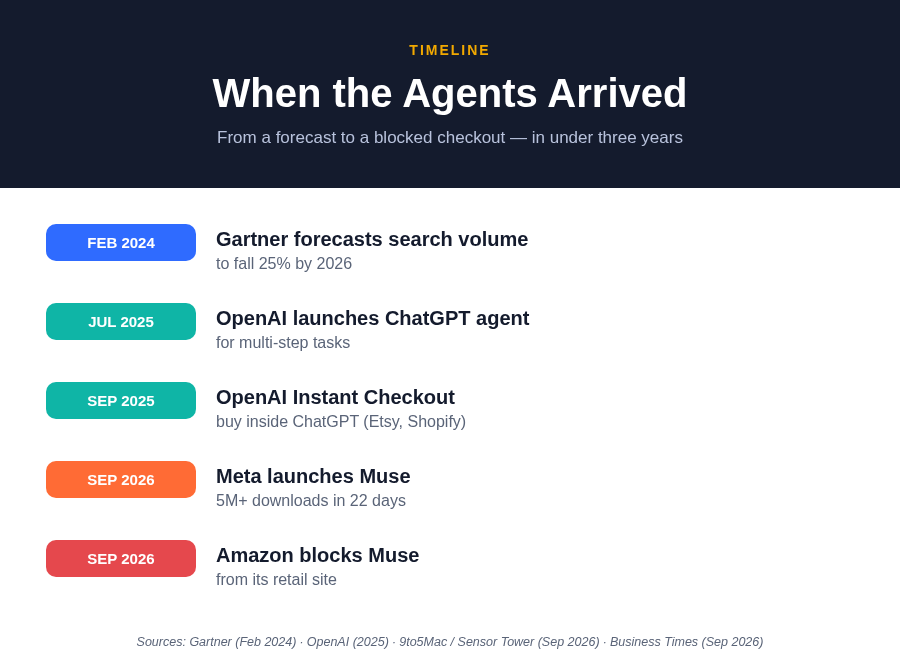
The warning arrived early. In February 2024, Gartner predicted that traditional search engine volume would drop 25 percent by 2026, displaced by AI chatbots and virtual agents. At the time it read like a distant forecast. Two years later it no longer reads as speculation.
The product launches stacked up. OpenAI released its ChatGPT agent in July 2025 for multi-step tasks, then followed in September 2025 with Instant Checkout, letting users buy from Etsy and Shopify without leaving the chat. Meta’s Muse agent launched in September 2026, crossed five million downloads within twenty-two days, and held the number-one spot on the US App Store for twelve consecutive days. In the same month, Amazon blocked Muse from its retail site — the first high-profile standoff between a retailer and a third-party shopping agent.
The revenue moved faster than most marketers expected. Salesforce’s analysis of the 2025 holiday season, drawn from roughly 1.5 billion consumers across 89 countries, found that AI- and agent-influenced sales reached $262 billion — about 20 percent of total retail sales. Retailers that had adopted AI agents grew sales 59 percent faster than those that had not. Traffic arriving through AI search channels such as ChatGPT and Perplexity roughly doubled year over year, and those visitors converted at about nine times the rate of social-media referrals.
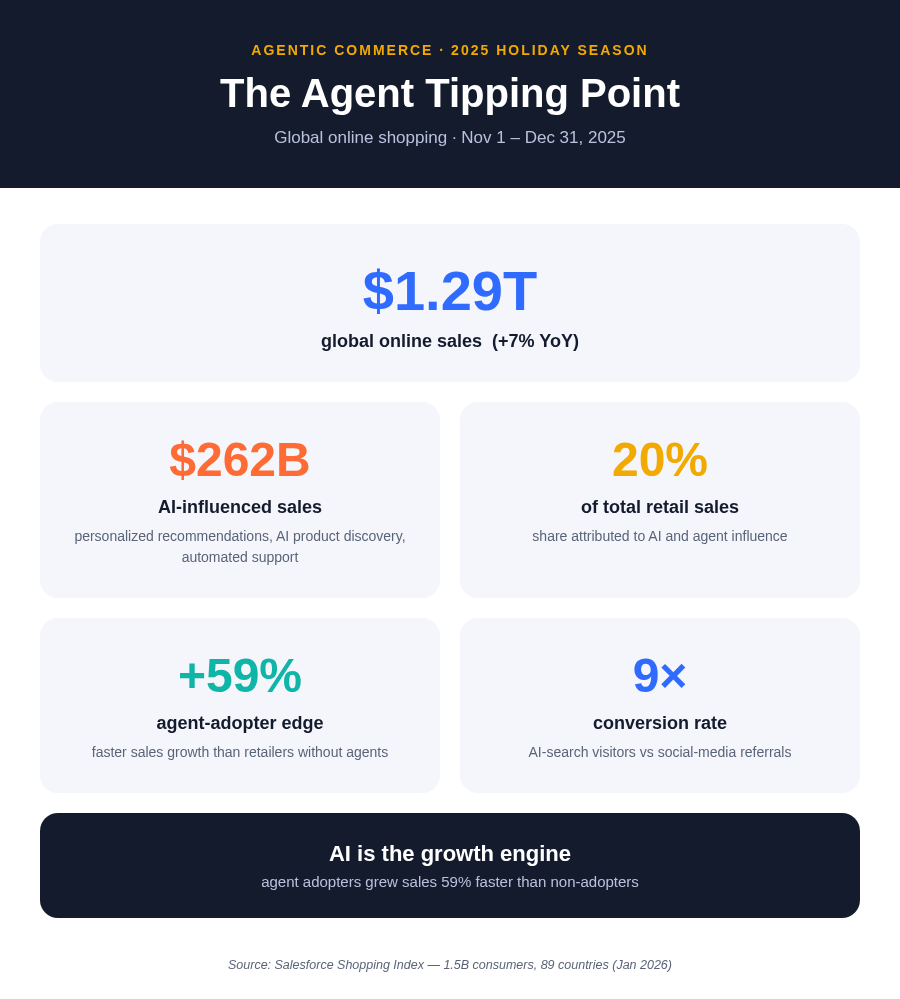
What makes this different from past channel shifts is that the revenue arrived while the traffic logs stayed clean. When a machine reads your product page, decides it is the right match, and routes over a customer who converts far better than a social visitor, you are participating in a new channel. You simply may not see it happen, because in many of these sessions your site was read, not visited.
What Personal Agents Actually Do
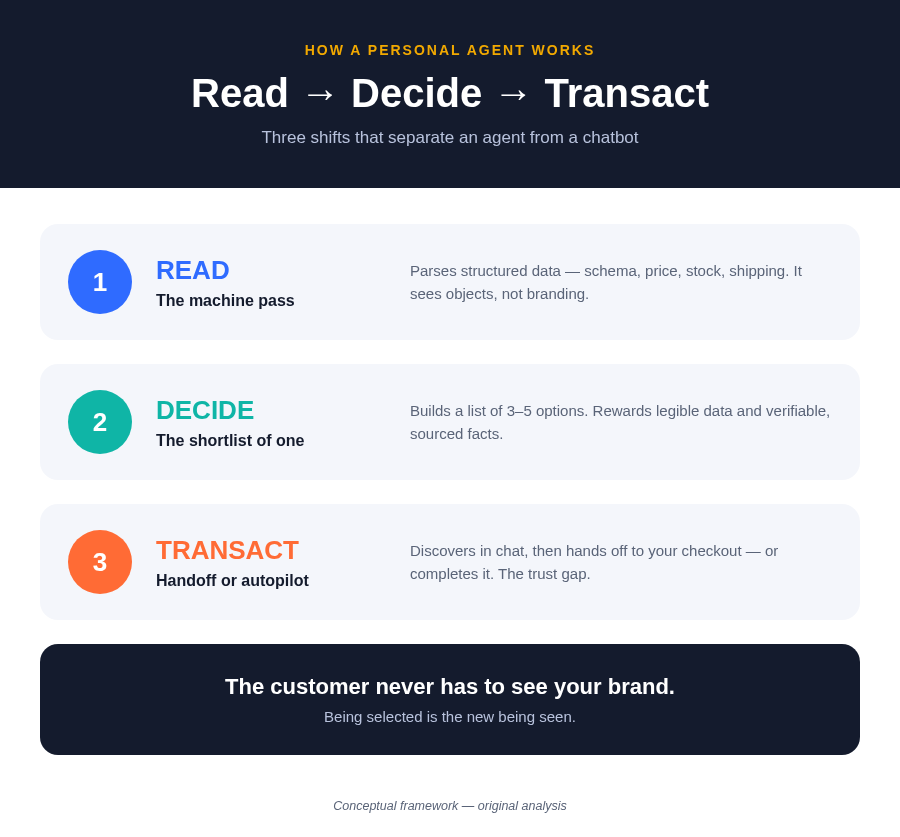
The word “agent” gets used loosely, as if it just meant a fancier chatbot. A chatbot waits for a question and answers it. A personal agent executes multi-step tasks across services, on the user’s behalf, without being prompted for each step. The functional delta between the two is the whole story in marketing terms. It rests on three shifts.
Read: The Machine Pass
An agent reads your site the way a compiler reads source code. It is trying to extract objects, attributes, prices, availability and constraints — not to experience your brand. It does not notice the product photography. It does not care about the video hero. It wants to know whether the product has a complete attribute schema, whether the price is machine-readable unambiguously, whether stock and delivery windows are stated in a way it can parse, and whether your structured data matches what other sources say about you.
It also reads differently from a search engine crawler. A classic crawler looked at links, metadata and keywords. An agent reads full page content and cross-checks the same claim against a competitor’s page, a review site and a community discussion, all before the answer reaches the person. This is why a page can rank well on Google while still confusing the agent that ultimately decides what to tell the shopper.
Decide: The Shortlist of One
After reading, the agent builds an internal shortlist, often only three to five options it presents to the user. This shortlist is the new shelf space. If your product or brand is not on it, you did not exist in that interaction, regardless of all your spend upstream.
The deciding factor is data legibility. Any agent comparison is essentially a structured database query. It prefers pages whose answer is already in extractable form over pages that require inference. The practical implication is that a well-structured product or service page that reads like a spec sheet will win agent selection over a beautifully illustrated editorial page that reads like a magazine.
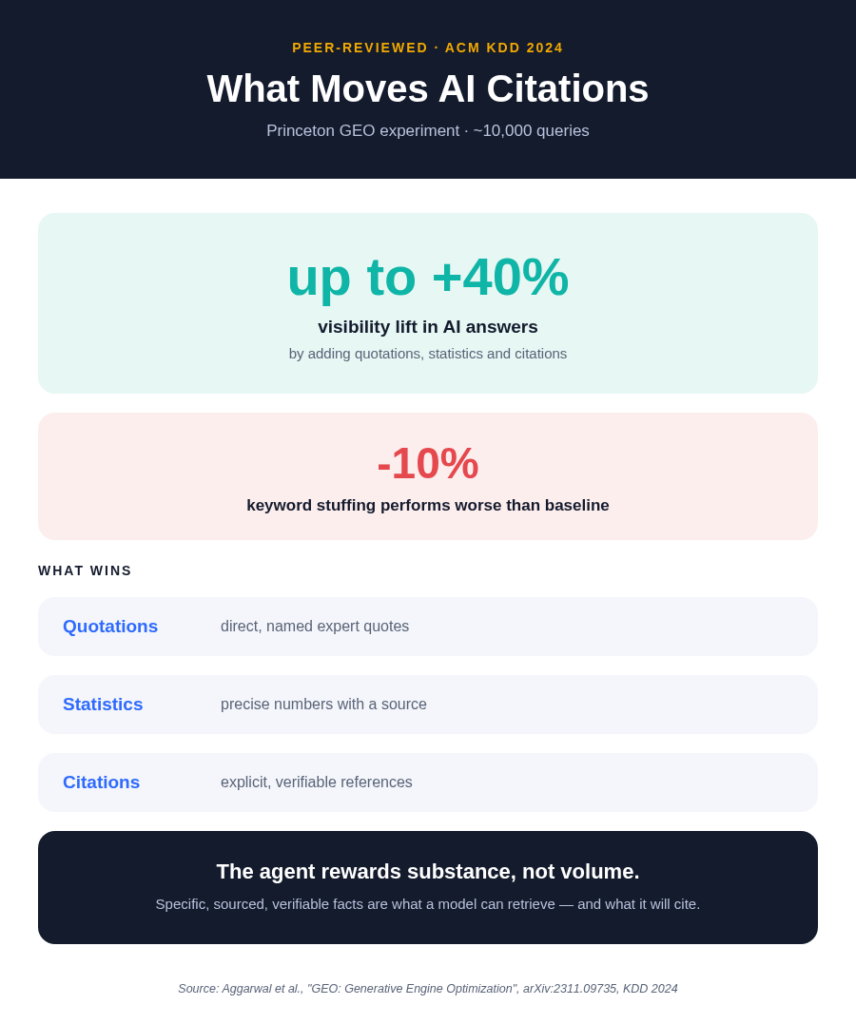
That is where a new discipline, generative engine optimization and its sibling answer engine optimization, begins to matter more than classic search engine optimization. In a controlled Princeton experiment presented at ACM KDD 2024, the researchers ran about 10,000 queries and found that adding source-attached statistics, direct expert quotes, and explicit citations could lift visibility inside AI-generated answers by up to 40 percent. The same experiment found that keyword stuffing — the oldest trick in the SEO book — performed worse than doing nothing.
Transact: The Handoff or the Autopilot
Transacting — where the agent actually completes a purchase — is the newest and most contested step, and the platforms have split philosophically. Some are building toward full checkout inside the assistant, covering search, cart and payment. Others have retreated from in-chat purchasing in favor of a model where the conversation is for discovery and the actual transaction hands off to the merchant’s own checkout, keeping the customer record and the relationship on the brand’s side. A third camp has released open-source agent blueprints that let a brand run an agent on its own infrastructure, so the machine stays inside the retailer’s app rather than in a third-party interface.
The trust question is not yet settled, and it is the whole reason checkout is contested. Amazon did not block Muse because the agent was incompetent; it blocked it because of what the agent represented — a third party inserting itself into the purchase path without Amazon’s terms, credentials or customer-relationship controls. The fight over who owns the checkout is really a fight over who owns the customer. That is why the transaction layer is moving last.
Why Legacy SEO Signals Weaken
A generation of marketing was built on a stable economy of attention. Someone typed a query. Google produced a list. A human scanned the list and clicked. Rank determined the click. The click determined revenue. Every keyword tool, content calendar, link-building agency and fee structure assumed that entire chain. In the agent era, each link in that chain has gotten weaker, and every playbook built on top of it inherits that weakness.
The Ranked List Is No Longer Where the Answer Lives
The first casualty is the list itself. Gartner’s 25 percent decline forecast was not about people searching less. It was about people getting answers without ever needing the list. When the machine composes the answer and cites the source inside a chat, the human never sees the ranking. The question of whether “rank one won” becomes meaningless when rank one exists in a page no human visits.
Ranking and Citation Have Partially Decoupled
For years the implicit promise of SEO was that ranking led directly to visibility. That coupling is loosening. In Salesforce’s holiday data, the traffic that actually converted at nine times the rate of social came through AI search surfaces — not through a classic ten-blue-links result. The mechanism that matters now is not “did I rank,” but “did the agent retrieve me, and did it describe me correctly.”
Keyword stuffing, the old fallback, now backfires. It was measurably worse than doing nothing in the controlled GEO research. The machine rewards density of verifiable information; it punishes manipulative writing.
Structure and Freshness Outrank Page Authority
The old discipline rewarded the canonical long-lived article. The machine rewards the well-scoped, recently-refreshed page that reads as a passage. The peer-reviewed GEO work points to a consistent pattern: what moves the needle is whether the page contains specific, sourced, quotable facts in a structure the agent can lift cleanly — not how many backlinks point at it, nor how much invisible markup wraps it.
The Backlink Becomes the Third-Party Mention
The old authority signal was the backlink from a respected domain. The equivalent signal in the agent era is not a technical link; it is whether humans and machines are talking about you in the places the agent reads. An agent deciding between two nearly identical products will defer to the one with a richer trail of independent conversation around it — reviews, community threads, comparison pages. The moat is no longer links you control. It is credible discussion you do not.
How to Become the Brand the Agent Cites
Once you understand which signals weakened and which new ones actually moved citation rates in controlled research, the work becomes concrete. None of it requires a whole new department. Most of it requires a different definition of what a page is for.
Structure Content for Passage-Level Extraction
Write for the paragraph the machine lifts, not the reader who scrolls. Answer the query in the heading itself. Give the answer again in the first 200 words of the body. Break complex topics into standalone blocks of roughly 120 to 180 words that work as an independent unit. Use definitive phrasing — “X is Y” or “X refers to Y” — in the passages you want cited, because those are the patterns retrieval systems pick up most. Long-form still works, but only if the interior is passage-structured. A long blob without internal structure gets skipped; the same content with strong sub-headings and clean paragraphs gets cited.
Publish Verifiable, Source-Attached Numbers
This is the single highest-leverage change any brand can make this year. Every claim should arrive with a figure, a named source and a date. The controlled GEO research showed statistics and attribution lift citation rates more than almost any other content change. Do not write “our platform is fast.” Write “median task-completion time across 4,200 sessions in Q2 2026 was 47 seconds, methodology available on request.” Specificity is what retrieval indexes favor. Vague superlatives are what the model routes around, because it has been trained to trust precise, attributable claims.
Machine-Readable Product Data Is the New Meta Description
In physical commerce, this matters more than prose. Attributes, color variants, materials, sizes, pricing, stock windows and shipping options all have to be complete in schema and current in the product feed. Every agent comparison across retailers is a database query. If your schema uses proprietary labels that match nobody else’s, you are invisible to a machine that does not know those labels mean something. This is infrastructure work, like being mobile-responsive in 2010 — unglamorous, and decisive.
Own a Distributed Presence on Places You Do Not Control
If third-party mention is the new backlink, the real work happens on external platforms and communities. On the B2B side that means the review and comparison platforms and industry publications that get picked up by AI answers. On the consumer side it means Reddit, YouTube reviews, influencer content, and the forums where unboxing photos and long-term-use reviews post organically. None of this means gaming review platforms. It means participating in the corpora the agents are actually reading when they answer a question about your category.
Instrument Agent Traffic as Its Own Channel
Most companies cannot answer a simple question: what percentage of your inbound pipeline arrived after an AI conversation, versus after a Google search? Until that gets instrumented separately from organic and paid, the leadership conversation will keep under-weighting the shift. ChatGPT is currently the dominant source of AI referral traffic, but Gemini, Perplexity, Claude, Copilot and the agentic browsers add a meaningful remainder that grows every quarter. Report agent referrals explicitly. The share is small in one quarter’s view and enormous across a year’s trajectory.
Block, Partner, or Build: Choose the Agent Posture
Every brand now faces a fork that other categories never had. The first option is blocking: prevent external agent traffic from transacting through your store. The second is partnering: integrate with major platforms so your catalog flows cleanly into chat commerce inside their surfaces. The third is building: run an agent on your own property or infrastructure, keeping the customer record, the checkout and the loyalty engagement in-house. Amazon went blocking. Others partnered. A cohort started building after open-source templates appeared. There is no neutral option. Sitting out the agent ecosystem is itself a strategic choice — usually the worst one, because the agents arrive whether you decide or not. If you have not decided, the decision has already been made by default.
Measure Being Cited, Not Just Ranking
The single most important strategic shift is to measure share of answer, not share of click. Track how often your brand is cited — correctly and favorably — across the AI engines your buyers actually use. That is a fundamentally different metric from rank or traffic. It is also more volatile. The same question asked twice can produce different answers. A single screenshot means nothing. Frequency over time, across a large prompt set, is the entire concept. If any tool or agency tries to sell you GEO with a one-prompt demo, that should be your red flag.
The China Mirror
China’s version of agent-led commerce looks a little different in texture and a lot similar in shape. The behavioral shift — interest forming inside a feed before a query is ever typed — is arguably native to the Chinese internet, where mobile-first habits, super-app ecosystems and recommendation-driven discovery reached maturity years before the equivalent pattern in the West.
What changes is the corpus the agent reads, the trust surface and the checkout rails. For global brands, the same principles apply — clean structure, verifiable statistics, passage-level extraction, third-party presence — but the places that carry signal weight are different platforms. Chinese community platforms, search Q&A forums, short-video review content and in-app review ecosystems function for Chinese-language agents in much the way Reddit and the Western review platforms function for English-language ones. Same principle, different database.
China’s retail rails also run differently. Discovery happens inside super-apps and video-commerce environments rather than a search-and-shop split, so the agentic layer is not a bolt-on — it is already entwined with commerce infrastructure, and payments run on rails built for mobile-first flows. For brands selling into or out of the Chinese market, the strategic question “will an agent eventually stand between my customer and my product” already has a partial yes. It just looks different, because it looks like an agent embedded in a super-app rather than a standalone browser assistant.
What This Means for Brand Loyalty
There is a second, quieter consequence hiding inside the technical shift, and it may end up mattering more than any of the tactical points.
Brand loyalty has been an asset built on repeated human exposure. The customer sees your logo, remembers your palette and your voice, forms a memory and then a habit. That entire construction depends on the customer actually perceiving you. In agent-mediated commerce, the perception loop can be shortened or eliminated entirely. The machine reads your data, compares it against the field, and hands the user a one-line answer. Your product shows up. Your brand does not. The customer may buy from you repeatedly and never have a felt experience of the brand.
This is what visibility becomes when the audience is replaced by a model. For years visibility meant attention. In the next decade it increasingly means selection without attention — a strange and quietly profound redefinition. You could argue you are not visible at all. You could equally argue that being consistently selected, correctly described and safely transacted-with is a purer form of visibility than the banner ad ever was. Which position you take says a lot about whether you think the brand is the logo or the product underneath it.
Brands that keep loyalty intact will probably be the ones that, in addition to the machine-legible layer, keep a meaningful human-facing surface — brand-owned apps, physical retail, creator relationships, community programs. The agent handles the boring, repetitive transactions: the reorder, the commodity pick. The brand handles the experience layer where humans actually want to spend time. The next decade of brand strategy is about drawing that boundary deliberately, rather than accidentally letting the machine absorb the whole relationship.
Summary
When an agent, not a human, browses your site, almost nothing you spent years learning how to do translates. The agent wave rolled out across 2025 and 2026 — Gartner’s 25 percent search-decline forecast no longer reads as speculation, Salesforce measured $262 billion in AI-influenced holiday sales with agent adopters growing 59 percent faster, and AI-search visitors converted at nine times the rate of social referrals. The new work is structural: passage-level writing, verifiable source-attached statistics, complete product data, a distributed third-party presence, a deliberate block-partner-build posture, and measurement by share of answer rather than traffic. The China story runs on different corpora but the same physics. Underneath it all sits something more important: brand loyalty, historically built on human exposure, now has to be rebuilt on machine selection, which is a different relationship and a different kind of visibility. You cannot opt out by ignoring it. The agents come whether you choose or not. The winners choose early, on their own terms.
Structured FAQ
Q1. What happens when an AI agent browses a website instead of a human?
A1. The agent reads the page as structured data, extracts facts and attributes, compares them against competitors and third-party sources, then either cites the page in an answer or adds it to a shortlist. The human may never see the page — the brand is selected without being visited.
Q2. Is SEO dead now that agents browse for people?
A2. SEO is not dead, but it is no longer the whole job. Ranking still feeds retrieval, but rank no longer reliably translates into visibility, and tactics that used to game rankings — keyword stuffing chief among them — now backfire in controlled research. The modern search team’s job now includes generative engine optimization, structured product data and citation measurement.
Q3. What actually moves the needle for getting cited by AI?
A3. The peer-reviewed evidence points to three things: source-attached statistics, direct expert quotes and explicit citations. Structured, passage-level writing with the answer up front helps the agent lift a clean block. Invisible markup and keyword stuffing do not help; in some tests they hurt.
Q4. Should I block AI agents from my site?
A4. Blocking is a real option, and a major retailer did it when an agent arrived on unauthorized terms. But blocking does not stop your content from being indexed by engines that cite it anyway, and it costs you agent-mediated sales. It is worth considering when an agent’s access pattern violates your terms; it is a poor default for brands with clean data and clean checkout.
Q5. How is this landing differently in China?
A5. The principle is the same, the corpus is different. Agent-assisted discovery is arguably further along inside super-app and short-video-commerce infrastructure, and the platforms where third-party signals carry authority are Chinese community, Q&A and review environments rather than their Western equivalents. GEO and answer-engine investment cannot be localized by simply translating English content — the corpora themselves differ.