Alphabet Q3 2026 Earnings: Why Google’s AI Mode Lower Ad Monetization Triggered a $500 Billion Stock Drop
Google’s Worst Day Is a Warning for Every Marketer
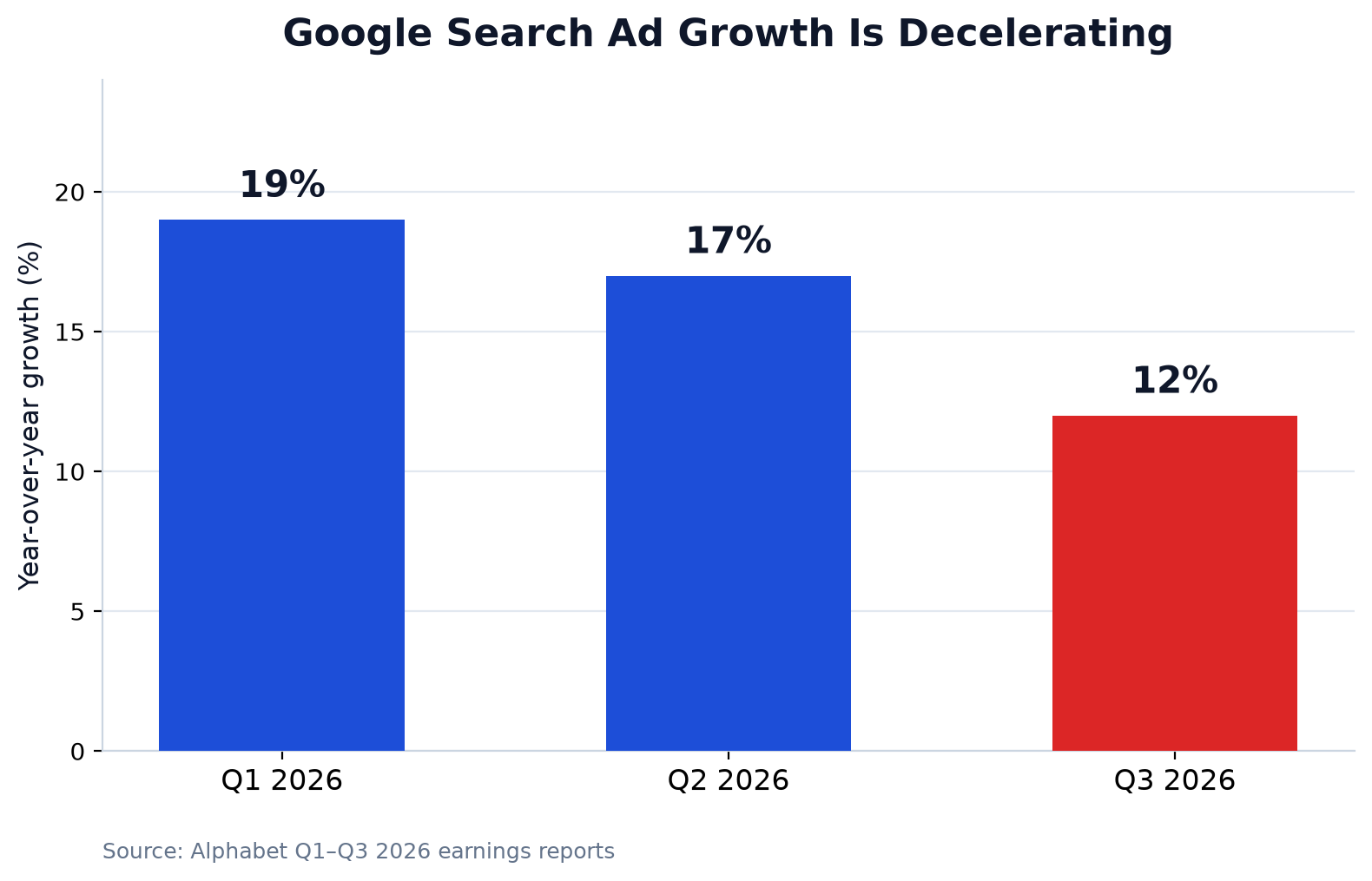
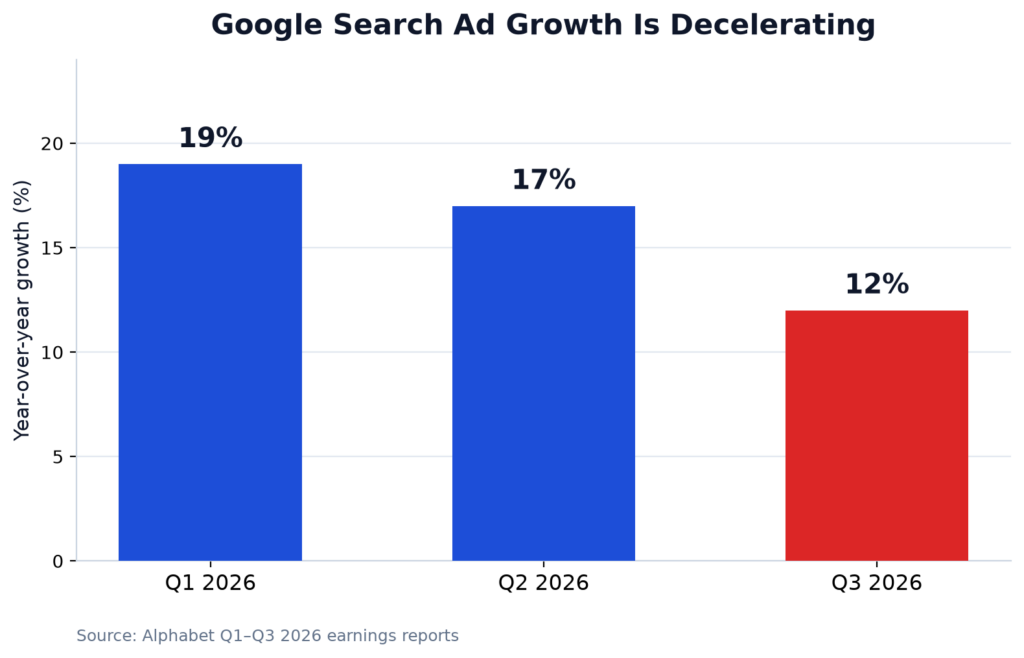
On October 29, 2026, Alphabet suffered its worst single-day sell-off since its 2004 IPO, erasing roughly half a trillion dollars in market value in a single trading session. The strange part is that the trigger was not a collapse in revenue. Total revenue jumped 25% year over year to $127.58 billion, and Google Cloud grew an astonishing 103%. What spooked investors was something subtler — a crack in the one line that has quietly paid for everything else: Google Search advertising. Search ad revenue grew just 12% in the quarter, down from 17% in Q2 and 19% in Q1, even as search query volume hit a five-year high. The reason, which Google’s own chief business officer admitted on the earnings call, is that AI Mode answers monetize at a lower rate than the ten-blue-links page they are replacing. That single admission reframes the future of the advertising model — not just for Google, but for every marketer who rents attention on the open web.
The Numbers That Shocked Wall Street
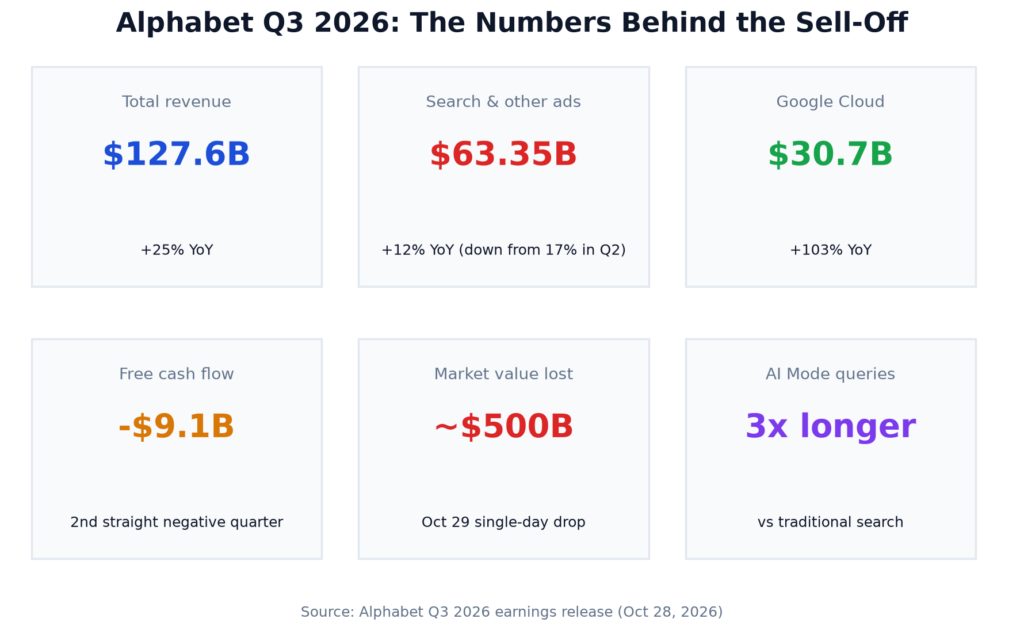
At first glance, Alphabet’s third quarter looked strong. The company reported $127.58 billion in total revenue, up 25% from the year before, and Google Cloud revenue surged 103% to $30.7 billion, with cloud operating profit up 209% and an operating margin that climbed to 36.2%. By any ordinary measure, this is a healthy, fast-growing business.
The problem was hiding inside the search line. Google Search and other advertising revenue reached about $63.35 billion, up only 12% year over year. That sounds fine in isolation, but the trend is the story: Search ad growth was 19% in the first quarter and 17% in the second. Twelve percent is not a blip; it is a deceleration curve, and the market priced it instantly.
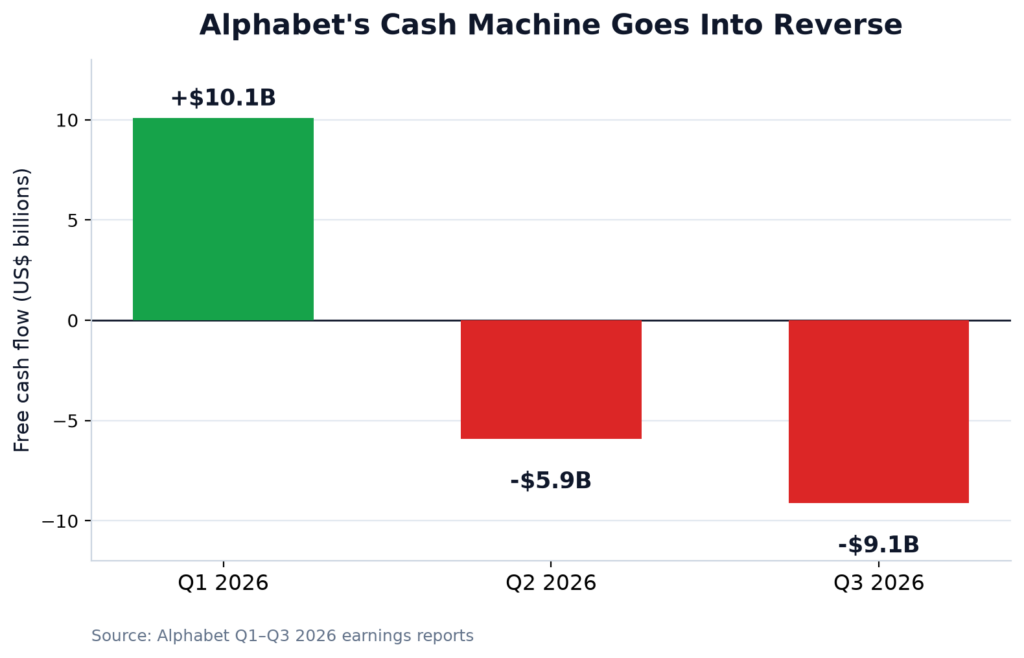
Shares fell 12.6% on October 29, erasing an estimated $500 billion in market value — Alphabet’s largest single-day loss since its 2004 IPO. The decline came on top of a separate, harder-to-ignore problem: Alphabet reported negative free cash flow of $9.1 billion, its second consecutive quarter of cash burn, after a positive $10.1 billion in Q1. For a company long described as a money printer, the shift from surplus to deficit in three quarters was itself enough to reset how investors value the business.
What made the sell-off so violent was the contradiction at its core. On the same call, CEO Sundar Pichai said Google’s year-over-year search query growth had reached its highest level in five years, driven by AI products. More people than ever are asking Google questions. Yet the revenue per question is falling. Growth in usage and shrinkage in monetization happening at the same time is exactly the scenario investors have been quietly dreading since the first AI summaries appeared.
Why the Market Was Surprised
The market has watched Google pour capital into AI for two years and tolerated it, on the assumption that AI would eventually add new monetization on top of the existing ad machine. The third quarter broke that assumption in a specific, measurable way.
Philipp Schindler, Google’s chief business officer, put it plainly on the earnings call: strong AI Mode query growth negatively impacted Search revenue growth because of the lower monetization in AI Mode. This was not a journalist’s interpretation — it was a rare, on-the-record admission from the company that its newest search product earns less money than the one it partially replaces.
The surprise, then, was not that AI search exists. Everyone knew that. The surprise was Google confirming that its flagship AI product is, right now, a worse business than the thing it is cannibalizing — and that there is no timeline for closing the gap.
The Mechanical Cause: Answers Replace Monetizable Links
To understand what broke, you have to look at how classic search actually makes money. A traditional results page is a machine for selling intent. A shopper types a product name, and Google serves a page with several sponsored slots, each tied to a keyword auction where advertisers bid against each other for a click. High commercial intent commands high prices, and the page has room for multiple paying positions.
AI Mode works differently, and the difference is mechanical, not cosmetic.
Fewer Ads Per Answer
An AI answer is, by design, a single synthesized response. Where the old page offered several ad slots stacked above and below organic links, an AI answer offers far fewer natural places to put an ad without wrecking the experience. Fewer ad slots per query means less revenue per query, even if every individual ad kept its old value. Google confirmed this directly: AI Mode simply carries fewer ads than a classic results page.
Lower Value Per Query
The second issue is what kind of query AI Mode attracts. Schindler noted that many AI Mode searches are upper-funnel — people researching and comparing rather than ready to buy. A user asking about insurance options or comparing laptop categories has real commercial intent, but it is not the “buy now” intent that commands the highest cost-per-click. As AI Mode absorbs more of the research phase of the purchase journey, the average value of a query slips.
The Cost Side Nobody Mentions
There is a third layer that makes the math worse, and this time it is visible in the cash flow statement. Serving a generated answer costs more in compute than serving a page of links, and that cost is landing directly on the balance sheet. Alphabet’s capital expenditure hit $51.36 billion in Q3 alone, up from $44.9 billion in Q2 and $35.7 billion in Q1, with full-year guidance of $195–205 billion. For every new dollar of revenue, Alphabet is now spending more than a dollar to build the infrastructure behind it. Lower revenue per query combined with higher cost per query is the exact combination that erodes margin from both directions — and it is why free cash flow has turned negative.
Google’s Fix: More Ads, Not Fewer
Google’s response is not to retreat from AI search but to pack more advertising into it. The company confirmed on the earnings call that ads inside AI Mode are rolling out to ten new countries — Australia, Canada, India, Kenya, Malaysia, New Zealand, Nigeria, Pakistan, the Philippines, and Singapore — with Brazil, Mexico, and the UK to follow in Q4. In the US, Google is launching multi-turn ads that drop sponsored placements into the follow-up queries of an ongoing AI Mode conversation.
Google also offered one encouraging data point: early tests show sponsored-product click-through rates in AI Mode comparable to the click-through rates of organic listings. That is a meaningful signal — it suggests users will click shopping ads inside AI answers as readily as they click unpaid results. But click-through rate is not revenue. Google supplied no raw figures, no cost-per-click data, and no timeline for when the monetization gap closes. For now, the gap is real, admitted, and open-ended.
What This Means for Non-Google Advertisers
If you are a marketer, the lesson of Alphabet’s worst day is not “Google is in trouble.” Google is fine — it grew 25%. The lesson is that the surface where your ads appear is changing shape, and your strategy has to change with it.
The most practical point is that you cannot yet buy AI Mode or AI Overviews as separate placements. Advertisers generally cannot target these AI surfaces on their own; they ride along inside existing campaigns, and existing negative keywords and brand exclusions still apply. That means the quality of your underlying data — especially product feeds and shopping listings — is now doing more of the heavy lifting than ever before. Sponsored product listings are the format Google cited for strong early click-through, and a clean, structured feed is the entry ticket to showing up there.
Attribution is the second hidden risk. Upper-funnel AI queries may feed a purchase that happens days later, in a session your last-click model credits to something else. Teams that only measure last-click results will systematically undercount what AI search actually contributed — or, on the flip side, overpay for conversational traffic that never converts. The only way to know which is to run holdout tests where budget allows.
Finally, plan for more AI ad inventory, not less. Google is explicitly expanding ads into more queries, more follow-ups, and more countries. More inventory usually means more competition for placements and, over time, shifting prices. The marketers who test early collect real data while everyone else is still guessing.
The China Mirror: When Ads Don’t Fit a Conversation
The most revealing counterpoint to Google’s struggle is happening on the other side of the Pacific, where the same question — how do you monetize an AI assistant? — is being answered in the opposite way.
China’s largest AI assistant, ByteDance’s Doubao, reached 419 million monthly active users in September 2026, up 143.6% year over year, according to QuestMobile. It is, by user count, one of the most-used AI products on earth. Yet by its own ecosystem’s reporting, the Doubao app generated less than 1 million yuan in daily revenue in the first half of the year — a rounding error for a product of its scale — and most of that came from e-commerce commissions, not advertising.
The reason is instructive. Chinese AI vendors concluded early that conversation is a hostile environment for ads. You can insert advertising into a short-video feed without breaking the experience, but a pop-up ad in the middle of a task-oriented conversation ruins the very thing the product is for. So Chinese players pivoted to three monetization levers Google barely uses: subscriptions, transaction commissions, and enterprise API fees. Doubao rolled out paid tiers; it began charging a roughly 12% rate on hotel bookings routed to Douyin’s local services platform; and its B2B arm, Volcano Engine, sells model access to enterprises.
MiniMax, one of China’s few publicly listed AI model companies, shows the same tilt. In its half-year report, enterprise and open-platform services had grown to 63.4% of revenue, up from 32.8% two years earlier, while its consumer AI products shrank as a revenue share.
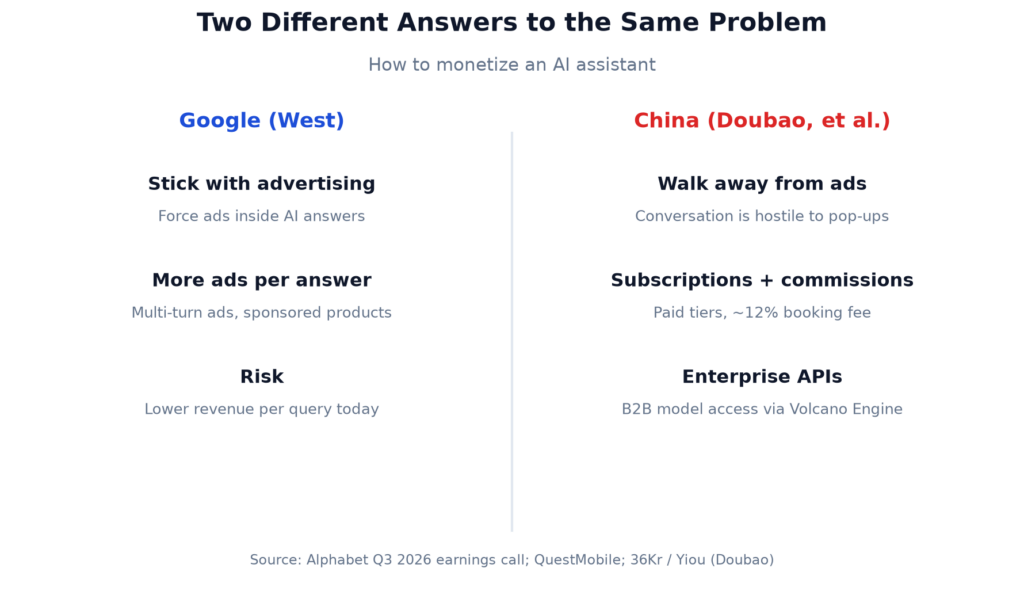
The contrast is stark. Google, because it is an advertising company, has no choice but to force ads into the answer and hope the math catches up. Chinese vendors, because they are not advertising companies, walked away from the ad model in conversation and found money in subscriptions and commissions instead. Both paths are hard. Neither has a clean answer yet. But they prove one thing clearly: the old assumption that an assistant with a billion users can simply bolt on the search-ad playbook is wrong.
The Takeaway for Platforms
For every platform that sells ads — not just search engines — Alphabet’s quarter is a warning with a specific shape. The risk is not that AI kills advertising. The risk is that AI changes where the highest-margin advertising lives, and the transition has a negative carry: usage grows, revenue per user falls, and the two don’t reconcile until someone invents a new format.
Google has survived this exact kind of shift before. When search moved from desktop to mobile, the screen shrank and the ad layout had to change with it; Google built formats native to the smaller screen instead of squeezing desktop ads into it. AI Mode is the same arc with higher stakes — the constraint is no longer a smaller screen but a single synthesized answer with almost no room for the old link-based economy.
The platforms that will manage this transition best are the ones that stop treating AI answers as a worse version of a results page and start treating them as a new surface with its own commercial logic. For Google, that means multi-turn ads and sponsored products inside answers. For China’s assistants, it means subscriptions and commissions. For every marketer caught in between, it means one uncomfortable truth: the link you used to buy is being replaced by an answer you can’t fully control — and the winners will be the ones who adapt their data, their attribution, and their expectations before the gap closes.
Conclusion
Alphabet’s worst day was not about a business in decline. It was about a market finally pricing in the fact that the most profitable advertising machine ever built is being dismantled in real time — by its own creator — and the replacement doesn’t pay as well yet. Google will almost certainly close the gap, because it has closed gaps like this before. But the episode marks the end of one comfortable era: the era when search advertising was a solved, predictable, endlessly scalable business. What comes next is an ad model being rebuilt on top of answers instead of links, and everyone who rents attention — from a global brand to a local retailer — is now building on that same unfinished ground.