What Global Marketers Can Steal From China’s AI Content Crackdown
China’s Generative AI Compliance Rules and What They Teach Global Marketers About Trust, Transparency, and Getting Cited in AI Answers
China’s AI content rules are not red tape. They show why compliance, not tricks, is the durable moat in GEO.
The Headline Everyone Misreads
When you hear the words ‘China AI crackdown’, your first instinct is probably to file it under red tape — a market that regulates first and asks questions later. Read it that way and you miss the entire lesson.
What China is actually doing with its generative AI rules is less about punishment and more about infrastructure. It is quietly building an environment where the content that gets surfaced, cited, and trusted is the content that can prove what it claims. The reframe that matters for every global marketer is simple: in the AI answer economy, compliance is not a cost of doing business. It is the moat.
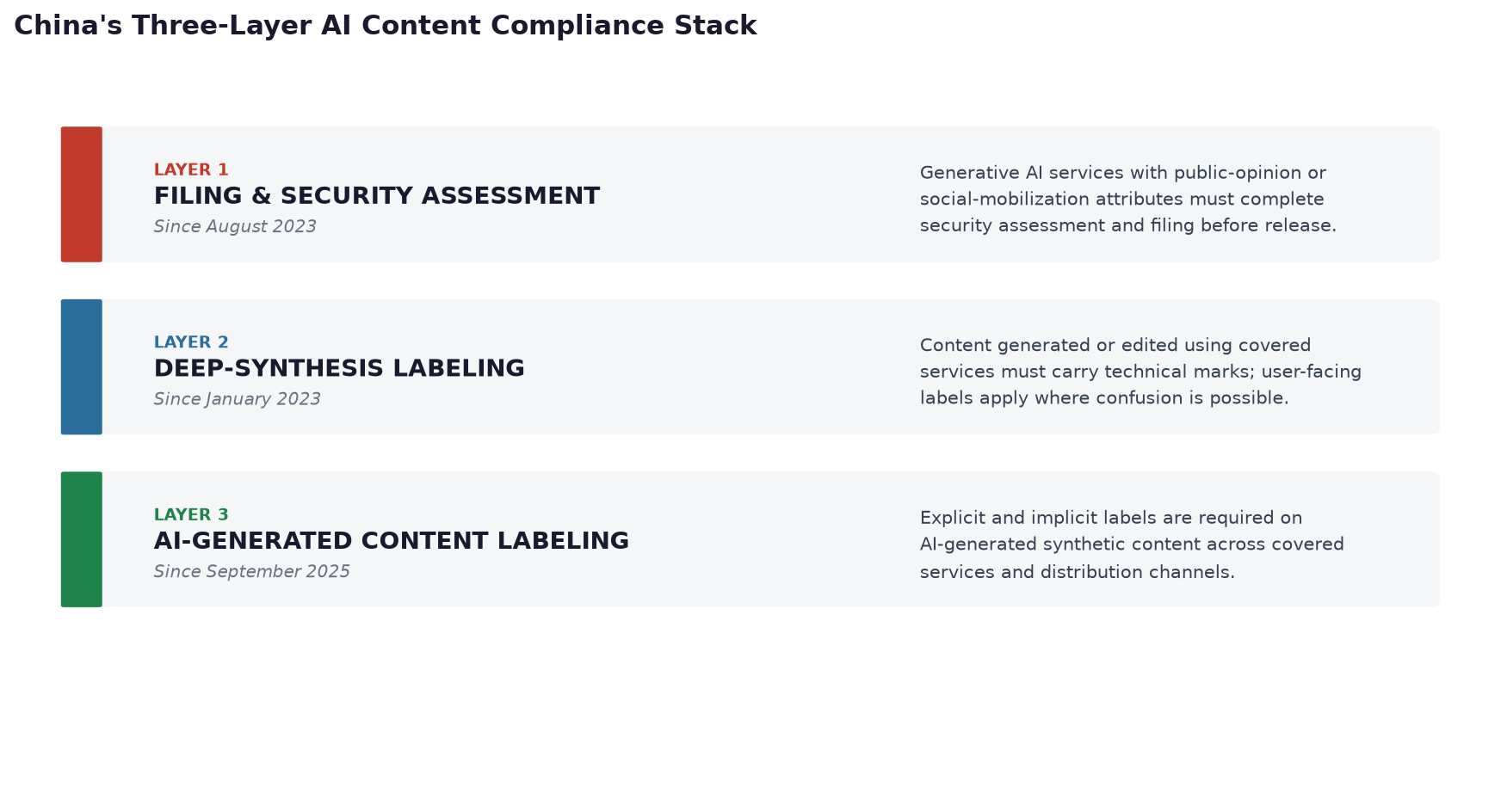
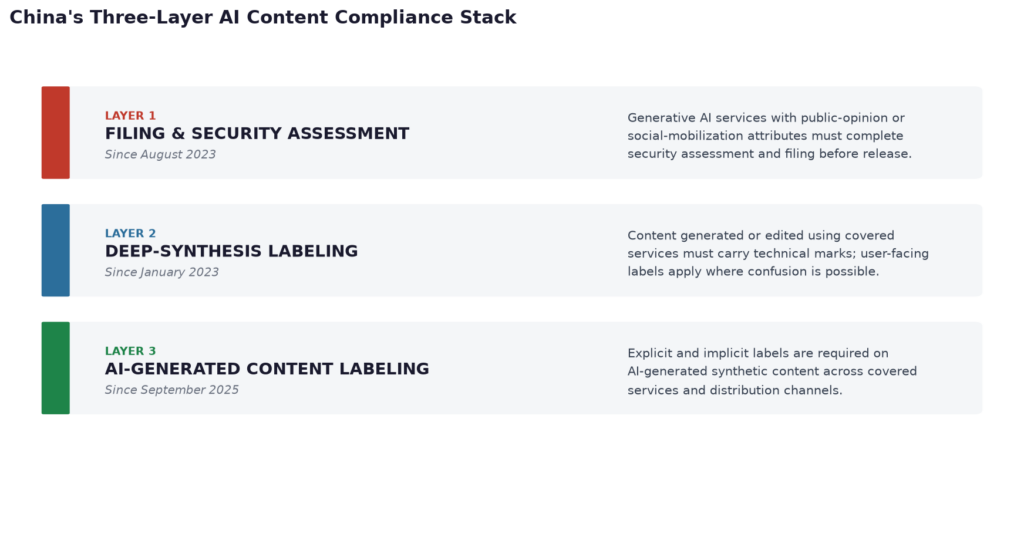
Consider how long this framework has been running. China’s generative AI filing regime has been in force since August 2023. Its content labeling rules have been layering on top of that foundation since early 2023 and again in September 2025. That is not a temporary clampdown. It is a permanent operating environment — and the market has simply absorbed it and kept building.
That is the headline most Western teams keep misreading. China is not choking its AI ecosystem. It is making traceability the price of entry, and the market has paid it and moved on.
What the Filing System Actually Does
Let us strip away the politics and look at the mechanism. Under the Interim Measures for the Management of Generative AI Services, in effect since August 2023, a generative AI service offered to the public in China has to complete a security assessment and an algorithm filing before release — but here is the nuance most summaries get wrong: this obligation applies to services with public-opinion attributes or social-mobilization capacity.
That qualifier matters more than it looks. Chatbots, content generators, and any tool that can shape what people read and believe almost by definition carry public-opinion attributes. So in practice the gate covers consumer-facing generative AI, even if the letter of the law is narrower than ‘every model must file’.
What does filing actually require? A declaration of who operates the service, what the model does, and where its data comes from. It is less a license to speak and more a requirement to be legible. For a marketer, the practical meaning is straightforward: in China, an AI tool that cannot explain itself does not ship. That single rule cascades through everything downstream — content, citations, brand claims, and ultimately what an AI answer engine is willing to repeat about you.
Traceability as a Feature
The part Western observers dismiss as bureaucracy is actually the part worth copying. Traceability — the ability to trace a claim back to its source — has been treated as a compliance burden. China has quietly turned it into a product feature.
Think about what this regime does to the supply chain of information. Every filed service has to know what data it was trained on, how it was evaluated, and how its outputs are marked. That means the humans feeding those systems have to keep records. Claims become auditable. Auditable claims are the raw material that AI answer engines are built to prefer, because a model can only cite what it can verify.
For global marketers, this is the insight that matters most. You do not need a regulator to tell you to make your content traceable. You can do it voluntarily — and you should, because traceability is exactly the quality that determines whether an AI assistant quotes you or skips you.
Why Trust Becomes the Ranking Signal
Here is the shift most teams still have not internalized. Traditional search ranked pages. Generative engines rank claims.
When a user asks an AI assistant a question, the assistant is not selecting a URL to display. It is assembling an answer from fragments of content it judges to be reliable. That judgment is a trust calculation. Sources with clear authorship, verifiable data, and consistent records win. Sources that cannot be checked get dropped, no matter how clever the optimization was.
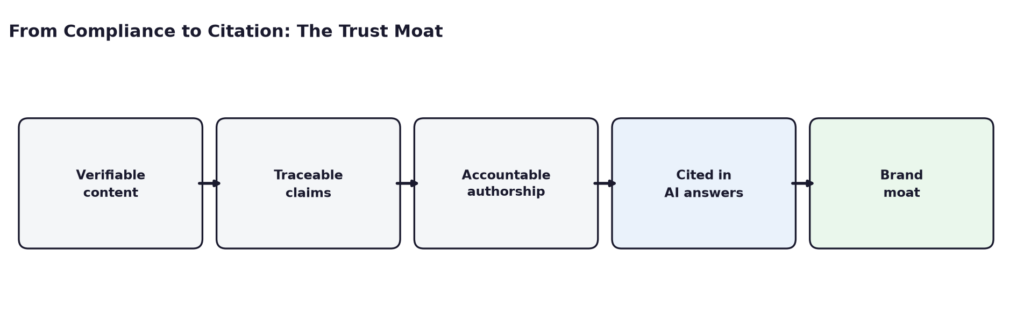
China’s regulatory push accelerates this exact dynamic. When filing, labeling, and auditability are mandatory, the entire ecosystem gets dragged toward verifiability — and verifiability is the new ranking signal. You can think of trust as the moat that compliance digs for you. The market does not reward the trickiest content anymore. It rewards the most checkable content.
Lessons for Global GEO Practice
Generative engine optimization — getting cited by ChatGPT, Perplexity, Gemini, and the rest — is still young enough that many teams treat it like an SEO loophole hunt. China’s experience suggests a different playbook.
The first lesson is that scale follows structure, not the other way around. China did not wait for a mature market to impose rules; it imposed rules and watched the market mature inside them. The second lesson is that disclosure compounds. A label, a source, an author byline — each small act of transparency makes the next one cheaper and the whole asset more citable.
The third and least comfortable lesson is that the shortcut economy is shrinking. Every trick that works by hiding something — fake citations, mass-generated thin content, undisclosed AI text — is precisely what both regulators and answer engines are learning to detect and discard.
Disclosure Is Not Optional Anymore
If you still think of disclosure as a nice-to-have, you are already behind. China now requires AI-generated synthetic content to carry both explicit and implicit labels, building on deep-synthesis labeling rules that date back to January 2023. The direction is one way: more labeling, not less.
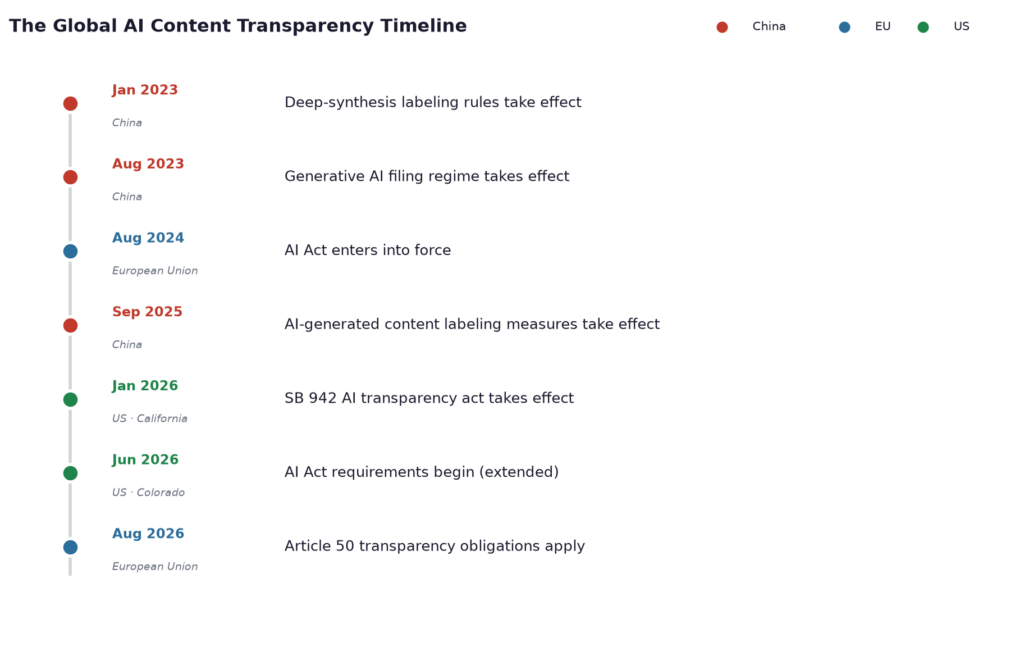
The same current is moving through Western markets, and the dates are now concrete. The EU AI Act entered into force in August 2024, and its Article 50 transparency obligations — the ones that require AI-generated content to be identifiable and machine-readable — apply from August 2026. California’s transparency act takes effect in January 2026. Colorado’s AI Act, whose start date was pushed back, is now set to begin by June 2026.
The pattern is unmistakable. Disclosure is converging across jurisdictions, which means it is rapidly ceasing to be a differentiator and becoming the baseline. Marketers who bake disclosure in now will be running ahead of the regulation instead of chasing it.
The Risk of Black-Hat GEO
Every new channel attracts the same temptations, and GEO is no exception. Prompt injection, hidden instructions meant to nudge a model toward a brand, mass-generated pages designed to look authoritative, fake statistics with no source — these are the black-hat moves of the AI answer economy.
They are also a losing trade, and China’s crackdown shows why the bet is worse than most realize. Black-hat tactics work only in a system that does not verify. The entire direction of the AI ecosystem — in China and globally — is toward verification. Filing, labeling, provenance, audit trails: each one closes a gap that black-hat techniques depend on.
When you optimize for the loophole, you build an asset that depreciates the moment the loophole closes. When you optimize for trust, you build an asset that appreciates as verification gets stricter. That asymmetry is the whole argument in one sentence.
Building a Compliance-First Content System
None of this is abstract. You can build a content system that is compliance-first in a few concrete moves, and every one of them also happens to be good GEO practice.
First, attach a named author and a publication date to everything you publish. Anonymous, undated content is the first thing an answer engine drops. Second, cite primary sources — government reports, peer-reviewed studies, official statistics — not blog posts quoting blog posts. Third, state numbers precisely and keep a changelog when they update. Fourth, label AI-assisted content honestly rather than pretending it is purely human.
The trick is to stop treating these as chores. Each one is a trust signal you are handing to the systems that decide whether to quote you. Build them into the workflow once and they become free forever after.
What Western Teams Keep Missing
There is a specific blind spot worth naming. Western marketing teams tend to see Chinese AI governance as an outlier — a heavy-handed local experiment with no bearing on their own markets. That framing gets it exactly backwards.
What China is doing is running the experiment first. The questions it is answering — how do you make AI output auditable, how do you label synthetic content, how do you keep bad actors out of the answer layer — are the same questions every other major market is now answering with a slight delay. The EU, the US states, and a growing list of countries are writing versions of the same rules.
The teams that win will be the ones who studied the early data instead of dismissing it. China is not a cautionary tale. It is a preview.
A Global Marketer’s Compliance Map
If you are marketing into both China and the global market, here is the map that matters. The specifics differ, but the spine is identical.
In China, the bar is filing for public-opinion services, deep-synthesis labeling, and explicit-plus-implicit AI content labels. In Europe, it is the AI Act’s transparency and machine-readability obligations, applying from August 2026. In the United States, it is a fast-moving set of state laws — California in January 2026, Colorado by June 2026 — layered on top of evolving federal guidance. Everywhere, the direction points toward the same three words: verifiable, traceable, accountable.
Your playbook does not change across borders. Publish named, dated, sourced, honest content. Label AI output. Keep records. The market with the strictest rules today is simply showing you where the rest are heading tomorrow.
The Long Game: Moat, Not Hack
Step back and the whole picture comes into focus. The marketers who are treating GEO as a new set of tricks to reverse-engineer are playing a short game in a channel that rewards the long one.
Compliance has a compounding effect that hacks cannot match. Every verifiable claim you publish makes your domain a little more trustworthy to the models that cite it. Every honest label makes the next piece of content slightly easier to believe. Over quarters and years, that compounds into something no black-hat trick can reproduce: a brand that answer engines treat as a source of truth.
China’s regulators understood something the market is only now discovering. The durable moat was never the algorithm. It was always the audit trail.
What to Do This Quarter
Here is where to start, in order.
One, audit your current content for verifiability. If a claim has no named source, either find one or cut the claim. Two, add authorship, dates, and primary citations to your ten highest-value pages. Three, write out a disclosure policy for AI-assisted content and start using it this month — before the 2026 labeling obligations land in the EU and US states. Four, build a fact sheet with your core statistics and their sources, and keep it updated; this single asset is the easiest way to become quotable.
None of this requires waiting for regulation. That is the point. The moat is available right now, and it costs less than the hacks you were about to buy.
The Bottom Line
China’s AI rules are not red tape. They are an early implementation of where the whole industry is going: an answer economy where verifiable, traceable, accountable content wins. Global marketers who read the pattern correctly will stop chasing tricks and start building the trust that gets them cited. Compliance is not the tax you pay to play. It is the moat that keeps you in the game.