More Data, Less Trust: Why AI Email Keeps Missing
Every email marketer over thirty-five remembers the discovery. You could put {first_name} in a subject line and watch open rates move. It felt like cheating. For about eighteen months, it worked.
It stopped working somewhere around the time everyone started doing it. A merge tag is not personalization; it is a name-shaped hole in a template that would have gone to the whole list anyway. Subscribers figured that out faster than most marketing departments did. By the time brands were proudly announcing their “1:1 personalization strategy” while swapping names into identical creative, the audience had already filed the whole category under noise.
Then generative AI arrived, and the industry made a reasonable assumption: now we can finally personalize for real. Different copy for different people. Different offers. Different product recommendations. At scale, in minutes, for a fraction of what it used to cost.
The assumption was half right, and the half that was wrong is the half that costs you money.
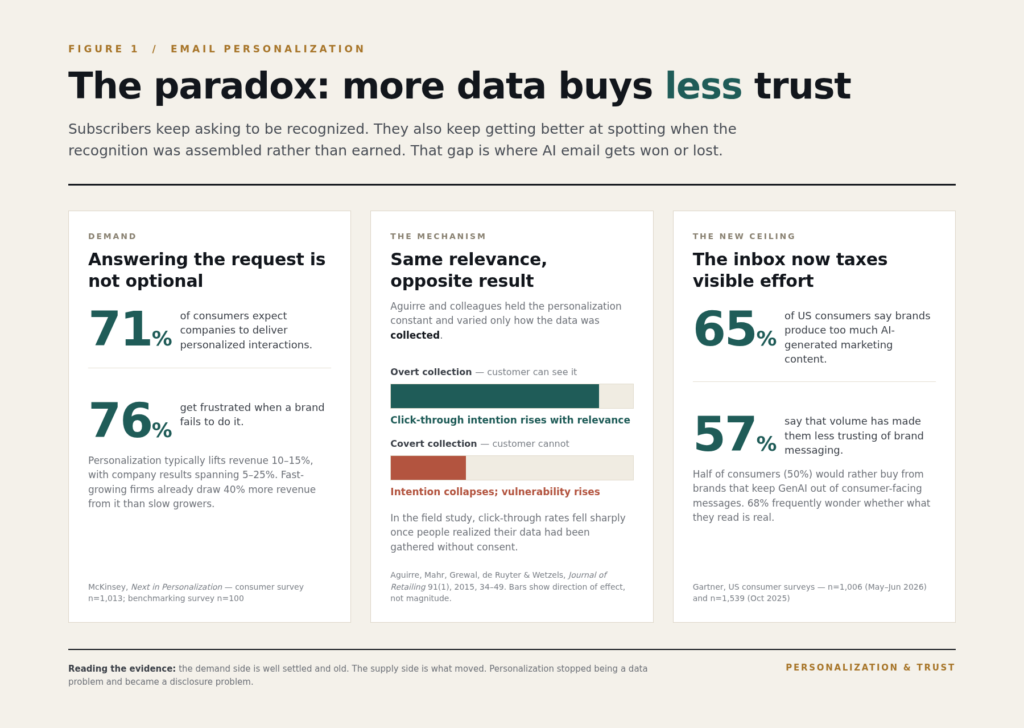
Here is the awkward finding. Gartner surveyed 1,006 U.S. consumers in mid-2026 and found that 65% believe brands are producing too much AI-generated content, while 57% say that volume has made them trust brand messaging less. Separately, in a survey of 1,539 U.S. consumers fielded in October 2025 and published in March 2026, half said they would rather give their business to brands that keep generative AI out of consumer-facing messages and advertising altogether.
Read those two findings together and the picture gets uncomfortable. The tool that was supposed to fix shallow personalization has produced a second, subtler version of the same problem: email that is personalized in every technical sense and still feels like it was written for nobody.
That is the whole argument of this piece. AI did not make personalization easy. It made relevance easy and trust harder, and most teams optimized for the half they could measure.
First, the Old Personalization Deserved to Die
Let us be fair to the merge tag. It was not stupid. It was cheap, it did lift engagement, and in a world of batch-and-blast it was a genuine improvement.
It failed for a structural reason: it personalized the address, not the reason. A subscriber who gets “Hi Sarah” above a generic spring sale banner learns precisely one thing — that the brand knows her name was typed into a form. The moment every competitor does the same, the signal carries no information. It becomes the email equivalent of a form letter with a fountain-pen signature.
Segmentation was the next attempt, and it was better but still blunt. Interest-based segments, engagement tiers, lifecycle stages — all real improvements, all still decisions made about groups. The individual received a message designed for a cohort. When the cohort is broad enough to be worth building, it is broad enough to be recognizable as a cohort.
The consequence was a measurable decline in engagement that the industry spent a decade explaining away with deliverability theories. But something else happened underneath the metrics, and it is the part that matters here: subscribers stopped expecting email to be good. Email became the channel you tolerate because the receipt is in there somewhere.
Which is why the AI moment looked like a rescue.
What AI Genuinely Changed — and What It Did Not
Let us give the technology its due, because the capability shift is real and it is not small.
Content can now be genuinely individual. Not just a swapped name, but different structure, different framing, different argument for different people. A lapsed subscriber with three past orders in one category and a first-time buyer in another no longer have to receive the same template with different product tiles.
Behavior can enter the copy, not just the targeting. Send time, frequency, and channel preference can be decided per person rather than per segment. The message can arrive when someone is actually receptive rather than when the campaign calendar says Thursday.
Prediction replaced reporting. Recommendation systems can surface what a person is likely to want next, rather than what people like them bought last quarter.
Production cost collapsed. Litmus found that only 6% of teams now need more than two weeks to produce an email, down from 62% in 2024. That is a genuine operational win.
Now the part nobody puts in the launch deck. Personalization, as a practice, was never really about the message. It was about the evidence — the implied claim that a brand has been paying attention. AI can manufacture the message. It cannot manufacture the attention. And subscribers are unusually good at telling the difference, because the difference shows up as a feeling, not a fact.
This is where the research gets interesting, because the mechanism has been documented for over a decade.
The Personalization Paradox, in Plain English
In 2015, Elizabeth Aguirre and her co-authors published a study in the Journal of Retailing that should be required reading for anyone building an AI personalization stack. They tested a simple proposition: does more personalization always help?
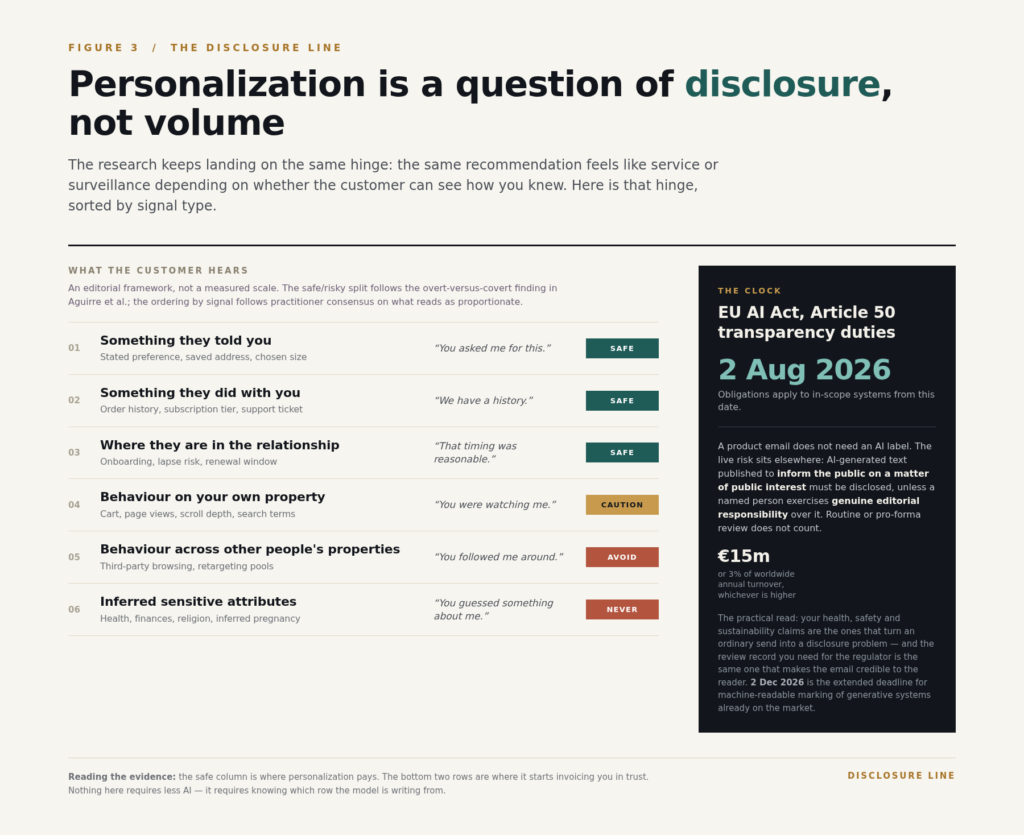
The answer was no, and the reason was not the amount of personalization. It was how the data got collected.
When firms collected information overtly — the customer could see it happening — more personalization produced more click-through intention. Relevance worked as expected.
When firms collected information covertly, the same relevance produced the opposite result. Click-through rates fell sharply once people realized their data had been gathered without their knowledge. The authors named the mechanism: perceived vulnerability. Not a privacy objection in the abstract, but a specific, affective discomfort at suddenly understanding you had been watched.
Sit with how precisely that maps onto AI email. The model does not know more about your subscriber than your CRM does. But it assembles that knowledge in a way that feels discovered rather than received. “We noticed you were browsing running shoes at 11 p.m. on Tuesday, so here are three options” is technically excellent personalization and socially alarming, because it reveals the observation rather than the conclusion.
The fix from that study was not less data. It was transparent collection and trust signals — visible reasons, credible context. Which is a design decision, and a copy decision, and almost never a model decision.
The Robotic Trap Has Three Doors
Teams keep walking into the same three failures, and they are worth naming separately because the fixes are different.
Door one: the surveillance tell. The email demonstrates what you know. This is the Aguirre effect with better grammar. It reads as competence to the person who built the data pipeline and as a threat to the person receiving it. The tell is usually specificity about observation rather than need: “we saw you looking” instead of “here is the thing you were looking for.”
Door two: the uncanny warmth. AI writes enthusiasm fluently and sincerity badly. The result is copy that is grammatically perfect and emotionally slightly wrong — a brand that says “we’re so excited to have you back!” to someone who has been a customer for six years and would prefer to be treated like an adult. Forced familiarity is worse than neutral distance, because it signals that the relationship is being performed.
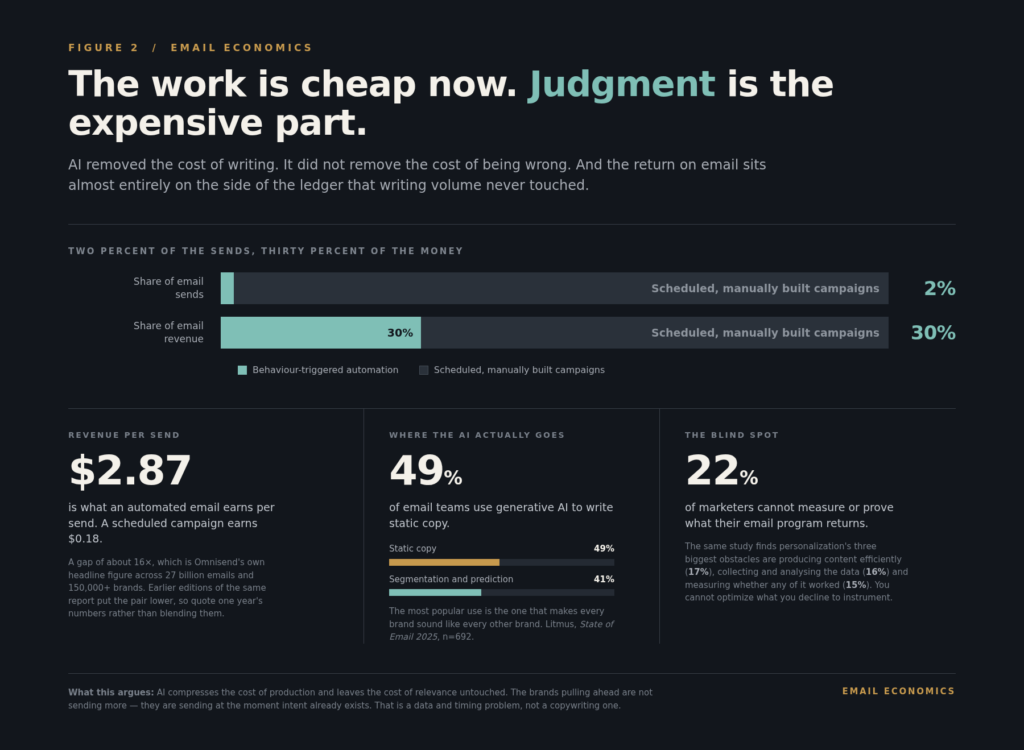
Door three: homogeneity. This is the one that quietly kills programs, and it follows directly from how the tools are actually used. Litmus reports that 49% of email teams use generative AI for static copy, while 41% use it for segmentation, behavioral prediction, and journey analysis. The majority use case is the one that makes every brand sound like every other brand, because everyone is prompting the same models with the same thin instructions and getting back the same warm, competent, indistinguishable register.
Stack door three on top of the Gartner numbers and the mechanism becomes obvious. If 65% of consumers think there is too much AI content and 57% trust brands less because of it, the problem is not that AI wrote the email. It is that the email sounds like the AI wrote it — and everyone can hear it.
The Playbook: Six Rules That Survive Contact With a Real List
None of this argues for going back to merge tags. It argues for spending your effort in a different place.
1. Personalize the reason, not the greeting
The question your email should answer is “why is this relevant to me,” not “what is my name.” A subject line that states a fact about the recipient’s situation outperforms one that states a fact about their identity. Relevance is a claim about their life; a name is a claim about your database.
2. Restrain the signal to what a good salesperson would say out loud
This is the most useful test I know. Imagine a human account manager with full access to the same data. Would they walk up and say “I saw you were on the site at midnight”? Of course not — not because they lack the information, but because a competent human understands which knowledge to use and which to reveal. Your model has no such instinct. You have to supply it as a rule.
A workable hierarchy: stated preferences and purchase history are safe. Lifecycle position is safe. On-property behavior needs care and a reason. Cross-site behavior and inferred sensitive attributes should be off the table entirely, and in the EU some of them are, legally.
3. Write voice-first prompts, not data-first prompts
A brand voice is a specification: vocabulary, sentence rhythm, what you never say, how you handle an apology, whether you use contractions. Hand a model a full voice spec and thin data, and you get something that sounds like you talking to a stranger. Hand it rich data and no voice spec, and you get something that sounds like a stranger talking to you specifically. The second is the failure mode everyone is currently shipping.
4. Choose specificity over flattery
“Your order arrives Friday” beats “we value you so much.” Flattery is the cheapest thing a language model can produce, which is exactly why it now reads as worthless. Specific, verifiable, useful statements are harder to generate and much harder to fake, and subscribers have learned to price them accordingly.
5. Keep a human lane for the emails that carry relationship risk
Re-engagement to a lapsing high-value customer. An apology after a service failure. Anything touching money trouble, health, or grief. These are the emails where being slightly wrong is expensive, and they are also the emails where AI’s failure modes are most visible. Automate volume; write the exceptions by hand. Litmus found that teams achieving the highest email ROI — 36:1 to 50:1 — dedicate 25–50% of their marketing headcount to email. The correlation is probably not accidental.
6. Instrument “feels human,” not just “was opened”
Open rate is close to useless as an absolute measure now. Apple’s Mail Privacy Protection preloads tracking pixels, and Litmus’s client market-share data puts Apple Mail somewhere above half of all opens, which means reported open rates are inflated by double digits for most lists. Click-through is better. Revenue per send is better still. But none of them measures the thing you actually care about, so add a qualitative channel: reply sentiment, “this felt automated” complaints, and unsubscribe reasons coded by hand once a quarter.
There is a hard number that makes this concrete. Omnisend analyzed 27 billion emails across more than 150,000 brands and found that behavior-triggered automations accounted for roughly 2% of sends but around 30% of email-attributed revenue, earning $2.87 per send against $0.18 for scheduled campaigns. The lesson is not “automate more.” It is that intent-timed relevance beats volume by an order of magnitude, and intent timing is a data problem, not a writing problem.
The Line You Cannot Prompt Your Way Around
Two things are converging on email teams at once, and they point in the same direction.
The first is consumer skepticism. The same Gartner survey of 1,539 U.S. consumers, fielded in October 2025, found that 68% frequently wonder whether the content they see is real, and 61% frequently question whether the information behind their everyday decisions is reliable. Only 27% said they still judge truth by intuition. People are checking.
The second is law. The EU AI Act’s Article 50 transparency obligations applied from August 2, 2026, and the European Commission’s implementation guidelines draw the line somewhere marketers should study carefully. Ordinary commercial copy is generally out of scope — a product email does not need an AI label merely because a model helped write it. But AI-generated text published to inform the public on a matter of public interest must be disclosed, and the exemption only holds where a named party has exercised genuine editorial responsibility. Perfunctory review does not count.
Penalties run to €15 million or 3% of worldwide annual turnover, whichever is higher.
Here is the part that makes this more than a compliance chore. The documentation the regulation demands — who reviewed this claim, what they verified, when — is the same documentation that makes an email feel written by a person. A brand that can show its work tends to have work worth showing. The compliance file and the voice guide are, in practice, the same artifact.
One practical example is worth flagging. A health, safety, or sustainability claim is where an ordinary promotional send turns into a disclosure problem. Those are precisely the emails where the regulatory record and the credibility of the copy are the same thing.
Where This Goes Next
Three shifts are worth planning against, and none of them are about generating more email.
Email becomes a conversation, and conversations cannot be batch-produced. Salesforce’s tenth State of Marketing report, drawn from 4,450 marketers in 26 countries, found that 83% see customers wanting two-way dialogue, while 69% admit they struggle to respond promptly and 84% still run campaigns they describe as generic. The gap is not a content gap. It is a context gap: only 58% of marketing teams have full access to service data, 56% to sales data, 51% to commerce data. You cannot hold a conversation with someone whose history you cannot see.
The batch send becomes the exception. Agentic systems that trigger on intent, rather than calendars that trigger on dates, invert the economics shown above. The 2%-of-sends, 30%-of-revenue split is a preview, not an anomaly.
Human voice becomes the premium signal. As AI-generated copy saturates the inbox, verifiable human judgment becomes the thing that gets opened. Gartner’s September 2026 survey found that 35% of consumers now rely on influencers less because of AI-generated content, while 43% rely more on real people. That is not nostalgia. It is a market repricing authenticity because supply collapsed.
What I Would Actually Do on Monday
Start with an audit, not a tool. Pull your last twenty emails and mark each one: does it reveal observation or deliver relevance? Is there a reason stated for why this person is receiving it? Would a good account manager have said that sentence out loud?
Then write the voice spec before you write another prompt. One page: vocabulary you use, vocabulary you ban, how you open, how you apologize, three emails you are proud of and three you are not. This document will do more for output quality than any model upgrade, because it is the only thing that distinguishes your generations from everyone else’s.
Then move your budget from volume to timing. If 2% of sends produce 30% of revenue, the marginal dollar belongs in event architecture — cart, browse, renewal, lapse, restock — not in another campaign calendar.
And then pick the lane you will never automate. Write it down. Tell the team. The discipline of naming what stays human is what keeps the rest of it credible.
The Short Version
For fifteen years, email personalization meant inserting a name. AI made it possible to insert a reason instead, and most brands used the new capability to insert a name more elaborately.
The research is not ambiguous about why that fails. Relevance helps when the customer can see how you knew. It hurts when they cannot. AI has made the second case dramatically easier to produce at scale, which is why the same technology that should have rescued email is now generating the fatigue that threatens it.
The brands that win the next two years will not be the ones sending the most individualized email. They will be the ones whose individualized email is true — where the specificity is real, the voice is theirs, and the reason for sending is something the recipient would recognize as a fair reading of their own behavior.
Personalization was never a data achievement. It was a demonstration of attention. AI can fake the first. It cannot fake the second, and subscribers can tell.