AI Copy at Scale: The Quality Ceiling Marketers Keep Hitting
Everyone braced for the wrong disaster.
When the first wave of writing models arrived, the fear was that the copy would be bad — clumsy, hallucinated, obviously mechanical. Three years on, that fear looks almost quaint. The copy is fine. Grammatically immaculate. Structurally sound. Politely enthusiastic in exactly the way a competent stranger is enthusiastic about your business.
And that is the problem. Not bad copy. Correct copy. Copy that could belong to anyone, which means it belongs to no one.
I call this the quality ceiling: the altitude where output stops improving in the ways that matter and starts converging instead. You keep turning the crank. The words keep coming. And every sentence drifts a little closer to the same smooth, frictionless, unobjectionable middle.
The ceiling is not a technical failure. It is an economic one. And it arrives with a bill.
Section 1 — The Quality Ceiling: What It Is and Why It Happens
The ceiling is easiest to see from the outside. Walk through five competitor sites in the same category and read the hero sections in sequence. They will not be identical. They will be interchangeable — which is worse, because interchangeability is invisible to the person who produced it and obvious to the person who receives it.
Three forces push AI copy toward that middle, and only one of them is the marketer’s fault.
A Note on What the Numbers Can and Cannot Tell Us
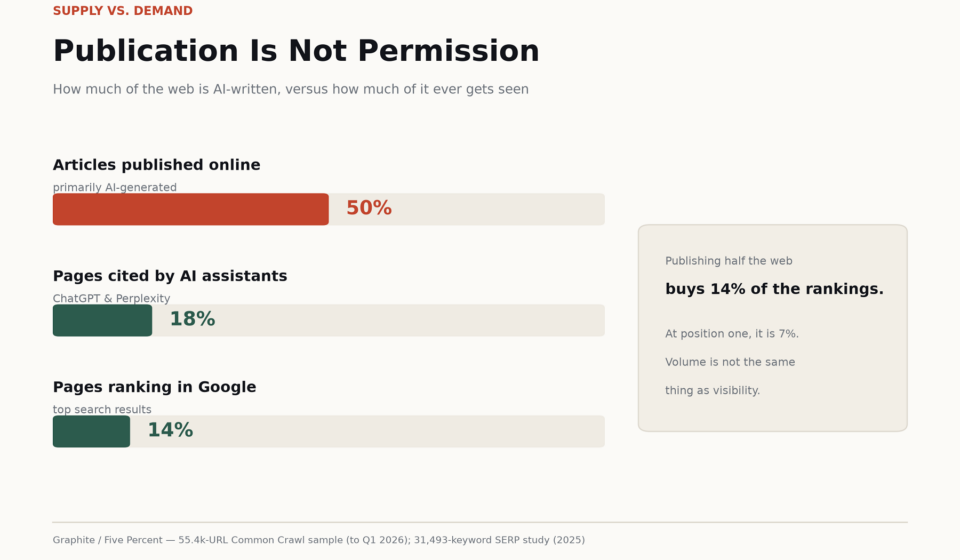
Graphite’s Five Percent research tracks a 55,400-URL sample from Common Crawl using three independent AI detectors — Pangram, Copyleaks and GPTZero — each validated at under 2% false positives. It puts primarily AI-generated articles at roughly half of everything published online: 50.9% in the fourth quarter of 2025, settling to 49.9% in the first quarter of 2026.
Read that as a directional signal, not a census. The methodology has real limits. Pre-ChatGPT articles stand in for “human,” detection tools disagree at the margins, and the study deliberately excludes AI-drafted-then-human-edited work — which is probably the larger category and, as we will see, the more interesting one.
The same research team asked a sharper question: does all that volume get seen?
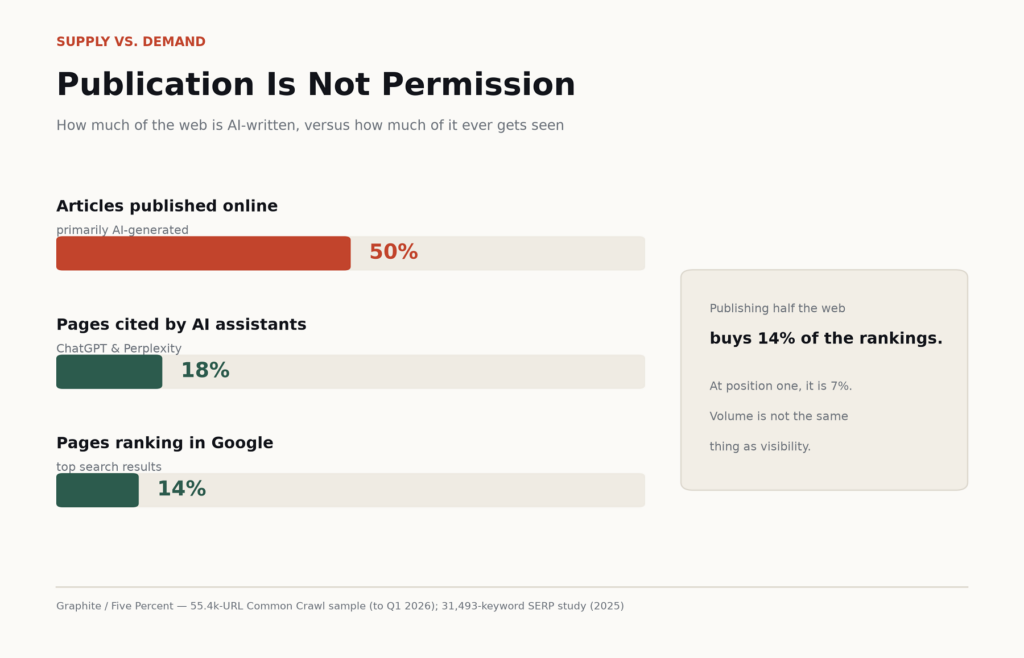
No. Fourteen percent of articles ranking in Google are machine-written. Eighteen percent of the pages ChatGPT and Perplexity cite. And at the very top of the results page — position one, where the actual money is — seven percent.
So here is the strange shape of the market. We are publishing at a scale no human industry has ever managed, and the visibility curve is nearly flat. Half the supply. A seventh of the reward.
The first force is statistical. A language model predicts the next most likely token. The most likely token is, by definition, the average of everything the model has read. Ask for a product description and you are asking, in a very literal sense, for the middle of the distribution. Distinctiveness lives in the tails. The model has been optimised to avoid the tails.
The second is institutional caution. Models are tuned to be helpful, harmless and inoffensive, and “inoffensive” carries a stylistic cost. Hedged claims. Balanced framing. Superlatives that assert nothing — cutting-edge, innovative, world-class — because a superlative is safe and a specific number is a liability. The model is not being lazy. It is being careful. Careful reads as bland.
The third is us. Most briefs say “write a compelling product description,” and most briefs get the same description, because a prompt with no particular in it can only produce output with no particular in it. The model is a mirror with a delay. Point it at nothing and it reflects nothing.
The Experiment That Explains the Paradox
In 2024, Anil Doshi and Oliver Hauser published an experiment in Science Advances that deserves a place on every content team’s wall. Writers produced short stories, some with ideas supplied by a language model, some without. Independent judges rated the AI-assisted stories more creative, better written and more enjoyable — particularly when the writer was less skilled to begin with.
Then came the second finding. The AI-assisted stories were measurably more similar to each other.
Individual creativity up. Collective diversity down. Everyone gets a little better and the shelf gets a little narrower.
That is the quality ceiling in one paragraph, and it is not a story about technology. It is a story about a commons being quietly enclosed. Each writer is acting rationally. The aggregate result is a monoculture nobody chose.
Section 2 — The Tell-Tale Signs of AI-Generated Copy
You can train your ear. Generic copy has a signature, and once you know it you hear it instantly.
Look for the runway. “In today’s fast-paced world.” “In an era where.” “As businesses increasingly.” These are not openings. They are taxiing.
Look for the adjective pile-up. “Cutting-edge, innovative, revolutionary solutions” is three adjectives doing the work of zero nouns.
Look for nominalisation — the habit of turning verbs into abstractions until nothing moves. “Optimisation of the customer experience” instead of “make the thing easier to use.” One of those is a sentence. The other is a filing cabinet.
Look for the missing number. Real copy has specificity in it: a customer name, a dated result, a refusal, a price. Generic copy has none, because the model cannot invent what it does not know and will not volunteer what it cannot verify.
And look for the absence of a position. Does this copy argue anything? Would a competitor be annoyed by it? If the answer is no, you have written something that cannot lose, which is another way of saying it cannot win.
None of these signs is proof of machine authorship. That is the point. They are proof of machine register — and register is what readers actually react to.
Section 3 — Why the Ceiling Is a Real Business Problem
Klaviyo and Datalily surveyed 8,000 consumers across eight markets in December 2025. The results should end any remaining debate about whether this matters.
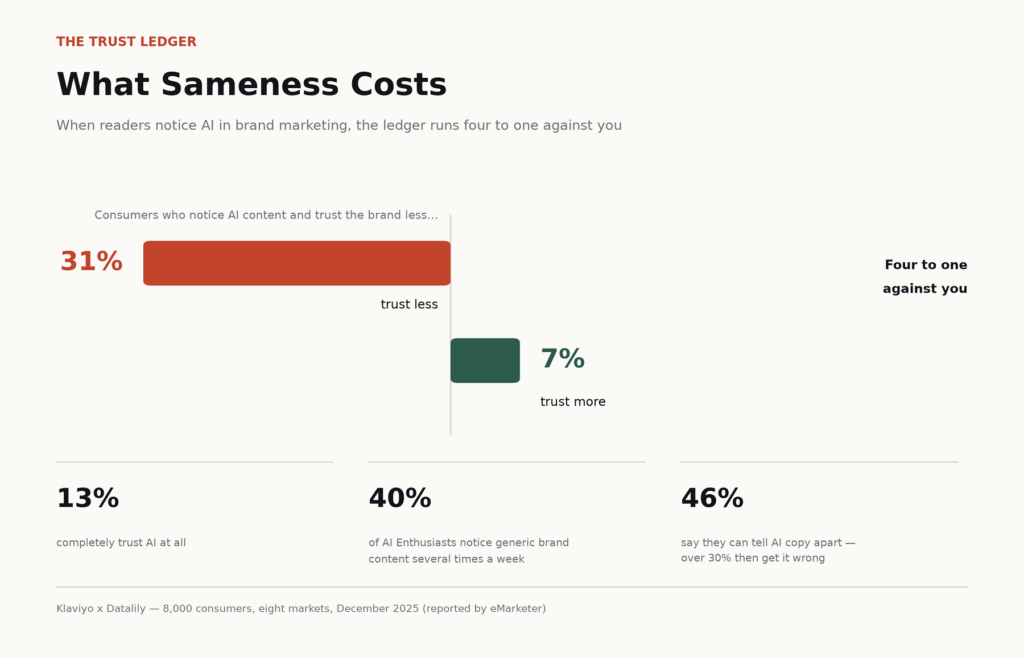
Thirty-one percent said spotting AI-generated content made them trust a brand less. Seven percent said it made them trust the brand more. Four to one, against you. Not because the copy was bad — because it was legible as machine output, and the reader felt the absence of a person behind it.
Only 13% said they completely trust AI at all. Forty percent of AI Enthusiasts — the most frequent users in the survey — said they encounter generic “AI slop” from brands several times a week. The most sophisticated audience is the least forgiving, which is the opposite of how most content strategy is built.
And there is a second, quieter number. Forty-six percent said they were confident they could tell AI writing apart; in the same body of research, more than 30% then wrongly identified a human-written customer service reply as machine-generated, and more than half assumed a real photograph was synthetic. The people who feel certain are the people most likely to be wrong.
The Paradox of Scale
Here is the trap, stated plainly.
Scaling generic content does not compound your brand. It dilutes it. Brand equity is built on recognition; recognition requires difference; difference is precisely what the machine is trained to smooth away.
You can publish a thousand pages that sound like everyone else’s thousand pages, or a hundred that sound like you. The first option feels like progress. Your dashboard will even agree with you for a while — impressions climb, sessions tick up, the line goes the right way. What never appears in the dashboard is the slow erosion of the one asset that makes any of it work.
And the search engines stopped rewarding the volume play anyway. Google’s March 2024 spam policy on scaled content abuse applies “no matter whether content is produced through automation, human efforts, or some combination of human and automated processes.” The violation is not the tool. It is the absence of value at volume. Same verdict, different judge. When machine-written pages do surface, they rank lower than human-written pages matched to the same keyword.
Section 4 — Breaking the Ceiling: The Playbook
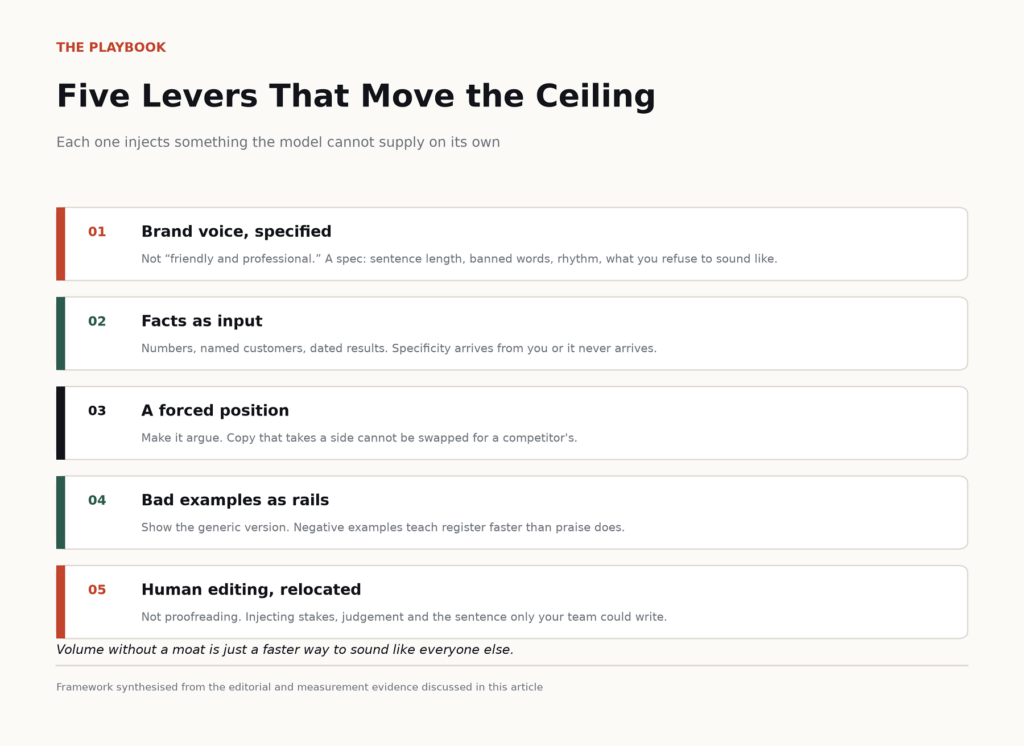
Five levers, in rough order of leverage. None of them requires better tools. All of them require better inputs.
Lever One: A Voice Spec, Not a Vibe
“Friendly and professional” is not a brand voice. It is a mood board. It produces copy that is friendly and professional in the way every other brand is friendly and professional, which is to say: invisible.
A voice spec is a set of constraints specific enough to be disobeyed. Sentence length, with a target and a ceiling. Words you ban outright. Words you overuse on purpose. Whether you use contractions. Whether you are allowed to be funny, and at whose expense. What you sound like when you are wrong — because a brand that cannot apologise in its own voice never had one.
The test of a good spec: hand it to two writers and get two pieces that could not be swapped. If they come back interchangeable, you wrote a style guide, not a voice.
Lever Two: Feed It Facts It Cannot Invent
Generic copy is starving for specificity, and specificity has to be imported.
Not “improved efficiency” — “cut invoice processing from eleven days to four.” Not “trusted by leading brands” — the actual name of the actual customer and the actual quarter. Not “designed for modern teams” — the specific thing about modern teams that makes the old tool fail.
This lever is self-enforcing, which is why I like it. A sentence containing a verifiable, dated, attributed result cannot be generic. It is too specific to be anyone else’s. You get anti-sameness for free, as a side effect of honesty.
Lever Three: Force a Position
Ask the model to argue. Not to describe, not to summarise, not to “highlight the benefits” — argue.
Copy with a stance cannot be swapped between competitors, because a stance is a claim about the world and competitors live in a different part of it. If your copy says the industry has been measuring the wrong thing for a decade, exactly one brand can say it.
Most marketers flinch here, and the flinch is expensive. Neutral copy is safe in the way a blank page is safe.
Lever Four: Use Bad Examples as Guardrails
We spend all our time showing models what good looks like. Show them what bad looks like instead.
Paste in the three worst paragraphs from your category — the ones that make you wince — and instruct: never sound like this. Negative examples cut sharper than positive ones because they teach a boundary rather than a target. “Write beautifully” is unfalsifiable. “Never open with a line about the fast-paced world” is a rule.
Every team should keep a hall of shame. It is the cheapest brand-voice asset you will ever build, and it gets more valuable as the models get better at imitating what everyone else already does.
Lever Five: Move the Human, Don’t Remove Them
This is where most AI-copy advice goes wrong. It treats the human as a proofreader.
Proofreading is the least valuable thing a person can do to machine output, because the machine already spells better than you do. The human contribution is not correction. It is the injection of stakes — the thing you know because you were in the room, the detail that only makes sense if you have used the product, the sentence that carries a small, deliberate risk.
Section 5 — The Human-AI Division of Labour
The old workflow was human writes, machine assists. The new one is messier, and better paid.
Let the machine handle the volume: product descriptions, variant testing, the routine pages that exist to be useful rather than memorable. Spend your people on the copy that has to be remembered, and give them enough time to make it strange.
The copywriter of 2026 is not a first-draft writer. They are an editor of machine output with an unusual mandate: to make it sound like a person with a point of view. That takes three skills that barely appeared in a job description five years ago. Prompting, which is really the discipline of specifying. Brand-voice curation, which is the work of deciding what your brand refuses to say. And editorial judgement, which is the capacity to look at fluent output and say: this is fine, and it is not us.
There is a warning buried in the research. A 2025 study from Microsoft Research and Carnegie Mellon, surveying 319 knowledge workers across 936 real examples of AI use on the job, found that higher confidence in AI was associated with less critical thinking. Workers shifted from generating their own analysis to verifying machine output — from problem-solvers to output-checkers. The skill that atrophies is the one you need most when the machine is wrong.
Section 6 — Where the Ceiling Goes Next
The ceiling is not fixed. It moves.
Regulation is arriving at the seam. The EU AI Act’s transparency obligations took effect in August 2026: text generated or manipulated by AI and published to inform the public on matters of public interest must be disclosed — unless it has undergone human review or editorial control with a named party holding editorial responsibility. Brussels has effectively written into law the distinction this article is arguing for. The presence of accountable human judgement is what separates publishable content from disclosed synthetic text.
The second shift is economic. As AI copy becomes the median, verifiably human, voice-driven copy becomes the premium. That is not nostalgia; it is supply and demand. Scarcity moves to whatever the machine cannot mass-produce, and the machine cannot mass-produce a specific opinion held by a specific person with something to lose.
The third is that fine-tuned, brand-native models will lift the ceiling for early adopters. A model trained on your own corpus produces more of your own register — which buys a lead, and then hands it to everyone else who does the same thing eighteen months later. Distinctiveness is a moving target. It always was.
The Takeaway
AI copy at scale solved a production problem and created a differentiation problem. A model trained on the statistical centre of human language will always return the centre of human language. That is not a bug; it is the specification.
Which leaves the question of who is responsible for the edges.
The brands that get through will treat AI as the volume engine and reserve their human capital for the one thing it cannot do: making copy that sounds like nobody else. Not because human writing is inherently better — plenty of it is worse — but because a person can decide to be specific, can choose to take a side, can risk being disliked. Those are choices, and a model optimising for the probable does not make them.
The ceiling is where the machine stops. Everything above it is a decision you have to make yourself.