The Day Your Brand Got Subtitled Instead of Translated
There is a specific silence that follows a China launch that hasn’t worked.
Not outrage. Not a boycott. Just a flat line. The site loads quickly. The copy is grammatical, reviewed by a native speaker and signed off across three time zones. The campaign has the right specs for every placement. And then nothing happens: no spike, no backlash, no story. Just a market that received the message politely and declined to care.
Headquarters draws the wrong lesson. They decide China is hard, that local competitors are irrationally cheap, that consumers there are “different.” All three statements are partly true. None of them is the reason.
The reason is simpler and more expensive: they translated their brand. They didn’t enter the market.
The Trap, Stated Plainly
Call it the localization trap. A company invests in surface adaptation — Chinese copy, a Chinese domain, a local celebrity cut into the global spot — and because that work is visible, it gets confused with the work that matters. Everyone in the approval chain can see the translation. Nobody in the approval chain can see the absence of a Chinese consumer journey.
So the trap closes quietly, in three steps. You localize the layer you can review — and the layer you can review is the shallowest one. The market responds to the layers you skipped, and you read that response as evidence about the market rather than evidence about your approach.
That’s the whole mechanism. It isn’t laziness. It’s a measurement problem. Brands optimize what headquarters can inspect.
Why Translation Feels Like Progress
Here’s the uncomfortable part: translation is genuinely necessary, and it genuinely looks like a milestone.
There is a spreadsheet with 4,000 strings on it. There is a vendor. There is a review cycle. There are reviewers who read Chinese and can explain the difference between 转化率 and 转化量. Weeks pass. Money leaves. Something ships. Every signal inside the organization says we did the work.
But inside the market, the buyer never sees the spreadsheet. They see a page that reads like it was written by someone who has never queued for a milk tea at three on a Saturday, never cross-shopped a rival on Pinduoduo, never watched a livestream host hold a product up and say 想要的扣1 — type 1 if you want it.
Linguistic correctness is the floor of the building. It isn’t the building.
What the Language Data Actually Says
It’s worth being precise about what language buys you, because the evidence is more interesting than the cliché.
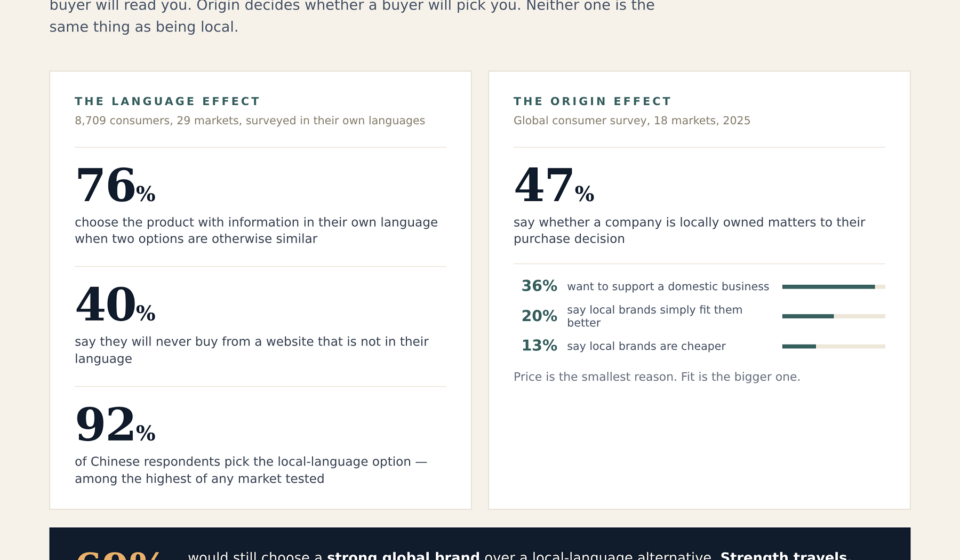
CSA Research surveyed 8,709 consumers across 29 markets, fielded by Kantar between late 2019 and early 2020. Seventy-six percent will pick the product with information in their own language when two options are otherwise similar. Forty percent say they will never buy from a website that isn’t in their language. Among Chinese respondents, 92% choose the local-language option — one of the highest readings in the study.
That sounds like a mandate for translation. It is one — for Layer One. But the same study found that 69% of consumers will still choose a strong global brand over a local-language alternative, and 75% say they’re more likely to buy from the same brand again if customer care is in their language. Read those figures together and the conclusion sharpens: language decides whether you get read, brand strength decides whether you get chosen, and service in their language decides whether you earn a second purchase.
Translation buys attention. It doesn’t buy preference. Those are separate budgets.
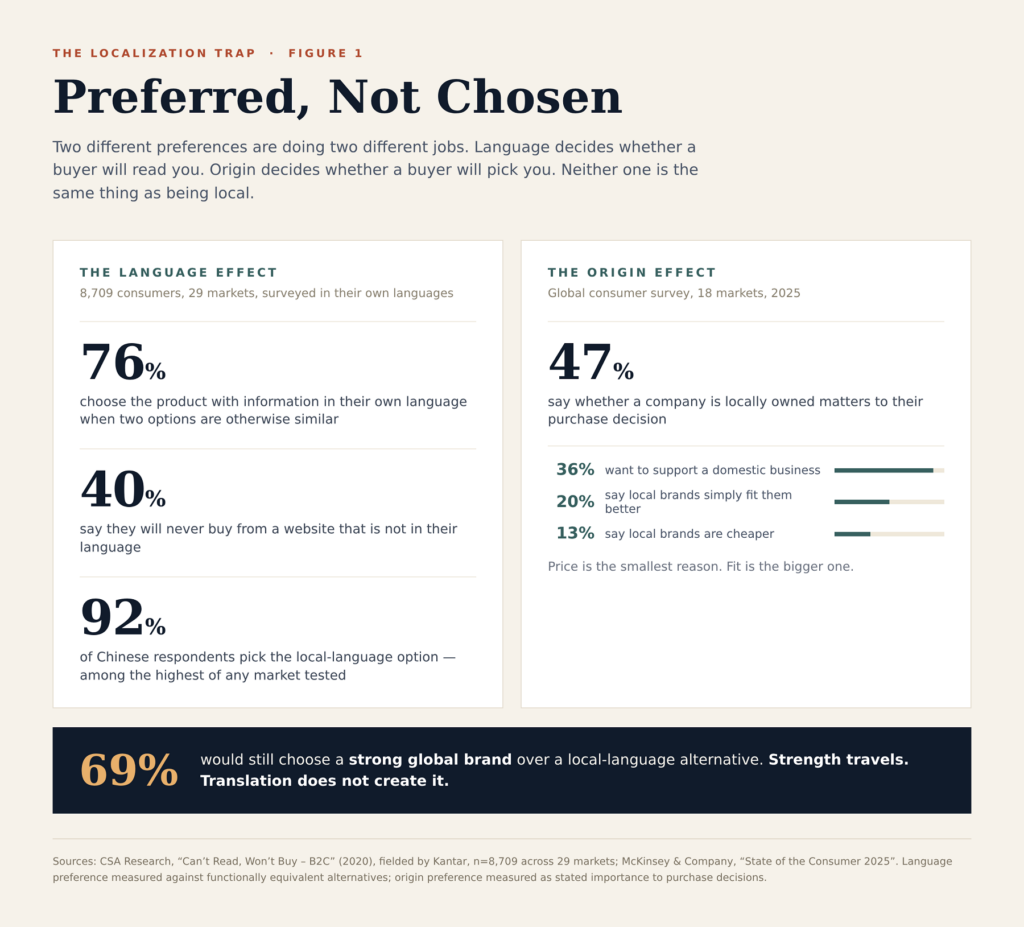
Meanwhile the preference for things that feel locally rooted is hardening, not softening. McKinsey’s State of the Consumer 2025 found that 47% of consumers globally say whether a company is locally owned matters to their purchase decision — and when asked why, 36% said they want to support a domestic business, 20% said local brands fit them better, and only 13% said local brands are cheaper. Price is the smallest reason. Fit is the bigger one.
In China the shift shows up in market share, not just sentiment: six of the ten fastest-growing beauty brands by share since 2020 are Chinese, against two between 2015 and 2020.
The Five Layers of Real Localization
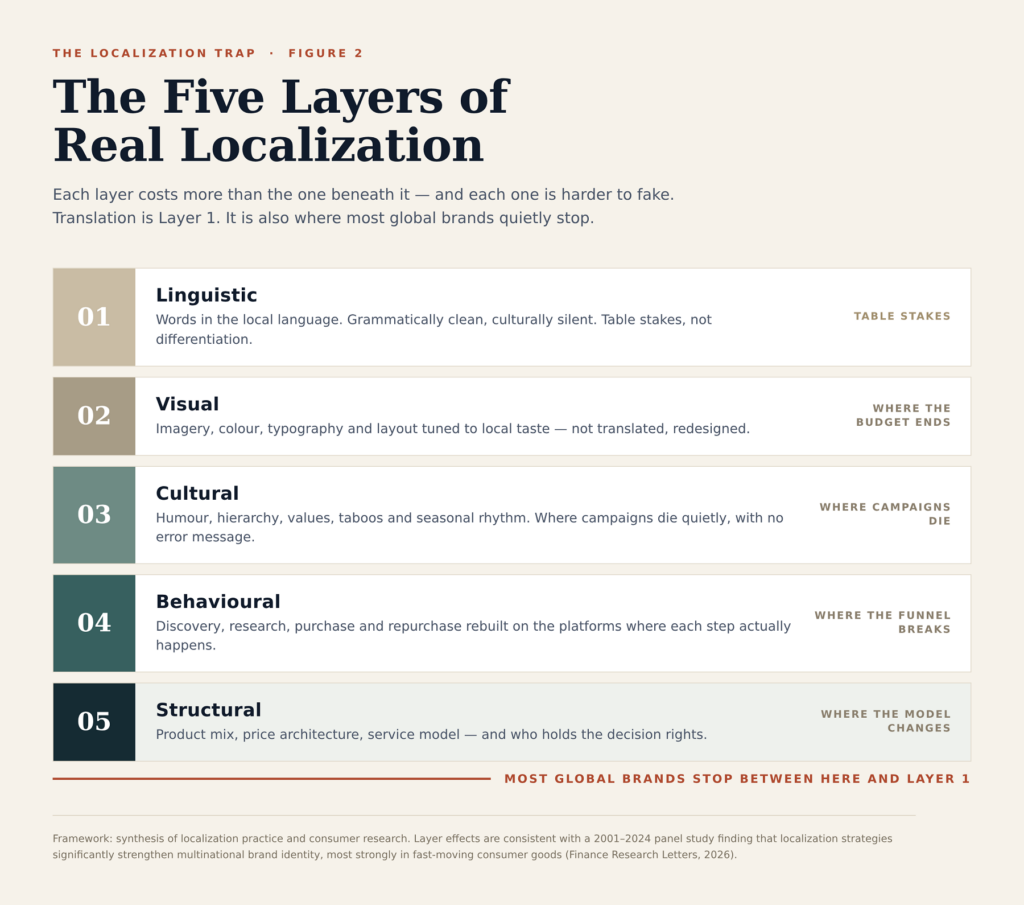
Localization isn’t a switch. It’s a depth scale, and every layer costs more than the one beneath it.
Layer One — Linguistic. Words in the target language. Necessary, insufficient.
Layer Two — Visual. Imagery, colour, typography, layout, crop ratios, and the amount of white space a market finds restful. This is where budgets usually stop, because it’s the last layer a headquarters art director can personally judge.
Layer Three — Cultural. Humour. Hierarchy. What reads as aspirational versus what reads as showing off. Which festival actually moves a category. Whether a joke about mothers-in-law lands as warmth or as an insult. Nothing here throws an error message; campaigns simply die quietly, and the post-mortem blames media buying.
Layer Four — Behavioural. The journey, rebuilt. Where discovery happens, where comparison happens, where the transaction closes, where the relationship continues afterwards. If your model assumes search engine to landing page to email nurture, and your buyer’s model is feed to search to group chat to livestream to repurchase, you haven’t localized. You’ve translated a funnel that doesn’t exist here.
Layer Five — Structural. The offer itself. Product mix, price architecture, pack size, service model, and the question nobody wants to raise — who holds decision rights. A direct-to-consumer brand built on a website, an email list and a subscription has to become something else to survive here. Not a translation of itself. A different machine with the same logo.
A Warning About Localization Theatre
Before the framework hardens into a slogan, one honest caveat: deeper is not automatically better, and localization for its own sake is its own failure mode.
A study in the Journal of Consumer Marketing tested Western against locally styled packaging with Chinese consumers and found something the researchers hadn’t expected. For hedonic products, the Western packaging was rated more positively and chosen more often. For utilitarian products, there was no meaningful difference. Localization, in other words, is not a law of physics. It’s a congruence problem.
Which reframes the exercise. The goal isn’t to look Chinese. The goal is to remove friction between what the brand claims and what the buyer experiences. Sometimes localizing the visual identity removes that friction. Sometimes localizing the product, the price or the journey does it — and redrawing the logo does nothing at all.
A separate panel study covering 2001 to 2024, published in Finance Research Letters in 2026, found that localization strategies significantly strengthen multinational brand identity, with the strongest effects in fast-moving consumer goods, working mainly through two mechanisms: offline promotion and advertising investment. Notice what those mechanisms are. Presence and repetition. Not translation files.
What Deep Localization Actually Looks Like
Three companies, three answers to the same question.
L’Oréal treated research as the localization budget. Its Shanghai centre opened in 2005 and now runs with roughly 400 researchers. It has conducted about 35 large-scale studies of Chinese skin, hair and scalp, tests more than 100,000 Chinese consumers a year, and over two decades has developed more than 300 formulas specifically for this market. In 2025 it was granted 94 patents — about 13% of the group’s global total — and it now makes 64% of the products it sells in China inside the country. It built a reconstructed Chinese skin model because the standard one wasn’t predictive here. In 2026 the Shanghai centre was upgraded from a country laboratory to a global R&D hub.
The telling detail isn’t the headcount. It’s the direction of travel. A peptide serum its China team developed is now sold in Western department stores. A haircare line built around a distinctly Chinese styling obsession — volume at the crown — went global. China stopped being a market where global products get adapted. It became a place where products get invented. That’s Layer Five working.
Nike is still paying for reaching that conclusion late. Greater China revenue fell from $7.55 billion in fiscal 2024 to $5.85 billion in fiscal 2026. Segment operating profit dropped faster than sales, from $2.31 billion to $1.28 billion. By the time the company moved, it had posted eight consecutive quarters of declining sales in the market.
The response is instructive precisely because it isn’t a campaign. Nike appointed its first vice-president of local product creation for Greater China and doubled that team. It has scheduled its first apparel collection designed and developed entirely in China. And from January 2027 it will stop most third-party partners from selling Nike online, concentrating digital sales on its own site and app plus official storefronts on Tmall, JD and Douyin — a move its China general manager described as fixing a marketplace that had become fragmented and cluttered. Topsports, which drew roughly 22% of revenue from selling Nike online, lost about HK$3 billion in market value on the news.
You can argue the distribution surgery was right or wrong. But look at the shape of the decision: product creation moved to China, and the channel was rebuilt around the platforms Chinese consumers actually use. That’s Layers Four and Five, executed under duress, years after Layer One was already polished.
Starbucks localized the product, the journey, and eventually the ownership. At the end of its third fiscal quarter of 2025 — the end of June — it operated 7,828 stores in China, had opened 70 new stores in the quarter and had entered 17 new county-level markets. That pace only makes sense if the store format itself had been rethought. Same-store sales grew 2%, quarterly revenue rose 8% to $790 million, and full-year fiscal 2025 revenue in China reached $3.105 billion.
The interesting work sits underneath. Iced shaken tea doubled. It separated flavour from sweetness, letting customers build more than 500 combinations without adding sugar — a very Chinese answer to a very Chinese question about sweetness. It runs a coffee farmer support centre in Yunnan that has logged more than 30,000 farmer trainings since 2012 and bought over 56,000 tonnes of Chinese coffee. And in November 2025 it agreed to sell up to 60% of its China retail business to a local investor while keeping 40% — the deepest layer of localization there is, which is letting local capital and local judgement set the pace.
That last move also says something about the competitive weather. Luckin had roughly 23,800 mainland stores by April 2025; Starbucks had about 7,750. Localization doesn’t buy immunity. It buys relevance while you fight.
The Journey Doesn’t Translate
Here is the layer most global playbooks get wrong, and the one that decides whether the other four ever pay off.
China had 1.125 billion internet users at the end of 2025, an 80.1% penetration rate, with 1.074 billion of them using short video. Physical goods sold online reached 13.09 trillion yuan in 2025, up 5.2% and equal to 26.1% of all retail sales. Live commerce alone passed 5 trillion yuan — close to a third of online retail — with roughly 660 million users, and more than half of that volume now runs through livestreams operated by the brands themselves rather than celebrity hosts.
Now look at where attention actually sits. In October 2025, Taobao recorded 1 billion monthly active users, Douyin 948 million, Pinduoduo 720 million, JD 648 million, Kuaishou 468 million and Xiaohongshu 235 million. Xiaohongshu is the one to study closely: 70% of its users search actively, and by the company’s own count it handles roughly 600 million searches a day, with about 170 million people a month going there specifically to ask what they should buy.
Sit with that. A platform with a quarter of a billion users where the dominant behaviour isn’t scrolling but searching, and where the content that ranks is written by ordinary people describing what happened when they used the product.
Now ask what a translated landing page does in that environment. Nothing. It isn’t in the room.
The Bill for Stopping at Layer Two
Brands that stall at Layers One and Two rarely get a dramatic failure. They get attrition, and then they get a headline.
Sa Sa closed its last 18 mainland stores by 30 June 2025, after a year in which revenue fell 9.7% and profit fell 65%. Mannings, which had more than 200 mainland stores at its 2011 peak, closed 92 of them across 2023 and 2024, was down to 16 at the start of 2025, and left the mainland in January 2026. IKEA’s China sales slid from a 2019 high of 15.77 billion yuan to 11.15 billion in fiscal 2024 — nearly 30% — while the company kept cutting prices to defend volume.
A.O. Smith is the cleanest illustration of what the China line does to a P&L. In 2026 it agreed to sell 81% of its China business. Two days later it reported that China sales had fallen 17% in the quarter. Strip China out, and in the first nine months of 2025 the company’s revenue growth went from 0% to 3%, and its EBIT margin from 19% to 21%.
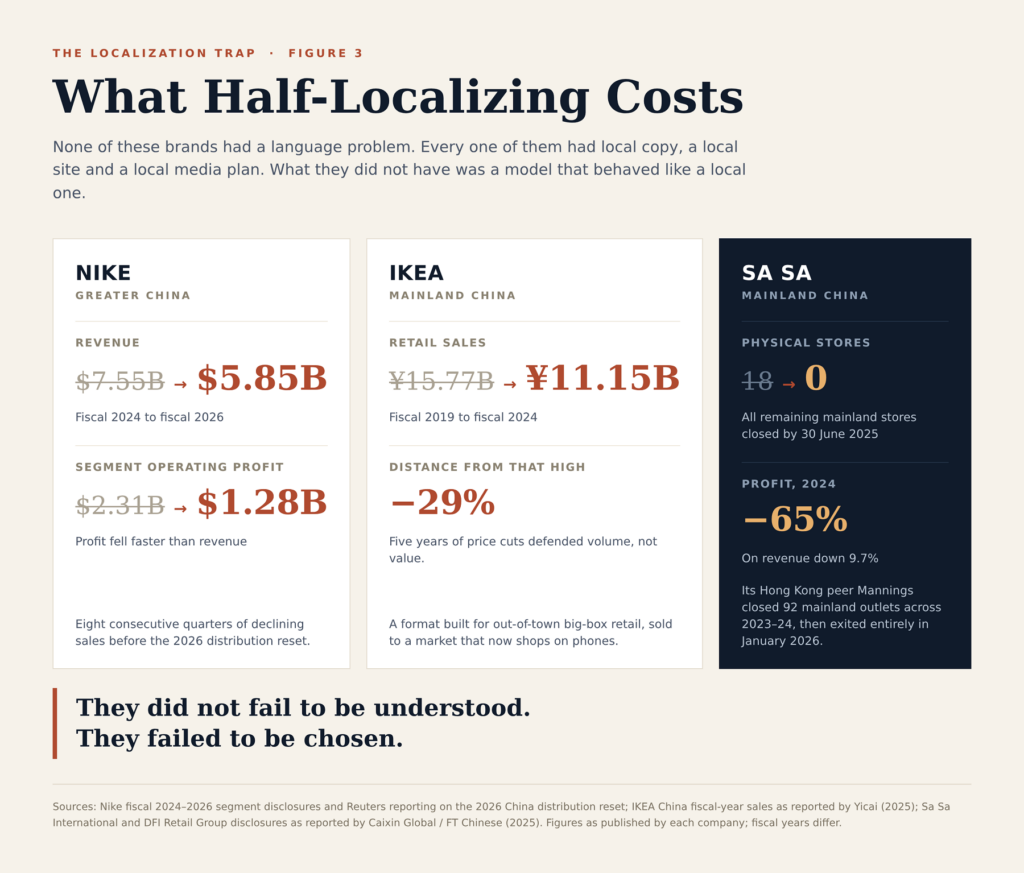
Three costs sit behind those numbers.
The credibility deficit. Consumers don’t conclude that the brand is foreign. They conclude that the brand is pretending — which is worse, because pretending implies you knew the difference and decided to skip it. The cost surfaces as a lower conversion rate on traffic you already paid for, which is the most expensive kind of discount.
The structural disadvantage. A domestic competitor starts at Layer Five and works upward. You start at Layer One and hope. Every quarter they iterate a product for a local use case you haven’t heard of; you wait for a slot on a global roadmap. The gap compounds.
The wasted spend. Underperforming campaigns get diagnosed as creative problems, media problems or agency problems. Usually it’s a fit problem. You bought reach in the right places and said something that didn’t belong there.
How to Escape the Trap
Five moves, in the order they need to happen.
Audit your real depth, honestly. Not “do we have a Chinese site” but “at which layer does our China operation have the authority to change something?” If the answer is Layer One, you aren’t localized. You’re subtitled.
Give the local team decision rights, not just execution duties. The panel evidence points to presence and repetition as the mechanisms that build brand identity. Neither survives a fourteen-hour time difference and a quarterly approval cycle. Localization executed by a regional office taking orders carries the cost and none of the benefit.
Fix congruence before you fix vocabulary. Ask where the friction sits between the claim and the experience. If a Chinese buyer’s honest reaction is “this is fine, but why would I pay more for it,” the problem isn’t the copy. It’s that the reason hasn’t been built yet — an R&D problem, a pricing problem or a product problem.
Rebuild the journey on local rails. Map where discovery, comparison, transaction and repurchase actually happen, then staff and fund those places. If your plan has no answer for search-driven communities, brand-operated livestreams and group chats, it isn’t a China plan.
Measure perception, not output. Stop reporting strings translated and pages shipped. Start tracking whether Chinese buyers describe you as a brand that understands them, whether they recommend you unprompted, and whether your repeat rate looks like a local brand’s. Those are the numbers that tell you which layer you’re standing on.
The Takeaway
Translation is an act of respect. It says: we thought you were worth the effort of being understood. It is also, on its own, an admission that you’re still outside.
The brands that get China right stop treating the market as a translation target and start treating it as a design constraint. They let the market change the product, the price, the channel and the org chart. They accept that a global brand which refuses to be changed by a market is really just a foreign brand with good manners.
So here’s the question to take into your next planning cycle. If every piece of Chinese copy you own vanished tomorrow, what would still make a Chinese consumer choose you? Whatever the answer is, that’s the layer you’ve actually reached. Everything above it is still homework.