Wuzhen’s 18-Point Plan: China’s Answer to the Global AI Governance Question
While the US Congress debated whether to criminalize superintelligent AI, China closed its Wuzhen Summit by releasing an 18-point “Global Open AI Action Initiative” built around a single idea: open source, open sharing, joint construction.
The contrast couldn’t be starker. Washington’s message: AI is dangerous, regulate it. Beijing’s message: AI should be shared, open it up.
Both are governance plays. They’re just playing for different audiences. And in November 2026, with the US and China locked in a competition for global AI influence, the Wuzhen initiative is China’s clearest statement yet of how it wants to govern — and export — artificial intelligence.
What Was Released
The 2026 World Internet Conference Wuzhen Summit closed on November 5 with the release of 《 Joining Hands to Build a Global Open Artificial Intelligence Action Initiative “- an 18 point action initiative
The theme is “open source, open sharing, joint construction, joint sharing”, and the initiative’s full title includes the idea of building a community with a shared future for cyberspace
It’s an action initiative — a set of proposed directions, not a binding document. And that distinction, as we’ll see, is both its weakness and its strategy.
The Four Pillars
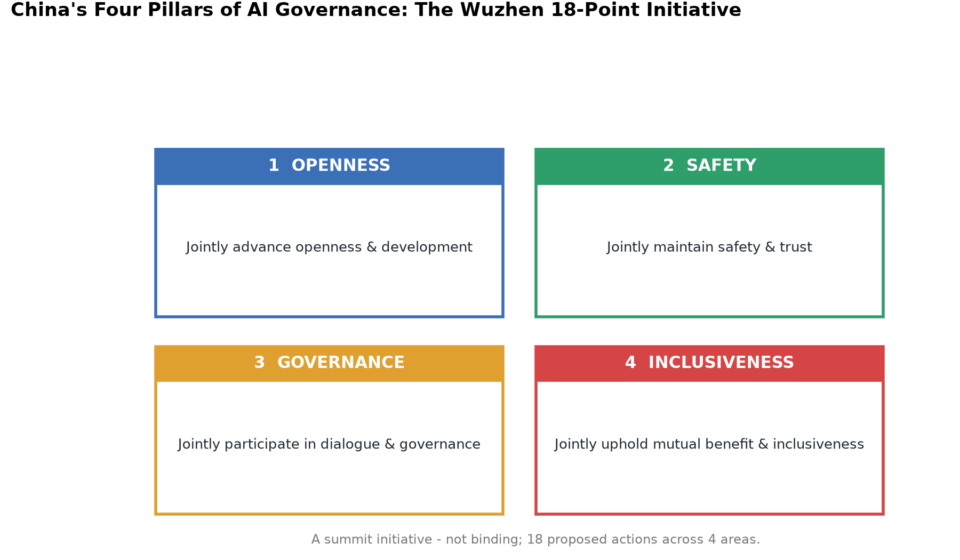
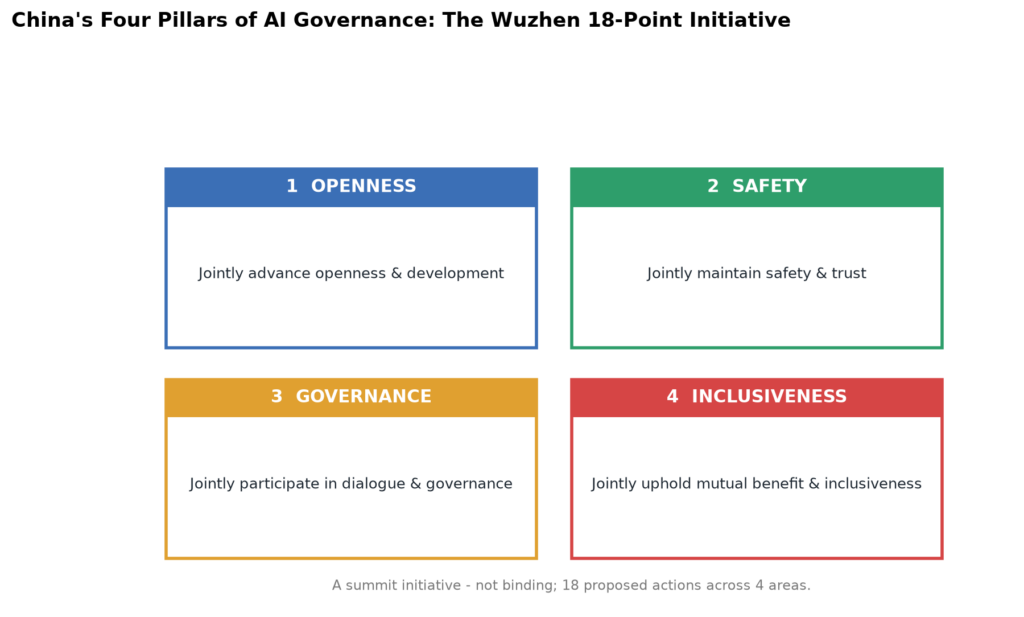
The 18 points are organized around four areas.
The first is jointly advancing openness and development — essentially championing access to AI for all countries and developers, not just those in the dominant tech ecosystems.
The second is jointly maintaining safety and trust — acknowledging the risks of AI while emphasizing responsible use rather than prohibition.
The third is jointly participating in dialogue and governance — a call for multilateral, inclusive conversation about AI rules, rather than one country setting the agenda.
The fourth is jointly upholding mutual benefit and inclusiveness — a nod to the Global South, and to the idea that AI’s benefits should be widely distributed.
Open. Safe. Inclusive. Multilateral. It’s a coherent vision — and one carefully designed to contrast with the US approach.
What This Is — and Isn’t
Precision matters here.
It is a summit initiative. It is not a treaty, a binding regulation, or an enforceable global governance rule. The 18 points are proposed actions, not completed commitments or implemented projects.
So don’t read it as “China has committed to these 18 things.” Read it as “China is proposing these 18 directions,” and understand that the actual effect depends on diplomatic follow-through.
The initiative’s name should also be handled carefully. “Global Open AI Action Initiative” is an informal English rendering; the official Chinese name is more precise. Anyone citing it should use the formal name or a careful translation, not a simplified one that might be mistaken for a different, binding document.
The Strategic Frame: “Open” vs. “Restrict”
Here’s why this matters beyond semantics.
China is positioning itself as the champion of open-weight models and accessible AI. That’s not just rhetoric — it reflects the actual structure of China’s AI industry, where models like DeepSeek, Kimi, and Qwen are distributed openly, and ecosystems are built on top.
This directly contrasts with the US move toward restriction. The ASI Prohibition Act (see our A1 coverage) proposed criminalizing superintelligence development. Data center moratoriums are spreading. The US framing is safety-first and restriction-oriented.
China’s framing is open-development. And that framing appeals to a specific audience: Global South nations and developers who can’t afford closed, premium AI, but who can build on open-weight models.
It’s a soft-power play. And it’s aimed precisely at the countries the US is also trying to court.
The Deeper Competition
Step back, and what’s happening is a competition over AI governance philosophy.
The US model: capability is dangerous, so gate it, regulate it, and restrict who can build and deploy it. This model prioritizes safety and control.
The China model: capability should be broadly accessible, so distribute it and manage risk through labeling and oversight. This model prioritizes access and development.
Both have real risks. The US model could entrench incumbents and slow innovation; the China model could distribute dangerous capability faster than oversight can keep up.
The Wuzhen initiative is China’s attempt to win the argument — and to enroll other countries in its framework before the US does.
What This Means for Enterprises and Developers
If you’re operating globally, this competition matters practically.
For enterprises in the Global South, Chinese open-weight models may be the most affordable path to AI capability. The Wuzhen initiative signals that China intends to keep that path open — and to offer governance partnerships alongside it.
For enterprises in the US and Europe, the choice is more constrained by regulation, but the availability of Chinese open models still shapes the competitive landscape.
For developers, the open-vs-restricted debate determines what tools you can build on. If the open model wins in your market, you get more flexibility; if the restricted model wins, you get more compliance overhead.
What to Watch Next
Three signals will tell you how this plays out.
Watch whether the Wuzhen initiative leads to concrete multilateral agreements — joint research, shared standards, or capacity-building programs. If it stays a declaration, its influence will be limited.
Watch how many countries formally endorse or align with the initiative. Broad adoption would signal that China’s framing has traction.
And watch whether the US responds with its own open or inclusive AI initiative — a sign that the governance competition is genuinely reshaping policy.
The Bottom Line
The Wuzhen 18-point initiative is China’s most complete articulation of how it wants to govern AI: openly, inclusively, and multilaterally.
It’s not binding, and it won’t settle the global governance debate. But it frames the terms of that debate — and it positions China as the champion of accessible AI for a world that can’t afford to be locked out.
As the US moves toward restriction, China is moving toward openness. The countries that choose between them will shape the future of AI governance for decades.