PetroChina Just Bought Into the Robot Revolution — Via Unitree
Venture capital has been pouring into humanoid robots for two years. But the real signal came on November 4, when a proposed joint venture was disclosed that puts China’s state-owned energy sector — via PetroChina’s Kunlun Manufacturing — in a controlling position alongside Unitree, the country’s most visible robotics company, and Beijing Fanjie Intelligence.
The business: industrial embodied intelligence solutions.
Translation: a central SOE with real factories and real dangerous jobs has decided robots are ready for prime time.
The Deal Structure (and Why “Two-Party JV” Is Wrong)
Here’s where precision matters, because much of the coverage simplified this into “PetroChina × Unitree.”
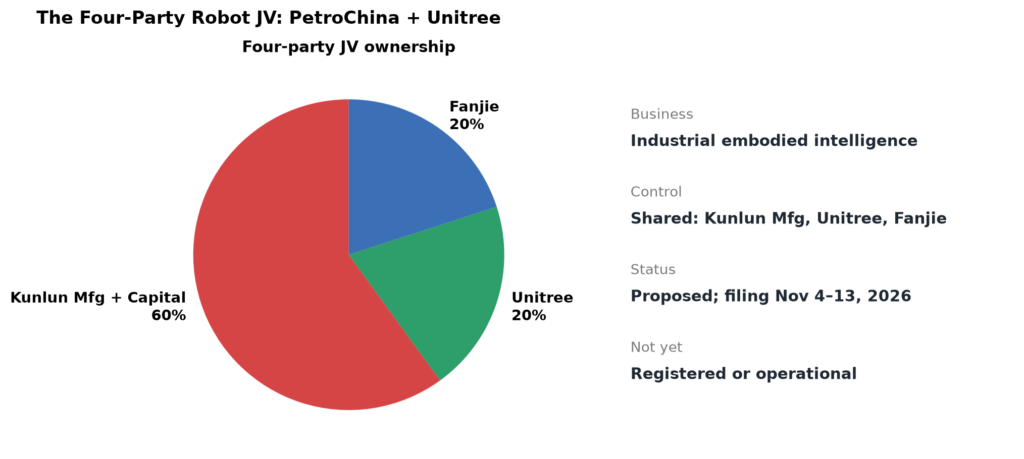
The proposed joint venture, disclosed via a Beijing market regulator (SAMR) merger filing, involves four parties: Kunlun Manufacturing (PetroChina’s equipment arm), its affiliate Kunlun Capital, Unitree, and Beijing Fanjie Intelligence.
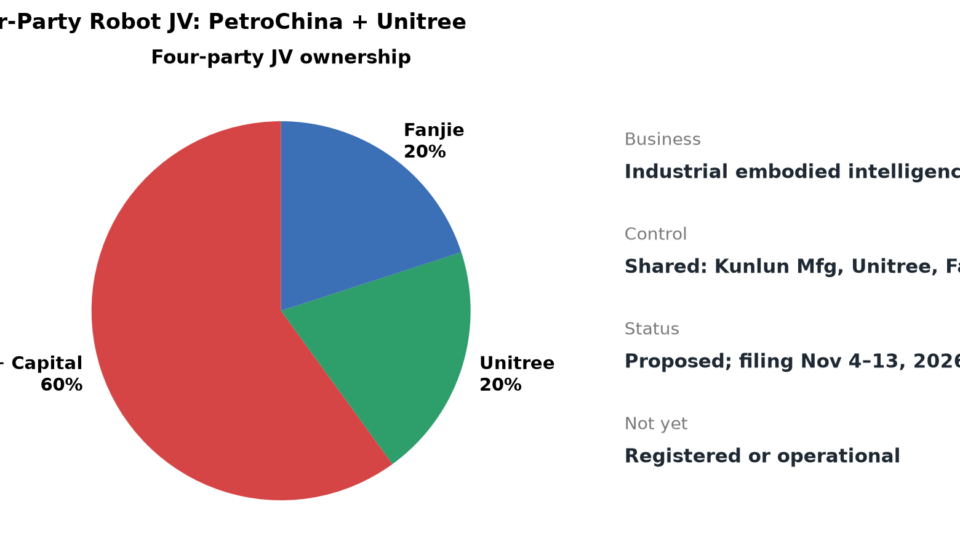
The equity split is: Kunlun Manufacturing and Kunlun Capital together hold 60%, Unitree holds 20%, and Beijing Fanjie Intelligence holds 20%. Joint control is shared among Kunlun Manufacturing, Unitree, and Fanjie.
The filing comment period runs from November 4 to November 13, 2026. As of the disclosure, the JV name hadn’t been announced, and the company is still in formation — not yet registered, not yet operational.
So this is a state-energy-controlled venture with robotics participation, not a simple two-party deal. That distinction matters for understanding who’s actually steering.
What “Industrial Embodied Intelligence” Means
The phrase sounds abstract, so let’s ground it.
Embodied intelligence refers to AI that operates through a physical body — robots that perceive, plan, and act in the real world, rather than just processing text or images. “Industrial” embodied intelligence means applying that to industrial settings: inspection, maintenance, hazardous-environment operations.
For PetroChina, the use cases are obvious. Oil and gas operations involve dangerous, remote, repetitive tasks: inspecting pipelines, monitoring wellheads, working in environments that are unsafe or uncomfortable for humans. These are exactly the jobs where embodied robots can substitute for human risk.
For Unitree, the value is different: access to real industrial scenarios that a pure robotics startup can’t easily secure on its own.
Why a Central SOE Matters
Here’s the part that elevates this above a typical funding round.
State-owned enterprises control massive industrial infrastructure and procurement budgets. When a central SOE commits to embodied AI, it’s not just writing a check — it’s opening a deployment channel. That’s a fundamentally different signal than a venture capital investment.
It also signals policy alignment. Embodied AI is a national priority in China’s industrial strategy. An SOE commitment suggests the technology is being positioned for real deployment, not just R&D.
The contrast with pure startup funding is stark. A VC bet is a bet on valuation. An SOE partnership is a bet on deployment — and deployment is what actually validates a robotics company.
The Caveats: Still Early
It’s important not to overstate what’s happened.
This is a proposed joint venture disclosed via regulatory filing. It hasn’t been registered, hasn’t been operationalized, and hasn’t produced any confirmed orders or deployments. The gap between “proposed JV” and “working robots in oil fields” is significant.
There’s also a sourcing nuance: the disclosure comes from media reports citing the Beijing SAMR merger filing. We haven’t independently located the specific government page for this case, so the details should be treated as reported through media transcription of the filing rather than a directly verified government document.
The Embodied AI Landscape
Step back, and this deal fits a broader trend.
China’s embodied AI and robotics market has been growing rapidly, with humanoid and quadruped robots moving from demo videos to early industrial deployment. Unitree is the most prominent Chinese robotics company in this space, known for its agile quadrupeds and humanoid platforms.
The petrochemical partnership is significant because it provides a concrete deployment scenario. Robotics companies can build impressive demos; what they need is a customer with real problems and the budget to solve them. An SOE with oil and gas infrastructure is exactly that customer.
What This Means for the Robotics Industry
Three implications stand out.
First, industrial deployment is the new battleground. The robotics companies that win won’t just have the best hardware — they’ll have the best access to real-world scenarios. SOE partnerships provide that access.
Second, central SOE involvement de-risks the sector. When state-owned enterprises commit to embodied AI, it signals policy support and long-term demand, which attracts further investment.
Third, expect more SOE-robotics pairings. As industrial deployment scenarios mature, more state-owned enterprises in energy, manufacturing, and infrastructure will look to partner with robotics companies.
What to Watch Next
Three signals will show how this develops.
Watch the formal registration. Once the JV is registered and operational, the real work begins — and the timeline will tell you how serious the deployment push is.
Watch for pilot deployments in PetroChina facilities. The first real-world use case will validate the model.
And watch whether other central SOEs follow. If PetroChina’s move sparks a wave of similar partnerships, the “SOE + robotics” model becomes a template.
The Bottom Line
The PetroChina-Unitree joint venture is more than a funding round. It’s a central state-owned energy giant committing to industrial embodied intelligence — with real factories, real dangerous jobs, and a procurement budget to match.
The deal is still in formation. The robots aren’t in the oil fields yet. But the signal is clear: China’s state-owned industrial sector has decided embodied AI is ready for deployment. And that’s the kind of endorsement that turns a promising technology into an industrial reality.