SAIC Gave Momenta 51%. That’s a Bigger Deal Than You Think.
In the old auto industry, the carmaker called the shots, and suppliers did what they were told.
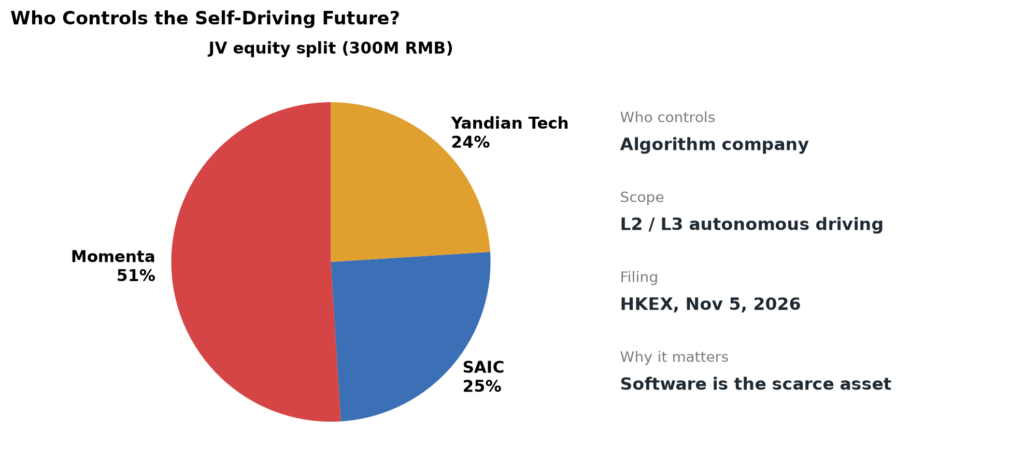
On November 5, SAIC Motor — China’s largest automaker — announced a joint venture where the algorithm company holds 51% control, and SAIC holds just 25%. The remaining 24% goes to Yandian Technology, a SAIC-affiliated supplier.
This isn’t just a corporate structure. It’s a recognition that in the autonomous driving era, the scarce asset isn’t the factory floor. It’s the software that drives on it.
The Deal Structure
Let’s start with the numbers, because the structure is the story.
The joint venture has registered capital of 300 million RMB. The equity split is Momenta 51% (held via its wholly-owned subsidiary), SAIC 25%, and Yandian Technology 24%. In absolute terms: Momenta contributes about 153 million RMB, SAIC 75 million, and Yandian 72 million.
The deal was announced via a Hong Kong Stock Exchange filing from Momenta and a SAIC board resolution on November 5. The stated purpose is to deepen cooperation on high-level autonomous driving products and services across global and all-vehicle platforms, covering L2 and L3 capabilities.
So SAIC and Yandian together hold 49%. But the controlling stake — 51% — belongs to the algorithm company.
The Power Shift: Algorithm Over Manufacturing
Why does this matter? Because it inverts the traditional OEM-supplier hierarchy.
Historically, automakers control joint ventures, and suppliers are minority partners. The carmaker owns the brand, the factory, and the customer relationship; the supplier provides components. That’s been the structure for a century.
Momenta’s 51% is a rarely-seen arrangement — the algorithm company, not the automaker, holds formal control. That doesn’t necessarily mean SAIC has lost influence (board composition, reserved matters, and veto rights all matter), but it does signal a genuine shift in who holds the scarce asset.
In the autonomous driving era, the scarce asset is the software stack. Building reliable L2/L3 autonomy requires millions of miles of data, sophisticated perception and planning algorithms, and rapid iteration. That’s not something an automaker can easily build in-house — at least not quickly. So the software specialist gains leverage.
Why It Matters for the ADAS Race
The context here is a fierce race in China’s autonomous driving market.
Chinese automakers are competing to match Huawei, Xiaomi, and Tesla on intelligent driving. L2 and L3 capabilities are becoming must-have features, not differentiators — and the companies that fall behind risk losing customers who increasingly expect advanced driver assistance as standard.
Partnering with a software specialist at scale is faster than building in-house capability. SAIC gets access to Momenta’s technology across its vehicle platforms; Momenta gets a major OEM partnership and a 51% stake in the joint venture. Both sides gain.
The Caveats: Control vs. Governance
It’s important to be precise about what “51% control” actually means.
First, the 51% is held by Momenta’s wholly-owned subsidiary, not by the parent company directly. That’s a structural detail that could matter for governance and liability.
Second, SAIC and Yandian together hold 49% — not a trivial minority. In practice, SAIC likely retains significant board and governance influence, especially on matters like product roadmaps, pricing, and manufacturing integration.
Third, the joint venture is still in the “proposed formation” stage. The full agreement — board composition, reserved matters, veto rights — hasn’t been publicly disclosed. Until it is, the exact balance of power is unclear.
So the headline “algorithm company controls the JV” is accurate, but the practical reality may be more balanced than the equity split suggests.
The Broader Trend
Step back, and SAIC’s deal is part of a larger shift.
Software-defined vehicles are reordering the OEM-supplier power balance. As cars become computers on wheels, the value migrates from mechanical engineering to software. The companies that control the software stack — Momenta, Horizon Robotics, Huawei — gain leverage over the automakers that need it.
Expect more automakers to cede software control to specialists as the ADAS race intensifies. The alternative — building everything in-house — is expensive, slow, and risky in a market moving as fast as China’s.
The winners will be software companies that can scale across multiple OEMs. Momenta, with SAIC as a major partner, is positioning itself for exactly that.
What This Means for the Industry
Three implications stand out.
First, the traditional hierarchy is eroding. Automakers that once dictated terms to suppliers now find themselves partnering as minority stakeholders in software-focused joint ventures.
Second, software capability is becoming the differentiator. Two cars with similar hardware can have vastly different autonomy experiences depending on the software. That shifts value toward the software specialists.
Third, partnerships matter more than ownership. SAIC isn’t “losing” its autonomous driving future — it’s securing access to best-in-class technology through a structure that aligns incentives.
What to Watch Next
Three signals will clarify how this develops.
Watch the full joint venture agreement. Once board composition and reserved matters are disclosed, the real balance of power will become clear.
Watch whether other Chinese automakers follow with similar structures. If they do, the “software company holds control” model becomes a trend, not an outlier.
And watch Momenta’s expansion to other OEMs. If it can scale beyond SAIC, it becomes a platform player, not just a supplier.
The Bottom Line
SAIC’s decision to give Momenta 51% of a joint venture is a signal that the autonomous driving value chain has been reordered. The scarce asset isn’t the factory — it’s the software.
Whether this becomes the template for the industry or an outlier remains to be seen. But the direction is clear: in the age of software-defined vehicles, the companies that write the code hold the leverage.