Which China Tactics Travel West — And Which Die at the Border
In December 2025, Meituan switched off community group buying.
Five years earlier, Meituan Youxuan had been the most aggressive land grab in Chinese retail. It launched in July 2020, reached 2,000 cities and counties within six months, and peaked around 20 million orders a day. Along the way it absorbed, by most accounts, more than RMB 100 billion of investment. Then it withdrew from 19 provinces in June 2025, and on December 15 the last warehouse went dark.
Which brings us to a second data point, subtler and more instructive. In May 2024, Tmall cancelled pre-sales for 618 — the deposit-now, balance-later ritual it had run since 2014. Consumer watchdogs had spent years documenting the mess: balances that quietly climbed, goods that never shipped, “lowest price” claims that weren’t. By early May, a single complaints platform had logged more than 80,000 pre-sale complaints. Five months later, Tmall brought pre-sales back for Singles’ Day.
Neither reversal was a Western failure. Both were decided in China, by people with better data than you have.
That is the uncomfortable part of the China playbook conversation. China is the world’s most productive marketing laboratory, and simultaneously its fastest-moving scrapyard. Tactics are born, scaled to a hundred million users, then redesigned, defunded or abandoned — often inside five years. By the time one reaches a conference stage in New York, it may already be an open argument in Hangzhou.
So the useful question is not “what’s working in China?” It is narrower and harder: what inside this tactic is universal human behaviour, and what is scaffolding that exists only over there?
The most expensive sentence in marketing
“It works in China” is not evidence. It is a description of one market at one moment, delivered by someone with a slide to sell.
You have seen the pattern. A brand sends a team to Shanghai, watches a livestream move 40,000 units of face cream in ninety minutes, flies home and pitches a six-figure live programme. Eighteen months later the programme is a cost centre, the host has quit, and nobody can say why the same tape didn’t play.
The failure is rarely about execution. It is about mistaking a system for a tactic. A Chinese tactic is usually a behaviour wrapped in an interface, a payment rail, a delivery network and a festival calendar. Copy the visible layer and you have imported the costume without the body.
A tactic is not a tactic. It is a stack of dependencies.
China did not produce better marketers. It produced a denser test environment, and density changes what is possible.
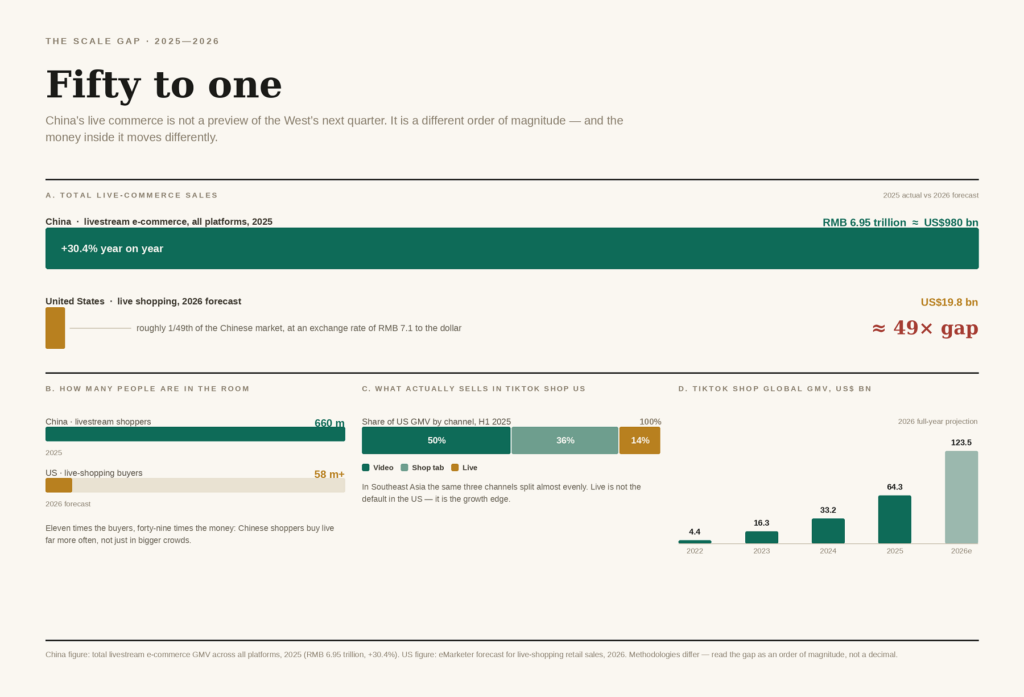
Consider the raw material. In 2025, an estimated 660 million Chinese consumers bought inside livestreams — 58.7% of internet users, equivalent to 70.2% of all online shoppers. Livestream commerce turned over an estimated RMB 6.95 trillion, roughly US$980 billion, up 30.4% year on year, with penetration of 36% of online retail. The reported number of live-commerce businesses rose from 8,000 in 2020 to 132,000 in 2025.
A caveat worth stating plainly: a separate white paper from a government-affiliated research centre put the same market at more than RMB 5 trillion, or about a third of online retail. Different methodologies, same direction. When two credible sources disagree by 40%, quote the range, not the point estimate.
That density is not a marketing achievement. It is infrastructure: payment embedded everywhere, delivery dense enough that a RMB 30 basket still ships, a creator economy large enough to staff a supply chain, and consumers who treat a livestream as a shopfront rather than an event.
Port a mechanic out of that environment and you are asking it to perform without its circulatory system.
The four-gate test
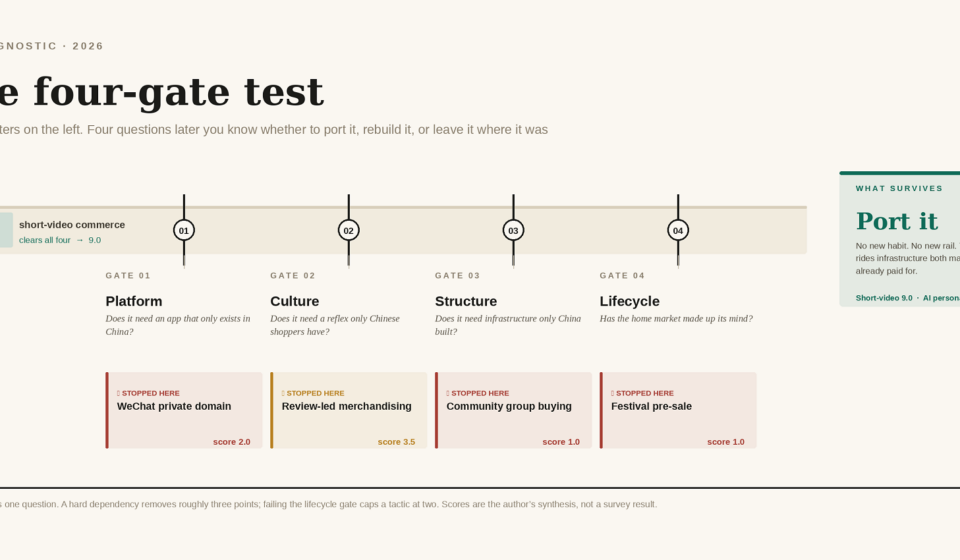
Four questions, in order. Every tactic that has travelled west successfully clears at least three. Every expensive failure I have watched failed at least two.
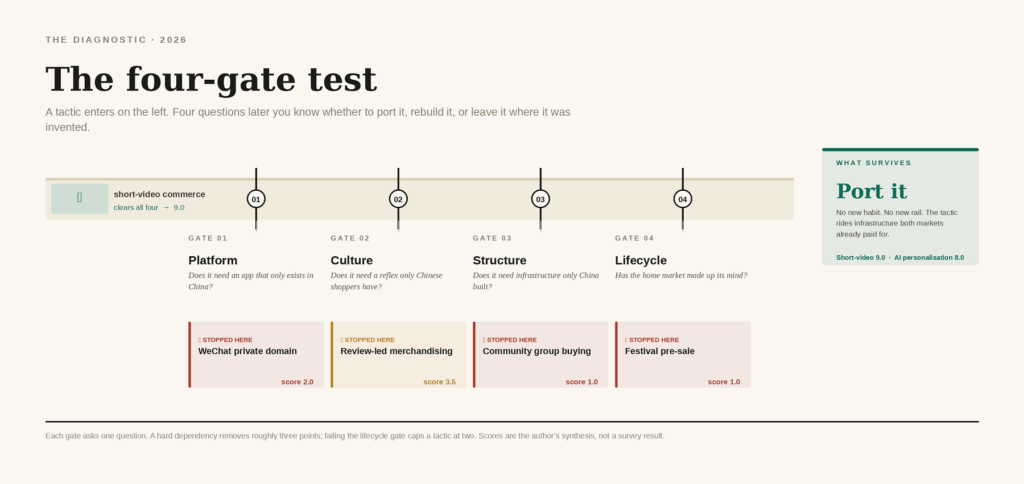
Gate one — platform. Does the tactic require an app that only exists in China? This is the gate everyone knows about, and the one they most often underestimate.
Gate two — culture. Does it depend on a reflex Chinese shoppers have and others don’t? Festival gift logic, group-buying psychology, the habit of reading forty reviews before buying a charging cable.
Gate three — structure. Does it need infrastructure only China built at national scale? Consolidated parcel networks, a neighbourhood group-leader layer, a super-app that also clears payments.
Gate four — lifecycle. Has the home market made up its mind? This is the gate almost nobody checks, and the one that quietly kills the most projects.
Gate one: a border made of software
WeChat is the cleanest case, because it has no functional equivalent anywhere.
Mini-programs — the lightweight apps that open inside WeChat without a download — facilitated more than RMB 8 trillion in transactions in 2024, according to Tencent. Monthly active users run near 945 million. In 2025, cross-border and overseas users opened mini-programs more than five billion times.
Which means a Chinese brand can run acquisition, content, community, checkout, service and repeat purchase inside one address book. Its Western counterpart spreads the same functions across six vendors and prays the identity graph holds.
So when a Western brand announces it is “building private domain”, what it usually means is a newsletter and a WhatsApp broadcast list. That is not the same animal. Copying WeChat’s private domain into a market without WeChat isn’t strategy. It’s cosplay.
Gate two: culture is not a content style
Culture is the gate people mistake for tone of voice.
The festival machine is the obvious case, and the pre-sale was its most extractable piece: lock the order now, pay later, hit a number on a fixed date. Western retailers have tried deposits and early access for years. None of it produces the same behaviour, because none of it sits on top of a calendar where hundreds of millions of people are already shopping on the same night.
Then there is the review reflex. Chinese consumers will research a nine-yuan purchase across three platforms before committing. That intensity is what makes review-led merchandising and rating-driven ranking so powerful. Western shoppers read reviews too — just less obsessively, and in markets where regulators now punish fake ones.
Culture does not port as content. It ports as behaviour, and only if the behaviour already exists.
Gate three: the parts you cannot see
Community group buying is a masterclass in invisible dependency.
The model looks simple: a neighbourhood group leader collects orders, the platform consolidates them, goods arrive next day for pickup. The simplicity is the illusion. It requires tens of thousands of micro-entrepreneurs who already hold trust inside a building, plus a delivery network dense enough that a low-ticket basket of vegetables still clears a margin.
It also requires that the economics work at small basket sizes — which, in China, they briefly did, subsidised by platforms burning cash. In 2021, Meituan’s “new initiatives” segment, which housed community group buying, posted an operating loss of RMB 38.4 billion. The retreat took years, and the exit was total.
If a tactic’s margin depends on a density your market does not have, no amount of creative execution saves it.
Gate four: the tactics that change their mind at home
The pre-sale is the best illustration of why this gate exists, precisely because it did not die.
Tmall built it in 2014, ran it for a decade, cancelled it for 618 in 2024 amid consumer-protection pressure, then restored it for Singles’ Day five months later. The stated reason was that higher-ticket categories — phones, appliances, coats — need a decision window. The commercial reason was probably that merchants wanted earlier commitments and locked-in ad budgets.
Either way, the signal is not “this tactic is dead”. It is “the market that invented it hasn’t settled on it”. Exporting an unsettled mechanic means exporting someone else’s live experiment, and paying for the results.
Community group buying is the other extreme: five years, more than RMB 100 billion in investment, national shutdown. Some tactics in the export pipeline are dead. Others are still arguing with themselves. Both make bad imports, for different reasons.
The scorecard
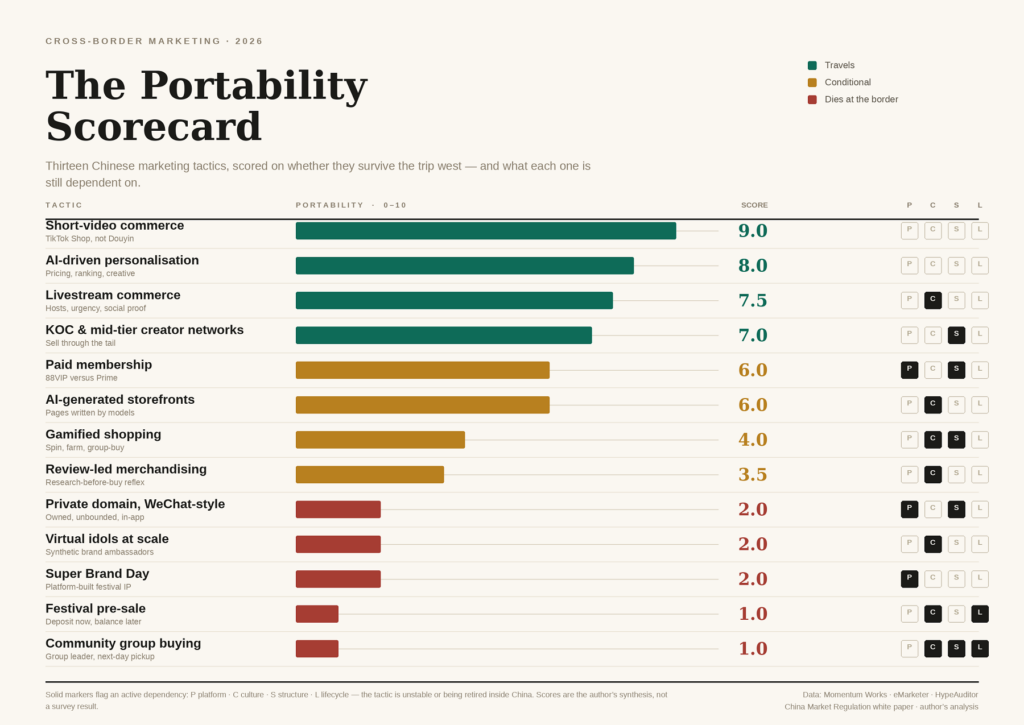
Score the shortlist before you budget for it.
What travels: the video-first marketplace
Short-video commerce scores highest, and the reason is almost embarrassingly simple: it requires no new consumer behaviour. People were already scrolling. All the format does is put a checkout on the scroll.
The numbers stopped being subtle a while ago. TikTok Shop turned over US$33.2 billion globally in 2024 and US$64.3 billion in 2025 — a 94% jump. In the first half of 2026 it did US$50.3 billion, up 92% year on year, with Momentum Works projecting US$123.5 billion for the full year. The United States generated about US$15.1 billion in 2025 and is now the platform’s second-largest market after Indonesia.
Note what this is not. It is not Douyin with a different logo. It is the same behavioural insight — discovery beats search in low-consideration categories — running on a commercial stack rebuilt from scratch.
Livestream travels too. It just arrives as a hobby, not a channel.
Here is where ambition and evidence part company.
US live shopping is forecast to reach US$19.8 billion in 2026, up 35% from US$14.6 billion, with more than 58 million buyers — close to a quarter of American digital buyers. Healthy growth. It is also roughly one-fiftieth the size of China’s 2025 livestream market, comparing a US forecast with a Chinese estimate.
Inside TikTok Shop US, live accounted for 14% of GMV in the first half of 2025, up from 10% in 2024. Video was half. Only one live session in the entire half-year cleared US$1 million in sales, down from four the year before. In Southeast Asia the same three channels split almost evenly — because the behaviour got there first.
Whatnot is the exception that makes a narrower point. It moved about US$8 billion of GMV in 2025, is valued at US$20 billion, and got there by building communities of collectors and resellers around live auctions rather than by discounting. Live commerce in the West isn’t a smaller China. It is a different animal that happens to use the same word.
The most portable thing China has exported isn’t a format
It’s an argument about where trust lives.
On Douyin in 2024, creators with fewer than a million followers generated about 21% of platform GMV; creators above a million generated about 9%. Nationally, top anchors were reported at 10.66% of livestream GMV in 2025, against 89.34% for mid-tier and smaller hosts. Meanwhile the Western engagement data points the same way: HypeAuditor’s 2026 Instagram benchmark puts nano-creators at 1.78% engagement, against 0.54% for micro-creators.
Two markets, two very different creator economies, one conclusion: distribution of trust beats concentration of reach. That insight ports perfectly. The machinery around it — the MCN layer, the commission splits, the group-leader network — does not.
Export the verb. Leave the noun at home.
What dies: private domain, and the myth of the Western WeChat
The principle behind private domain is real and valuable: stop renting your demand from an algorithm and own the relationship. Every serious brand should act on it.
But the mechanism is welded to WeChat. The reason a Chinese brand can push a coupon, take payment, book a service and run a community inside one thread is that WeChat is a messaging app, a payment network, a mini-program runtime and an identity layer at once. The closest Western approximation is email, SMS, WhatsApp business messaging and a loyalty app — four vendors, four identity graphs, four consent regimes.
The transferable version isn’t “build private domain”. It is “shorten the distance between attention and repeat purchase, on rails you control”. That is a strategy. Everything else is a screenshot.
What dies: the festival machine
Singles’ Day works because of a specific cultural scaffold: a manufactured holiday, gift logic, a shared countdown, and platforms willing to coordinate a national event. The pre-sale was the most portable piece of that machine, and its inventor is still switching it on and off.
The exportable remnant is duller than the myth. Scarcity with a deadline works. A made-up holiday works. What does not travel is the assumption that hundreds of millions of people will shop on your date because you declared it.
What dies: community group buying
Worth repeating from the opening, because it is the cleanest case in the file. The format needed subsidies to acquire, a social layer the West does not have, and delivery density that only exists where populations are packed tightly enough. All three conditions had to hold at once. None of them scaled.
What dies: synthetic celebrities
Chinese platforms industrialised virtual idols years ahead of the West, and the format looked like the future of brand ambassadors: no scandals, no ageing, total schedule control.
Consumers, it turns out, weren’t consulted. In DoubleVerify’s 2026 global study of 22,000 consumers across 21 countries, 37% said they viewed brands using clearly AI-generated influencers negatively, against 29% positive.
The nuance is the useful part. When a real creator uses AI to make content, sentiment flips: 39% positive against 25% negative. Audiences aren’t rejecting the technology. They are rejecting the substitution. Port the augmentation, not the android.
The partial travellers
Three tactics travel on conditions, and each condition is a decision you can actually make.
Paid membership. The model ports; the bundle does not. Alibaba’s 88VIP reached 53 million members by late 2025, each spending about nine times what a non-member spends. Amazon Prime reached an estimated 201 million US members in December 2025, spending roughly US$1,170 a year against US$570 for non-members. Membership works when the value is legible. Ecosystem bundling works when you own the ecosystem.
AI-generated storefronts. The technology is neutral; the disclosure culture is not. Western shoppers punish pages that feel synthetic and undisclosed far more harshly, and regulators are starting to agree.
Gamified shopping. Spin-to-win and loyalty games travel. Pinduoduo-style gamification — the farming mechanics, the referral trees, the ten-friend unlock — does not, because it runs on a tolerance for friction that Western users read as spam.
One more deserves a warning label: per-user AI pricing. Chinese platforms customise offers at a granularity Western retailers have the data for but not the appetite. After a decade of dynamic-pricing backlash, “your coupon is different from your neighbour’s” is a legal and reputational risk, not a growth lever.
The porting protocol
Five steps, in order. Skipping step two is how budgets die.
1. Name the behaviour, not the tactic. “Impulse purchase triggered by a trusted face in a live setting” is a behaviour. “Livestream commerce” is an implementation.
2. Map the dependency stack. For each layer — behaviour, interface, payment, fulfilment, calendar — ask whether it exists locally. Every missing layer is a rebuild, not an adaptation.
3. Substitute, don’t transplant. Find the local rail doing the same job. WhatsApp and email instead of WeChat. TikTok Shop instead of Douyin. Shop Pay or Klarna instead of an in-chat wallet.
4. Rebuild the unit economics from zero. Chinese tactics frequently assume labour costs, creator supply and delivery density that are two to five times cheaper or denser. A format that clears margin in Chengdu can be underwater in Leeds with identical execution.
5. Test the behaviour before you build the machine. A US$20,000 pilot that measures whether people will buy from a live host tells you more than a US$2 million platform build that assumes they will.
What this means for the next two years
Four calls, all falsifiable.
Live commerce in the West stays community-first. Collectors, hobby niches, high-consideration goods with expert hosts. It will keep growing at 30%-plus off a small base and still be a rounding error against China in 2028. Brands that staff for a mass channel will over-hire.
The next genuinely portable export is agentic commerce. China is already running AI shopping assistants and model-generated storefronts at scale; the West is building the same rails through model providers and retailer APIs. Unlike live commerce, this one depends on infrastructure both markets are actively building — which makes it the rare tactic that could cross the border at full strength.
Advantage shifts from access to translation. Knowing what happens in China is now cheap; it is on X, in Telegram groups, in a dozen newsletters. The scarce skill is telling a mechanic apart from a behaviour, which is a research discipline, not a sourcing one.
Expect the copy to arrive late and smaller than the pitch. Every failed port I have watched had the same shape: a real insight, an over-scaled build, and a quiet retreat blamed on “market maturity”.
The takeaway
The border between Chinese and Western marketing isn’t geographic. It is architectural — a wall built from payment rails, delivery density, platform logic and consumer habit.
Tactics built on universal behaviour climb it easily. Short-video commerce cleared it because people already knew how to scroll. Tactics welded to a specific app, a specific festival or a specific subsidy structure stay on the other side, however good the case study looked.
And the cheapest mistake of all is importing something China has already dropped, or is still arguing about. The pre-sale is on again. Community group buying is gone. The celebrity-anchor model is being deliberately deflated — top hosts’ share of livestream GMV has fallen to about a tenth, by design.
China remains the best place in the world to watch the future of commerce get tested. It is a terrible place to shop for a strategy you can use unchanged. The brands that win the next cycle will be the ones that learn to read the lab report instead of buying the equipment.