The Political Premium on Compute: How One Midterm Election Rewrote the Risk Calculus for AI Infrastructure
The 48 hours between November 3 and November 5, 2026, will be remembered as the moment the AI trade met politics — and lost some of its innocence.
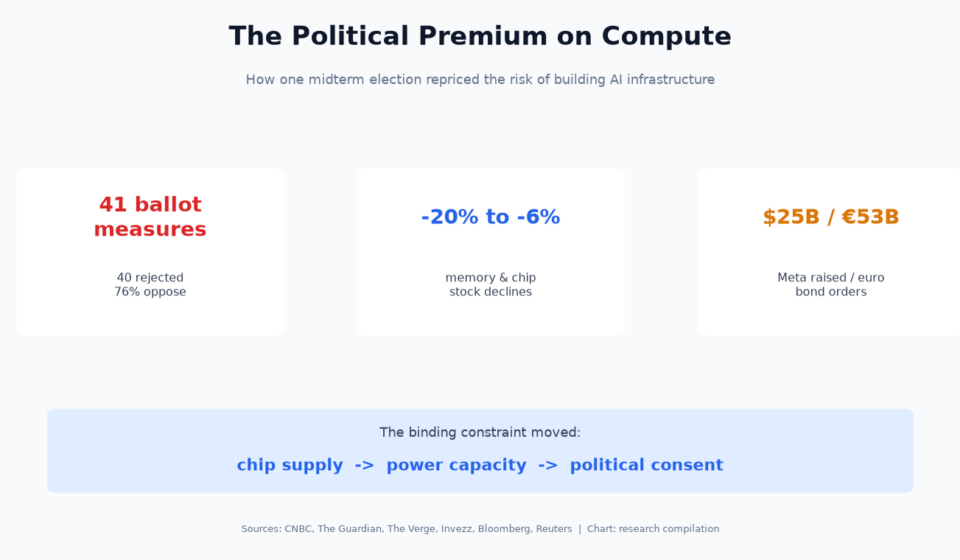
In that window, three signals arrived almost simultaneously. American voters in ten states rejected 40 of 41 local ballot measures tied to data-centre construction, with NBC News exit polling finding that 76% of voters opposed data centres in their communities. Memory chip stocks suffered their sharpest two-day rout in more than two years, with SanDisk down 20%, Micron down 16% and SK Hynix down 13%. And Meta raised roughly $25 billion in 48 hours, with its debut euro bond drawing a record €53 billion in orders — even as S&P cut its outlook to negative.
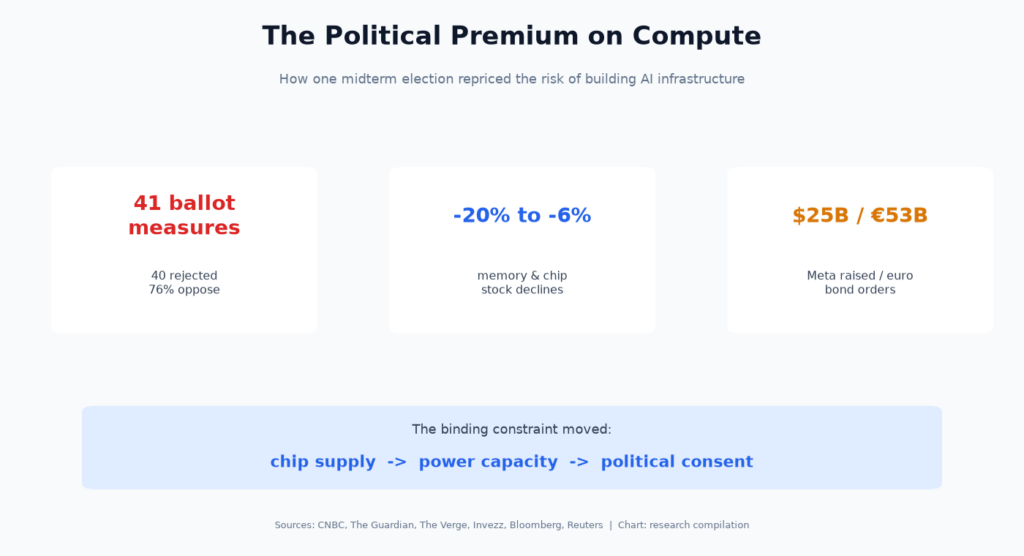
Read separately, each is a story. Read together, they describe something more important: the binding constraint on AI expansion has shifted from chip supply to political consent. That shift changes the economics of every AI infrastructure asset on earth.
A paradox in three parts
The first signal is the ballot box. The 41 measures were varied — some sought outright bans, others proposed 180-day moratoriums or caps on electricity and water use. But the underlying question was consistent: should this community host the physical infrastructure of the AI economy? Increasingly, the answer was no. Cross-party opposition, driven by concerns about energy bills, land use and the sense that economic benefits accrue to developers rather than residents, produced a near-total sweep.
The second signal is the stock market. Memory stocks are the most sensitive instrument in the AI trade because they sit at the base of the stack. When they fall 20% in two days, the market is not just reacting to weak chip earnings; it is repricing the assumption that AI buildout will continue unimpeded. The triple trigger — disappointing Qualcomm and Arm guidance, the Democratic sweep of Congress, and the ballot results — converged to produce a selloff that wiped roughly $3 trillion from US equities.
The third signal is the bond market, and it is the most interesting. Meta raised about $25 billion in 48 hours — $15 billion in dollar bonds and €9 billion in its first euro bond — with the euro tranche drawing €53 billion in orders, a record for any European corporate bond. Yet S&P had just revised Meta’s outlook to AA- negative, citing the strain of AI infrastructure spending on its finances.
The paradox explained
How can a company face a negative outlook and still attract record demand for its debt? The answer is that the two markets are answering different questions.
Rating agencies look at cash flow and see danger: Meta is spending aggressively on AI infrastructure, its free cash flow is under pressure, and the spending trajectory shows no sign of moderating. A negative outlook is a warning that a downgrade is possible if that does not improve.
Bond investors look at yield and see opportunity. Meta is paying about 1.4 times the risk premium that Alphabet offered on comparable euro debt priced just days earlier. For fixed-income investors hungry for AI exposure, a generous yield from a AA- rated issuer is attractive, even with the caution flags. They are pricing the risk in, not ignoring it.
Both can be right at the same time. The rating agency is asking whether Meta is creditworthy. The bond investor is asking whether Meta’s debt is good relative value. The first is a question about safety; the second is a question about price.
The hierarchy of constraints
The deeper insight is that the constraint on AI expansion has moved up a level.
Between 2023 and 2024, the binding constraint was chip supply — specifically, advanced GPUs and high-bandwidth memory. Companies could not get enough silicon, and that scarcity drove prices and valuations.
In 2025, the constraint shifted to power. Data centres consume enormous amounts of electricity, and grid capacity became the bottleneck. Utilities and regulators started to push back, and the lead time for new power infrastructure stretched into years.
In 2026, the constraint has shifted again — this time to political consent. A data centre needs a zoning variance, a power contract and, increasingly, a community’s blessing. Each of those is a political process, and each can say no. The ballot results showed that the answer is frequently no.
This progression matters because each constraint is harder to solve with money than the one before. Capital can buy chips. Capital can fund power plants, given time. But capital cannot buy a zoning approval or a community’s consent. Those are political goods, and they are now the scarcest input in the AI economy.
What S&P’s downgrade really says
The S&P revision is often read as a story about Meta’s finances. It is really a story about the collision between capital and permission.
Meta can raise money. The market proved that. What the rating agency flagged is that the spending the money finances — data centres — faces a riskier environment. If the buildings cannot be built on schedule, the returns on the capital deployed decline. A negative outlook is, in part, a recognition that the political and physical constraints now emerging elsewhere could undermine the economics of the spending.
That is why the three signals belong together. The ballot results raise the probability that data centres get delayed or blocked. The stock selloff prices that probability into AI-linked equities. And the bond market, while still willing to lend, demands a premium for the added uncertainty. Together, they form a political risk premium on compute.
The Menlo cross-read
The same week, Menlo Ventures published its 2026 State of Enterprise AI report, finding that enterprise AI spending had reached $176.8 billion — up 5.4 times in a year — with AI agents now consuming more AI than humans and the top three labs capturing 69% of enterprise spending.
The report is a reminder of the demand side. Enterprises are spending furiously on AI, and that spending ultimately flows into compute, which flows into data centres. The demand is not the problem. The problem is whether the physical and political infrastructure can keep up.
Read against the ballot results, the Menlo numbers take on a different colour. A 5.4x increase in spending implies a corresponding increase in compute demand. If a meaningful share of the data centres needed to serve that demand cannot be permitted, the result is either higher prices for the compute that does get built, or a shortfall that slows enterprise AI adoption. Either way, the constraint is no longer demand.
What it means for the hyperscalers
For Microsoft, Google, Amazon and Meta — the four companies driving the bulk of hyperscale construction — the ballot results introduce a new line item in every project model: political risk.
The strategic response is already visible. Hyperscalers are diversifying geographically, looking at jurisdictions with more receptive politics and available power. They are investing in their own power generation and in efficiency improvements that reduce energy intensity. And they are increasingly engaging in local politics, because the alternative — being surprised by a ballot measure — is worse.
But none of these responses is quick. A new data centre takes years to plan, permit and build. A political shift can happen in a single election cycle. The mismatch between the speed of politics and the speed of infrastructure is the core tension of the next phase of AI.
The systemic risk
The systemic risk is that the political premium compounds. If data-centre opposition spreads from a handful of localities to a national movement, the cost of building AI infrastructure rises across the board. That would not stop AI, but it would slow it, raise prices and shift the economics toward companies that can afford to navigate the politics — which are, disproportionately, the largest incumbents.
There is an irony here. The ballot results were, in part, a protest against the concentration of AI’s benefits. But if they raise barriers to entry, they may end up entrenching the very concentration they were meant to challenge.
What to watch
Three signals will show whether this is a local phenomenon or a national turn: whether state legislatures follow the ballot measures with restrictive statutes; whether federal permitting reform moves in the opposite direction; and whether hyperscalers begin disclosing project delays tied to community opposition.
There is also a market signal to watch: whether the premium Meta pays on its debt — 1.4 times Alphabet’s — widens or narrows as the political environment evolves. That spread is, in effect, a live price for political risk.
The bottom line
The AI industry spent two years worrying about chip shortages and a year worrying about power. The 2026 midterms suggest it should have been worrying about planning committees. The election did not just change who controls Congress; it priced a new political premium into every AI infrastructure asset on earth — and that premium is unlikely to disappear.