The 76% Problem: Why American Voters Just Voted Against the AI Boom in Their Backyards
American voters just delivered the clearest verdict yet on the AI buildout, and it was almost unanimous.
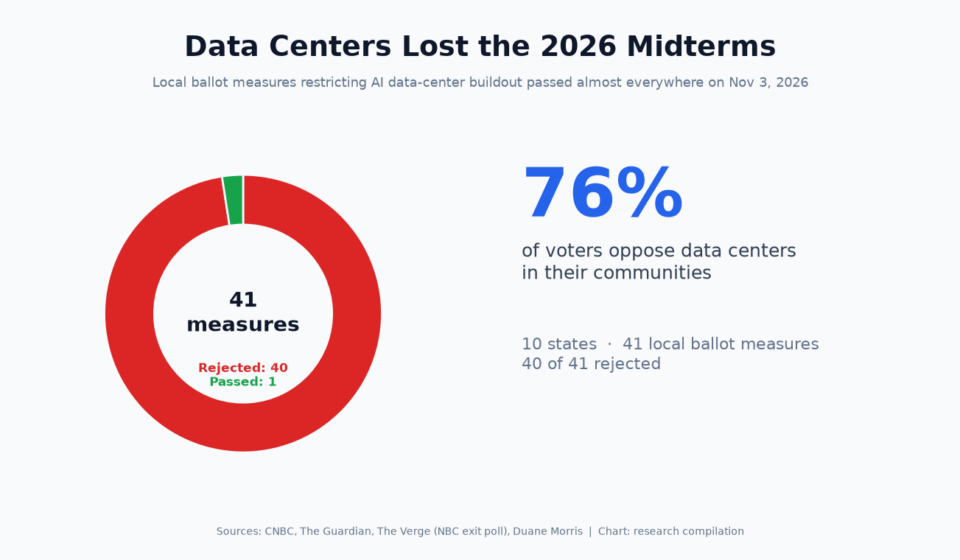
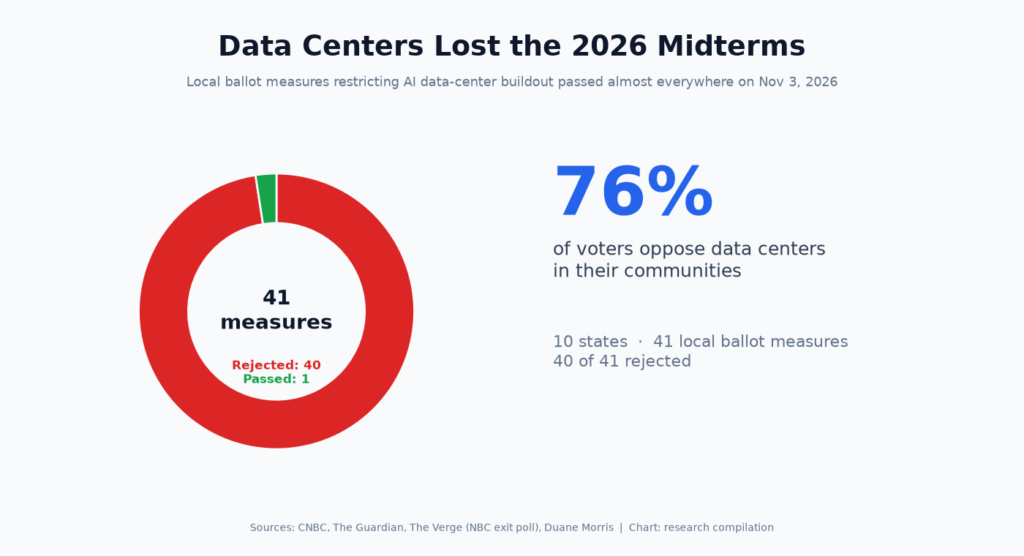
In the largest wave of anti-data-centre votes in US history, residents in ten states weighed in on 41 local ballot measures on November 3. They rejected 40 of them — a near-total sweep that cut across party lines and left developers, utilities, and hyperscalers scrambling to reassess their expansion plans.
The measures were not uniform. Some sought outright bans. Others proposed 180-day moratoriums, or caps on the electricity and water a facility could consume. A few were binding; others were advisory. But the underlying question was the same everywhere: should this community host the physical infrastructure of the AI economy?
Increasingly, the answer was no.
Why voters said no
The complaints are consistent and concrete. Data centres consume enormous amounts of electricity, and in many jurisdictions that demand is showing up on residential bills. They compete for land and water. They create relatively few permanent jobs relative to their footprint. And the economic benefits — tax abatements, construction work — often flow to the developer and the utility rather than to the neighbours.
NBC News exit polling captured the mood: 76% of voters said they opposed data centres in their communities. That is not a partisan fringe. It is a supermajority.
The political backdrop
The ballot results did not happen in a vacuum. Democrats won control of Congress in the same election, and the party has grown noticeably more sceptical of unconstrained AI expansion. Representative Alexandria Ocasio-Cortez has floated a national moratorium on new data centres until Congress writes guardrails ensuring the buildout does not raise electricity costs or proceed without community consent.
Whether such a bill can pass is an open question. But the direction of travel is clear. The debate over AI is shifting from abstract concerns about jobs and misinformation to something far more tangible: the power plant, the water main, and the zoning meeting down the street.
What it means for the hyperscalers
For Microsoft, Google, Amazon, and Meta — the four companies driving the bulk of hyperscale construction — the vote introduces a new line item in every project model: political risk.
Capital was never the constraint. These firms can raise tens of billions in days. The constraint is now permission. A data centre that cannot get a zoning variance, a power contract, or a community’s blessing is a stranded asset, no matter how much silicon is waiting to be installed.
This is why the midterm result matters beyond the localities themselves. It signals that the AI buildout has entered its political phase, where the ability to navigate local democracy becomes as important as the ability to design a chip.
What to watch
Three things will show whether this is a local phenomenon or a national turn: whether state legislatures follow the ballot measures with restrictive statutes; whether federal permitting reform moves in the opposite direction; and whether hyperscalers begin disclosing project delays tied to community opposition.
The AI industry spent two years worrying about chip shortages. The 2026 midterms suggest it should have been worrying about planning committees.