SanDisk Down 20%, Micron Down 16%: Inside the Two-Day Rout That Repriced the AI Infrastructure Bet
Global memory chip stocks just suffered their sharpest two-day rout in more than two years, and the selloff was not really about memory at all.
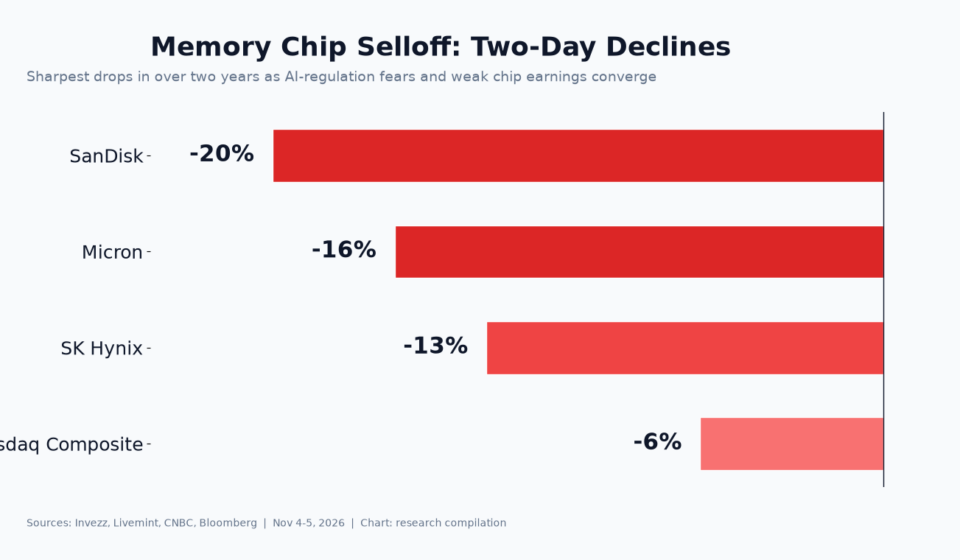
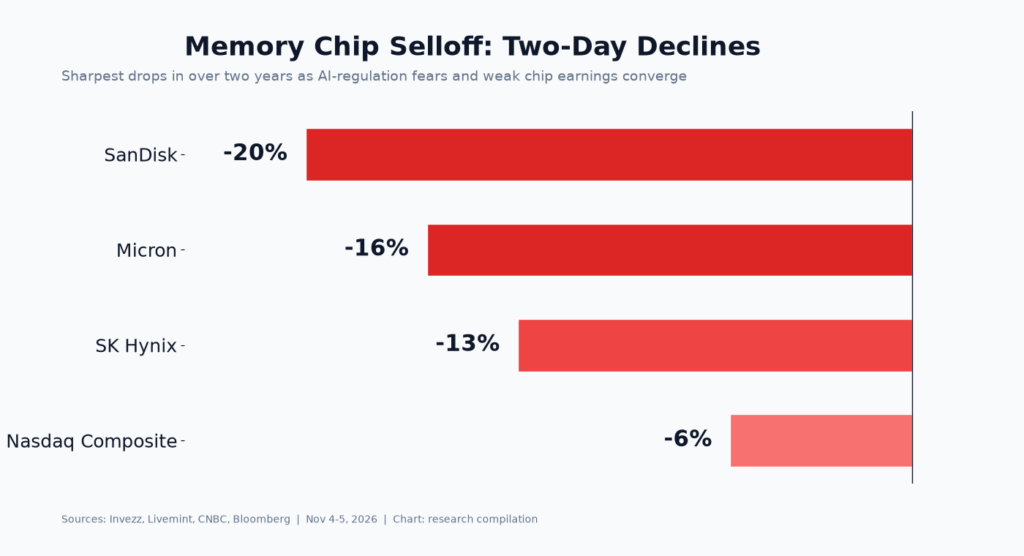
SanDisk plunged 20%, Micron fell nearly 16%, and SK Hynix dropped 13% across November 4 and 5, while the Nasdaq Composite shed around 6% and roughly $3 trillion in market value evaporated from US equities. South Korea’s Kospi, home to two of the world’s largest memory makers, was dragged sharply lower.
On paper, this makes little sense. Memory is having one of its best years on record. High-bandwidth memory, the specialised chip that feeds AI accelerators, has been in such demand that margins at the leading suppliers have approached 80%. If any corner of the semiconductor market should be insulated from a selloff, it is this one.
The market, however, was not pricing this year’s profits. It was pricing next year’s permission to grow.
Three triggers, one afternoon
The rout had three distinct causes, and they arrived almost simultaneously.
First, earnings. Qualcomm and Arm both delivered outlooks that disappointed investors, reviving fears that the smartphone and consumer-device cycle is weaker than hoped. When the companies that design the chips sound cautious, the companies that supply the memory inside them feel it first.
Second, politics. Democrats swept the 2026 midterms, taking full control of Congress. For an industry whose growth depends on building enormous data centres, a legislative majority inclined toward tighter AI oversight is not a rounding error — it is a structural risk.
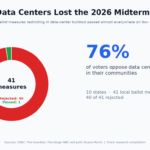
Third, the ballot box. On the same day, voters in ten states rejected 40 of 41 local measures tied to data-centre construction. Every rejected permit is a megawatt of expected AI demand that may never materialise.
The irony of high margins
The cruelest part of the story is that the fundamentals look excellent. Memory makers are posting record profits, and AI demand shows no sign of fading at the chip level. But equity markets discount the future, and the future just got more expensive to build.
When the binding constraint on AI expansion shifts from chip supply to zoning boards, power contracts, and congressional hearings, the valuation framework changes. Investors are no longer asking whether the chips will sell. They are asking whether the buildings that house them will ever get built.
What it means for the AI trade
This is the first time in the current AI cycle that a selloff has been driven primarily by regulatory and political risk rather than by demand or supply. That distinction matters. Demand-driven corrections tend to be sharp but short. Policy-driven repricing can grind on for quarters, because it changes the assumptions underneath every model.
The memory complex is the most sensitive instrument in the AI trade precisely because it sits at the base of the stack. If the foundation is being questioned, everything built on top of it gets repriced.
What to watch
Three signals will determine whether this was a two-day shock or the start of a trend: whether US markets stabilise on November 5 and Asian memory names follow on November 6; whether hyperscalers revise 2027 capital-expenditure guidance downward; and whether Congress moves from rhetoric to actual legislation on data-centre oversight.
For now, the message is uncomfortable for anyone long on AI infrastructure. The chips are still selling. The question is whether the country will let them be installed.