China’s CIIE Turns an Import Fair Into a Global Launchpad, With a Record 480 Debuts
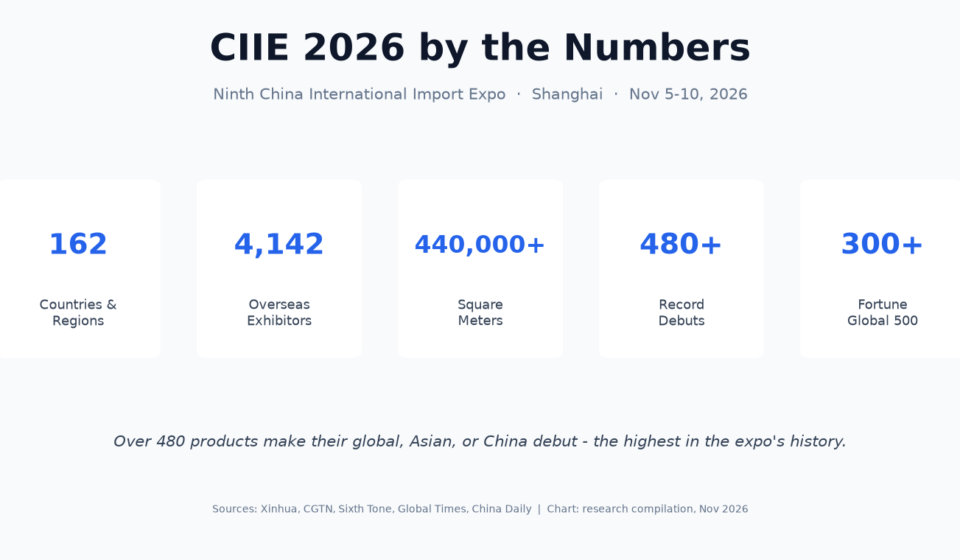
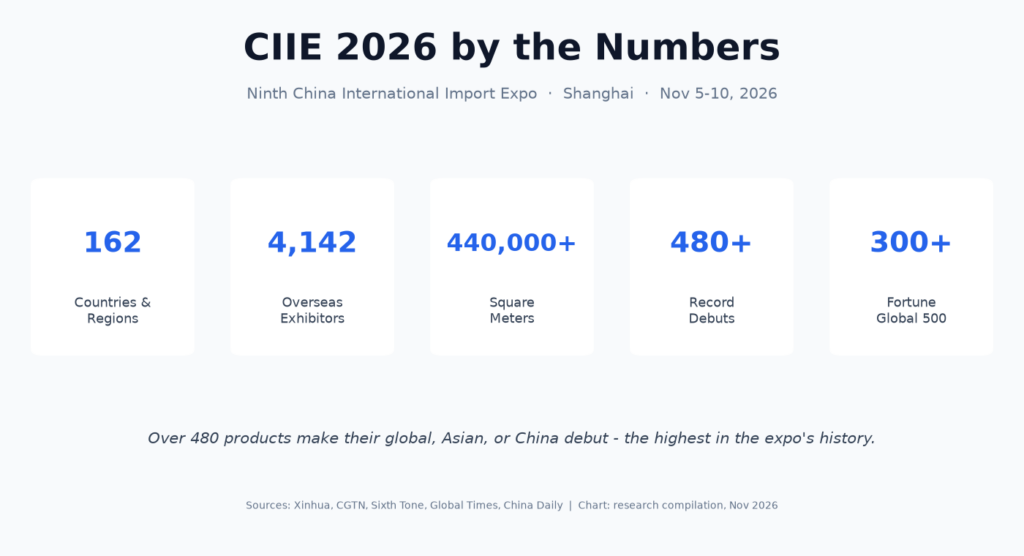
The ninth China International Import Expo (CIIE) opened in Shanghai on November 5, and the headline numbers alone justify the billing: 162 countries and regions, 4,142 overseas exhibitors, more than 300 Fortune Global 500 companies, and an exhibition floor that, for the first time, tops 440,000 square meters.
But the figure that matters most is 480.
That is the number of products making their global, Asian, or China debut at this year’s expo — the highest in the event’s nine-year history. Among them: a 6G terminal prototype from a US company, a 360-degree hearing device from Swiss firm Advanced Bionics, and a steady stream of new medicines from global pharmaceutical giants.
The signal is hard to miss. The CIIE was launched in 2018, at the height of the first US-China trade war, as a diplomatic counterweight — a showcase of China’s willingness to buy the world’s goods. Nine editions later, its function has quietly inverted. The expo is now less a bazaar for surplus inventory than a stage for the world’s newest technology.
A US 6G prototype, unveiled in Shanghai
The most symbolically loaded debut came from a US company, which unveiled a 6G terminal prototype on Chinese soil. In an era of export controls and technology decoupling, a US firm still chose Shanghai as the venue for a global first — a reminder that commercial logic and geopolitical logic do not always point the same way.
For global brands, the CIIE has become a low-cost, high-visibility launch platform. A single debut here reaches 162 countries, 300-plus Fortune Global 500 peers, and a media corps that treats the event as a barometer of China’s openness.
The format has evolved deliberately. In earlier editions, the emphasis was on volume — how much China would import. This year, organisers leaned into the launch narrative: more than 2,000 first-time exhibitors, a record number of debuts, and a programme built around frontier categories, from AI to advanced manufacturing.
The supply chain behind the show
The debut economy only works because China can manufacture, assemble, and ship what gets launched. The same week, the western city of Chengdu hosted the World Display Industry Conference, where a government-backed report put China’s new-display industry revenue above 838.6 billion yuan — roughly 53% of the global market — with upstream breakthroughs in Micro-LED mass transfer and ultra-thin metal masks.
That matters for anyone reading the CIIE as a bellwether. A product that debuts in Shanghai can be sourced, produced, and scaled inside the same country. The expo’s pitch is not just market access; it is end-to-end industrial capability.
The deals are quieter than the spectacle
For all the pageantry, concrete commercial numbers remain sparse on day one. Kazakhstan signed roughly $100 million in agreements on opening day — a useful anchor, but far from a full picture of the deals that will be inked over the six-day run.
A pharma executive offered the most telling quote of the day: this is our ninth consecutive year taking part, and many medicines we first presented at the expo have since launched here. That is the real CIIE story — not a single transaction, but a recurring pipeline from debut to market.
What to watch
Three things will define whether the 2026 edition lives up to its billing: the total value of deals signed by the close on November 10; whether the 6G prototype is followed by concrete commercial partnerships; and whether the debut-heavy format keeps drawing first-time exhibitors.
For now, the message from Shanghai is unambiguous. The world’s newest technology will get its biggest stage here — and the countries and companies that skip it may find themselves watching from the sidelines.