WeChat vs Douyin — Where Attention Actually Sits
For a decade the shorthand was tidy: WeChat has the people, Douyin has the appetite. In July 2026 the two scoreboards crossed, and most brand plans are still drawn on the old map.
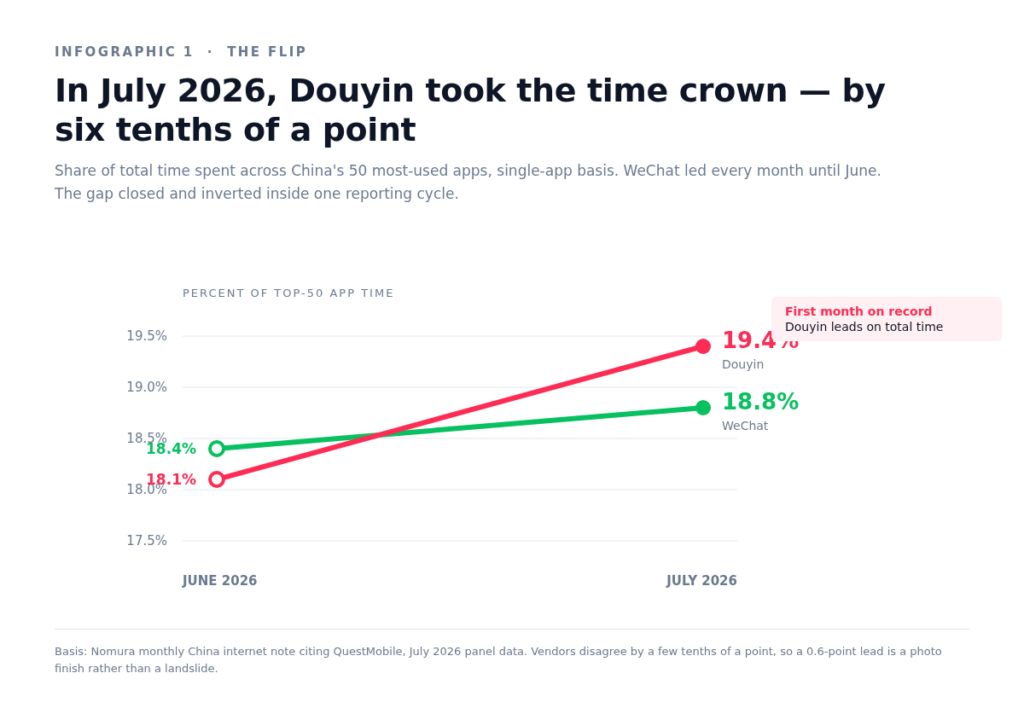
Douyin just became the app Chinese people spend the most time on. Not the most people — the most time. In July 2026 it took 19.4% of all time spent inside China’s 50 biggest apps; WeChat took 18.8%. According to Nomura’s monthly tracking of QuestMobile panel data, it was the first month in which the order flipped.
If that surprises you, you are not alone. The whole “WeChat vs Douyin” conversation has rested on a comfortable assumption: WeChat wins on scale, Douyin wins on intensity, and the two balance out. The intensity part was always right. The balance part just stopped being true.
But here is what deserves your afternoon. The flip did not make WeChat irrelevant, and it did not make Douyin the new home page for brands. What it did was expose how sloppy our word for this contest has become. Attention is not one number. It is four, and they do not travel together.
What changed in July, and what did not
Start with the scoreboard, because the scoreboard is unambiguous.
Douyin’s total time grew 29% year on year. WeChat’s grew 3%. Pull those apart and the mechanics are almost embarrassingly simple: Douyin got 19% more daily users, and each of them stayed 8% longer. WeChat got 3% more daily users, and each of them stayed exactly as long as before.
Read that again. WeChat’s growth is entirely demographic — more people, same behavior. Douyin’s is demographic and behavioral — more people, and each one sinking deeper. WeChat has run out of new humans to add. Douyin is still teaching the people it already has to stay longer.
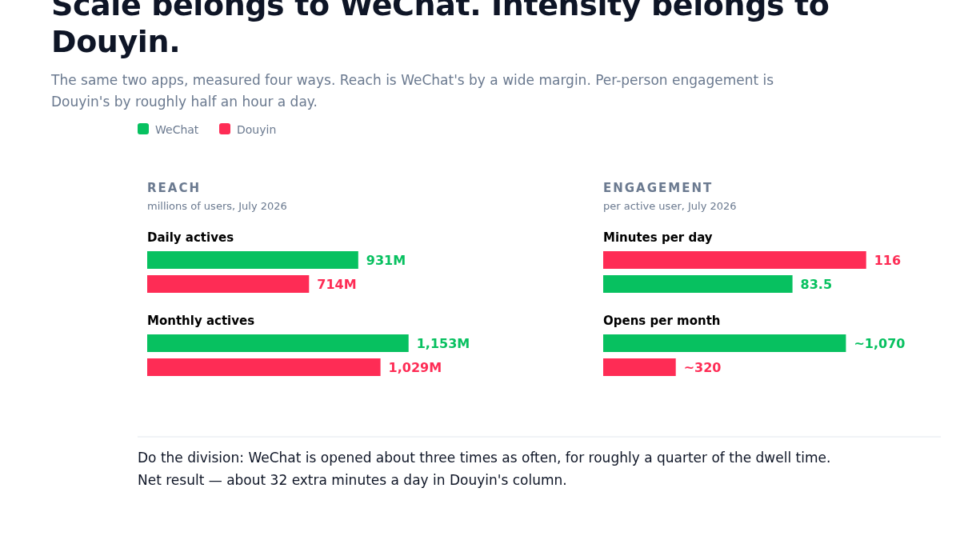
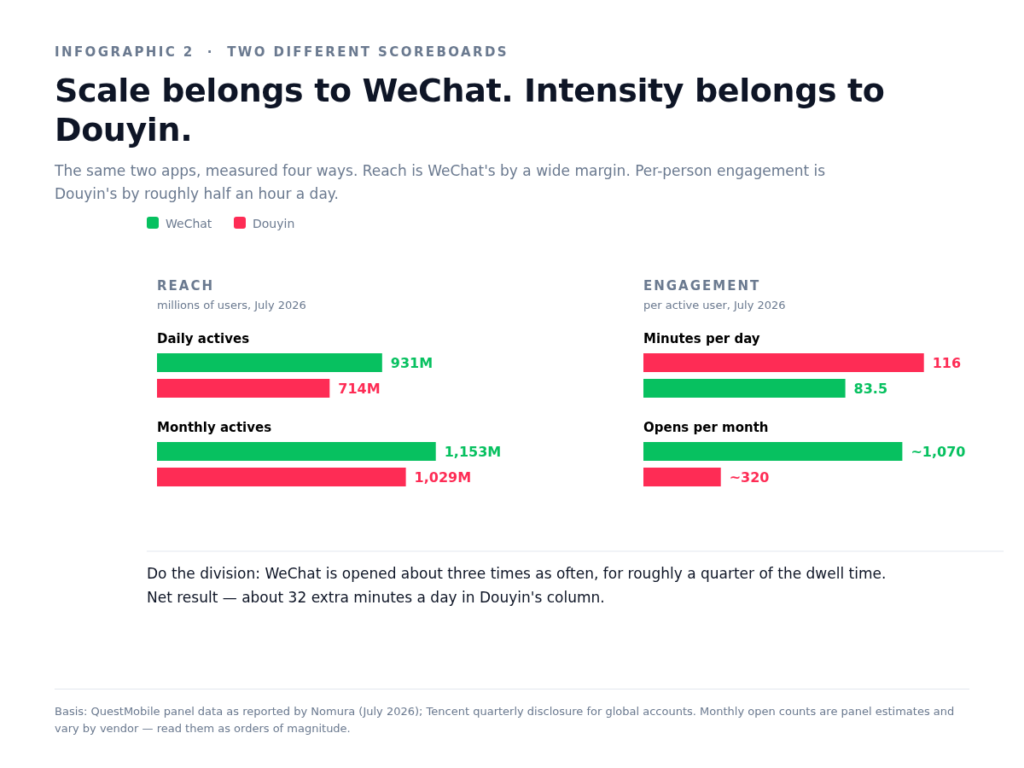
Meanwhile the thing WeChat has always owned, it still owns completely. 931 million people open it every day. Douyin’s figure is 714 million. On monthly reach inside China the gap is 1.153 billion to 1.029 billion; on penetration it is 90.2% against 80.6%. Tencent’s own quarterly disclosure puts combined Weixin and WeChat accounts at 1.439 billion worldwide, up 2% — a figure that includes overseas users and therefore flatters the domestic picture, though the direction is real.
So: more than two hundred million extra daily humans for WeChat, and thirty-two extra minutes per human for Douyin. Somewhere in that sentence sits the entire strategic problem.
Two scoreboards, one category error
This debate goes in circles because we keep scoring two different games on one sheet.
Reach is a counting exercise. How many distinct people can you put a message in front of? WeChat wins, and will keep winning for years, because it is not competing for your leisure — it is embedded in your logistics. Paying, booking, clocking in, collecting a delivery code. You do not choose to open WeChat. You need it.
Intensity is a duration exercise. Once someone is inside, how long do they stay, and how much of their guard is down? Douyin wins, and the margin is not small: 116 minutes a day against 83.5.
Then there is frequency, the metric almost nobody quotes, and the one that explains the other two.
The division problem
Here is a sum every media planner should run once.
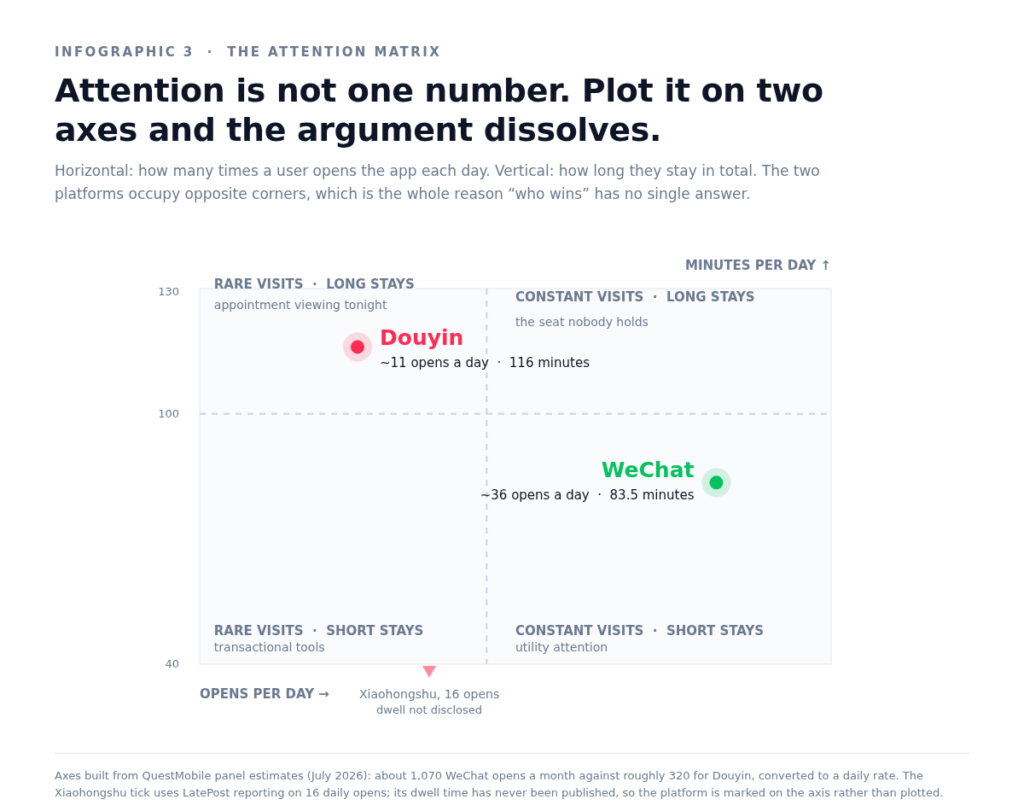
WeChat gets opened roughly 1,070 times a month per user. Douyin, roughly 320. Convert to a daily rate and you get about 36 opens against about 11.
Now divide minutes by opens. WeChat’s average visit runs just over two minutes. Douyin’s runs closer to ten and a half.
That ratio does more work than any share figure in this piece. WeChat is not a place you spend time; it is a place you keep returning to for a couple of minutes at a time, thirty-odd times a day. Douyin is the reverse: you go there rarely, by the standards of your thumb, and you do not come out quickly.
Which makes “which platform gets more attention” a badly formed question. WeChat collects more interruptions. Douyin collects more absence from the rest of your life.
The four kinds of attention
If you want a framework that survives the next data release, stop ranking platforms and start classifying the attention they sell.
Utility attention is high frequency, low dwell, high obligation. WeChat owns it. The value here is not storytelling; it is being present at the moment of need — the payment, the booking, the after-sales message, the loyalty card that actually loads. Brands that treat WeChat as a broadcast channel pay for reach they could buy cheaper elsewhere and waste the one thing it uniquely offers: a place in someone’s operating system.
Immersive attention is low frequency, long dwell, low obligation. Douyin owns it. The value is narrative, mood, and the slow erosion of skepticism that happens when someone watches forty minutes of a creator they trust. The currency is completion, not frequency.
Research attention is deliberate, comparative, heavy on images and text. Xiaohongshu owns it: roughly 400 million monthly users, 170 million daily, some 800 million searches a day, and about 16 opens a day per user. People arrive with a question and leave with a shortlist.
Search attention is intent already formed. Baidu still holds it, though it is being eaten from above by AI answers and from below by in-app search.
Four types, four jobs. The mistake is rarely choosing the wrong platform. It is buying one kind of attention and briefing for another.
Why the line crossed: three forces
Crossovers like this are rarely one story. At least three were running at once.
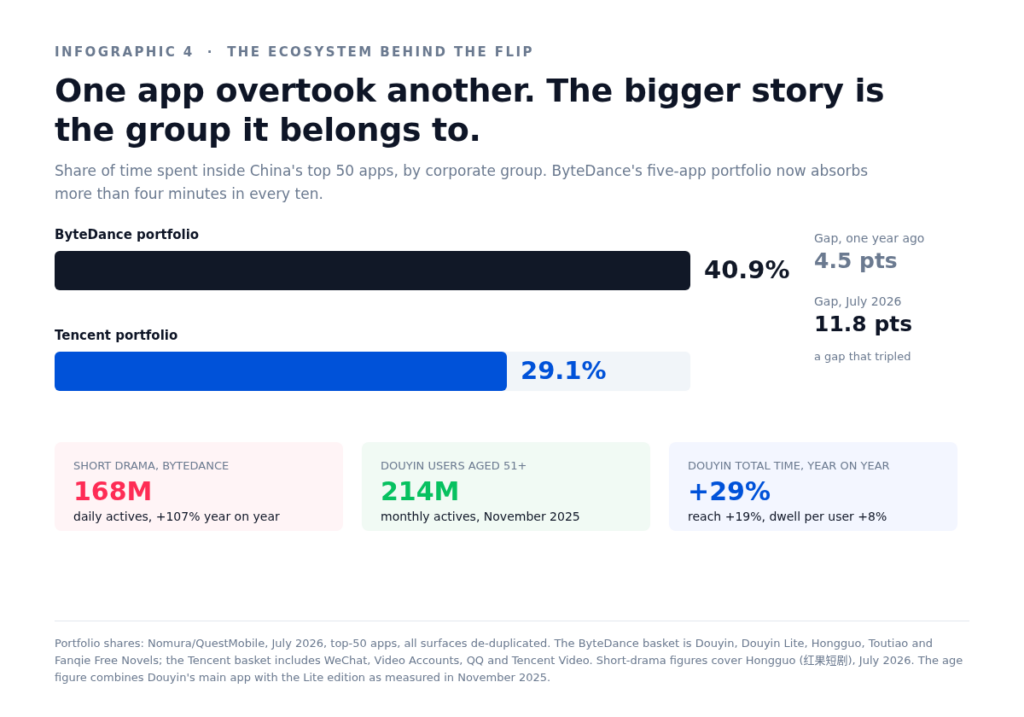
Short drama ate the evening. ByteDance’s Hongguo hit 168 million daily actives in July, up 107% year on year, with total time up 157%. Its daily audience is now reportedly larger than the combined daily audience of the four big long-video platforms. A viewer who once watched two episodes of a 45-minute drama now watches twenty episodes of a 90-second one: same evening, more app-minutes, and the minutes land inside a ByteDance property. China’s micro-drama audience reached 664 million people by December 2025, and those viewers average 129 minutes a day on the format. That is not a content trend. It is a re-plumbing of prime time.
The 51-plus cohort arrived. Douyin’s main app carried 214 million monthly users aged 51 and over as of November 2025, with the Lite edition adding another 121 million; by October 2025 that age group made up 22.6% of the user base. The cliché that Douyin is a young people’s app has been dead for at least two years. The fastest-growing audience on China’s biggest attention platform is the one most brands still address with a WeChat article.
The feed became a store. Commerce stopped being a separate destination. Discovery, consideration, checkout and reorder now happen without leaving the scroll, which is why “time spent” and “revenue” are no longer separate conversations.
None of these forces involves WeChat getting worse. All three involve Douyin getting more useful to more people for longer.
The ecosystem you are actually buying
One app overtook another. The more consequential number sits one level up.
Across China’s top 50 apps, ByteDance’s five — Douyin, Douyin Lite, Hongguo, Toutiao and Fanqie Free Novels — now hold 40.9% of total time. Tencent’s portfolio holds 29.1%. A year ago the gap was 4.5 percentage points. It is now 11.8.
Sit with that. Roughly four minutes in every ten that a Chinese smartphone user spends inside a major app now happen inside a ByteDance product. Tencent still reaches more people, and reaches them at moments of higher intent. But ByteDance has assembled a portfolio that covers the whole arc of a bored evening: comedy, drama, news, novels. Buy “Douyin inventory” and you are buying into that portfolio’s mood, not just its feed.
The macro backdrop nobody puts in the deck
The flip is a platform story sitting on top of a national one.
Chinese mobile users now spend 7.96 hours a day on their phones and open something 112.9 times. Mobile monthly actives reached 1.276 billion in December 2025 — against the 1.125 billion internet users CNNIC counts, a gap that comes from the two series measuring different things: devices, duplicate accounts, different definitions. Growth is essentially finished. The market is a fixed pool of hours being redistributed.
The redistribution has a direction. Online audiovisual now sits ahead of instant messaging as China’s most-used application category — 1.099 billion users against 1.094 billion — and it has held the top spot for several years. Short video alone reached 1.074 billion users, a 95.4% penetration rate, and was the only major category to grow both its user base and its usage rate in 2025. Audiovisual users average 201 minutes a day.
Then the detail that should reframe your planning: 44.6% of people who came online for the first time in 2025 entered through short video — 32.2 percentage points more than entered through messaging. The on-ramp to the Chinese internet is no longer a chat window. It is a feed.
What this actually means for the media plan
Three adjustments follow, and none of them is “move budget to Douyin”.
Allocate by attention mode, not platform share. A retention program and a brand campaign are not competing for the same yuan; they buy different psychological states. WeChat money should be judged on service quality, response time and repeat purchase. Douyin money should be judged on completion, recall and discovery lift. Blending them into one ROAS number is how good channels get cut for the wrong reasons.
Rewrite the brief to the dwell time. A two-minute visit and a ten-minute visit cannot share a script. WeChat creative should behave like a service: precise, useful, one clear action, no wind-up. Douyin creative should behave like an episode: a reason to stay past second three, sound on, and enough unresolved tension to earn the next minute. The most common failure I see is a fifteen-second brand film, muted, pointed at a WeChat feed — and a service message pointed at a Douyin feed.
Keep the reach asset, but stop calling it a media channel. WeChat’s 931 million daily users and 90.2% penetration remain the only way to touch nearly every adult in the country, including the older, wealthier, less algorithmic half of the market. Video Accounts grew total user time more than 20% year on year in the second quarter, and by QuestMobile’s count more than a third of its users are over 40. That is not a consolation prize. It is a different audience with a different purchase rhythm.
Three moves for the next twelve months
- Run two dashboards, not one. Reach per yuan on WeChat, minutes per yuan on Douyin. If a single blended attention metric is on the slide, delete the slide.
- Buy Douyin by occasion, not by demographic. The evening drama block, the commute feed and the pre-sleep scroll are three products with three creative requirements. Buying “women 25–40” across all three is buying noise.
- Treat short drama as media, not content. It is the largest new reservoir of attention in the country, it commands 129 minutes a day from its audience, and almost no brand has a format for it yet. That gap is an opportunity with an expiry date.
What would prove me wrong
Fair challenges deserve a fair test, so here are the three that would change my read.
First, the 0.6-point lead sits inside the noise band of panel measurement. Vendors put these shares a few tenths apart; one month is a data point, not a trend. If the lines cross back in September and October, the honest headline is “photo finish”, not “new king”.
Second, a meaningful chunk of Douyin’s time growth is short-drama driven, and short-drama economics are still subsidized. If that engine cools, some of those minutes leave with it.
Third, time share is not revenue share. WeChat still owns the payment rails, the mini-program economy and the private-domain relationship most consumer brands actually monetize. A platform can win the clock and lose the checkout.
The bottom line
The “WeChat vs Douyin” question was always the wrong question, and July 2026 made that obvious by breaking the tie in the least convenient way available.
WeChat is the country’s reach layer: 931 million daily humans, 36 opens a day each, a couple of minutes at a time. Douyin is the country’s duration layer: 714 million daily humans, 11 opens a day each, ten and a half minutes at a time. One sells presence. The other sells absence. Brands need both, but for entirely different reasons, with entirely different creative, measured on entirely different numbers.
Stop asking which platform wins. Start asking which kind of attention you are buying — and whether the work you made can survive eleven minutes of it.
FAQ
Which platform has more users, WeChat or Douyin?
WeChat. In mid-2026 it reached 931 million daily and 1.153 billion monthly users inside China, against Douyin’s 714 million daily and 1.029 billion monthly. Globally, Tencent reports 1.439 billion combined Weixin and WeChat accounts.
So has Douyin overtaken WeChat?
On time, yes: July 2026 was the first month on record in which Douyin led, at 19.4% versus 18.8% of total time across China’s top 50 apps. On people, no, not close. Both statements hold at once, which is exactly why the “versus” framing misleads.
How much time does each app get per user per day?
About 116 minutes on Douyin and 83.5 on WeChat — roughly half an hour more per person per day on Douyin, even though WeChat is opened about three times as often.
Where does Gen Z spend its attention?
Younger users concentrate in Douyin and Xiaohongshu, and treat WeChat mainly as plumbing: messages, payments, group chats, mini-programs. Xiaohongshu alone sees around 800 million searches a day, which makes it a research engine more than a social network.
Is Douyin still a young person’s platform?
No. Users aged 51 and over reached 214 million monthly actives on Douyin’s main app by November 2025 — about 22.6% of the base — with another 121 million on the Lite edition. The silver cohort is now the platform’s growth engine, not its edge case.