Where Chinese Consumers Actually Click Buy: Conversion by Channel, Charted
A brand director in Shanghai pushes a page across the table. Six platform logos, six conversion rates, two decimal places each. Tmall, JD, Pinduoduo, Douyin, Xiaohongshu, WeChat mini-program. It is a beautiful slide.
“Where did these come from?” I ask.
He thinks for a moment. “The agency.”
Which agency?
“The one before this one.”
This happens constantly, and it is worth being blunt about why. China’s conversion data is not scarce because nobody measures it. It is scarce because the people who measure it sell the answer. Platforms do not publish conversion rates; agencies estimate them; the estimates get passed through enough decks that they acquire the texture of fact. By the fifth retelling, a number invented to win a pitch has become an industry benchmark.
So rather than build you a sixth version of that slide, I did something less satisfying and far more useful. I went looking for what can actually be verified, then built the argument from that. Government statistics. The one public platform measurement series. Company filings. Platform disclosures. Four charts, no decoration, and a clear line between what is known and what is merely repeated.
Here is what survived.
China’s e-commerce stopped growing, which changes what conversion even means
Start with the number that reframes everything else.
For three years, the share of Chinese retail sales that happens online has been falling. It peaked at 27.6 percent in 2023, slipped to 26.8 percent in 2024, and landed at 26.1 percent in 2025. In the first nine months of 2026 it came in at 25.7 percent, against 25.9 percent a year earlier. Online goods sales reached 13.09 trillion yuan in 2025, up 5.2 percent, while total retail sales grew 3.7 percent. Faster than the market, yes. But no longer fast enough to keep expanding its own share.
Now look at the buyer side. China had 976 million online shoppers as of June 2025. That is up 1.09 million from December 2024. One point one million people, in half a year, on a base of nearly a billion. That is not a growth market. That is a market at its ceiling.
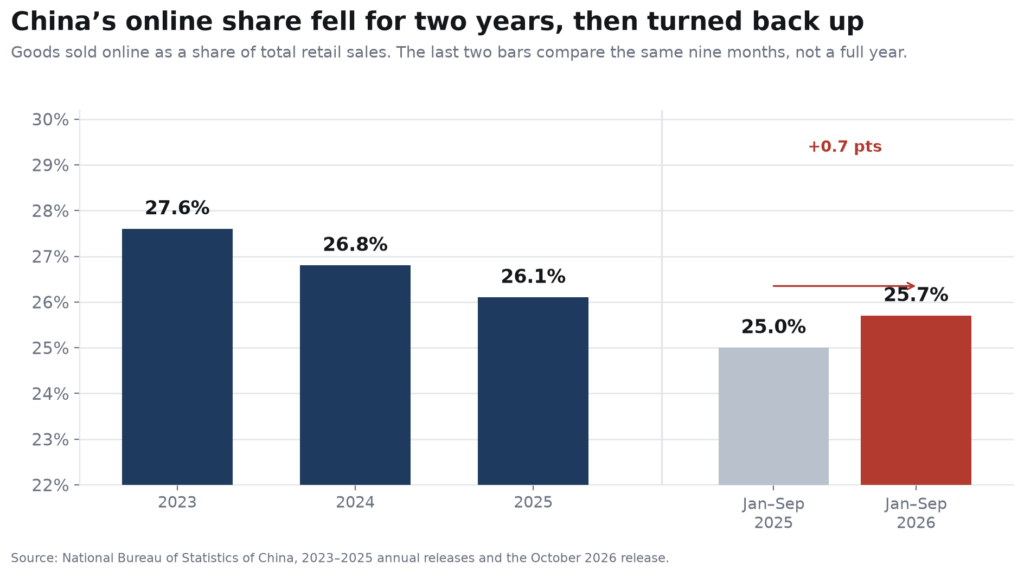
When the pond stops filling, the only thing left to do is fish harder in the same water. Every incremental order now has to be taken out of someone else’s cart, which is why conversion rate — not traffic, not reach, not impressions — has become the single most contested number in Chinese marketing. It is also why so many conversion statistics in circulation are inflated: nobody wants to be the person presenting a flat market.
The one measurement series worth trusting, and its built-in trap
There is exactly one public dataset that reports absolute, platform-level payment conversion in China, and it belongs to QuestMobile.
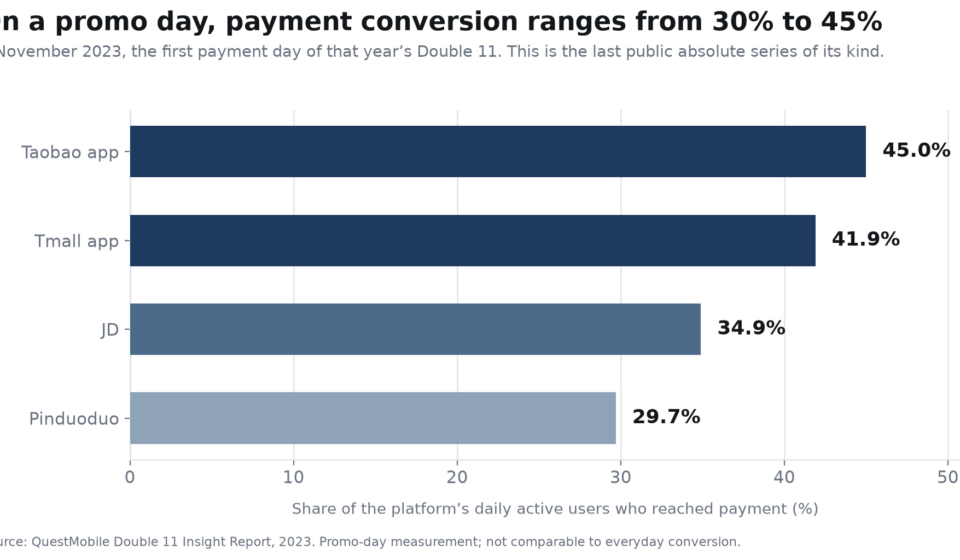
On 1 November 2023, the first payment day of that year’s Double 11, the share of each app’s daily active users who reached payment was 45.0 percent for Taobao, 41.9 percent for the Tmall app, 34.9 percent for JD and 29.7 percent for Pinduoduo.
Two things jump out. The ordering is exactly what a model of consumer intent would predict: the search-first platforms convert hardest, the browsing-first platforms convert softest. And the spread is enormous — the leader converts roughly one and a half times the trailer, before any adjustment for category mix or price band.
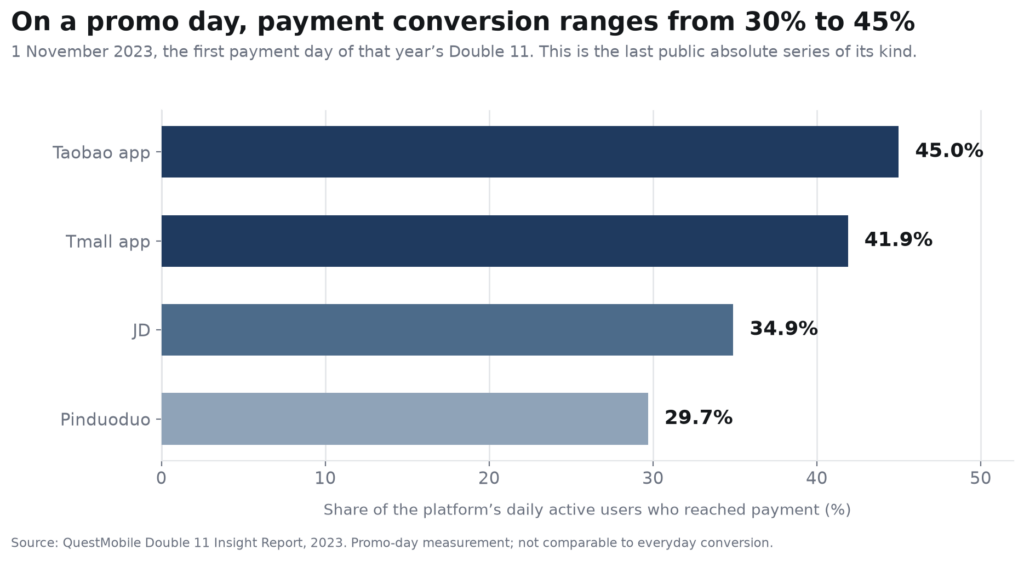
Now the trap. That series is a promo-day measurement, and promo days are engineered to make conversion look spectacular. Coupons are stacked, presales have been running for two weeks, and the audience is a self-selected crowd of people who came specifically to buy. A 45 percent payment conversion tells you how efficient Taobao is at harvesting intent it already owns. It tells you almost nothing about a Tuesday in March, when the same app is competing with a group chat and a short video for the same thumb.
Which brings us to the least popular sentence in conversion analytics: a conversion rate without a stated denominator and a stated window is not a metric, it is decoration. Gross merchandise conversion has a second problem too — it counts orders, not kept orders. In apparel and large appliances, the gap between those two numbers can swallow an entire margin.
The feed learned to search
If you want to understand where Chinese conversion is actually migrating, stop looking at platforms and look at scene structure.
Douyin used to be a pure content-to-cart machine: you watch, you feel something, you buy. Over four years the platform has rebuilt itself into something closer to a search engine with a recommendation front-end. Shelf-scene GMV — the money closed in the shop tab, in search results and in store listings — moved from roughly 20 percent of total platform GMV in 2022, to 30 percent in 2023, to 40 percent in 2024, and to 45 to 46 percent in 2025. During the 618 promotion in 2025 it touched about 50 percent. Between August 2024 and August 2025, shelf-scene GMV grew 49 percent, and 5.36 million new merchants and 5.11 million new creators started earning on the platform.
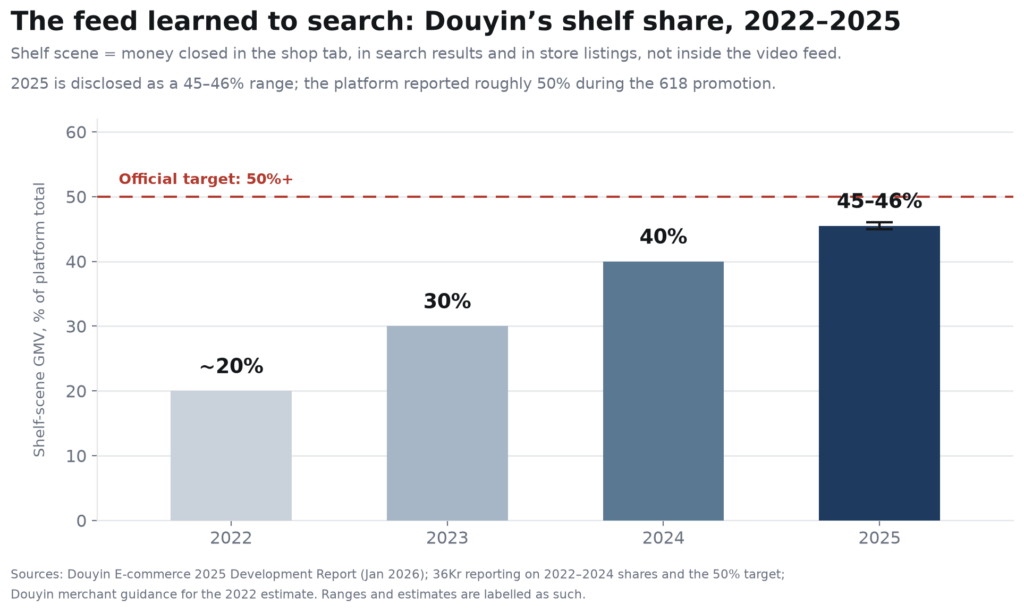
This is the single most important structural shift in Chinese e-commerce, and most foreign brands are still reading it backwards. The story is not that Douyin became good at selling. The story is that Douyin built a place for people to look things up after they have been sold to. The seed still happens in the feed. The money increasingly changes hands in a listing.
The practical consequence is uncomfortable for anyone who budgeted Douyin as an awareness channel. Roughly half of the platform’s commerce now behaves like a retail search engine, which means the work that lifts conversion there is unglamorous: listing quality, keyword coverage in product titles, review density, price consistency across scenes. Content gets you the visit. The listing gets you the order. Brands that fund only the first half are paying for attention and calling it performance.
Live commerce hit the brakes, and the stars went with it
For five years, live commerce was the story everyone told about Chinese retail. That story has changed tense.
Ministry of Commerce data shows live-stream transaction value growing 11.3 percent in 2025 — respectable in a flat market, but a long way from the triple-digit years that built the category’s reputation. Meanwhile the Chinese Academy of Social Sciences found that top streamers’ share of live-commerce GMV collapsed from 26.66 percent in 2022 to 10.66 percent in 2025.
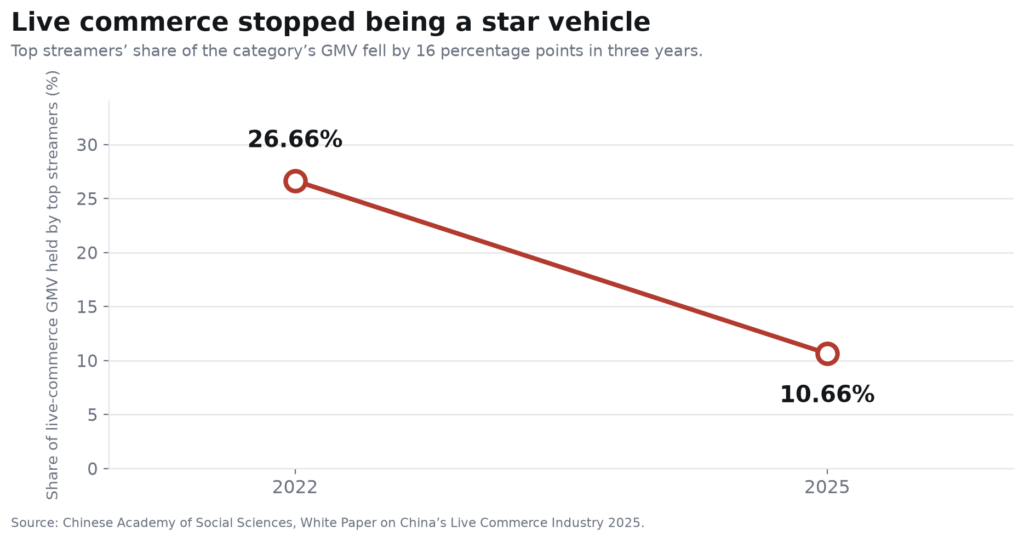
Read that as a conversion story rather than an influencer story. What a superstar streamer actually sold was a scarcity event: a two-hour window in which the price was genuinely better and the audience was genuinely large, which temporarily overrode normal purchase resistance. That works exactly once per product. When every brand runs a livestream and every night has a star, the scarcity evaporates, the discount becomes permanent overhead, and conversion reverts to the shop.
You can see the reversion in this year’s numbers. During the opening phase of Double 11 2026, Douyin reported that the number of store-run livestreams breaking 10 million yuan in sales grew 98 percent year on year, while the number of merchants breaking 10 million yuan grew 74 percent. The conversion moved from the personality to the storefront.
Xiaohongshu: the highest intent in China, and the lowest checkout
Xiaohongshu is the platform where Chinese consumers most openly want to buy things, and the platform where the fewest of those purchases actually close.
Roughly 39 million users a day express explicit product-purchase intent there, across about 140 million purchase-intent actions. Among the merchants in its Rise100 programme, GMV grew more than 2.6 times in 2025, with an average repurchase rate of 32 percent. Users who join a brand’s shopping fan club watch twice as many livestreams and convert at three times the rate of ordinary users.
And yet the platform’s own strategic choice has been to route the transaction elsewhere. In May 2025 it opened direct links to Tmall through the Hongmao programme; a parallel arrangement with JD followed. Five months later, during Double 11, more than 100 single products had crossed 10 million or even 100 million yuan in sales through those linked paths.
It is not a weak commerce platform. It is an unusually strong consideration engine with a structural checkout problem — a place where desire is manufactured at scale and then handed to a shelf to be monetised. That is not a criticism; it is a business model, and a good one for the platform.
For brands the implication is sharp. Do not build a Xiaohongshu profit and loss on in-app GMV. Build it on assisted revenue — demand you can trace into Tmall, JD or your own mini-program — and negotiate hard for the data that lets you prove it.
JD: the conversion feature is the return policy
JD is the cleanest case in China of conversion built on something other than price.
In the second quarter of 2026 the company reported 346.4 billion yuan in revenue, with annual active customers, quarterly active customers and PLUS members all growing at double-digit rates. It held the number one share in 3C and home appliances, AI-enabled product sales grew 125 percent, and JD Retail’s operating margin reached 4.6 percent — in a quarter that included a major promotion. Citi described JD as defending a “fulfilment moat” in self-operated 3C and appliances.
That moat is a conversion mechanism, not a logistics trophy. In categories where the basket is expensive and the risk feels real, the thing that closes the sale is not a five-yuan coupon. It is the confidence that the box arrives tomorrow, that installation is included, and that sending it back will not become a hobby. JD is not really selling electronics. It is selling the absence of regret, and it charges a margin for that.
The lesson generalises badly to cheap, low-consideration goods and extremely well to everything else. If your category has a high return rate, your conversion problem and your trust problem are the same problem, and no amount of creative will fix it.
Tmall: membership is the conversion machine
Alibaba’s conversion advantage has quietly stopped being about traffic and started being about a list.
88VIP passed 62 million members in the quarter ending March 2026, growing at a double-digit rate, and reached roughly 64 million by the June quarter. In the same March quarter, customer management revenue — the money brands pay for access to those shoppers — grew 8 percent on a comparable basis. During Double 11 2026, 124 brands passed 100 million yuan in sales within four hours of the opening, and 27,681 brands beat their entire previous-year Double 11 takings.
Citi’s read on the opening phase was pointed: Tmall outperformed the Taobao marketplace specifically because of 88VIP contribution and brand advertising growth. A paid membership pre-selects frequent, high-value, low-friction buyers, and then lets brands rent access to them. You are not converting strangers on Tmall. You are buying a better denominator.
Pinduoduo: conversion sold at a discount
In the first quarter of 2026, total revenue grew 11 percent to 106.2 billion yuan. But look at the split. Online marketing services — the advertising business, historically the profit engine — grew just 2.5 percent to 49.9 billion yuan. Transaction services grew 20 percent to 56.3 billion yuan and, for the first time, became the larger half of the business at 53 percent of revenue.
Pinduoduo is deliberately making the cost of acquiring a conversion cheaper for merchants, and making its own money further down the chain, in fulfilment, commissions and cross-border. Cheaper clicks, thinner baskets, higher velocity. It is a volume-and-turn instrument, and it should be modelled on contribution per unit rather than return on ad spend.
WeChat private domain: the highest multiple, the hardest ceiling
Every China marketer has heard that private domain converts several times better than public traffic. That claim is broadly true, and it is also the most consistently misused number in the industry.
Youzan’s published case data gives a sense of the scale. Quanmian Shidai, a consumer goods brand, runs about 61 million members and roughly 28 million private-domain user IDs; personalised recommendations lifted its conversion rate fivefold and repurchase by 30 to 40 percent. A womenswear label, SIINSIIN, now generates more than 70 percent of its mini-program sales from private-domain members.
Those are real multiples. They are also conditional on something brands keep forgetting: the audience has to exist before it can convert. Private domain is not a channel you switch on. It is a channel you buy into — with public-domain media, packaging inserts, store staff, service conversations — and the payback lands years after the spend. The flywheel has to be paid for before it spins, which is why so many brands start one, fund it for seven months, and then quietly report that it “doesn’t scale”.
A rule change that matters more than any benchmark
Ahead of Double 11 2026, the Ministry of Commerce and six other departments issued the “Five Excellences” action plan for quality e-commerce, targeting practices such as automatic price-matching and “lowest price on the internet” claims. Alongside it, platforms simplified promotions: Tmall dropped cross-store spending thresholds for direct discounts, JD cancelled deposit-based presales, Douyin pushed instant markdowns.
The most reliable way to lift conversion in China for the past decade — be visibly the cheapest — is being regulated into a smaller role. Conversion will increasingly be decided by service, assortment, delivery certainty and trust signals, which are slower to build and much harder to copy.
What to do on Monday
Budget by stage, not by platform. Every channel in China is doing one of four jobs: making desire, helping people compare, closing the sale, or keeping the customer. Xiaohongshu and Douyin do the first. Search on Tmall and JD does the second and third. WeChat does the fourth. Allocate against the job, then pick the platform that does it cheapest for your category.
Set your own denominator. Instrument your own platform-level conversion — sessions to product views, product views to add-to-cart, cart to payment — and use industry figures only for direction.
Measure the handoff. What share of the demand you create on content platforms actually closes in search, on your own storefront, or in your mini-program? If you cannot answer that with data, you are funding an unknown share of someone else’s revenue.
Treat membership as media. 88VIP, PLUS, fan clubs, WeChat groups: paying for a pre-qualified audience is usually cheaper per conversion than paying for impressions.
Price the return. Gross conversion is a vanity metric in apparel and appliances. Build net-of-return conversion into every platform review.
The short version
China’s conversion map is not a ranking. It is a division of labour. The feed manufactures desire. The shelf takes the money. The membership keeps the customer. The return policy decides whether any of it was real.
Get the stages right and the platform choice mostly makes itself. Get them wrong and you will spend the next twelve months A/B testing creative against a structural problem, while a competitor with a worse product and a better denominator quietly takes the order.