The Economics of One Word: Why China’s Beauty Market Rewards Mechanisms and Punishes Brand Names
A search box has no brand in it. That one fact explains more about China’s beauty market than any consumer survey — and it explains why a company can grow 68-fold on a phrase and still lose control of it.
Search strips the brand out of demand.
When a shopper types “dry, sensitive, damaged barrier, which cream”, she is not looking for a company. She is describing a condition. Whoever answers that query gets the order; nobody gets loyalty. The usual marketing order inverts: in a branded market you buy attention and hope for intent, here you buy intent and hope for memory.
Regulators choose which words you may rent.
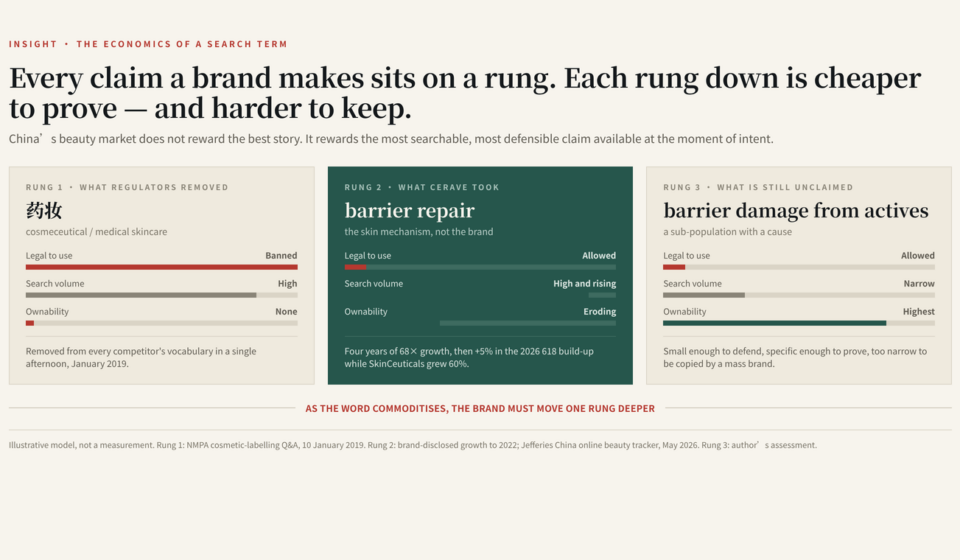
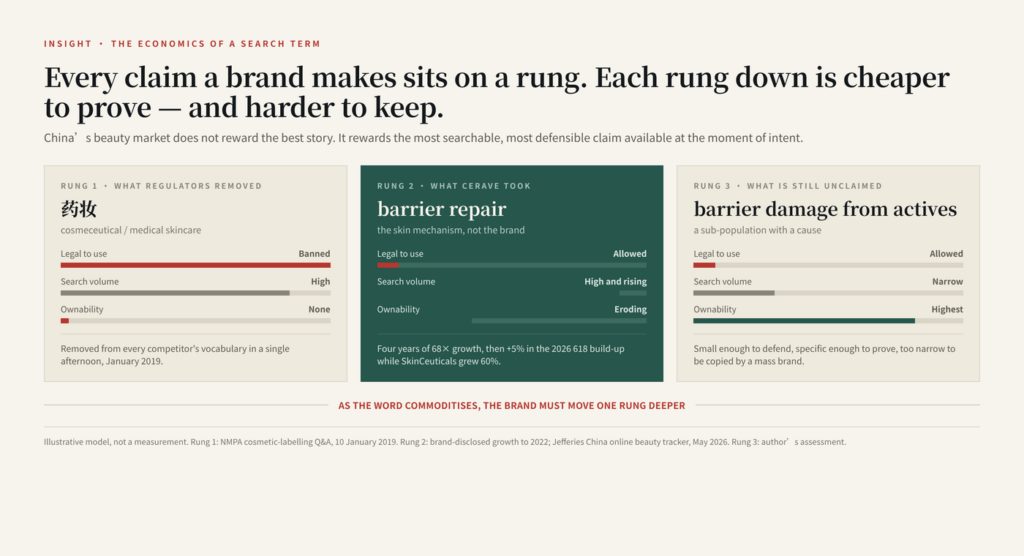
In January 2019 China’s drug regulator declared “药妆” — cosmeceutical, medical skincare — an illegal claim. Every competitor lost the same word on the same afternoon. What survived was physiology. A regulator can outlaw a category label; it cannot outlaw the fact that skin barriers break. That is why the surviving vocabulary of the category is mechanical: barrier, ceramide, repair.
A proven mechanism is a public good.
This is the part brands miss. Once a company spends years and a thousand dermatologists making “barrier repair” legible, the phrase becomes free infrastructure. Winona, Comfy, Cetaphil and Curel can stand on it without paying a cent for the education that made it work. The marketing budget built a category, not a moat. In economics the term is non-excludable: you cannot stop rivals from enjoying what you paid to create.
So the moat migrates somewhere slower. Not the word — the proof pipeline behind it: physician networks, clinical case programmes, co-published white papers, the kind of institutional citation that takes five years and cannot be bought in a media plan. Media is fast and copyable. Credibility is slow and isn’t.
The trap is built into the win.
The better you prove a word, the faster it commoditises. This is not a failure of execution; it is the mechanism working as designed. It shows up in the monthly data before it shows up in any strategy deck.
The exit is unattractive and correct: go one rung deeper. From mechanism (“barrier repair”) to sub-population with a cause (“barrier damage from actives, from over-cleansing, from clinical procedures”). Smaller search volume, narrower proof, far higher defensibility. You trade reach for ownership.
Which points to a question more useful than “what’s trending”: after you have paid to explain a word to an entire market, will that word still be yours?